
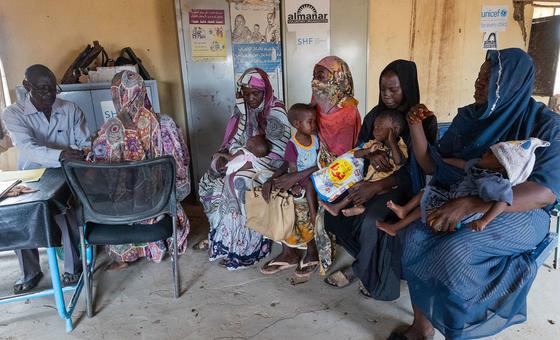
‘A war of atrocities’ – UN human rights investigators warn Sudanese civilians are paying the highest price

“They burned everything,” said one witness of a shelling attack in the Zamzam displacement camp in war-torn Darfur. “They claimed they only wanted to fight soldiers, but they punished the whole community.”

The war crimes and human rights violations perpetrated by all parties to the conflict between the military government and Rapid Support Forces (RSF) militia are documented in the latest report to the UN Human Rights Council, published by the UN’s investigative body probing violations in Sudan, known as the Independent International Fact-Finding Mission (FFM). 

The report, ‘A War of Atrocities” found that both the Sudanese army (SAF) and the RSF have directed large-scale attacks against civilians and vital infrastructure including medical centres, constituting serious violations of international law.

Systematic human rights abuses

Our findings leave no room for doubt: civilians are paying the highest price in this war,” said Mohamed Chande Othman, chair of the FFM.

According to the report, civilians are being targeted by both sides for their real or perceived affiliation with the opposing side. Executions, torture, and rape have become a daily horror for many communities in the war-torn country.

The RSF intentionally directed attacks against non-Arab communities in the besieged Darfuri city of El Fasher and the surrounding region, increasing the toll on what the UN refugee agency, UNHCR, calls the world’s fastest-growing displacement crisis.

Around 12.1 million people have fallen victim to forced displacement as of July. More civilians were killed or fled after the SAF targeted the state of Gezira.

Violence against women

Many civilians interviewed for the report said that they had suffered sexual assault. One witness said that she, along with other women and underaged girls, was subjected to rape in an abandoned building.

Victims – especially women and children, who bear the greatest burden – deserve justice and reparations,” said Joy Ngozi Ezeilo, one of the independent investigators.

For women and girls in Sudan, receiving psychological or medical support is nearly impossible both because of the fear of retaliation from reporting violence and because of regular RSF and SAF attacks on hospitals.

Risk for humanitarian workers

Over 84 Sudanese humanitarian workers were killed, and more were arbitrarily detained between the start of war in April 2023 and April this year after intentional attacks and kidnappings.

The FFM is also conducting an ongoing investigation on a drone attack against a joint World Food Programme and UNICEF convoy in June. Five humanitarian workers died in the attack while several others were injured.

Meanwhile, humanitarian aid continues to be delayed or obstructed.

A ‘roadmap for justice’

Our report not only exposes atrocities, it also lays out a roadmap for justice,” said FFM expert Mona Rishmawi.

The warring parties, mediators, and civil society can all play a role in ending the conflict, as outlined in the report.

Civil society initiatives, such as the Sudanese youth-led initiative “emergency rooms”, are some of the ways in which local communities can begin to repair the fabric of basic human rights law across Sudan.

The report also calls on the international community to enforce an arms embargo, back the International Criminal Court (ICC), and stop cooperating with any combatants or civilians suspected of war crimes, among other recommendations.

The international community has the tools to act. Failure to do so would not only betray the Sudanese people – it would betray the very foundations of international law,” said Mr. Othman.
Source link

Syria: Violence in Alawite areas may be war crimes, say rights investigators

Many of the victims were Alawite, a minority community in Syria, which the former ruling Assad family belonged to.  

Some community members are believed to have been killed in March by forces or individuals loyal to the country’s new leadership, the National Transitional Authority, which is headed by interim President Ahmed Al-Sharaa.

In response to the “arrest operation” launched on 6 March, fighters loyal to toppled President Bashar al-Assad responded by capturing, killing and injuring hundreds of interim government forces, the commissioners said.

Looting was also widespread, while homes were set alight, leaving tens of thousands of civilians displaced, the commissioners continued.

In total, approximately 1,400 people were reported killed in the ensuing massacres, predominantly civilians.

“The vast majority were adult men, but victims included approximately 100 women, the elderly and the disabled, as well as children,” the UN Commission of Inquiry on Syria said.

Still a target

It also warned that the Alawite community which formed former Mr. al-Assad’s power base is still being targeted today. Alawites make up about 10 per cent of the majority Sunni country. 

According to the commissioners’ latest report, the victims killed in March were murdered and tortured, while the bodies of the dead were also mutilated.

They added that some acts were filmed and published on social media, along with footage of civilians being abused and humiliated.

Chair of the UN panel, Paulo Pinheiro, condemned the scale and brutality of the violence which reportedly involved Alawite men being identified and singled out before being led away to be shot and killed in multiple majority Alawite villages and neighbourhoods.    

Bodies were left in the streets for days, with families prevented from conducting burials in accordance with religious rites, while others were buried in mass graves without proper documentation,” the commissioners’ report stated.

Meanwhile, hospitals became overwhelmed “as corpses piled up”.

Eye-witnesses

The Commission’s latest report is based on extensive investigations, including more than 200 interviews with victims and witnesses, including in Latakia and Tartus.  

The investigators also visited three mass grave sites and met senior Syrian government officials.

Today, Alawite communities still live in fear and face ongoing abductions of women, arbitrary arrests, enforced disappearances and looting and occupation of their property, investigators noted.  

Protection must be a priority

They should be protected by the new authorities in charge of Syria, commissioners insisted.  

The affected communities need to see urgent action to increase their protection. Beyond referral of suspected perpetrators to criminal justice, individuals suspected of involvement in violations during the March events should be immediately removed from active duties pending investigation,” said Commissioner Lynn Welchman.

Additionally, screening processes need to be expanded so that known or suspected perpetrators of grave violations in the past are not recruited into the ranks of the interim government security forces, she maintained.

After 14 years of civil war which ended last December when opposition forces including Hayat Tahrir al-Sham (HTS) – led by interim Prsident al-Sharaa – the  swept into Damascus, forcing out Mr. al-Assad, lasting damage has been done to Syria’s unity.

“The extreme violence that occurred has deepened existing rifts between communities, contributing to a climate of fear and insecurity amongst many Syrians throughout the country,” the Commissioners said.

“We call on the interim authorities to continue to pursue accountability for all perpetrators, regardless of affiliation or rank,” Mr. Pinheiro continued. “While dozens of alleged perpetrators of violations have reportedly since been arrested, the scale of the violence documented in our report warrants expanding such efforts.”  

‘My husband died in my arms’: Russian drone attacks on Ukrainians amount to crimes against humanity, UN investigators report

“Russian armed forces have committed the crimes against humanity of murder and the war crimes of attacking civilians, through a months-long pattern of drone attacks targeting civilians on the right bank of the Dnipro River in Kherson Province,” the Independent International Commission of Inquiry on Ukraine said.

Attacks have been carried out since July 2024 in Kherson city and 16 localities stretching over more than 100 kilometres in river front areas under Ukrainian Government control. 

They are ongoing and nearly 150 civilians have been killed and hundreds more injured to date, according to official sources.

Attacks ‘planned and organised’

“The recurrence of these attacks for over 10 months, against multiple civilian targets and in a wide geographic area, demonstrates that they are widespread and systematic and have been planned and organised, requiring the mobilisation and allocation of necessary resources,” the report said.

The Commission examined over 300 publicly available videos of attacks and over 600 text posts on Telegram channels and, where possible, identified victims. 

Over 90 residents from affected areas were interviewed, including victims, witnesses, local authorities and medical personnel. 

Civilians were targeted “in various circumstances, mainly when they were outdoors, both on foot or while using any type of vehicles” the report said. Most victims were men, but women and children also were affected.

‘My husband died in my arms’

A woman from Poniativka village recounted that in September 2024, she was walking home with her husband and suddenly heard a drone. It was already above their heads and immediately dropped an explosive, giving them no time to seek shelter. Both were injured. 

My husband died in my arms, bleeding to death, because the ambulance did not arrive on time. I tried to stop the bleeding with a T-shirt, but it was not enough,” she said.

Videos posted on Telegram

Russian forces mostly used civilian drones that are widely commercially available, which were then modified.

The weaponized versions of these drones allow their operators, via an embedded camera, to remotely track, aim, and drop explosives on targets. They can return to their point of origin to be reused,” the report said.

“Occasionally, perpetrators employed suicide drones that are also equipped with cameras but that explode upon impact on their targets.”

Hundreds of the video feeds have been regularly disseminated on Russian Telegram channels, some of which have thousands of subscribers. 

“The video footage that they posted displays the attacks and the resulting death, injury, damage, or destruction, and is styled like video games, often accompanied by background music and threatening text,” the report said.

Ambulances targeted

Furthermore, ambulances also have been targeted and struck by drones to prevent them from reaching victims, and some have died because they could not get to a medical facility in time. 

“A 45-year-old man from Stanislav village recounted that in November 2024, a drone dropped an explosive near him as he was riding a moped, badly injuring his leg. An ambulance arrived, and while he was receiving first aid, a drone dropped two explosives on the ambulance,” the report said.

The Commission stressed that the use of drones to target civilians and civilian objects is a violation of the fundamental principle of international humanitarian law as such attacks may only be directed at military objects.

“The Commission therefore concludes that Russian armed forces perpetrated the war crime of intentionally directing attacks against civilians in Kherson Province,” it said, while “posting videos of civilians being killed and injured amounts to the war crime of outrages upon personal dignity.”

‘Drones were attacking everything’

The drone attacks have spread terror among residents of the affected areas. Many wait for cloudy days to go out, or seek cover under trees, where possible. 

“Drones were attacking everything; minibuses, cars, pedestrians…every time you went out of the house, you had to check the sky and look out for a buzzing sound and, in any case, run,” a man from Antonivka settlement told the Commission.

Moreover, fear is further induced by frequent messages posted on Telegram, such as “Get out of the city before the leaves fall, you who are destined to die.”

“The recurrent drone attacks, the widely disseminated videos showing them, and numerous posts explicitly exhorting the population to leave suggest a coordinated state policy, on the part of the Russian authorities, to force the population of Kherson Province to leave the area,” investigators said.

They concluded Russian forces may have committed the crime against humanity of forcible transfer of population.

Mandate from Human Rights Council

The commission is mandated by the UN Human Rights Council to investigate all alleged violations and abuses of human rights, violations of international humanitarian law and related crimes in the context of the aggression against Ukraine by Russia.

The three Commissioners serve in their individual capacity and are independent from any government or organization, including the UN.


Source link