General Assembly President urges Europeans to ‘stand up’ for the UN

In a key address to the European Parliament in Strasbourg, France, Annalena Baerbock repeated her call to uphold multilateralism amid “trying times” globally. 

She noted that just 40 days into 2026, the world has already seen crises around Venezuela, Iran and Greenland, on top of continuing devastation in Ukraine, Gaza, Sudan and elsewhere.

International order ‘under attack’ 

The international order is not only under pressure, it is under attack,” she told lawmakers.  

“And we face a new and more troubling kind of crisis: conflicts waged not even under the pretence of self-defence or respect for international law but often carried out in open defiance of it.” 

She warned that at precisely the moment the world most needs cooperation and the UN, “powers – even those who have a special responsibility to protect peace and security – are pulling away from it or even outright attacking it.”  

Protect the UN Charter 

Ms. Baerbock recalled that four years ago, when she was Germany’s Foreign Minister, she addressed the General Assembly and called for the UN to stand up for Europe’s peace as Russia launched its full-scale invasion of Ukraine. 

“Today, I’m coming as President of the General Assembly to Europe, calling for Europe to stand up for the United Nations because the world needs the UN. But right now, the UN and its principles as enshrined in the Charter, needs the world too,” she said, referring to all continents. 

“It needs you to form a cross-regional alliance to protect, defend and champion the Charter and the international rules-based system that benefits us all individually and collectively.” 

Defend the truth 

First and foremost, the EU must defend the truth in a world where “fake news, falsities, mis- and disinformation” are everywhere.  

“Defending the truth means we cannot negotiate the facts; we cannot ‘go along to get along’ in the hope that it will avoid a tariff,” she said.  

Ms. Baerbock acknowledged that defending the truth “is easier said than done, especially when you’re faced with blackmail or coercion, or threats and intimidation.”   

European unity over Ukraine 

She stressed, however, that “no one can do it alone”, highlighting European Union (EU) collective action in this regard. 

“Four years ago, Europe watched as 100,000 troops amassed on Ukraine’s borders, shocked into paralysis. Nobody could have imagined the EU, which has been described as ‘too slow and too bureaucratic, too divided’ would unite over a weekend,” she said. 

The invasion began on a Thursday and by that Monday morning “the EU collectively passed one of the largest sanctions packages ever recorded because it responded as one, with conviction and purpose.” 

‘The world is calling’ 

But Europe did not act alone as she pointed to late-night calls and pleas made to other countries around the world.  

Today dear colleagues, the world is calling. It’s not only about Greenland, it’s also about Latin America, about Africa. Once again, it’s about the international peace order, once again it’s about the UN Charter,” she said. 

“The UN needs Europe and I count on your answer to be a clear and resounding: yes, we will be there for our peace, for the international peace order, for the United Nations.” 

Support UN reform 

The Assembly President said the UN also needs Europe “to reform it, to make it better, to make it more effective and efficient.”  While the 80-year-old Organization is not perfect, she insisted that the world would not be better off without it. 

“Imperfection is an opportunity to strengthen and refine, not to cut down and demolish,” said Ms. Baerbock. 

“We cannot allow those who would weaponize failings or setbacks to use existing inefficiencies or duplications as justification to unravel all that we have built, nor allow exclusive clubs to hold responsibilities for world peace.”  

Lead by example 

The UN is also “dealing with an existential liquidity crisis,” with some Member States not paying their assessed contributions – whether late, or not at all, for years. 

She noted that UN financial rules further require any “unspent” budgeted money to be returned to Member States, even if it was never received in the first place. 

“If the EU wants to preserve and strengthen the UN, then the EU should lead by example,” she said.  This includes paying dues on time and in full and proposing ways “to overhaul this Kafkaesque financial rule of reimbursing funds never received”. 

Similarly, the EU should step up when it comes to the selection of the next Secretary-General “as one might wonder how in 80 years the UN has never selected a woman to serve its highest office, despite there being four billion potential candidates on Earth.” 

Source link

‘We must stand up for our shared humanity – each and every day’: UN human rights chief

Tuesday’s solemn commemoration marks the day 81 years ago that the Auschwitz-Birkenau concentration and extermination camp – where over a million people were murdered – was liberated by Allied forces towards the end of World War Two. 

Commenting on the disturbing rise of antisemitism in recent years – including the “heinous attacks” targeting Jewish communities in Sydney and Manchester – Mr. Türk warned that “hatred and dehumanization are creeping into our daily lives.” 

He urged people to remember the lessons of the Holocaust, during which six million Jews were killed by the Nazis and their collaborators. 

“The genocide did not begin with concentration camps and gas chambers; it started with apathy and silence in the face of injustice, and with the corrosive dehumanization of the other.”

The need for remembrance

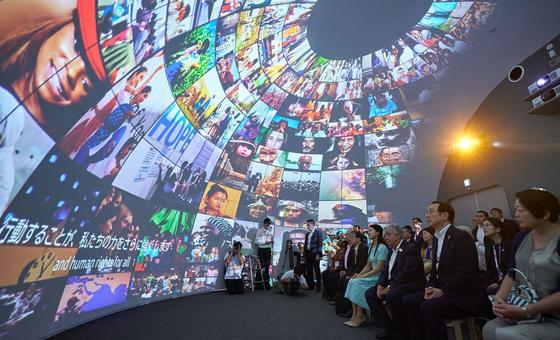
The central theme of this year’s commemoration is Holocaust Remembrance for Dignity and Human Rights.

Reflecting this theme and addressing some of today’s challenges, the High Commissioner emphasised the need for “laws that prohibit discrimination, and politicians who do not polarize by calling out differences – but unite by calling out injustice.”

To protect humanity from repeating its darkest chapters, Mr Türk stated: “We need education about the Holocaust, human rights for all ages, and robust, inclusive systems to moderate digital content, so that people can express their concerns without fear.”

Reasons for hope 

Calling on the world to use available tools today such as international human rights law, unprecedented access to verifiable information and “the memory of how exclusion can turn into annihilation”, Mr Türk demanded action to counter the “plague” of racism, antisemitism, and dehumanisation.

Together, we must challenge exceptionalism, supremacy, and bigotry wherever we encounter them: at the dinner table, at our workplaces, and on social media,” the rights chief continued.

“Each of us can be an architect of a world free from discrimination and intolerance.”

Echoing the words of Anne Frank and remembering her step sister, Eva Schloss, who died a few weeks ago, Mr Türk emphasised that “nobody needs to wait a single moment before starting to improve the world.” 

Listen to our interview with Ms. Schloss, who spoke to UN News in Geneva in 2018, here

The UN commemorates

New York – United Nations Holocaust Memorial Observance

  • Start Time: 11:00am EST, General Assembly Hall, United Nations Headquarters

Exhibition: Between Life and Death: Stories of Rescue during the Holocaust | Visitors’ Lobby, United Nations Headquarters |15 January – 20 February 2026

Exhibition: Holocaust Remembrance – A Commitment to Truth | Visitors’ Lobby, United Nations Headquarters | 15 January – 8 February 2026

Geneva – Holocaust Remembrance 

  • Start Time: 1pm CET, Palais des Nations, Room XVI

Source link

Secretary-General on UN at 80: Humanity strongest when we stand as one

Speaking at Methodist Central Hall, the very same venue where the first-ever UN General Assembly was held on 10 January 1946, Mr. Guterres called on delegates at the event to be “bold enough to change. Bold enough to find the courage of those who came to this Hall 80 years ago to forge a better world.” 

From bomb shelter to diplomatic gathering 

Organised by the United Nations Association-UK, Saturday’s anniversary event gathered over 1,000 delegates from across the world, with speakers including President of the General AssemblyAnnalena Baerbock, the UN Champion for Space Professor Brian Cox and the UN Refugee Agency’s Goodwill Ambassador Maya Ghazal. The event also marks the 80th anniversary of the first UN Security Council, which took place on 17 January 1946 at nearby Church House. 

During his keynote address, Mr. Guterres reflected on the symbolic location of the commemoration. The first General Assembly took place within the same walls four months after the end of the Second World War, in a heavily bombed London where tens of thousands had been killed, a powerful reminder as to why the UN had been created. 

“To reach this Hall, delegates had to pass through a city scarred by war. Buckingham Palace, Westminster Abbey, and the House of Commons had been shelled by the Luftwaffe. And as those bombs fell, terrified civilians huddled here, in the basement of the Methodist Central Hall — one of the largest public air-raid shelters in London,” said the Secretary-General.   

Throughout the Blitz, as many as 2,000 people gathered in the hall for protection, before the nations of the world assembled there in 1946 to ‘save succeeding generations from the scourge of war’.  

“In many ways, this Hall is a physical representation of what the United Nations is: a place people put their faith — for peace, for security, for a better life,” reflected Mr. Guterres. 

The world of 2026 is not the world of 1946 

In the 80 years since the first General Assembly, the UN has expanded from 51 members to 193. Mr. Guterres emphasised that the General Assembly, the UN’s chief deliberative, policymaking and representative body, is “the parliament of the family of nations. It is a forum for every voice to be heard, a crucible for consensus, and a beacon for cooperation.”

Whilst he acknowledged that the General Assembly’s work “may not always be straightforward or seamless,” he described it as a “a mirror of our world, its divisions and its hopes. And it is the stage on which our shared story plays out.”

Reflecting on the last decade, Mr. Guterres spoke of how “the conflicts in Gaza, Ukraine and Sudan have been vicious and cruel beyond measure; artificial intelligence has become ubiquitous almost overnight; and the pandemic poured accelerant on the fires of nationalism — stalling progress on development and climate action.”

Mr. Guterres emphasised how 2025 was a “profoundly challenging” year for international cooperation and the UN’s values.

Aid was slashed. Inequalities widened. Climate chaos accelerated. International law was trampled. Crackdowns on civil society intensified. Journalists were killed with impunity. And United Nations staff were repeatedly threatened — or killed — in the line of duty.”

The UN reported in 2025 that global military spending reached $2.7 trillion — over 200 times the UK’s current aid budget, or equivalent to over 70 per cent of Britain’s entire economy.

Fossil fuel profits have also continued to surge whilst the planet broke heat records, Mr. Guterres underlined.

“And in cyberspace, algorithms rewarded falsehoods, fuelled hatred, and provided authoritarians with powerful tools of control.”

Multilateralism over division

A “robust, responsive and well-resourced multilateral” system is needed to address the world’s interconnected challenges, Mr. Guterres urged, but the “values of multilateralism are being chipped away.”

The Secretary-General gave the example of a landmark international agreement to protect marine life in international waters and the seabed, which comes into force on Saturday, as a “model of modern diplomacy, led by science, with the participation not just of governments, but of civil society, Indigenous Peoples and local communities.”

“These quiet victories of international cooperation — the wars prevented, the famine averted, the vital treaties secured — do not always make the headlines. Yet they are real. And they matter. If we wish to secure more such victories, we must ensure the full respect of international law and defend multilateralism, strengthening it for our times.”

As he addressed the London audience, the Secretary-General expressed his “gratitude to the United Kingdom for its decisive role in creating the United Nations,” and for being “such a strong pillar of multilateralism and champion of the United Nations today.”

© United Nations/Shaun Ottway

UN Secretary-General António Guterres (right) met with UK Prime Minister Keir Starmer at 10 Downing Street in London on Friday.

High stakes for a better world 

Looking towards the future, the Secretary-General called for an international system that reflects the modern world, including reforming international financial systems and the Security Council.

“As global centres of power shift, we have the potential to build a future that is either more fair — or more unstable.”

The Secretary-General reminded delegates in London that when the UN first opened its doors, “many of its staff bore the visible wounds of war — a limp, a scar, a burn.”

“There is a persistent myth — now echoing louder each day — that peace is naïve. That the only ‘real’ politics is the politics of self-interest and force,” Mr. Guterres said.  

“But the founders of the United Nations were not untouched by reality. On the contrary, they had seen war, and they knew: Peace, justice and equality, are the most courageous, the most practical, the most necessary pursuits of all.” 

*Miranda Alexander-Webber is a communications officer with the United Nations Regional Information Centre for Western Europe (UNRIC).

Source link

Guterres in Japan: ‘Humanity is strongest when we stand as one’

It brings together more than 160 countries and organizations – a testament to Japan’s enduring commitment to global dialogue and cooperation, said Secretary-General António Guterres.  

Japan has helped shape some of the most important multilateral achievements of our time,” he added, commending Japan for choosing peace and international cooperation following defeat at the end of the Second World War.  

A tireless advocate for nuclear disarmament, a generous contributor to peace, and a steadfast champion of human security, Japan has help lead ever since it joined the United Nations nearly 70 years ago.

Commitment to cooperation

The moral of the United Nations’ story is simple: humanity is strongest when we stand as one,” Mr. Guterres said.  

“Although many may not realise it, the United Nations touches our lives every single day,” he said, noting that the UN provides food assistance to more than 150 million people, supplies vaccines to 45 per cent of the world’s children, and supports elections in some 50 countries.  

From landmines to biodiversity, women’s rights to refugees, freedom of the press to access to clean water, the UN sustains a vast global system of conventions and treaties – while its Charter is the pillar of international law.  

‘Reform is crucial’

But today, as the multilateral project of nations working together under a common purpose is challenged, it must adapt.

From the composition of the Security Council to unjust and unfair international financial systems, reform is crucial.  

Since leaders adopted the Pact for the Future in 2024, a blueprint to make multilateralism more effective, Mr. Guterres has also launched the UN80 initiative to help ensure that the 80th anniversary of the UN is not only a moment of reflection, but a catalyst for renewal.  

“These are times of peril. But they are also times of profound opportunity -and obligation,” said the Secretary General.

Source link

Security Council urged to stand firm as Bosnia and Herzegovina faces deepening crisis

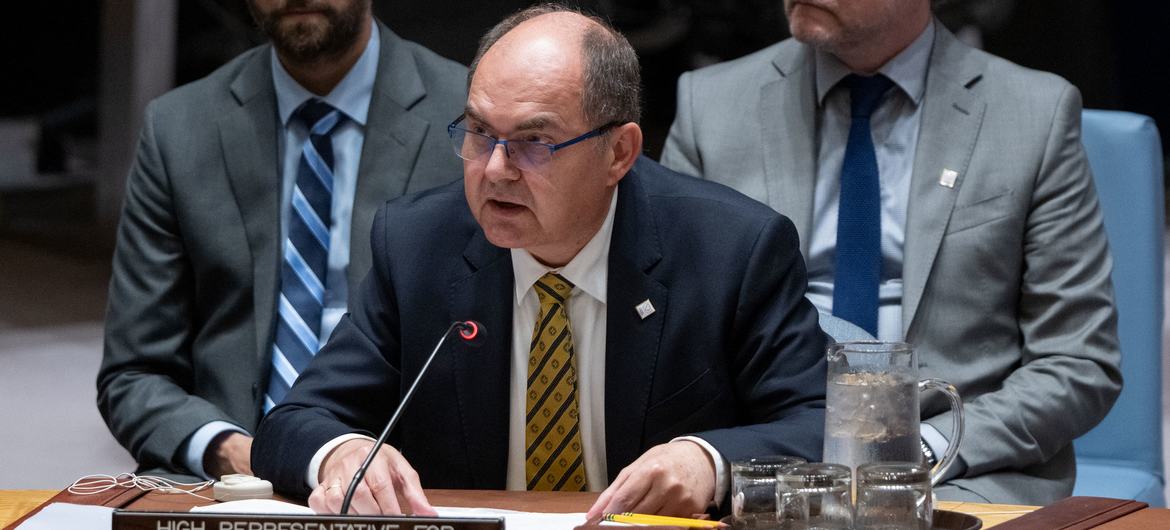
High Representative Christian Schmidt briefed on latest developments surrounding implementation of the 1995 General Framework Agreement for Peace in Bosnia and Herzegovina, which ended more than three years of bloodshed and genocide following the breakup of the former Yugoslavia.

The accord, also known as the Dayton Peace Agreement, established a new constitution and created two entities within the country: the mainly Bosniak and Croat Federation of Bosnia and Herzegovina and the ethnically Serb Republika Srpska.

Constitutional order under attack

Mr. Schmidt – who’s key role is overseeing implementation of the 1995 agreement – said conditions for the full implementation of the civilian aspects of the deal have vastly deteriorated.

“The first quarter of this year was marked by a significant rise of tensions, which without question amounts to an extraordinary crisis in the country since the signing of the Dayton Agreement,” he said.

I may underline that I see a political crisis. I do not yet have indications for a security crisis.”

The sudden deterioration stems from reactions following the 26 February conviction of Republika Srpska President Milorad Dodik for failing to enforce the decisions of the High Representative. 

He was sentenced to one year in prison and banned from political office for six years but has appealed the decision.

After the verdict, Mr. Dodik intensified his attacks on the constitutional order of the country by directing the authorities of the Republika Srpska to adopt legislation that effectively bans State-level judiciary and State-level law enforcement in the Republika Srpska and by even putting on the table a draft Entity constitution, hinting at de facto secession,” said Mr. Schmidt.

He told the Council that given the speed with which the draft laws and constitution were made public strongly suggests that they had been prepared well in advance.

Christian Schmidt, High Representative for Bosnia and Herzegovina, briefs members of UN the Security Council on the situation in the country.

Fears of disintegration

He said these acts and legislation fundamentally contradict the implementation of the Dayton Accords and “endanger the territorial and societal integrity of the country and of its peoples by performing secessionist acts.”

Furthermore, “they also create legal and executive insecurity by establishing Entity laws and institutions that contradict and compete with State law and competence.” 

He stressed that “it will require institutions created in Dayton, such as the Constitutional Court, to prevent this country from falling apart, and when it comes to safeguarding the functionality of the State, my legal competencies as High Representative as well.”

As a result, the State-level coalition has been seriously affected, momentum towards European Union (EU) accession has stalled and the functionality of the State is being undermined, while reforms have been sidelined. 

This development is not irreversible, but it is severe,” he warned.  “It needs to be addressed without delay, it requires active engagement by the international community.”

Communities shun extremism

The High Representative noted that the Serb community “did not pay heed to Mr. Dodik’s unlawful directives.” For example, although ethnic Serbs working in State-level institutions have been pressured to abandon their posts, “these calls and threats have been left overwhelmingly unanswered.”

Meanwhile, the Bosniak community “has been able to remain calm despite the tensions and to continue on the path of patient dialogue also in order to keep the country’s European integration on the table.”

He also noticed “a continuing pro-European commitment” on the part of the Croat community, “as well as an increased willingness to engage in inter-ethnic dialogue, including in local disputes.” 

Mr. Schmidt was adamant that the people of Bosnia and Herzegovina can and do live together.

For the most part, the communities in the country do not support extremism or secessionism,” he said. “There is ample evidence for that in daily life, but ethnocentric politics spends too much time on dividing the communities rather than uniting them.”

Peace accord remains crucial

While the country is facing complex and varied challenges, he said the current extraordinary crisis is the result of severe attacks against the Dayton Agreement “encompassing the constitutional and legal order” and has nothing to do with the peace deal itself.

“Bosnia and Herzegovina is facing difficult times. Nobody would have expected 30 years ago that the international community is needed as much today as it is,” he said.

“But the Peace Agreement that this UN Security Council endorsed 30 years ago remains the very foundation on which the future of Bosnia and Herzegovina with its sovereignty, territorial integrity, and political independence can be built.”

Although reopening or redefining Dayton challenges the basis for peace and prosperity in the country, “this does not mean we should not talk about necessary amendments and adoptions of this constitution,” he said.

Attacks threaten ‘very foundation’

“The way forward includes countering threats and attacks to its very foundation, but also implementing meaningful reforms, including in the context of the country’s European integration,” he continued.

“It is about strengthening institutional stability and functionality of the State and continuing to reinforce election integrity in view of the country’s general elections in 2026.”  

Mr. Schmidt concluded his remarks by urging the international community to continue to support and assist the country and the people of Bosnia and Herzegovina to shape their future and to reassure the population that they have not been forgotten.   

Source link