Myanmar crisis deepens five years after coup, as military ballot entrenches repression

The people of Myanmar continue to suffer amid “widespread violations of international human rights law and international humanitarian law,” as the cycle of impunity persists, the spokesperson for UN Secretary-General António Guterres said in a statement, on Friday, marking the anniversary.

“The suffering of the people of Myanmar has deepened,” Farhan Haq, the UN Deputy Spokesperson, said, pointing to escalating military airstrikes hitting civilians, acute food insecurity and nearly 5.2 million people displaced, both inside the country and across borders.

The Secretary-General, he added, remains “deeply concerned by the rapidly deteriorating situation” and its serious regional repercussions, including rising transnational crime, economic volatility and soaring humanitarian needs.

Elections deepen divisions

The grim anniversary has coincided with the conclusion of three-phased elections imposed by the military, which UN officials say have further polarised society and intensified violence instead of providing a credible political pathway.

They warned that the military-controlled ballot has compounded the crisis rather than offering a route back to civilian rule.

The process “failed to respect the fundamental human rights” of Myanmar’s citizens and “served only to exacerbate violence and societal polarisation,” Volker Türk, UN High Commissioner for Human Rights, said.

The vote was held in only 263 of 330 townships, largely confined to urban areas under military control. Large swathes of conflict-affected regions were excluded, along with displaced populations and minorities, including the Rohingya.

The main opposition National League for Democracy (NLD), which won the 2020 elections in a landslide, was barred from participating. Dozens of other parties opposed to military rule were also banned, and many of their leaders remain detained.

Violence and coercion during voting

The voting period between December 2025 and January 2026 was reportedly marked by intense violence. Open sources documented 408 military air attacks, which killed at least 170 civilians during the election period alone.

On 22 January, a military airstrike on a populated area in Bhamo Township, Kachin State, reportedly killed up to 50 civilians, with no reported presence of combatants.

To suppress dissent, the military arrested 324 men and 80 women under a unilaterally adopted election protection law, including for minor online activity. In one case, a 49-year prison sentence was imposed for posting anti-election material.

Mounting humanitarian and economic toll

The political repression is unfolding alongside a rapidly worsening humanitarian and economic crisis.

Nearly one quarter of Myanmar’s population now faces high levels of acute food insecurity, while more than one third are in urgent need of humanitarian assistance. Humanitarian access has been repeatedly obstructed, including in Rakhine State, where desperately needed aid for starving communities has been blocked.

Myanmar’s economy has lost nearly $100 billion since the coup, with the gross domestic product (GDP) not expected to recover to pre-pandemic levels for years.

“The military’s usurpation of power has also been accompanied by disastrous mismanagement of the country’s economy,” Mr. Türk said.

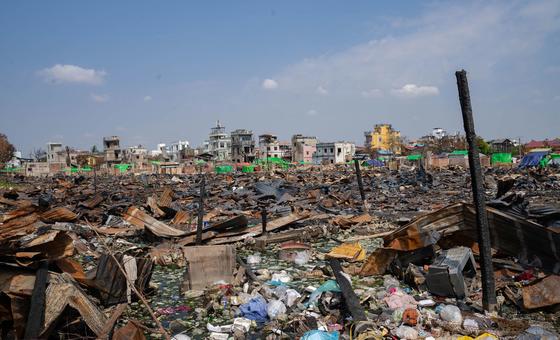
An IDP camp in Kayah (Karenni) state, eastern Myanmar / © UNOCHA/Siegfried Modola

At the same time, accountability mechanisms warn that serious international crimes against civilians continue unabated.

Nicholas Koumjian, head of the Independent Investigative Mechanism for Myanmar, said there is evidence that civilians across the country have endured atrocities amounting to crimes against humanity and war crimes since the military takeover.

The military has carried out air strikes, indiscriminately or deliberately attacking civilians in their homes, hospitals, and schools,” he said, adding that many detainees have been subjected to brutal torture.

The Mechanism is also investigating a growing number of allegations of atrocities committed by opposition armed groups.

Rohingya seek justice at world court

Amid the bleak outlook, an independent human rights expert pointed to a rare moment of accountability as Rohingya survivors testified before the International Court of Justice (ICJ) in the genocide case brought by the Gambia against Myanmar.

Special Rapporteur Tom Andrews praised the survivors’ courage, saying their testimony allows “the light of truth to shine through the darkness of the most horrific of crimes.”

He stressed that justice is not abstract, but “built on the courage of individuals who are willing to speak truth to power.”

Mr. Andrews has been appointed by the Geneva-based Human Rights Council to independently monitor and report on the situation in Myanmar. He is not a UN staff and does not draw a salary from the Secretariat.

The International Court of Justice (ICJ) in The Hague hears arguments concerning the case brought by the Gambia against Myanmar / UN Photo/ICJ/Frank van Beek

The Secretary-General reiterated that a viable path back to civilian rule must be founded on an immediate cessation of violence, a genuine commitment to inclusive dialogue and the swift release of all arbitrarily detained leaders, including President Win Myint and State Counsellor Aung San Suu Kyi.

“Regional and international unity and sustained engagement are needed,” the statement said, “to support a Myanmar-led solution that fully addresses the root causes of conflict, ensures accountability and responds to immediate humanitarian and development needs.”

The Secretary-General’s Special Envoy on Myanmar, Julie Bishop, continues to engage with all stakeholders, in close cooperation with ASEAN and regional partners, in the search for common ground toward a durable resolution and sustainable peace.


Gaza City: Daily bombardment, more displacement amid escalating military offensive

UN Spokesperson Stéphane Dujarric said people are once again on the move after Israel placed the entire city under displacement orders. Aid partners recorded more than 25,000 displacements between Sunday through Wednesday.

Some critical services have already been suspended while some humanitarian facilities have suffered severe damage, disrupting operations and the delivery of essential services.

Aid partners suspend activities

“Our partners working on health, report that some of them have had to suspend activities at primary healthcare centres, while partners working on nutrition say that 12 out of 49 outpatient therapeutic sites have halted services amid the ongoing airstrikes in Gaza City,” he said,

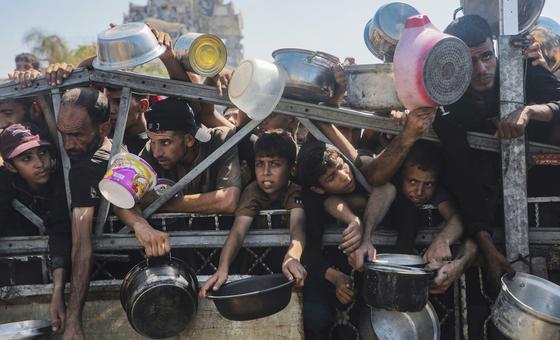
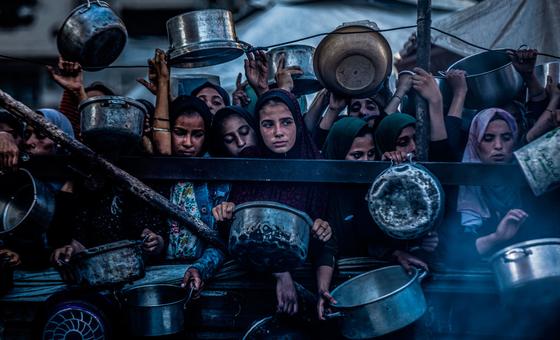
At least two community kitchens have also suspended operations, and three others have had to relocate within the city.

Furthermore, UN partners working on education are concerned that 95 temporary learning sites in northern Gaza serving about 25,000 children may be at imminent risk of closure due to displacement orders and ongoing insecurity.

Child malnutrition worsens

UN child rights agency UNICEF has also warned that child malnutrition in the Gaza Strip continues to worsen at an alarming rate. 

The percentage of children identified as acutely malnourished increased to 13.5 per cent in August, from 8.3 per cent in July – or 12,800 boys and girls.

Mr. Dujarric said UNICEF has been working to scale up the entry of essential nutrition supplies and distribute them, alongside nutrition partners, at about 140 sites across the Gaza Strip.

“While stocks of ready-to-use therapeutic food have recently increased, the current quantities of other critical nutrition supplies for infants and pregnant and breastfeeding women are wholly insufficient,” he said.

Meanwhile, almost half of all functioning hospitals are located in Gaza City, including half of all intensive care unit beds for the entire Gaza Strip, according to the World Health Organization (WHO).

With the Israeli offensive already underway, the Gaza Strip cannot afford to lose any of these remaining facilities, the UN agency said.

Impediments to aid delivery continue

These developments are happening as delays and impediments to humanitarian movements inside Gaza continue.

Missions still take long hours to complete, even when they are approved in advance by the Israeli authorities, meaning that teams have no choice but to wait on roads that are often dangerous or congested.

Additionally, the UN Office for the Coordination of Humanitarian Affairs (OCHA) has recently observed an increase in denials of the participation of Palestinian staff in missions, including both drivers and personnel.

Mr. Dujarric noted that denials are often communicated at the last minute, resulting in operational delays as alternatives must be quickly identified.

“What we need is full facilitation of the work and movement of humanitarian actors into and throughout the Gaza Strip. This must include unimpeded access to the north and to the south alike,” he said, adding that “every delay can cost lives.” 

Military spending worldwide hits record $2.7 trillion

The world is spending far more on waging war than in building peace,” the UN Secretary-General António Guterres said at a press briefing for his new report on the threat posed by the steady rise in military expenditure.

Spending on security needs increased across all five global regions during 2024, marking the steepest year-on-year rise for at least the last three decades. Compared to the $2.7 trillion directed to military budgets, the world could eliminate extreme poverty for just under $300 billion.

A more secure world begins by investing at least as much in fighting poverty as we do in fighting wars,” said Mr. Guterres.

A choice between aid or arms

The alarming amount spent on arms-related costs last year alone is 750 times the 2024 UN regular budget. It also equates to almost 13 times the development assistance provided by the OECD’s development assistance committee in 2024, indicating a stark trade-off between military expenditure and sustainable development.

“Redirecting even a fraction of today’s military spending could close vital gaps – putting children in school, strengthening primary health care, expanding clean energy and resilient infrastructure, and protecting the most vulnerable,” said Mr. Guterres.

For a small portion of what was invested in militaries this past year – and the previous decade – the world could fund education for every student in low and lower middle-income countries, eliminate child malnutrition globally, fund climate change adaptation in the developing world, and bring the international community closer to achieving the Sustainable Development Goals (SDGs), the UN estimates.

“Rebalancing global priorities is not optional – it is an imperative for humanity’s survival,” said the UN disarmament chief Izumi Nakamitsu at the press briefing.

‘Sustainable development is in jeopardy’

With only one of the five of the SDGs on track, Mr. Guterres stressed that “our shared promise of sustainable development is in jeopardy.”

While more is being spent on militaries, less is being spent for social investment, poverty reduction, education, health, environmental protection and infrastructure – hindering progress on nearly all the SDGs and undermining the UN Charter, the UN’s cornerstone document. 

“But we know that development is a driver of security and multilateral development cooperation works,” said UN Development Programme (UNDP) deputy chief Haoliang Xu.

“When people’s lives improve, when they have access to education, healthcare, economic opportunities and when they can live lives of dignity and self determination, we will have more peaceful societies and a more peaceful world.”

A new security approach

“Investing in people is investing in the first line of defense against violence in any society,” said Mr. Guterres.

The report calls for a more human-centered and multidimensional approach that priorities diplomacy, international cooperation, and paves the way for sustainable development.

In a vicious cycle, lack of economic opportunity, poverty, and underdevelopment breeds instability – fuelling violence and a rise in State expenditure on the military, the UN report contends.

Investing in development and sustainable security has the potential to stop today’s arms race and alleviate the need for military spending. 

The evidence is clear: excessive military spending does not guarantee peace,” said Mr. Guterres. “It often undermines it – fuelling arms races, deepening mistrust, and diverting resources from the very foundations of stability.”

Source link

Syria: Political transition on ‘a knife-edge’ amid military skirmishes

Geir Pedersen told ambassadors that in Sweida governate, where sectarian violence in July also spurred conflict in the capital Damascus, the 19 July ceasefire has come under strain, but the conflict has not resumed so far.

However, “we are still seeing dangerous hostilities and skirmishes on the margins of Sweida, and violence could resume at any moment,” he said.

In northeast Syria, efforts to implement the 10 March agreement between the interim security forces and the mostly-Kurdish Syrian Democratic Forces (SDF) continue. Just this month, there have been spikes in violence between the two militaries in the Aleppo governorate.

While attempts to convene the two sides outside of the country have been unsuccessful, Mr. Pedersen welcomed reports of contacts between officials.

Despite these security incidents, Mr. Pedersen stressed that the situation has been relatively calm this month, applauding the efforts of those who have worked to tamp down hostilities.

However, in terms of the political situation, “the country remains deeply fragile and the transition remains on a knife-edge.

Political transition?

After 13 years of civil war, Mr. Pedersen underscored the need for an inclusive, Syrian-led political transition that enables the Syrian people determine their own future peacefully, independently and democratically.

Syrians need to feel that this transition is not a series of ad hoc arrangements and isolated institutions, but a clear and comprehensive path, based on inclusion and transparency, to implement the principles of resolution 2254,” he said.

To encourage the voluntary, safe return of refugees and internally displaced persons, Mr. Pedersen stressed the need for coordinated support to repair Syria’s depleted infrastructure.

The best way to secure such support is through a genuine political transition that lays the path for long-term stability and sustainable governance. Indeed, without credible reforms, stronger institutions, and a firm commitment to the rule of law, international support risks being squandered or misdirected,” he stressed.

Humanitarian situation still dire

Amid the precarious military and political situation, 16 million Syrians across the country need humanitarian aid, according to Emergency Relief Coordinator Tom Fletcher.

Additionally, over 185,000 people have been displaced across Sweida, Dar’a, Rural Damascus and beyond.

The overall situation is dire. We need to sustain urgent delivery of food, health, shelter, clean water, fuel, restoration of water and electricity infrastructure, education. In some areas, those arriving now outnumber the existing population. Services are overwhelmed,” said Mr. Fletcher.

Teams from the UN humanitarian aid coordination office (OCHA) have visited Sweida and other towns, delivering aid and assessing needs.

OCHA has also provided emergency food packages, flour and essential household items to tens of thousands of people.

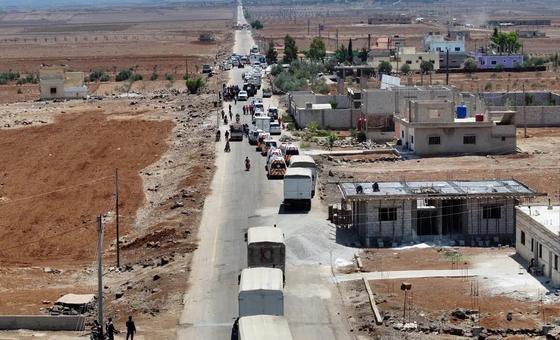
However, insecurity and road closures have disrupted the supply of aid from the UN, NGO partners and the Syrian Arab Red Crescent.

“We need better humanitarian and commercial access. And most of all, we need safety,” Mr. Fletcher stressed, particularly referring to attacks on aid convoys, health facilities, medics and ambulances.

Drastic cuts

Nevertheless, “despite funding and security challenges, the UN and partners are delivering as much lifesaving support as we can with the resources we have,” reaching 3.5 million people on average each month, a noticeable increase from last year.

But with the 2025 humanitarian appeal in the country only 14 per cent funded, ongoing aid cuts in many Western capitals are projected to lead to reduced staffing of at least 40 per cent across the humanitarian community inside Syria.

The UN relief chief emphasised that without more funding, “we won’t be able to sustain these vital efforts, let alone expand them to more people who need them.”

Furthermore, while he urged humanitarian support, he also stressed that long-term development investment is needed in Syria “to reduce and ultimately end reliance on humanitarian aid.”

Source link

Gaza: Aid insufficient to avert ‘widespread starvation’ as Israeli military ramp-up forces more people to flee

“The risk of starvation is everywhere in Gaza,” UN Human Rights Office spokesperson Thameen Al-Kheetan told reporters in Geneva.

“This is a direct result of the Israeli government’s policy of blocking humanitarian aid,” he said.

Mr. Al-Kheetan insisted that in the past few weeks, Israeli authorities have only allowed aid to enter in quantities that remain “far below what would be required to avert widespread starvation”.

The UN said on Monday that hunger-related deaths continue to be reported in the Strip, including among children.

More people displaced

As the Israeli army intensified its attacks in the north of the enclave, it has continued to issue displacement orders for Palestinians, Mr. Al-Kheetan said.

He noted that Gazans have been told to move to the Al-Mawasi area, despite continuing airstrikes and disastrous conditions there.

“Hundreds of thousands of Palestinians displaced to Al-Mawasi have little or no access to essential services and supplies, including food, water, electricity and tents,” he warned.

Deadly pursuit of aid

The OHCHR spokesperson stressed that reaching humanitarian aid “can be a deadly pursuit” with latest data indicating that 1,857 Palestinians were killed while seeking food from 27 May, when the US and Israel-backed militarized aid distribution scheme known as the Gaza Humanitarian Foundation started its operations.

Out of that number, he said that 1,021 were killed in the vicinity of the Gaza Humanitarian Foundation sites and 836 on the routes of supply trucks.

“Most of these killings appear to have been committed by the Israeli military,” Mr. Al-Kheetan said.

Asked how the situation could get even worse, Jens Laerke, the spokesperson for the UN humanitarian affairs coordination office (OCHA), said that “it has already gotten worse”, insisting on the devastating effects of the Israeli ban on the entry of shelter materials into the enclave.

While the Israeli authorities recently announced that they would lift the ban on shelter supplies, Mr. Laerke said that “the United Nations and our partners have as of last night not been able to bring in shelter materials following the Israeli announcement.”

“There’s a set of impediments that still needs to be addressed, including Israeli customs clearance,” he added.

Need for shelter

The UN said on Monday that according to partners’ estimations at least 1.35 million people in Gaza need emergency shelter.

Aid agencies have warned that tents being used in Gaza are worn out from prolonged sun exposure and frequent displacement.

Asked about the reasons given for the ban on shelter items, Mr. Laerke explained that in a conflict, some shelter items such as tentpoles can fall under the “dual-use regime” as they could be used for both civilian and military purposes.

“Shelter has been banned entry for about five months and in that period over 700,000 people have been displaced or re-displaced,” he said.

People forced to flee time and again often have to leave behind the tents that they have been provided, Mr. Laerke explained, which creates a challenge for aid workers “trying to respond to people where they are”.

The looming expansion of Israel’s military activities in Gaza City is another major concern for UN humanitarians, as it would again push thousands of people into a severely overcrowded area in the south of the Strip.

Asked about the impact of Israel’s plans to occupy Gaza City, Mr. Al-Kheetan underscored a “huge risk” for civilians.

“There are risks of mass displacement… more killings and more misery that we have already seen in the Gaza Strip,” he warned. “Among those who will be affected are the most vulnerable, people with disabilities, the injured, the children, women”, he concluded.

Response to prison video

In other developments, the human rights spokesman said that video footage showing Israeli National Security Minister Itamar Ben-Gvir berating and taunting Palestinian leader Marwan Barghouthi inside an Israeli jail was “unacceptable.”

He said the minister’s behaviour and the publication of the images constitute an attack on Mr. Barghouthi’s dignity.

He added that international law requires that all detainees be treated humanely, with dignity, and that their human rights be respected and protected.

“Such conduct by the minister responsible for the Israeli Prison Service may encourage violence against Palestinian detainees, enabling human rights violations in Israeli detention facilities,” he said

Source link

‘There is no military solution’ to end Israel-Palestine conflict, Security Council hears, as starvation stalks the Gaza Strip

Two top UN officials warned that the Israeli cabinet’s green light this week for a fresh offensive aimed at gaining total military control of Gaza City – home to around one million Palestinians – would only risk igniting “another horrific chapter” of displacement, death and destruction.

Miroslav Jenča, Assistant Secretary-General for Europe, Central Asia and the Americas, told ambassadors that Israeli Prime Minister Benjamin Netanyahu’s proposed plan for “defeating Hamas” and the establishment of an alternative civilian administration that is neither Hamas nor the Palestinian Authority, risked “yet another dangerous escalation” that would destabilise the entire region.

However, according to Israeli media reports, the senior political affairs official continued, the Israeli plan foresees the displacement of all civilians from Gaza City by 7 October, affecting some 800,000 people – many previously displaced.

Reports indicate that forces would then surround the city for three months.  This would reportedly then be followed by an additional two months to seize control of central Gaza’s camps and clear the entire area of Palestinian armed groups.

Calamitous plan

If these plans are implemented, they will likely trigger another calamity in Gaza, reverberating across the region and causing further forced displacement, killings, and destruction – compounding the unbearable suffering of the population,” said Mr. Jenča, calling for a full, immediate, and permanent ceasefire, the unconditional, immediate release of all hostages and compliance with international humanitarian law by Israel.

He said there was no military solution to end the conflict adding that planning for Gaza’s future “as we address the urgency of developments on the ground today,” is critical.

Mr. Jenča called for establishing political and security frameworks to ease the humanitarian crisis, while beginning recovery and reconstruction efforts that address the legitimate concerns of both Israelis and Palestinians – in line with realising a two-State solution.

United Palestine

“Critically these frameworks must facilitate a legitimate Palestinian Government that can reunify Gaza and the West Bank, including East Jerusalem, politically, economically and administratively.”

Furthermore, it must be made up of a united leadership representing all of Palestine. He called on the Palestinian Authority to “advance its stated goal of holding elections” to this end.

‘This is starvation’: Rajasingham

Senior humanitarian affairs official Ramesh Rajasingham told ambassadors that hunger-related deaths were already rising, ahead of any new mass-displacement policy for Gaza City.

“Whatever lifelines remain, are collapsing under the weight of sustained hostilities, forced displacement and insufficient levels of life-saving aid.”

He said with local authorities documenting the deaths of 98 children from severe acute malnutrition – 37 since 1 July – “this is no longer a looming hunger crisis – this is starvation.”

The head of the humanitarian affairs coordination office (OCHA) in Geneva said he was extremely concerned over the “prolonged conflict and further human toll that is likely to unfold following the Government of Israel’s decision to expand military operations in Gaza.”

“This marks a grave escalation in a conflict that has already inflicted unimaginable suffering.”

‘Grim milestone’

“A grim milestone has also been crossed in the humanitarian community,” he lamented, noting that over 500 humanitarian workers have been killed in Gaza since hostilities escalated, including at least 167 women. Smear campaigns against aid operations continue unabated.  “As we approach World Humanitarian Day, we must insist on the protection of all aid workers,” he added.  

States – all those with any influence – must look within our bruised collective conscience and summon the courage to do what is necessary to end this inhumanity and pain, he said.

Civilians must be protected, and hostages must be released unconditionally.  Arbitrarily detained Palestinians must be freed. Israel must agree to and facilitate humanitarian relief operations, both into and within the Gaza Strip, to reach the population in need.

The International Court of Justice’s (ICJ) provisional measures in the case on the application of the Genocide Convention in Gaza remain in place, the top OCHA official added, including the demand that Israel take immediate and effective measures to enable the provision of urgently needed basic services and humanitarian assistance.

Israel’s military takeover of Gaza City would mark ‘a dangerous escalation’: Guterres

The announcement following an Israeli cabinet meeting “marks a dangerous escalation and risks deepening the already catastrophic consequences for millions of Palestinians, and could further endanger more lives, including of the remaining hostages,” it said.

The statement noted that Palestinians in Gaza continue to endure a humanitarian catastrophe of horrific proportions. 

More displacement, death and destruction

The UN chief warned that this further escalation will result in additional forced displacement, killings and massive destruction, compounding the unimaginable suffering of the population.

He reiterated his urgentappeal for a permanent ceasefire, unimpeded humanitarian access across Gaza, and the immediate and unconditional release of all hostages.

 “The Secretary-General once again strongly urges the Government of Israel to abide by its obligations under international law,” the statement continued.

End the occupation

Mr. Guterres recalled that in an Advisory Opinion last July, the International Court of Justice (ICJ) declared that Israel is under an obligation to cease immediately all new settlement activities, to evacuate all settlers from the Occupied Palestinian Territory, and to bring to an end its unlawful presence there as rapidly as possible.

 “There will be no sustainable solution to this conflict without an end to this unlawful occupation and the achievement of a viable two-State solution,” the statement concluded, stressing that “Gaza is and must remain an integral part of a Palestinian State.”

Security Council meeting

In the wake of the development, the Permanent Observer of the Observer State of Palestine, Riyad Mansour, held consultations with the president of the UN Security Council in New York.

“This escalation by the Israeli Government is going in total contradiction to the will of the international community, international law and common sense – and, I even dare to say, against the wish of the majority of people inside Israel as we read opinion polls,” he told journalists at UN Headquarters.

The Security Council is due to meet on Saturday at 3 PM in emergency session to discuss the crisis. 

Insufficient aid still a problem

Meanwhile, civilians continue to be killed and wounded in Gaza, where even basic tasks such as finding food and water have become impossible, the UN Office for the Coordination of Humanitarian Affairs (OCHA) said in an update.

Furthermore, aid entering the Strip continues to be far below the minimum required to meet the immense needs, OCHA added.

Scarcity and ‘exorbitant prices’ 

“Since the entry of some commercial trucks into Gaza in the past few days, partners reported a minor reduction in commodities prices as of yesterday. Most food items remain scarce in the market and sold at exorbitant prices,” OCHA said.

At the same time, airdrops in different parts of Gaza continue to reportedly kill and injure people, with one child reportedly losing their life in Khan Younis on Thursday.

While welcoming all efforts to provide desperately needed aid, OCHA reiterated that the most efficient way to bring supplies into Gaza is by road. 

It is imperative that aid is allowed to enter through all crossings and via all available corridors so that the UN and its partners can deliver it at scale in a safe and dignified manner through their community-based mechanisms, reaching the most vulnerable,” the agency said.

Severe heatwave

OCHA added that the region has been hit by a severe heatwave as people continue to struggle with access to water.

On Thursday, aid partners reported that the South Gaza Desalination Plant’s electricity line was damaged for the third time in the past seven days and the plant is operating at less than 14 per cent of its capacity. 


Source link

Libya: UN urges restraint as military buildup threatens renewed violence in Tripoli

In a statement late on Wednesday (local time), the UN Support Mission in Libya (UNSMIL) expressed deep concern over continued reports of armed group mobilisation in densely populated areas, urging all parties to refrain from the use of force and inflammatory rhetoric.

The Mission strongly urges all parties to avoid any actions or political rhetoric that could trigger escalation or lead to renewed clashes,” it said.

UNSMIL stressed that protection of civilian lives and property under international law remains a binding obligation for all political and security actors.

Those responsible for attacks against civilians will be held accountable,” the Mission said.

Pursue dialogue, not violence

The Mission reiterated its support for the implementation of security arrangements developed by the Truce and Security and Military Arrangements Committees, emphasising that “forces recently deployed in Tripoli must withdraw without delay.

It also underscored that dialogue – not violence – remains the only viable path to achieving sustainable peace and stability in Tripoli and across Libya.

The appeal comes amid reports of military movements in the capital and renewed clashes between armed groups, reflecting the persistent volatility that has plagued Libya since the fall of former leader Muammar Gaddafi in 2011.

Political stalemate

The country remains divided between rival administrations in the east and west, with unity efforts repeatedly stalled.

A UN-brokered ceasefire signed in 2020 raised hopes for national elections, but progress has been hampered by political deadlock and sporadic outbreaks of violence – particularly in Tripoli.

In May, clashes erupted in several districts of the capital, reportedly triggered by the killing of a prominent militia leader. The fighting, which involved heavy weaponry in densely populated areas, forced hundreds of families to flee and further strained the city’s already fragile infrastructure.

Source link

SECURITY COUNCIL LIVE: ‘Diplomacy must prevail’ over Iran following US military intervention, urges Guterres

The UN Secretary-General told the Security Council on Sunday that the bombing of Iran’s nuclear sites by the United States marks a “perilous turn”, warning that the region cannot endure yet another “cycle of destruction.” António Guterres said the must be an immediate ceasefire and returned to “serious, sustained negotiations.” We’ll have live updates from our Meetings Coverage team below and app users can follow here.

Source link

UN Secretary-General urges military restraint from India, Pakistan

In a note to correspondents issued by his spokesperson on Tuesday, Secretary-General António Guterres called for military restraint from both countries.

The world cannot afford a military confrontation between India and Pakistan,” the note said.

On Monday, the Secretary-General had warned that the tensions between the two South Asian neighbours had reached “their highest in years.”

He offered his good offices to both governments to help defuse tensions and promote diplomacy, stressing that “a military solution is no solution.”

Source link

Myanmar crisis deepens as military attacks persist and needs grow

The 28 March quakes killed over 3,800 people and damaged or destroyed more than 55,000 homes across multiple regions, including Bago, Kayin, Magway, Mandalay, Southern Shan, Naypyitaw and Sagaing.

Families already displaced by years of conflict now face early torrential rains, extreme heat and rising risk of disease. Nearly 20 million people – more than a third of the population – needed assistance even before the earthquakes.

Unremitting violence

Despite the scale of the disaster, High Commissioner for Human Rights Volker Türk warned on Friday that the Myanmar military has launched at least 243 attacks – including 171 airstrikes – since the massive tremors.

Most of the attacks occurred after 2 April, despite both the military and the opposition National Unity Government (NUG) announcing unilateral ceasefires which were largely unobserved.

It is imperative that the military immediately stop all attacks on civilians and civilian objects,” he said in his statement, calling for a genuine and permanent nationwide halt to hostilities and a return to civilian rule.

He underscored the need to put the people of Myanmar first, prioritise their rights, and achieve a peaceful resolution.

Instead of further futile investment in military force, the focus must be on the restoration of democracy and the rule of law in Myanmar,” Mr. Türk said.

Delays putting lives at risk

UN humanitarians in the country also warn that the situation remains dire.

Speaking to journalists in New York via video link from Yangon, Humanitarian Coordinator ad interim Marcoluigi Corsi said that one month on, people are still living in the open and facing increasingly difficult conditions.

The suffering is immense and the stakes are very high,” he said on Thursday, urging the international community to translate funding pledges into rapid, large-scale support.

“Every delay means more lives at risk and more communities in Myanmar struggling to rebuild.”

Lack of funding imperils response

Agencies have reached 600,000 people with water, sanitation and hygiene services. They have also provided nearly 500,000 people with food assistance and over 100,000 with emergency shelter.

But the response remains constrained by severe underfunding.

Mr. Corsi called on donors to urgently disburse their pledged amounts. Without timely action, the crisis would get worse, he warned.

Lives depend on our collective commitment to delivering the support that is desperately needed…the time to act is now,” he said.

The $275 million addendum to the 2025 humanitarian response plan has received just $34 million – or about 12 per cent – leaving affected communities without assistance.

Disease outbreak risk

According to the UN World Health Organization (WHO) over 450,000 people require critical health services, but only about 33,600 have been reached so far.  

Disease outbreaks are also a growing concern as nine of the 20 townships most at risk for cholera fall within earthquake-affected areas. Stagnant water from delayed rubble removal is creating mosquito breeding grounds, driving up the risk of malaria and dengue.  

Limited access to medicines and medical supplies are further straining already overstretched health facilities.

Source link