World News in Brief: Türk slams relentless Russian attacks, Gaza update, Cyclone Gezani hits Madagascar

His reaction followed overnight attacks on energy infrastructure in Kyiv, Dnipro and the key port city of Odesa.

Nearly 8,800 multistorey buildings in Kyiv, Kharkiv and Odesa are without heating.

In Kharkiv, temperatures are forecast to drop to minus 10°C or 14°F on Thursday evening, said Viktoriia Andrievska from the UN aid coordination office, OCHA.

“Without heating or electricity, homes will turn freezing, basic services will stop, for example, the lifts will stop working, and people, especially older residents and families with children, will struggle to stay warm and safe,” she said.

Illegal strikes

In his statement, the UN human rights chief emphasised the lasting impact of “large-scale” attacks by Russia on Ukrainian energy infrastructure, which he stressed are prohibited under international law.

“Millions of households struggle with only a few hours of electricity each day,” Mr. Türk said, noting that unheated schools have been forced to shut and medical care has been impacted too.

International efforts to end the war in Ukraine continue, meanwhile, with Moscow announcing on Thursday that it expected the “next round” of talks “to take place shortly”, according to a Kremlin spokesperson.

Gaza: Another UN worker is killed, says UNRWA

Another UN worker has been killed in Gaza, despite a ceasefire agreement between Hamas fighters and the Israeli military.

According to the UN agency for Palestine refugees, UNRWA, a staff member was killed during Israeli airstrikes on Tuesday, reportedly after an attack by Hamas militants in Rafah.

UNRWA said that the Israeli strikes in Gaza City and shelling in Khan Younis killed at least four Palestinians, including their colleague, as he was hit while out walking on Salah Eddin Street in central Gaza.

Nearly 400 staffers killed

Since the war began, 391 UNRWA staff and partners have been killed.

In other Gaza news, Israeli forces have demolished a United Nations school in Jabalia in northern Gaza, it has been confirmed.

According to UNRWA, the school was one of a number of facilities it has behind the so-called “Yellow Line” of concrete blocks that separates the Israel Defense Forces from the people of Gaza.

Between January and February, eight UNRWA schools in the militarised area have been reportedly demolished by Israeli forces, the UN agency said.

Cyclone Gezani displaces thousands in northeastern Madagascar

Tropical Cyclone Gezani has killed at least 31 people and displaced thousands after making landfall in Madagascar on 10 February, bringing winds exceeding 195 km/h, heavy flooding and widespread destruction across eastern and central regions.

According to local authorities, four people remain missing and 35 have been injured. Preliminary reports indicate that more than 250,000 people have been affected, with nearly 7,000 displaced. 

Over 65,000 homes have been flooded, damaged or destroyed, and around 600 classrooms have been partially or completely rendered unusable.

UN emergency teams deployed

The UN International Organization for Migration (IOM) has deployed emergency teams to Toamasina to support authorities as displaced families shelter in 28 evacuation centres across 16 districts. A national state of emergency has been declared.

“The scale of devastation…has left families struggling to cope with urgent needs and heavy losses,” said IOM Chief of Mission Roger Charles Evina.

The Government is leading search-and-rescue operations and delivering emergency shelter and food assistance, including the distribution of 800 metric tonnes of rice, with support from UN agencies and partners.

A $3 million allocation from the UN Central Emergency Response Fund will assist more than 90,000 people as additional donor funding supports early response efforts.

The UN aid coordination office, OCHA, warned that the cyclone could also affect central and southern Mozambique in the coming days.

Source link

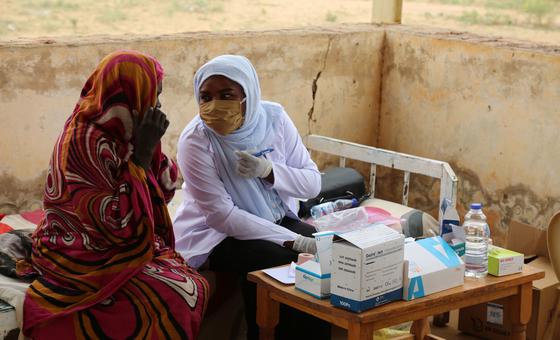
Child malnutrition hits catastrophic levels in parts of Sudan

According to an alert from the IPC, a global food security monitoring system, thresholds for acute malnutrition were surpassed in two new areas of North Darfur – Um Baru and Kernoi – following the fall of the regional capital, El Fasher, in October 2025 and a massive exodus.

December assessments found acute malnutrition levels among children of 52.9 per cent in Um Baru – nearly twice the famine threshold – and about 34 per cent in Kernoi.

The IPC stressed that the alert does not constitute a formal famine classification but warned that conditions are deteriorating rapidly – and action is urgently needed.

These alarming rates suggest an increased risk of excess mortality,” the experts said, adding that many other conflict-affected or inaccessible areas may be facing similarly catastrophic conditions.

Projection acute food insecurity in Sudan from February to May 2026.

See our UN News explainer on the evidence-based IPC index here.

Um Baru and Kernoi

Um Baru and Kernoi are in remote areas of northwestern North Darfur, near key displacement corridors leading toward the Chadian border.

Both areas have absorbed large numbers of civilians fleeing fighting in and around El Fasher, where conflict has shattered markets, disrupted livelihoods and sharply curtailed humanitarian access.

Sudan’s war, which erupted in April 2023 between the once-allied Sudanese Armed Forces (SAF) and the Rapid Support Forces (RSF), has devastated food systems nationwide, triggering mass displacement, market collapse and repeated disruptions to health, water and nutrition services.

Across the country, nearly 4.2 million cases of acute malnutrition are now expected in 2026, including more than 800,000 cases of severe acute malnutrition, representing a sharp increase from 2025 levels, according to IPC projections.

What the alert means

The IPC alert is intended to draw urgent attention to the worsening conditions and does not introduce any new formal classification.

It builds on earlier IPC analyses that confirmed famine (IPC Phase 5) in El Fasher, North Darfur in 2024, and Kadugli, South Kordofan, in September 2025 – and projected famine risk in at least 20 other areas across greater Darfur and greater Kordofan.

The new findings indicate that famine-like conditions are likely spreading beyond previously assessed locations, driven by continued fighting, displacement and the collapse of food, health and water systems, IPC analysts said.

Greater Kordofan at risk

The IPC also warned of rapidly deteriorating conditions across Greater Kordofan, where famine was already confirmed in Kadugli and severe conditions were projected in Dilling and the Western Nuba Mountains.

Renewed fighting since late October has displaced more than 88,000 people in the region, pushing total displacement above one million. Markets there are among the least functional in Sudan, with food prices far above national averages.

Without an immediate end to the fighting and large-scale humanitarian access, IPC experts said preventable deaths are likely to rise.

Source link

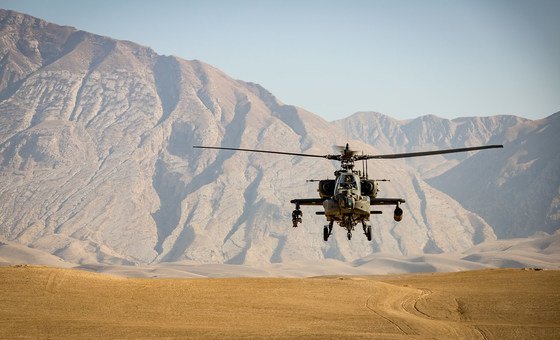
Military spending worldwide hits record $2.7 trillion

The world is spending far more on waging war than in building peace,” the UN Secretary-General António Guterres said at a press briefing for his new report on the threat posed by the steady rise in military expenditure.

Spending on security needs increased across all five global regions during 2024, marking the steepest year-on-year rise for at least the last three decades. Compared to the $2.7 trillion directed to military budgets, the world could eliminate extreme poverty for just under $300 billion.

A more secure world begins by investing at least as much in fighting poverty as we do in fighting wars,” said Mr. Guterres.

A choice between aid or arms

The alarming amount spent on arms-related costs last year alone is 750 times the 2024 UN regular budget. It also equates to almost 13 times the development assistance provided by the OECD’s development assistance committee in 2024, indicating a stark trade-off between military expenditure and sustainable development.

“Redirecting even a fraction of today’s military spending could close vital gaps – putting children in school, strengthening primary health care, expanding clean energy and resilient infrastructure, and protecting the most vulnerable,” said Mr. Guterres.

For a small portion of what was invested in militaries this past year – and the previous decade – the world could fund education for every student in low and lower middle-income countries, eliminate child malnutrition globally, fund climate change adaptation in the developing world, and bring the international community closer to achieving the Sustainable Development Goals (SDGs), the UN estimates.

“Rebalancing global priorities is not optional – it is an imperative for humanity’s survival,” said the UN disarmament chief Izumi Nakamitsu at the press briefing.

‘Sustainable development is in jeopardy’

With only one of the five of the SDGs on track, Mr. Guterres stressed that “our shared promise of sustainable development is in jeopardy.”

While more is being spent on militaries, less is being spent for social investment, poverty reduction, education, health, environmental protection and infrastructure – hindering progress on nearly all the SDGs and undermining the UN Charter, the UN’s cornerstone document. 

“But we know that development is a driver of security and multilateral development cooperation works,” said UN Development Programme (UNDP) deputy chief Haoliang Xu.

“When people’s lives improve, when they have access to education, healthcare, economic opportunities and when they can live lives of dignity and self determination, we will have more peaceful societies and a more peaceful world.”

A new security approach

“Investing in people is investing in the first line of defense against violence in any society,” said Mr. Guterres.

The report calls for a more human-centered and multidimensional approach that priorities diplomacy, international cooperation, and paves the way for sustainable development.

In a vicious cycle, lack of economic opportunity, poverty, and underdevelopment breeds instability – fuelling violence and a rise in State expenditure on the military, the UN report contends.

Investing in development and sustainable security has the potential to stop today’s arms race and alleviate the need for military spending. 

The evidence is clear: excessive military spending does not guarantee peace,” said Mr. Guterres. “It often undermines it – fuelling arms races, deepening mistrust, and diverting resources from the very foundations of stability.”

Source link

Gaza: Acute malnutrition among children hits record high

In July alone, nearly 12,000 children under five were identified as acutely malnourished out of 136,000 screened, according to aid partners. 

Of these, more than 2,500 were found to suffer from severe acute malnutrition, the most life-threatening form, and 40 had to be hospitalized in stabilisation centres.

More children affected

The proportion of children with severe acute malnutrition is rising, OCHA said.  

In June and July, 18 per cent of all acutely malnourished children had severe acute malnutrition, compared with 12 per cent between March and May.

Moreover, humanitarian access constraints are adding to the crisis.

Last month, aid partners were only able to reach 8,700 of the 290,000 children under five who require feeding and nutrition supplements due to the severe shortage of lipid-based nutrient supplements entering Gaza.

OCHA said the development “marks a dramatic collapse in the malnutrition prevention programme”, noting that an average of 76,000 children – or a quarter of those in need – were reached each month between April and June.

Distribution of other key nutrition supplies has also declined sharply, which is affecting children, pregnant women and breastfeeding mothers.

Shelter crisis worsens

Meanwhile, no shelter materials have entered Gaza since 2 March. 

At the same time, more than one million shelter items, and 2.3 million items such as tents, tarps, and sealing-off materials, have been procured and are currently stuck in Jordan and Egypt as the Israeli authorities have not approved their entry. 

The shelter crisis continues to worsen, with most families living in severely overcrowded and unsafe conditions. Some have no shelter at all. 

In July, humanitarians assessed 44 displacement sites, discovering that 43 had families with no shelter.

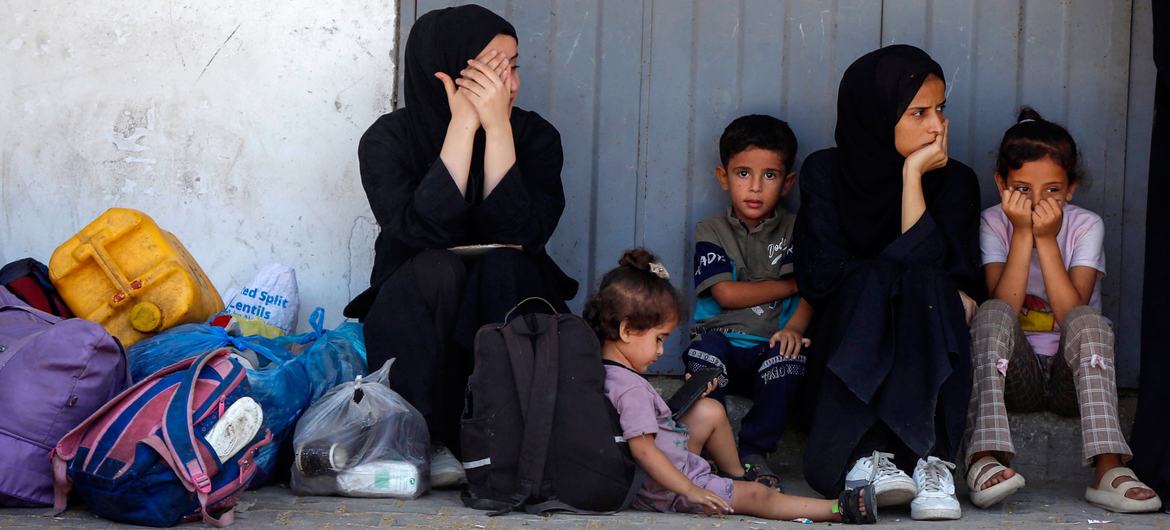
A family rests after evacuating from Deir Al-Balah in the Gaza Strip. (file)

Bombardment and displacement continue

The situation is further deteriorating due to ongoing bombardment, displacement orders and insecurity, which continue to displace families and disrupt humanitarian operations.

OCHA reported that overall, realities on the ground remain largely the same since Israel announced a “tactical pause” in military operations to allow the safe passage of aid.

The UN agency reiterated that supplies that have entered remain insufficient given the immense needs, while UN convoys continue to face challenges in delivering aid.

Aid missions taking hours

While fewer humanitarian movements have been denied outright, missions that are approved still take hours to complete, with some taking more than 18 hours.

On Wednesday, five out of 11 missions requiring coordination with the Israel authorities were facilitated. These included collecting food from the Kerem Shalom and Zikim crossings.

Another four missions were impeded but eventually fully completed, which included the collection of fuel from Kerem Shalom crossing and transfer of fuel from southern Gaza to the north. 

Medical evacuation update

One of the missions saw the medical evacuation of 15 children to Jordan, and 42 companions, with support from the World Health Organization (WHO).  However, more than 14,800 patients in Gaza still urgently need specialized medical care.

OCHA also reported on the flow of commercial goods into the Strip, noting that several trucks carrying food items have been entering over the past days. 

While the UN will continue to monitor the situation, humanitarians again stressed the need for unimpeded and predictable humanitarian access into and within Gaza, warning that “without it, time and resources are wasted, lives are lost, and the response cannot match the scale of the needs.” 

Source link

UN’s lifesaving programmes under threat as budget crisis hits hard

Member States had paid just $1.8 billion towards the UN’s $3.7 billion regular budget for 2025, as of 9 May. Including unpaid contributions from previous years, total unpaid assessments stand at approximately $2.4 billion as of 30 April.

The United States is the largest debtor at about $1.5 billion, as the Trump Administration is withholding funds to cut what it sees as unnecessary spending.

Other major contributors with unpaid dues include China ($597 million), Russia ($72 million), Saudi Arabia ($42 million), Mexico ($38 million) and Venezuela ($38 million). An additional $137 million is yet to be paid by other Member States.

The UN’s separate peacekeeping budget faces a similar crisis, with $2.7 billion in unpaid assessments as of 30 April.

Amidst the fiscal challenges, Secretary-General António Guterres in March launched the UN80 initiative to improve efficiency, streamline operations and reduce costs – including a possible 20 per cent staff cut through eliminating duplication.

Women, health, refugee support at risk

The situation is equally concerning at UN agencies and programmes, which have their own budgets and funding channels.  

The UN sexual and reproductive health agency, UNFPA, for instance has warned that women and girls in crisis zones – such as the Democratic Republic of the Congo (DRC), Haiti, Sudan and Afghanistan – are already suffering from shrinking support.

Cuts have slashed the ability to hire midwives, supply essential medicines, deploy health teams, and provide safe spaces for survivors of sexual violence.

In Mozambique, nearly 750,000 displaced persons and refugees are in urgent need of protection, but the UN refugee agency (UNHCR) warns it may have to suspend essential services, including healthcare, education, and support for survivors of gender-based violence, with only one-third of its funding appeal met.

HIV/AIDS programs are also at risk. In Tajikistan, UNAIDS Country Director Aziza Hamidova reports that 60 per cent of HIV programme support is in jeopardy. Community health centers have already closed, outreach has been cut, and access to PrEP testing and counseling has dropped sharply.

Dwindling funds for crisis response

The Office for the Coordination of Humanitarian Affairs (OCHA) – which leads UN’s response to crisis – is raising alarms over the cascading impact of funding gaps.

In Sudan, only 13 per cent of the $4.2 billion needed for 2025 has been received, forcing 250,000 children out of school. In the DRC, gender-based violence cases have surged 38 per cent, but programmes are shutting down. In Haiti, cholera response efforts risk collapse. Meanwhile, just 25 per cent of Ukraine’s 2025 humanitarian appeal has been funded, jeopardizing critical services.

UN Emergency Relief Coordinator and head of OCHA, Tom Fletcher, has already announced staff cuts and scaling back of some country programmes.

Source link