Indirect disaster effects cost the world nearly $2 trillion per year, Guterres says on International Day

Most of the exorbitant costs of disaster are preventable with proper funding and planning —one of the main messages for this year’s International Day for Disaster Risk Reduction, themed Fund Resilience, Not Disasters, observed on Monday.

“Every dollar invested in resilience saves many more in avoided losses and protects the dignity of those most at risk. The choice is ours. We can continue to fund disaster response or we can invest in resilience,” said Amy Pope, chief of the International Organization for Migration (IOM).

In 2024 alone, nearly 46 million people were displaced by disasters, the highest number ever recorded, but disaster risk reduction efforts remain severely underfunded, according to the IOM. 

Preventable disaster costs

“As the climate crisis accelerates, disasters are multiplying and amplifying – devastating lives and livelihoods, erasing decades of development gains in an instant,” said UN Secretary-General António Guterres in his message to mark the Day. 

“The cost to the global economy is staggering: an estimated $2 trillion every year, when indirect costs are taken into account.”

Indirect costs include the wider social and ecosystem losses that come as a result of natural catastrophes. Earthquakes, floods, storms, droughts and heatwaves made up 95 per cent of direct costs in the past two decades, according to the report. 

“Wildfires in Europe and the Americas, and devastating earthquakes in Myanmar and Afghanistan prove that no country is immune, but the heaviest toll falls on communities already struggling with conflict, poverty, and hunger,” said Ms. Pope.

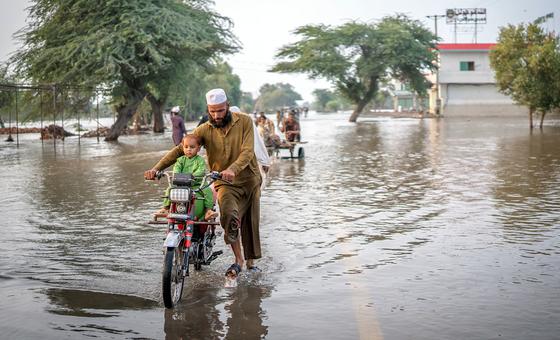
Different natural catastrophes affect different regions in the world. In South Sudan, annual floods can submerge houses, farmland and schools, forcing people to flee their homes and increasing food insecurity. 

As a disaster prevention measure, dykes have been constructed in South Sudan with the support of the IOM, protecting farmland and restoring livelihoods. 

Promoting disaster reduction 

The International Day for Disaster Risk Reduction was established in 1989 to foster a global culture of risk-awareness and celebrate how communities around the world are reducing their exposure to disasters. 

“The impact of disasters depends in large part on the choices we make, how strong our infrastructure is, how much we invest in prevention, and how well we protect the most vulnerable,” said Ms. Pope.

With planning and funding, the negative impacts of disasters can be reduced. Accordingly, this year’s Day call is for an increase in disaster risk funding and for the development of risk-adapted and resilient private investment. 

Mr. Guterres stressed that for every decision they make, the public and private sectors must take risk into account to minimise exposure and vulnerability to hazards. 

“On this Day, let’s commit to meet surging risk with a surge in funds, and build a safer and more equitable future for all,” he said. 

Military spending worldwide hits record $2.7 trillion

The world is spending far more on waging war than in building peace,” the UN Secretary-General António Guterres said at a press briefing for his new report on the threat posed by the steady rise in military expenditure.

Spending on security needs increased across all five global regions during 2024, marking the steepest year-on-year rise for at least the last three decades. Compared to the $2.7 trillion directed to military budgets, the world could eliminate extreme poverty for just under $300 billion.

A more secure world begins by investing at least as much in fighting poverty as we do in fighting wars,” said Mr. Guterres.

A choice between aid or arms

The alarming amount spent on arms-related costs last year alone is 750 times the 2024 UN regular budget. It also equates to almost 13 times the development assistance provided by the OECD’s development assistance committee in 2024, indicating a stark trade-off between military expenditure and sustainable development.

“Redirecting even a fraction of today’s military spending could close vital gaps – putting children in school, strengthening primary health care, expanding clean energy and resilient infrastructure, and protecting the most vulnerable,” said Mr. Guterres.

For a small portion of what was invested in militaries this past year – and the previous decade – the world could fund education for every student in low and lower middle-income countries, eliminate child malnutrition globally, fund climate change adaptation in the developing world, and bring the international community closer to achieving the Sustainable Development Goals (SDGs), the UN estimates.

“Rebalancing global priorities is not optional – it is an imperative for humanity’s survival,” said the UN disarmament chief Izumi Nakamitsu at the press briefing.

‘Sustainable development is in jeopardy’

With only one of the five of the SDGs on track, Mr. Guterres stressed that “our shared promise of sustainable development is in jeopardy.”

While more is being spent on militaries, less is being spent for social investment, poverty reduction, education, health, environmental protection and infrastructure – hindering progress on nearly all the SDGs and undermining the UN Charter, the UN’s cornerstone document. 

“But we know that development is a driver of security and multilateral development cooperation works,” said UN Development Programme (UNDP) deputy chief Haoliang Xu.

“When people’s lives improve, when they have access to education, healthcare, economic opportunities and when they can live lives of dignity and self determination, we will have more peaceful societies and a more peaceful world.”

A new security approach

“Investing in people is investing in the first line of defense against violence in any society,” said Mr. Guterres.

The report calls for a more human-centered and multidimensional approach that priorities diplomacy, international cooperation, and paves the way for sustainable development.

In a vicious cycle, lack of economic opportunity, poverty, and underdevelopment breeds instability – fuelling violence and a rise in State expenditure on the military, the UN report contends.

Investing in development and sustainable security has the potential to stop today’s arms race and alleviate the need for military spending. 

The evidence is clear: excessive military spending does not guarantee peace,” said Mr. Guterres. “It often undermines it – fuelling arms races, deepening mistrust, and diverting resources from the very foundations of stability.”

Source link

UN warns of $4 trillion shortfall threatening global development goals

Speaking at UN Headquarters in New York, Secretary-General António Guterres, General Assembly President Philémon Yang and Economic and Social Council President Bob Rae stressed the need for more resources and a global financial overhaul.

Without an effective response, they stressed, the world risks falling even further behind on ending poverty, fighting climate change, and building new sustainable economies.

They were addressing the ECOSOC annual forum on financing for development, which follows last week’s World Bank and International Monetary Fund (IMF) Spring Meetings where global growth, trade tensions and the rising debt burden in developing countries were front and centre.

Everyone loses in a trade war

This year’s ECOSOC Forum comes at a pivotal time,” Mr. Guterres told delegates, warning that global cooperation itself is under threat.

He pointed to rising trade tensions as a major risk, noting that while fair trade is a clear example of the benefits of international collaboration, the surge in trade barriers poses a “clear and present danger” to the global economy – as seen in recent downgrades to global growth forecasts by the IMF, the World Trade Organization (WTO), and UN economists.

In a trade war, everybody loses – especially the most vulnerable countries and people, who are hit the hardest,” he said.

We must shift into overdrive

Mr. Guterres highlighted how many donors are pulling back from aid commitments while soaring borrowing costs drain public investments, putting the SDGs “dramatically off track.”

With just five years to reach the SDGs, we need to shift into overdrive,” he stressed, urging countries to deliver bold outcomes at the upcoming Fourth International Conference on Financing for Development, in Seville.

“Against this turbulent background, we cannot let our financing for development ambitions get swept away.”

Secretary-General António Guterres (right) addresses the ECOSOC 2025 Forum on Financing for Development Follow-up. At his left is Philémon Yang, President of the General Assembly.

Crushing debt burdens

ECOSOC President Bob Rae echoed these concerns, emphasising that over three billion people live in countries where governments spend more on interest payments than on health or education.

“We desperately need a more affordable debt architecture – it’s that simple,” he said, calling for urgent reforms that would allow countries a fair chance to repay what they owe while investing in their futures.

He also sounded the alarm over rising trade barriers – citing recent moves by major economies, like the United States, to impose new tariffs.

Trade is not a four-letter word,” Mr. Rae said, “it is a positive way for countries to exchange goods and services and emerge from poverty.”

He urged countries not to see trade as a zero-sum game – where there are only winners and losers – and embrace fair, open trading systems as a path to shared prosperity.

Calls for reform

General Assembly President Philémon Yang underscored the consequences of rising debts and shrinking fiscal space.

In more than 50 developing countries, governments now spend over 10 percent of their revenues on debt servicing – and in 17 of them, over 20 percent – a clear warning sign of default, according to UN economists.

“Our inability to reform the international financial architecture is severely restricting capital access,” Mr. Yang warned, stressing that closing the financing gap – now estimated at over $4 trillion annually – is critical to achieving the SDGs.

Time is of the essence. Let us use this ECOSOC Forum to bridge divides, build trust, and lay the foundation for success.

The 17 Sustainable Development Goals are all interconnected, for instance progress on SDG 2 to end hunger is closely tied to advances in health and education.

Looking ahead to Seville

As negotiations continue towards an agreed outcome in Seville, Secretary-General Guterres highlighted three priority areas – tackling unsustainable debt, strengthening multilateral development banks and unlocking new streams of sustainable finance.

He called for mobilizing more domestic resources, innovative financing solutions, better controls on illicit financial flows and stronger partnerships with the private sector.

ECOSOC President Rae added that the conversation must move beyond declarations to concrete, measurable action.

We need innovation, creativity and partnerships that deliver lasting and transformative impact,” he said.

The Fourth International Conference on Financing for Development – to be held from 30 June to 3 July in Seville, Spain – represents a critical opportunity to rebuild the global financial system to unleash the investments urgently needed to achieve the SDGs.

Source link