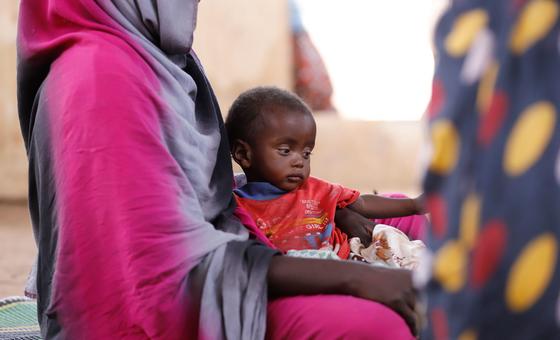
Child malnutrition hits catastrophic levels in parts of Sudan

According to an alert from the IPC, a global food security monitoring system, thresholds for acute malnutrition were surpassed in two new areas of North Darfur – Um Baru and Kernoi – following the fall of the regional capital, El Fasher, in October 2025 and a massive exodus.

December assessments found acute malnutrition levels among children of 52.9 per cent in Um Baru – nearly twice the famine threshold – and about 34 per cent in Kernoi.

The IPC stressed that the alert does not constitute a formal famine classification but warned that conditions are deteriorating rapidly – and action is urgently needed.

These alarming rates suggest an increased risk of excess mortality,” the experts said, adding that many other conflict-affected or inaccessible areas may be facing similarly catastrophic conditions.

Projection acute food insecurity in Sudan from February to May 2026.

See our UN News explainer on the evidence-based IPC index here.

Um Baru and Kernoi

Um Baru and Kernoi are in remote areas of northwestern North Darfur, near key displacement corridors leading toward the Chadian border.

Both areas have absorbed large numbers of civilians fleeing fighting in and around El Fasher, where conflict has shattered markets, disrupted livelihoods and sharply curtailed humanitarian access.

Sudan’s war, which erupted in April 2023 between the once-allied Sudanese Armed Forces (SAF) and the Rapid Support Forces (RSF), has devastated food systems nationwide, triggering mass displacement, market collapse and repeated disruptions to health, water and nutrition services.

Across the country, nearly 4.2 million cases of acute malnutrition are now expected in 2026, including more than 800,000 cases of severe acute malnutrition, representing a sharp increase from 2025 levels, according to IPC projections.

What the alert means

The IPC alert is intended to draw urgent attention to the worsening conditions and does not introduce any new formal classification.

It builds on earlier IPC analyses that confirmed famine (IPC Phase 5) in El Fasher, North Darfur in 2024, and Kadugli, South Kordofan, in September 2025 – and projected famine risk in at least 20 other areas across greater Darfur and greater Kordofan.

The new findings indicate that famine-like conditions are likely spreading beyond previously assessed locations, driven by continued fighting, displacement and the collapse of food, health and water systems, IPC analysts said.

Greater Kordofan at risk

The IPC also warned of rapidly deteriorating conditions across Greater Kordofan, where famine was already confirmed in Kadugli and severe conditions were projected in Dilling and the Western Nuba Mountains.

Renewed fighting since late October has displaced more than 88,000 people in the region, pushing total displacement above one million. Markets there are among the least functional in Sudan, with food prices far above national averages.

Without an immediate end to the fighting and large-scale humanitarian access, IPC experts said preventable deaths are likely to rise.

Source link

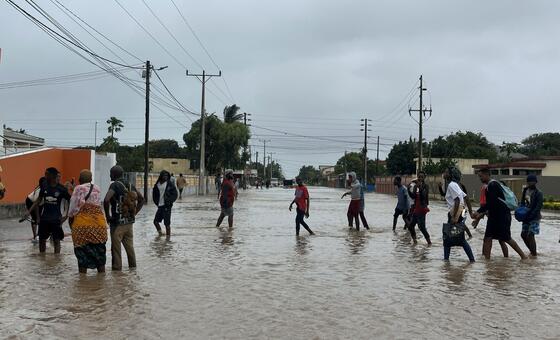
Mozambique floods heighten disease, malnutrition risks – UN agencies

The head of aid coordination office, OCHA, in the country, Paola Emerson, told reporters in Geneva that more than half a million people have been impacted by the floods, triggered by heavy rains in the first weeks of the new year.

“The numbers keep rising as extensive flooding continues and dams keep releasing water to avoid bursting,” she said.

Mozambique’s Gaza province is most affected along with Maputo and Sofala provinces.

‘Melting’ houses

Speaking from Xai-Xai, Gaza’s capital city, Ms. Emerson stressed that 90 per cent of the country’s people live in adobe houses, which are earth-based structures “that basically melt after a few days’ rains”.

Health facilities, roads and critical infrastructure are also heavily impacted. Ms. Emerson said that some 5,000 kilometres of roads have been damaged across nine provinces, including the main road linking the capital Maputo to the rest of the country, which is currently inaccessible, resulting in major supply chain disruptions.

Meanwhile, dams continue to release water even as heavy rains subside.

“From just one dam, up to 10,000 cubic metres-worth of water were being discharged. That is approximately 25 times the amount of water that could be held in the press briefing room you are in today, every second,” Ms. Emerson told journalists, seated in a room with capacity for more than 100 people.

You cannot imagine the strength of this water and the impact it has on people and the infrastructure.

National emergency

The Government of Mozambique has declared a national emergency and has established an emergency operations centre in Gaza province. Xai-Xai, which is near the Limpopo River, has been inundated, prompting evacuations. Ms. Emerson said that authorities have issued alerts for downtown Xai-Xai, “including warnings of crocodile risks in flooded areas”.

“River levels are rising and are reaching urban areas or heavily populated areas,” she said. “The crocodiles that are in the Limpopo River…are able to get into urban or populated areas that are now submerged underwater.

Also speaking from Xai-Xai, the UN Children’s Fund (UNICEF)’s Chief of Communication in Mozambique, Guy Taylor, warned that flooding is “turning unsafe water, disease outbreaks and malnutrition into a deadly threat for children”.

Lethal combination

The combination of waterborne diseases and malnutrition “can often prove lethal,” he said, stressing that even before the floods, four out of every 10 children in Mozambique experienced chronic malnutrition.

“This renewed disruption to food supplies, to health services and to care practices threatens to push the most vulnerable children into a dangerous spiral,” he insisted.

Mr. Taylor added that Mozambique is now entering into its annual cyclone season, creating the risk of a double crisis. “We can prevent disease, deaths and irreversible losses to children, but we need to act fast,” he said.

The UNICEF spokesperson described Mozambique as “a country of children and young people”, with an average age of 17.

“When floods and cyclones strike, as they have repeatedly and with increasing frequency over recent years, it’s the youngest and children who are hit hardest,” he concluded.
Source link

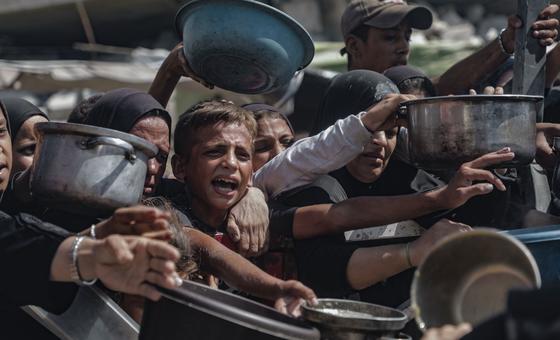
Daily malnutrition deaths continue as Israeli forces push further into Gaza City

Military activities continue in and around Gaza City, but also in the south, taking a heavy toll on civilians, including deaths, injuries and further displacement,” said UN Spokesperson Stéphane Dujarric at the daily press briefing in New York: “Our colleagues report that people continue to flee, mainly towards the coast.”

More than 76,000 people have been newly displaced since mid-August, with most occurring in the north, he said, citing the latest reports from UN agencies on the ground that are monitoring population movements. More than 23,000 people were displaced from northern Gaza.

Coastal areas are also crowded with tents, forcing many people to flee from Gaza City in the north towards central areas, according to the UN humanitarian coordination agency, OCHA.

Famine response: ‘We can do this again’

Daily reports of malnutrition deaths continue, the UN Spokesperson said. Since the start of the nearly two-year-long war, more than 300 people, including many children, have died of malnutrition in the Strip, according to local authorities.

The World Food Programme (WFP) reported that the situation “continues to deteriorate”, the UN Spokesperson added, adding that families without able-bodied members to fetch food are facing the highest risks.

As such, the UN agency resumed last week its distribution system of digital vouchers, reaching 22,000 people, including vulnerable groups, following a five-month pause.

“We and our partners are continuing to transport aid and other medical supplies to and from the crossings [into Gaza], but the current situations on the ground have not yet allowed us to resume community-based distribution,” Mr. Dujarric said. “Only a ceasefire will ensure necessary conditions for a massive response to prevent famine from spreading further.”

During the previous ceasefire from January to March, he said “we reached nearly every single person in the Gaza Strip with lifesaving aid, and we can do this again.”

Obstacles delay urgent aid deliveries

WFP said obstacles include supply shortages and violent unrest around convoys which is making distributions “nearly impossible”.

According to the UN humanitarian agency, the movement of aid teams inside Gaza remains heavily restricted. OCHA also reported that about one in three planned missions were “impeded or outright denied by Israeli authorities” between Friday and Monday, the UN Spokesperson said.

As a result, many missions could not be completed, he said, also noting that strict Israeli inspections continue to significantly delay aid clearance at Ashdod Port.

Visas for top Palestinian officials blocked

News reports indicated that the United States announced last week that it would not issue visas to senior Palestinian leaders ahead of the high-level General Assembly meetings later this month at UN Headquarters in New York.

That includes a conference on 22 September where Heads of State and Government are expected to endorse a political declaration adopted by leaders attending an international conference in late July, endorsing the two-State solution.

Responding to a reporter’s question on the matter, Mr. Dujarric said “the participation of a senior Palestinian delegation to the conference is essential.”

UNRWA chief levels charge of ‘scholasticide’

Philippe Lazzarini, Commissioner-General of the UN agency for Palestine refugees, UNRWA, raised alarms at what would have been the start to the school year for more than 600,000 children in Gaza.

Gaza is in ruins; so is its education system,” he said in a statement on Monday. “Instead of going back to school, like most children around the world, around 660,000 girls and boys in Gaza will be sifting through the rubble, desperate, hungry, traumatised and mostly bereaved.”

The longer they stay out of school with their trauma, the higher the risk they become “a lost generation, sowing the seeds for more hatred and violence”, the UNRWA chief warned.

“Ceasefire is the only way forward to reverse the famine and the ‘scholasticide’ hitting the children of Gaza,” he said.

Source link

Malnutrition deaths mark ‘latest in the war on children’ in Gaza: UNRWA chief

These young deaths are “the latest in the war on children and childhood in Gaza,” Philippe Lazzarini, head of UN Palestine refugee agency UNRWA, said in a tweet on Wednesday.

The toll also includes some 40,00 boys and girls reported killed or injured due to bombardment and airstrikes, at least 17,000 unaccompanied and separated children, and one million deeply traumatised youngsters who are not getting an education. 

“Children are children,” he said.

 “No one should stay silent when children die, or are brutally deprived of a future, wherever these children are, including in Gaza.”

A sombre reunion

Thousands of sick children in Gaza need urgent medical evacuation, according to UN aid coordination office OCHA.

Olga Cherevko, a spokesperson for the agency, recalled the moment she recognized a young girl requiring treatment in a Gaza hospital after a year’s interval, once again suffering from malnourishment.

“I remembered her long eyelashes,” the veteran humanitarian told UN News, describing seven-year-old Janah, who she came across at Gaza City’s Patient Friendly Hospital on Tuesday.

“The first time I met her was in the IMC Field Hospital in southern Gaza in April 2024. Back then, she was severely malnourished and was getting treatment. And she gradually became better and was released eventually and went home.”

Seven-year-old Janah is treated at Gaza City’s Patient Friendly Hospital.

Evacuation saves lives

However, Janah was now back in hospital “because the malnutrition became aggravated and the condition that she has also is not properly diagnosed and cannot be properly diagnosed.” 

The girl is on a list of people to be medically evacuated for treatment outside Gaza.  The most recent evacuations took place last week when the World Health Organization (WHO) supported the transfer of 15 critically ill children to Jordan, but more than 14,800 people are still waiting.

Ms. Cherevko stressed the importance of ensuring that evacuations continue to save as many lives as possible.

More aid needed

She also pointed out that for children and adults with pre-existing conditions, their situation becomes worse with malnutrition.

“It wouldn’t be this way if they had proper nutrition, because these conditions existed before the starvation crisis and they weren’t getting as sick as they are now,” she said.

“This is why it’s imperative to make sure that we have proper conditions on the ground for adequate volumes of supplies to be entering – everything from food to medicine to nutrition to shelter,” she continued. 

“And these lifelines have to be really enabled for us to be able to deliver this aid to the people in need.” 

Source link

Record starvation and malnutrition in Gaza; more West Bank displacement

That warning comes from the UN World Food Programme (WFP) in a tweet posted on Tuesday, calling for more aid to be allowed into the enclave by Israeli authorities. 

Gaza’s Ministry of Health reported that five people died over the past 24 hours due to malnutrition and starvation, the UN Office for the Coordination of Humanitarian Affairs (OCHA) said in its latest update.

This brings the total number of malnutrition-related deaths to 227, including 103 children, since October 2023.  

Still not enough aid

Humanitarians continue to decry the low level of supplies entering Gaza, which remains a fraction of what is needed to meet the immense needs of the roughly 2.1 million people living there.

One third of the population is not eating for days on end, and half a million are on the brink of starvation, WFP emphasised.

The agency is calling for at least 100 trucks a day to be allowed into Gaza, much faster approvals and clearances, and for no armed presence or shooting near humanitarian convoys and food distribution sites, among other measures.

Humanitarian missions face obstructions

Although the UN and partners continue to do everything possible to bring assistance in, humanitarian movements still face significant delays and other challenges. 

UN Spokesperson Stéphane Dujarric outlined the situation for journalists attending the regular media briefing at Headquarters in New York. 

He said on Monday humanitarians had formally asked Israel to coordinate 16 missions – including the collection of food, medical supplies and fuel – from the Kerem Shalom and Zikim border crossings, the only two aid corridors in operation.

Other missions involved moving goods and personnel within Gaza, from south to north and within the southern part of the Strip. 

‘Precious time’ wasted

Out of the 16 missions, four were facilitated and three were denied; another four were impeded but eventually were fully accomplished,” he said.

Of the remaining missions, two were cancelled by the respective organizations and two more that involved collection of food and health supplies from the Kerem Shalom crossing were impeded and unable to be completed.  Another mission was impeded but was still ongoing.

“Efforts to coordinate humanitarian movements often drag on for hours due to unpredictable clearances by the Israeli authorities, wasting precious time,” he added. 

West Bank unrest

OCHA also updated on the situation in the occupied West Bank, where another Palestinian Bedouin community was displaced on Monday due to violence by Israeli forces and settlers. 

Israeli forces raided the community of Ein Ayoub in Ramallah governorate and ordered the immediate eviction of its roughly 100 Palestinian residents.

Many of these people have no alternative means of shelter, OCHA said. 

Source link

Gaza: Guterres urges probe into killing of journalists, as child malnutrition deaths rise

The reporters – five of whom worked for the Al Jazeera media network – were killed in a targeted Israeli strike in Gaza City the previous day. 

These latest killings highlight the extreme risks journalists continue to face when covering the ongoing war,” UN Spokesperson Stéphane Dujarric said during his regular media briefing from New York.

“The Secretary-General calls for an independent and impartial investigation into these latest killings.” 

Respect the press

Mr. Dujarric pointed out that at least 242 journalists have been killed in Gaza since the war began nearly three years ago.

“The Secretary-General underscores that journalists and media workers must be respected, they must be protected and they must be allowed to carry out their work freely, free from fear and free from harassment,” he said.

© UNICEF/Mohammed Nateel

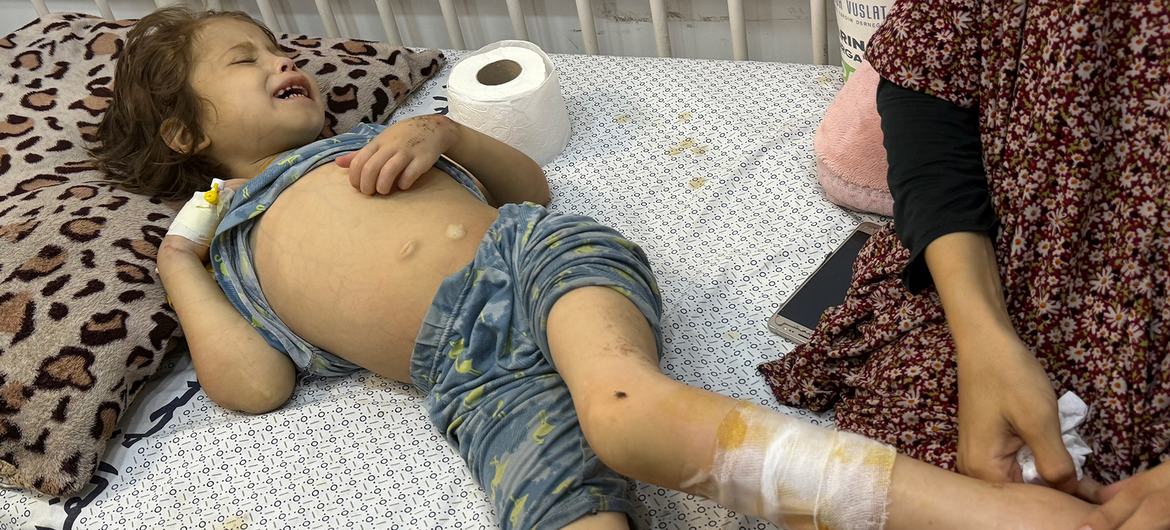
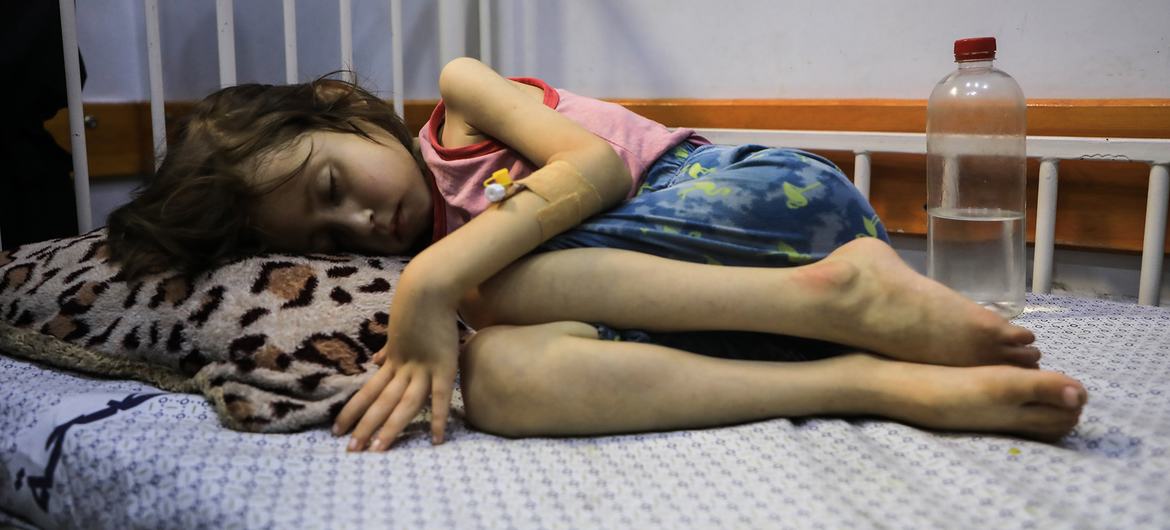
A child suffering from malnutrition lies on a bed in the Patient Society Hospital in Gaza City.

Hungry children dying

Meanwhile, the number of children in Gaza who have died from malnutrition since October 2023 has surpassed 100, according to the Gazan health authorities, the UN aid coordination office, OCHA, said in an update.

More than a third of the population is not eating for days at a time, according to the UN World Food Population (WFP).  Furthermore, acute malnutrition is spiking, with over 300,000 children at severe risk.

This comes amidst a recent warning by the UN Food and Agriculture Organization (FAO) that a mere 1.5 per cent of cropland in the enclave remains both accessible and undamaged, “signaling a near-total collapse of the local production of food.”

Aid taken from trucks

On the aid front, the UN and its partners collected food and hygiene kits from the Kerem Shalom/Karem Abu Salem border crossing on Wednesday.

“However, supplies were offloaded directly from these trucks before reaching their destination, given the extreme desperation pervasive in Gaza today,” OCHA said.

The agency stressed that people there “need a predictable lifeline – not a trickle of aid – so they do not feel they need to take desperate measures to survive.”

WFP said that just to cover basic humanitarian food assistance needs, more than 62,000 metric tonnes are required to enter Gaza every month, and so far, humanitarians have not been permitted to bring in enough supplies to support the population. 

Fuel shortages continue

Humanitarians also collected fuel from the Kerem Shalom crossing on Wednesday. Israel is allowing, on average, the entry of about 150,000 litres of fuel daily, which is still far below the minimum required. As a result, life-saving operations continue to be at risk.

The Palestine Civil Defence organization has warned that more than half of their ambulances have stopped operating across Gaza due to the shortage of both fuel and spare parts. 

“Israeli authorities must allow aid to enter through all crossings and via all available corridors so that humanitarians can deliver – at scale, in a safe and dignified manner – to reach the most vulnerable, including women, children and older people,” OCHA said. 

Source link

Aid blockade deepens Gaza crisis as malnutrition deaths rise, warns UNRWA

“For over 150 days, not a single truck from UNRWA has been permitted to deliver food, medicine or other essentials into Gaza,” the agency said on Friday. “This denial of access is costing lives every single day.”

Nearly 100 children dead from malnutrition

According to Gaza’s Ministry of Health, cited by the UN, at least 61,158 Palestinians have been killed and more than 151,000 injured since October, amid relentless Israeli bombardment and ground operations.

UNRWA said nearly 350 of its own staff are among the dead since Israel’s military operation in Gaza began following the 7 October 2023 Hamas-led terror attacks.

Many civilians have been killed while sheltering in schools or tents, or while queuing for food.

Food insecurity is now acute. UN data show 193 people — including 96 children — have died from malnutrition since the start of August, with July seeing the highest monthly rate of acute malnutrition recorded in children under five.

Soaring prices

Wheat flour prices have soared by up to 15,000 per cent compared to pre-war levels. “Sustained, large-scale deliveries are the only way to stabilise food supplies and prices,” UNRWA stressed.

Health services are close to collapse. More than half of essential medical supplies are already out of stock, and hospitals have been forced to ration fuel for generators. UNRWA teams have nevertheless managed over 1.5 million health consultations since March, but “without resupply, our ability to save lives is dwindling,” the agency warned.

Vast scale of displacement

Displacement is on a vast scale: 1.9 million people — around 90 per cent of Gaza’s population — have been forced from their homes, many repeatedly. Nearly 100,000 are crammed into over 60 UNRWA-run shelters.

In the northern Israeli-occupied West Bank, around 30,000 people from Nur Shams, Tulkarm and Jenin refugee camps remain unable to return home due to Israel’s “Iron Wall” military operation, ongoing since January.

The agency urged immediate, unhindered humanitarian access. “We need the world to act — to open the crossings, to stop the suffering, and to uphold the most basic principles of humanity,” it said.

The UN Security Council is due to meet in New York in emergency session on Sunday morning local time to discuss the Israeli cabinet’s endorsement of a military takeover of Gaza City which is home to around one million Palestinians.

Gaza: Acute malnutrition among children hits record high

In July alone, nearly 12,000 children under five were identified as acutely malnourished out of 136,000 screened, according to aid partners. 

Of these, more than 2,500 were found to suffer from severe acute malnutrition, the most life-threatening form, and 40 had to be hospitalized in stabilisation centres.

More children affected

The proportion of children with severe acute malnutrition is rising, OCHA said.  

In June and July, 18 per cent of all acutely malnourished children had severe acute malnutrition, compared with 12 per cent between March and May.

Moreover, humanitarian access constraints are adding to the crisis.

Last month, aid partners were only able to reach 8,700 of the 290,000 children under five who require feeding and nutrition supplements due to the severe shortage of lipid-based nutrient supplements entering Gaza.

OCHA said the development “marks a dramatic collapse in the malnutrition prevention programme”, noting that an average of 76,000 children – or a quarter of those in need – were reached each month between April and June.

Distribution of other key nutrition supplies has also declined sharply, which is affecting children, pregnant women and breastfeeding mothers.

Shelter crisis worsens

Meanwhile, no shelter materials have entered Gaza since 2 March. 

At the same time, more than one million shelter items, and 2.3 million items such as tents, tarps, and sealing-off materials, have been procured and are currently stuck in Jordan and Egypt as the Israeli authorities have not approved their entry. 

The shelter crisis continues to worsen, with most families living in severely overcrowded and unsafe conditions. Some have no shelter at all. 

In July, humanitarians assessed 44 displacement sites, discovering that 43 had families with no shelter.

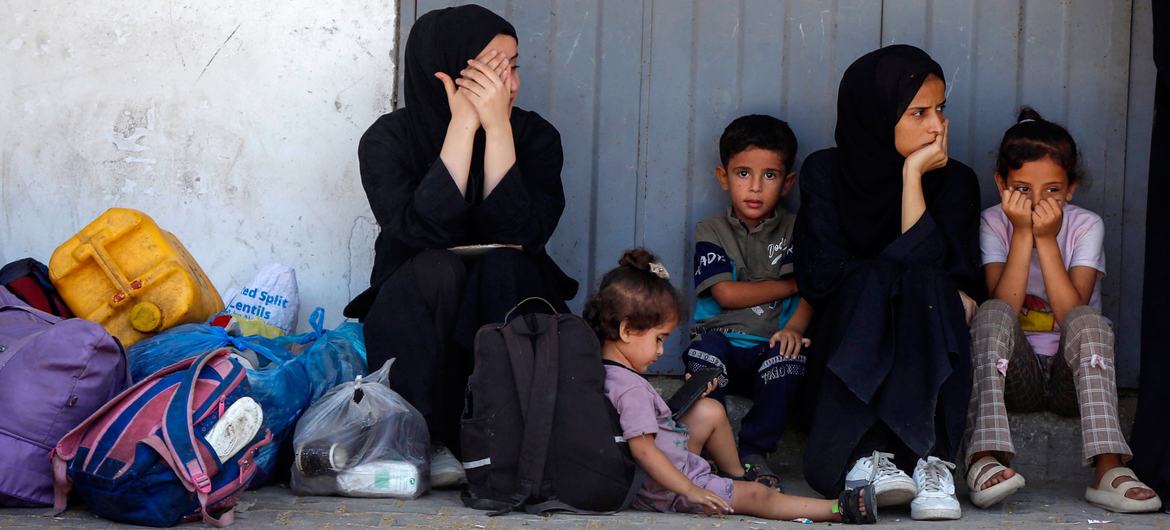
A family rests after evacuating from Deir Al-Balah in the Gaza Strip. (file)

Bombardment and displacement continue

The situation is further deteriorating due to ongoing bombardment, displacement orders and insecurity, which continue to displace families and disrupt humanitarian operations.

OCHA reported that overall, realities on the ground remain largely the same since Israel announced a “tactical pause” in military operations to allow the safe passage of aid.

The UN agency reiterated that supplies that have entered remain insufficient given the immense needs, while UN convoys continue to face challenges in delivering aid.

Aid missions taking hours

While fewer humanitarian movements have been denied outright, missions that are approved still take hours to complete, with some taking more than 18 hours.

On Wednesday, five out of 11 missions requiring coordination with the Israel authorities were facilitated. These included collecting food from the Kerem Shalom and Zikim crossings.

Another four missions were impeded but eventually fully completed, which included the collection of fuel from Kerem Shalom crossing and transfer of fuel from southern Gaza to the north. 

Medical evacuation update

One of the missions saw the medical evacuation of 15 children to Jordan, and 42 companions, with support from the World Health Organization (WHO).  However, more than 14,800 patients in Gaza still urgently need specialized medical care.

OCHA also reported on the flow of commercial goods into the Strip, noting that several trucks carrying food items have been entering over the past days. 

While the UN will continue to monitor the situation, humanitarians again stressed the need for unimpeded and predictable humanitarian access into and within Gaza, warning that “without it, time and resources are wasted, lives are lost, and the response cannot match the scale of the needs.” 

Source link

Malnutrition crisis deepens for Sudan’s children as war rages on

Across the five states that make up Darfur, UNICEF data revealed a 46 per cent increase in the number of children treated for SAM in January to May 2025 compared to the same period last year.

The rate of acute malnutrition has surpassed emergency levels set by the World Health Organization (WHO) in 9 of the 13 localities across Darfur.

In North Darfur alone, over 40,000 children were admitted for SAM treatment in the first five months of the year – double the number from the same period last year.

Besieged and starved

This malnutrition surge comes amid intensifying conflict in North Darfur since April. Entire neighborhoods have been besieged, hospitals targeted by airstrikes, roads rendered impassable while aid convoys have faced looting and violent attacks.

The situation is particularly catastrophic in El Fasher, where humanitarian access has been nearly completely severed since the RSF militia besieged the city – the last held by Government forces in the region – and cut off assistance in April of 2023.

UNICEF successfully delivered a batch of supplies to El Fasher earlier this year, but efforts to send additional aid have been blocked.

Children in Darfur are being starved by conflict and cut off from the very aid that could save them,” said Sheldon Yett, UNICEF Representative for Sudan. “This is a moment of truth; children’s lives depend on whether the world chooses to act or look away.”

The crisis has triggered mass displacement in the area: in April, nearly 400,000 people fled the Zamzam camp near El Fasher. Many walked up to 70 kilometres to reach Tawila, where more than 500,000 displaced people survive with little access to food, water, or adequate shelter.

Nationwide crisis

SAM is the deadliest form of malnutrition, and children suffering from it are highly vulnerable to life-threatening complications and face a high risk of death without proper treatment.

And the crisis isn’t limited to the Darfur states – SAM admissions rose by more than 70 per cent in North Kordofan, 174 per cent in Khartoum State and a staggering 683 per cent in Al Jazirah State.

However, the report noted that the rise in admissions in Al Jazirah and Khartoum is partially due to improved security and humanitarian access, enabling more families to reach health centres.

Compounding the crisis is Sudan’s lean season – a period of food scarcity between harvests – which is rapidly increasing the risk of mass child mortality, particularly in areas already nearing famine thresholds.

Cholera outbreaks, measles cases and collapsing health services are further aggravating the crisis, putting vulnerable children at even greater risk.

UNICEF response

UNICEF and its partners are saving lives by treating the wounded and malnourished, drilling wells and distributing food. But despite their best efforts, the violence is driving needs faster than they can be met.

UNICEF is calling on all parties to allow unimpeded humanitarian access to affected populations and urges renewed diplomatic pressure on all sides for a cessation of hostilities.

The agency is also appealing to the international community for more lifesaving funds. An additional $200 million is needed this year to sustain and expand essential nutrition services, including treatment for acute malnutrition.

Source link

Gaza: 57 children reported dead from malnutrition, says WHO

Since the aid blockade began on 2 March, 57 children have reportedly died from the effects of malnutrition, according to the Ministry of Health.

If the situation persists, nearly 71,000 children under the age of five are expected to be acutely malnourished over the next 11 months.

Briefing journalists in Geneva, WHO’s representative in the Occupied Palestinian Territory Dr. Rik Peeperkorn said that that Israel’s complete aid embargo has left only enough WHO supplies to treat 500 children with acute malnutrition – “a fraction of the urgent need”

“People are trapped in this cycle where a lack of diversified food, malnutrition and disease fuel each other,” he warned.

Dr. Peeperkorn’s comments follow the publication on Monday of a new analysis by the UN-backed food security alert scale known as the IPC showing that one in five people in Gaza – 500,000 – faces starvation, while the entire 2.1 million population of the Strip is subjected to prolonged food shortages. WHO is a member of the IPC.

An escalating hunger crisis

“This is one of the world’s worst hunger crises, unfolding in real time,” Dr. Peeperkorn said.

The UN health agency representative spoke of his recent visit to Kamal Adwan hospital in north Gaza, where each day more than 300 children are screened at a WHO-supported nutrition centre. During the visit, the hospital reported more than 11 per cent of cases with global acute malnutrition.

Describing the affected children, he said, “I’ve seen them [in the] wards… A child of five years old, and I thought he’s two and a half”.

WHO supports 16 outpatient and three inpatient malnutrition treatment centres in the enclave with lifesaving supplies, but the stopping of aid by Israel and shrinking humanitarian access are threatening its ability to sustain these operations.
Dr. Peeperkorn insisted on the long-term damage from malnutrition which “can last a lifetime”, with impacts including stunted growth, impaired cognitive development and health.

“Without enough nutritious food, clean water, access to health care, an entire generation will be permanently affected,” he warned.

The WHO official stressed that the agency was “constantly” raising with Israeli authorities the need to get supplies into the Strip. Some 31 WHO aid trucks are at a standstill in Al-Arish in Egypt just a few dozen kilometres away from the Rafah border crossing with Gaza and more supplies are positioned in the West Bank, ready to move “any day when this is allowed”.

‘Health care is not a target’

Turning to attacks on health care, Dr. Peeperkorn said that the burn unit of Nasser Medical Complex in the southern town of Khan Younis was reportedly hit by an Israeli airstrike on Tuesday, killing two and injuring 12. The attack has resulted in the loss of 18 hospital beds in the surgical department including eight “critical” intensive care beds.

Media reported that a Palestinian journalist was killed in the attack during treatment for injuries sustained in a previous airstrike.

“Health care is not a target,” Dr. Peeperkorn concluded. He reiterated calls for the protection of health facilities, an immediate end to the aid blockade, the release of all hostages held by Palestinian armed groups and for a ceasefire “which leads to lasting peace”. 

Food Ministry canteens to have millets on menu in view of its health benefits

New Delhi, Sep 12 (IANS) The Union Food Ministry has directed its official canteens and meetings to serve millets in order to promote their consumption, in view of their health benefits.

Millets may be included as one of the snacks/biscuits made of millets, such as ragi biscuits/cookies/ladoos and baked millet chips etc. as snacks to be served in the meetings, it said.

Millet/ragi dosa, millet mix vada, millet mix puri and idli/ragi ladoo etc to be used in the canteens and as far as possible, locally available millet-based products should be used, it said.

The year 2023 will be celebrated as the International Year of Millets (IYoM). The Department of Food and Public Distribution has been actively promoting procurement/ consumption of millets in the country and utilisation of procured millets for distribution in the TPDS/ICDS/MDM Schemes.

The Ministry said that millets’ consumption confers several benefits and helps in managing life style diseases. Due to their high density of nutrients including vitamins, minerals, phyto chemicals and dietary fiber, millets are also excellent grains to alleviate malnutrition and micronutrient deficiency.