From rural margins to media trailblazers: India’s women journalists are rewriting the news

Khabar Lahariya, literally “news waves”, is an all-women media organisation run since 2002 by rural reporters, many of them Dalit, Adivasi and Muslim, dispatching fresh stories from some of the most marginalised regions.

“We faced challenges at every level,” founder Kavita Devi told UN News. “People would say women can’t be journalists, but we went to villages, persisted and proved that women can not only report but tell stories that others cannot.”

Long before global conversations about diversity entered newsrooms, these women were building their own.

From illiterate to multimedia producer

Villagers initially doubted women could be journalists and educational barriers made recruiting reporters a daunting challenge, Ms. Devi said, recalling the scepticism they encountered.

At the time, female reporters were virtually absent from newsrooms in Uttar Pradesh and Bihar. Many of the women who joined Khabar Lahariya had little formal education.

One such journalist, Shyamkali, transformed from being illiterate to becoming a senior reporter.

Khabar Lahariya reports in local languages, including Bundeli, Awadhi and Bhojpuri, rejecting the idea that legitimacy requires elite, urban Hindi or English.

Reporting from the margins

“I didn’t know how to write a resume or handle a camera, but with training and guidance, I was able to learn everything, from interviewing to mobile journalism, and now I report stories that mainstream media ignore,” Shyamkali told UN News.

Khabar Lahariya’s reporting also goes beyond mere representation. Shyamkali recounted a story about a woman who, driven to desperation, acted violently against her abusive husband. 

Mainstream media reported the incident without context, focusing only on the shocking act, she said. But, Shyamkali’s reporting brought the woman’s perspective and underlying social realities to light, demonstrating how women journalists can add nuance, empathy and depth to stories often ignored or misrepresented.

Women ‘see their own image in the news’

Language plays a critical role in Khabar Lahariya’s mission. Publishing in local dialects like Bundeli, Awadhi and Bhojpuri, ensures that news is accessible, relatable and empowering for rural communities. 

“When we explain issues in their language, people understand better,” Ms. Devi said.

“They see their own image in the news, especially women.”

Game changing digital media

Transitioning from print to digital platforms has been a game changer for Khabar Lahariya, with its staff embracing mobile journalism, learning to anchor, produce and share news on social media platforms like Facebook, YouTube and Instagram.

Technology has empowered us to amplify voices from communities that were always ignored.

“Technology has empowered us to amplify voices from communities that were always ignored,” Shyamkali said, recalling the initial fear and excitement of tackling digital media.

“I never imagined handling a camera or sending live reports from a phone, but now I can.”

This digital expansion not only increases visibility, but enhances women’s agency, confidence and economic independence, proving that technology and training can transform social realities at the grassroots level.

Founded in 2002, Khabar Lahariya is an all-women media organisation run by rural reporters, many of them Dalit, Adivasi and Muslim.

Telling the whole story

Women remain just one in four people seen, heard or read about in the media, according to the 2025 Global Media Monitoring Project (GMMP) report.

When women’s voices are missing, the public is denied half the story.

Kalliopi Mingeirou, chief of UN Women’s section to end violence against women and girls, told UN News “this is not because women lack expertise or leadership” but because media continues to rely on the same narrow set of voices, too often defaulting to men as experts and decision makers.

Indeed, democracy depends on informed debate and inclusive decision making, she said.

“When women’s voices are missing, the public is denied half the story,” she said. “This distorts reality, weakens accountability and narrows the democratic space. In today’s context of backlash against gender equality, the exclusion of women in news is not only a gender issue, it is a democratic deficit.”

‘Radical rethink’ required

Progress on gender representation in media has not only stalled, it is under threat, according to the new report.

“These findings are both a wake-up call and a call to action,” said Kirsi Madi, Deputy Executive Director of UN Women. “When women are missing, democracy is incomplete.”

Despite making up half of the world’s population, women today account for just 26 per cent of news subjects and sources globally, a figure that has barely shifted in the last 15 years, the report found.

“A radical rethink is needed so that media can play its role in advancing equality,” Ms. Madi said. “Without women’s voices, there is no full story, no fair democracy, no lasting security and no shared future.”

Source link

Killing of journalists in Gaza hospital attack ‘should shock the world’: UN rights office

OHCHR Spokesperson Thameen Al-Kheetan said condemnation of the two strikes by Israeli forces on the Nasser Hospital in Khan Younis now needs to be channelled into a demand for accountability and justice for all those killed.

At least 20 died, including four health workers and five journalists, later named as Ahed Abu Aziz, Hussam al-Masri, Mariam Dagga, Mohammed Salama and Moaz Abu Taha. They worked for outlets including Middle East Eye, the Associated Press, Al Jazeera and Reuters.

Two strikes

Video taken at the scene shows a second strike apparently targeting rescuers who had arrived at the scene of the initial attack on southern Gaza’s largest medical facility on Monday.

“We know that one of the five journalists appears to have been killed in the first air strike while three others including the women journalist appear to have been killed in the second air strike. This is a shock and this is unacceptable,” said Mr. Al-Kheetan.

“At least 247 Palestinian journalists have been killed in Gaza since the 7th of October 2023,” he continued.

“These journalists are the eyes and the ears of the whole world and they must be protected…This raises many, many questions about the targeting of journalists and all of these incidents must absolutely be investigated and those responsible must be held accountable.

He added that OHCHR was continuing to corroborate the factual details of Monday’s strikes, adding that targeting journalists as well as hospitals is forbidden under international law.

The head of UN cultural agency, UNESCO – which advocates for press freedom and journalists’ safety – also condemned the killings, reiterating her call to respect UN Security Council resolution 2222, unanimously adopted in 2015 on the protection of journalists, media professionals and associated personnel as civilians in situations of conflict.

Audrey Azoulay said UNESCO is providing emergency assistance to journalists in the Gaza Strip, including psychosocial assistance, access to working equipment, and capacity-building

Investigations must ‘yield results’

Israeli Prime Minister Benjamin Netanyahu responded to the killings expressing regret, describing the incident as a “tragic mishap”. He said the Israeli military would carry out “a thorough investigation.”

The OHCHR spokesperson told journalists in Geneva that Israeli authorities had carried out investigations in the past, as the occupying power.

“But these investigations need to yield results. There needs to be justice. We haven’t seen results or accountability measures yet,” he said.

More to follow…

Source link

Gaza: UNESCO condemns ‘unacceptable’ killing of journalists

“I condemn the killing of journalists Anas Al-Sharif, Mohammed Qreiqeh, Ibrahim Zaher, Mohammed Noufal, Moamen Aliwa, and Mohammed Al-Khaldi and call for a thorough and transparent investigation,” UNESCO’s Director-General, Audrey Azoulay, said in a statement on Tuesday.

Five of the six worked for the influential Qatari-based media organization, Al Jazeera: Anas Al-Sharif and Mohammed Qreiqeh were on air correspondents, while Ibrahim Zaher, Mohammed Noufal and Moamen Aliwa worked as camera operators. Mohammed Al-Khaldi was a freelance photojournalist.  

They were reportedly killed by an Israeli attack on a tent used by media personnel at the entrance of Al-Shifa Hospital in Gaza City.

Blatant, premeditated attack

The Israeli Defense Forces (IDF) alleged that 28-year-old correspondent Anas al-Sharif was a serving Hamas operative. Al Jazeera strongly denies this, describing the attack as an “assassination” and “yet another blatant and premeditated attack on press freedom.”

The UN Human Rights Council-appointed independent expert on freedom of expression issued a statement on 31 July denouncing an Israeli military spokesperson’s “repeated threats” and “unfounded accusations” against Mr. Anas Al-Sharif, flagging it as “a blatant attempt to endanger his life and silence his reporting” in Gaza.  

Condemning the attack in the strongest possible terms on Tuesday, two special rapporteurs described the killings as “an attempt to silence reporting on the ongoing genocide and starvation campaign” in Gaza.

“It is outrageous that the Israeli army dares to first launch a campaign to smear Anas Al-Sharif as Hamas in order to discredit his reporting and then kill him and his colleagues for speaking the truth to the world,” the experts said, demanding an immediate investigation into the killings and full access to international media, which Israel currently bars from entering Gaza.

Special Rapporteurs and other independent experts are appointed by and report regularly to the Human Rights Council. They work in their individual capacity, are not UN staff and receive no payment for their work.

Violation of international law

UNESCO chief Ms. Azoulay stressed that targeting journalists reporting on conflicts is unacceptable and violates international law.  

She also reiterated her call to respect UN Security Council Resolution 2222, which was unanimously adopted in 2015 to protect journalists, media professionals and associated personnel in conflict situations.

Since October 2023, UNESCO has reported at least 62 journalists and media workers killed in the line of duty in Palestine, excluding deaths in circumstances unrelated to their work, while OHCHR reports that at least 242 Palestinian journalists have been killed in the same time frame. 

Gaza: Guterres urges probe into killing of journalists, as child malnutrition deaths rise

The reporters – five of whom worked for the Al Jazeera media network – were killed in a targeted Israeli strike in Gaza City the previous day. 

These latest killings highlight the extreme risks journalists continue to face when covering the ongoing war,” UN Spokesperson Stéphane Dujarric said during his regular media briefing from New York.

“The Secretary-General calls for an independent and impartial investigation into these latest killings.” 

Respect the press

Mr. Dujarric pointed out that at least 242 journalists have been killed in Gaza since the war began nearly three years ago.

“The Secretary-General underscores that journalists and media workers must be respected, they must be protected and they must be allowed to carry out their work freely, free from fear and free from harassment,” he said.

© UNICEF/Mohammed Nateel

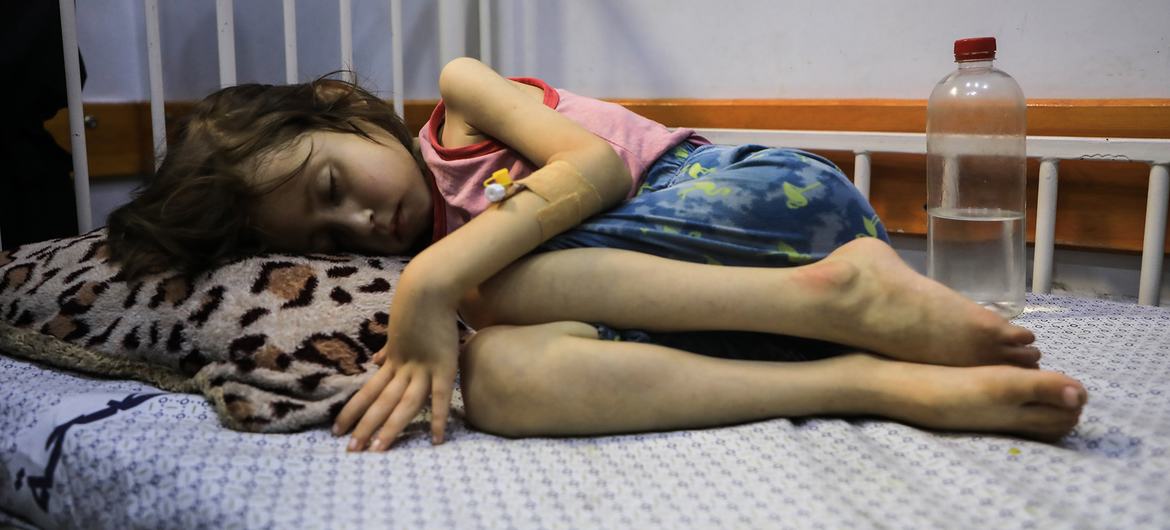
A child suffering from malnutrition lies on a bed in the Patient Society Hospital in Gaza City.

Hungry children dying

Meanwhile, the number of children in Gaza who have died from malnutrition since October 2023 has surpassed 100, according to the Gazan health authorities, the UN aid coordination office, OCHA, said in an update.

More than a third of the population is not eating for days at a time, according to the UN World Food Population (WFP).  Furthermore, acute malnutrition is spiking, with over 300,000 children at severe risk.

This comes amidst a recent warning by the UN Food and Agriculture Organization (FAO) that a mere 1.5 per cent of cropland in the enclave remains both accessible and undamaged, “signaling a near-total collapse of the local production of food.”

Aid taken from trucks

On the aid front, the UN and its partners collected food and hygiene kits from the Kerem Shalom/Karem Abu Salem border crossing on Wednesday.

“However, supplies were offloaded directly from these trucks before reaching their destination, given the extreme desperation pervasive in Gaza today,” OCHA said.

The agency stressed that people there “need a predictable lifeline – not a trickle of aid – so they do not feel they need to take desperate measures to survive.”

WFP said that just to cover basic humanitarian food assistance needs, more than 62,000 metric tonnes are required to enter Gaza every month, and so far, humanitarians have not been permitted to bring in enough supplies to support the population. 

Fuel shortages continue

Humanitarians also collected fuel from the Kerem Shalom crossing on Wednesday. Israel is allowing, on average, the entry of about 150,000 litres of fuel daily, which is still far below the minimum required. As a result, life-saving operations continue to be at risk.

The Palestine Civil Defence organization has warned that more than half of their ambulances have stopped operating across Gaza due to the shortage of both fuel and spare parts. 

“Israeli authorities must allow aid to enter through all crossings and via all available corridors so that humanitarians can deliver – at scale, in a safe and dignified manner – to reach the most vulnerable, including women, children and older people,” OCHA said. 

Source link

Journalists being forgotten on the frontline, warns injured war reporter

“I believe in nothing right now. Our press vests are turning us into targets and it’s becoming a death sentence for us,” Christina Assi told UN News recently.

On 13 October 2023, Ms. Assi – who was working as a photojournalist for Agence France Presse (AFP) – lost her right leg after two Israeli air strikes targeted the exposed hillside where she and other colleagues were observing the ongoing conflict between Israeli forces and Hezbollah militants.

This year’s commemoration of World Press Freedom Day on 3 May was marked with sorrow as nearly 300 journalists have been killed in recent conflicts. 

Ms. Assi stands among the few survivors, and she never imagined that she would be targeted simply for doing her job.

The day of the attack

She recounted the harrowing events of that day – one of her first major assignments, which quickly became the most traumatic experience of her life.

“It was starting to get dark and that’s when we were about to leave and then suddenly, out of nowhere, we were targeted,” she said.

“The first time I was on the ground, I couldn’t really understand what was happening, and I was screaming for help. So, my colleague Dylan rushed to help me and put a tourniquet on me. But then, like 40 to 47 seconds later, we were targeted again.”

After the second strike, Ms. Assi found herself alone beside a burning car. Bleeding and gravely injured, she had no choice but to crawl away to save her life.

“My press vest was too heavy, and the camera belt was suffocating,” she recalled. In that moment, she began to lose faith in international laws and conventions.

“As journalists, we are left alone,” she said. “Our press vests are turning us into targets—it’s becoming a death sentence for us.”

The silence of the international community

For Ms. Assi, the international community’s response to the attack – including condemnations and UN calls for investigation – has been utterly ineffective.

“I do believe that we need more than words. We need concrete action and something to happen where that should lead to justice in one way or another. If it’s not now, then later,” she said.

She strongly condemns the impunity with which attacks on journalists continue. “Our cases are being dismissed as collateral damage when, in fact, they are not. These are war crimes, and there should be a real investigation.”

The forgotten journalists of Gaza

Ms. Assi also emphasized that the same impunity applies to Palestinian journalists in Gaza, who have been documenting the war there since day one.

“They’ve been silenced, targeted in every possible way. It’s all over social media and in the news—and yet nothing has been done. No action has been taken to protect these journalists,” she said.

She pointed out that the lack of international presence hasn’t stopped the violence. “Even with the limited footage we’ve received, it’s clear how horrific everything is. But the world hasn’t reacted the way it should have. No one has even tried to stop it.”

Carrying the flame

Nearly a year after losing her leg, Ms. Assi carried the Olympic torch in the French city of Vincennes, ahead of the Paris Games in July 2024.

It was more than a symbolic gesture but a powerful opportunity to pay tribute to her colleague, Reuters journalist Issam Abdallah, who was killed in the same attack. 

“It was a great opportunity for us to honour all the fallen journalists and let the world and the international community and the Europeans and all those who didn’t know about what happened to us, let them know about what happened,” she said.  

Source link