Syria transition gains ground with Kurdish deal, but violence and humanitarian strain persist

Briefing ambassadors for the first time as Deputy Special Envoy, Claudio Cordone pointed to the 30 January ceasefire and integration agreement between the Syrian Government and the Syrian Democratic Forces (SDF) as a potentially transformative development.

The deal provides for a phased military and administrative integration of northeast Syria and includes provisions on the return of displaced people and the protection of Kurdish civil and educational rights, building on Presidential Decree 13 on linguistic, cultural and citizenship rights.

“Hostilities have ended and work on an implementation plan has been progressing in a positive manner,” Mr. Cordone said, noting deployments of Ministry of Interior forces in Al-Hasakeh and Qamishli, and discussions on local governance and political appointments.

The Secretary-General on 30 January welcomed the agreement, appealing for all sides “to work swiftly to ensure its implementation, especially in terms of the peaceful integration of northeast Syria, the rights of Syrian Kurds, the safe, dignified and voluntary return of the displaced.”

In a presidential statement issued on Thursday, Council members likewise welcomed the “comprehensive agreement” and stressed the need to adhere to it to “minimize civilian suffering” and prevent any “security vacuum” around ISIL (Da’esh) detention facilities.

What is the UN doing in Syria now?

The UN is supporting Syria’s political transition while continuing large-scale humanitarian operations across the country.

The Office of the Special Envoy is engaging with the Government and a broad range of stakeholders to help advance the political process, including implementation of the recent agreement on northeast Syria, support for inclusive governance, and the protection and promotion of human rights.

At the same time, humanitarian agencies are delivering life-saving assistance to millions of Syrians.

UN teams and partners are providing food, water, medical supplies, shelter and protection services, while supporting mine action, restoring basic services and helping create conditions for safe, dignified and voluntary returns.

Visit the UN News Focus on Syria section to read more about UN’s work in and engagement with Syria.

Situation remains sensitive

The evolving situation around those facilities remains sensitive.

Mr. Cordone said the UN is closely following transfers of Syrian and non-Syrian Da’esh suspects to Iraq, adding that Iraqi proceedings must “fully respect fair trial standards” and urging Member States to repatriate their nationals “as swiftly as possible.”

While the northeast has seen relative stabilization, tensions persist elsewhere.

In Sweida, renewed clashes between Government forces and local armed groups have caused damage and electricity outages. Protests calling for self-determination have resurfaced, and the UN reiterated calls for confidence-building measures within “the full respect of Syria’s sovereignty and territorial integrity.”

In southern Syria, Israeli incursions and search operations have continued, alongside reports of aerial herbicide spraying damaging crops. The UN envoy called for “full respect for international law” and urged Israel to withdraw from areas it occupies “in violation of the 1974 Disengagement of Forces Agreement,” while supporting “mutually acceptable security arrangements between Israel and Syria.”

Humanitarian challenges persist

Humanitarian conditions remain severe despite modest improvements.

Lisa Doughten, Director of Financing at the UN Office for the Coordination of Humanitarian Affairs (OCHA), said recent clashes displaced tens of thousands; although many have returned, about 130,000 people remain uprooted across Al-Hasakeh, Ar-Raqqa and Aleppo governorates. More than 90 per cent are women and girls, with many sheltering in overcrowded camps or with host families already under strain.

Heavy flooding this week in Idleb and northern Latakia killed two children and damaged or destroyed some 2,000 tents, affecting over 5,000 displaced people.

Still, access and basic services are gradually improving in parts of the northeast. UN teams have reached 200,000 people and organized more than 170 truck movements. In Ain al-Arab (Kobane), electricity supply has reportedly resumed after repairs.

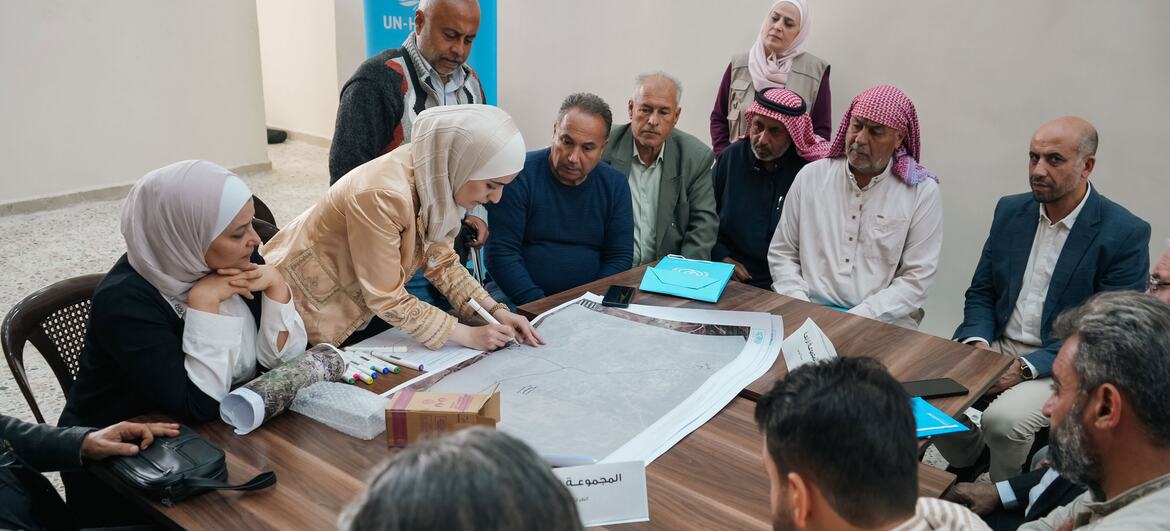
Participants at a UN workshop on recovery priorities, challenges and response planning.

Meaningful representation of all Syrians crucial

Politically, the next milestone in the transition is the formation of the People’s Assembly. Voting for most elected seats took place in October 2025 – with additional seats, including in Raqqa, due to be filled. Confirmation is awaited on the appointment of 70 members by President Ahmed al-Sharaa, as well as of the date of the opening session.

Mr. Cordone reiterated the importance of meaningful representation of Syria’s regions and diverse groups, stressing that “the protection and promotion of human rights – including addressing the issue of the missing and transitional justice – are fundamental elements for a credible and successful political transition.

‘Extraordinary role’ of Syrian women

He highlighted the “extraordinary role” of Syrian women and civil society over the decade-long conflict, saying women’s political participation at all levels is “a pillar for a state committed to plurality, inclusion and opportunity for all.”

“I salute the Syrian people for their determination in overcoming decades of oppression and brutal conflict. I look forward to strengthening the UN’s partnership with Syria in pursuit of a stable, peaceful and prosperous future,” he said in Arabic as he concluded his briefing.

Source link

Syria: Ceasefire under strain as violence and aid access issues persist in Sweida

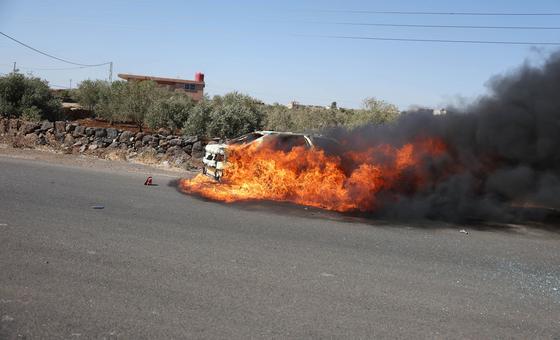
The 19 July truce followed weeks of sectarian clashes, Israeli airstrikes and grave human rights violations in the southern governorate, also known as As-Sweida.

As a result, more than 190,000 people have been displaced there and in neighbouring Dar’a and Rural Damascus governorates.

The fighting also caused severe damage to infrastructure and to livelihoods.  Electricity networks, water production assets including wells, and key public facilities were impacted.

Volatility, surveillance and demonstrations

Between 1 and 5 August, the security situation in Sweida and surrounding areas remained volatile, with clashes reported in three places, according to the OCHA flash update.

“Additionally, aerial surveillance activity attributed to the Israeli Defence Forces (IDF) has been observed over multiple locations in Dar’a and As-Sweida, contributing to regional tension,” the agency said.

During the same period, public demonstrations occurred across multiple locations in Sweida, reiterating calls for improved humanitarian access and protection.

Parallel demonstrations also took place in Dar’a and Damascus governorates which emphasised the importance of national unity. 

Aid efforts continue

Humanitarian access remains constrained, OCHA said, as the UN and partners continue to support response efforts.  

The main highway between Sweida and the capital, Damascus, has been inaccessible since 12 July due to security concerns. 

Furthermore, the southern corridor via Busra Esh-Sham in eastern Dar’a was temporarily closed for 24 hours but reopened on Monday, affecting aid delivery.

“Humanitarian actors scaled up response efforts, including fuel and food deliveries to As-Sweida and Dar’a, commercial convoy facilitation, and shelter support for displaced populations,” OCHA said.

Inter-agency mission

Since the escalation of hostilities, humanitarians have provided bread assistance to nearly 1.5 million people.

OCHA also led an inter-agency mission to Dar’a to assess shelter conditions and to discuss medium-term housing options for displaced people.

Meanwhile, restoration of essential services is ongoing in Sweida, with partial electricity restored through emergency repairs.  

However widespread telecommunication and internet outages persist across the governorate, and maintenance of water and power networks continues in rural areas. 

Source link

Myanmar crisis deepens as military attacks persist and needs grow

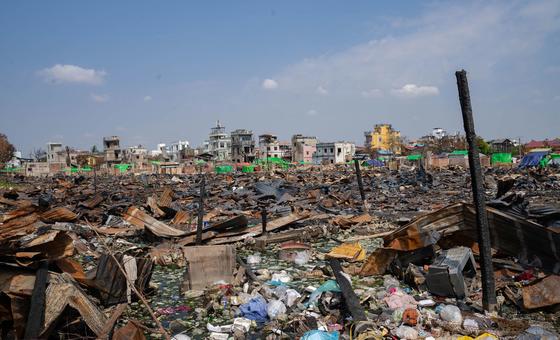
The 28 March quakes killed over 3,800 people and damaged or destroyed more than 55,000 homes across multiple regions, including Bago, Kayin, Magway, Mandalay, Southern Shan, Naypyitaw and Sagaing.

Families already displaced by years of conflict now face early torrential rains, extreme heat and rising risk of disease. Nearly 20 million people – more than a third of the population – needed assistance even before the earthquakes.

Unremitting violence

Despite the scale of the disaster, High Commissioner for Human Rights Volker Türk warned on Friday that the Myanmar military has launched at least 243 attacks – including 171 airstrikes – since the massive tremors.

Most of the attacks occurred after 2 April, despite both the military and the opposition National Unity Government (NUG) announcing unilateral ceasefires which were largely unobserved.

It is imperative that the military immediately stop all attacks on civilians and civilian objects,” he said in his statement, calling for a genuine and permanent nationwide halt to hostilities and a return to civilian rule.

He underscored the need to put the people of Myanmar first, prioritise their rights, and achieve a peaceful resolution.

Instead of further futile investment in military force, the focus must be on the restoration of democracy and the rule of law in Myanmar,” Mr. Türk said.

Delays putting lives at risk

UN humanitarians in the country also warn that the situation remains dire.

Speaking to journalists in New York via video link from Yangon, Humanitarian Coordinator ad interim Marcoluigi Corsi said that one month on, people are still living in the open and facing increasingly difficult conditions.

The suffering is immense and the stakes are very high,” he said on Thursday, urging the international community to translate funding pledges into rapid, large-scale support.

“Every delay means more lives at risk and more communities in Myanmar struggling to rebuild.”

Lack of funding imperils response

Agencies have reached 600,000 people with water, sanitation and hygiene services. They have also provided nearly 500,000 people with food assistance and over 100,000 with emergency shelter.

But the response remains constrained by severe underfunding.

Mr. Corsi called on donors to urgently disburse their pledged amounts. Without timely action, the crisis would get worse, he warned.

Lives depend on our collective commitment to delivering the support that is desperately needed…the time to act is now,” he said.

The $275 million addendum to the 2025 humanitarian response plan has received just $34 million – or about 12 per cent – leaving affected communities without assistance.

Disease outbreak risk

According to the UN World Health Organization (WHO) over 450,000 people require critical health services, but only about 33,600 have been reached so far.  

Disease outbreaks are also a growing concern as nine of the 20 townships most at risk for cholera fall within earthquake-affected areas. Stagnant water from delayed rubble removal is creating mosquito breeding grounds, driving up the risk of malaria and dengue.  

Limited access to medicines and medical supplies are further straining already overstretched health facilities.

Source link