A new agreement between the Syrian government and Kurdish-led forces in the country’s northeast is being viewed by the United Nations as a potentially significant step toward stabilising a region long shaped by conflict and competing authorities.
Briefing members of the UN Security Council for the first time in his role as Deputy Special Envoy for Syria, Claudio Cordone highlighted the ceasefire and integration agreement signed on January 30 between Damascus and the Syrian Democratic Forces (SDF). The arrangement, he said, could mark an important turning point if implemented effectively.
Agreement Aims To Integrate Northeast Syria
The deal outlines a gradual process to integrate the military and administrative structures of northeast Syria with the Syrian state. It also contains provisions aimed at facilitating the return of displaced residents and safeguarding Kurdish cultural and educational rights.
Officials say the framework builds upon earlier government measures, including Presidential Decree 13, which recognised certain linguistic, cultural and citizenship rights for Kurdish communities.
Cordone told the Council that hostilities in the region had largely subsided and that work on implementing the agreement had begun.
Security deployments by Syria’s Ministry of Interior have already taken place in key cities such as Al-Hasakeh and Qamishli, while talks are underway regarding local governance arrangements and political appointments.
The United Nations Secretary-General welcomed the agreement soon after it was announced, urging all sides to move quickly to ensure its full implementation. He emphasised that the deal should guarantee the peaceful integration of the northeast, protect Kurdish rights and enable displaced Syrians to return home voluntarily and safely.
Security Council members echoed that message in a presidential statement this week, describing the deal as a comprehensive step that could help prevent further civilian suffering and reduce risks surrounding detention facilities holding suspected fighters from the Islamic State group, also known as ISIL or Da’esh.
UN Continues Political And Humanitarian Engagement
Alongside political mediation, the United Nations remains heavily involved in humanitarian operations across Syria.
The office of the UN Special Envoy continues to engage with the Syrian government and other political actors in an effort to advance the broader political transition. These discussions include implementing the northeast agreement, encouraging inclusive governance and promoting respect for human rights.
At the same time, UN agencies and partner organisations are delivering food, water, healthcare and shelter to millions of Syrians affected by years of war. Aid teams are also supporting mine clearance operations, restoring damaged infrastructure and helping communities rebuild basic services.
These efforts aim to create conditions that would allow displaced families to return home in safety and dignity.
Security Concerns Persist In Several Regions
Despite the relative calm in parts of the northeast, the situation across Syria remains fragile.
Cordone said the United Nations is closely monitoring the transfer of suspected Islamic State fighters from Syria to Iraq. He stressed that legal proceedings must meet international fair-trial standards and urged countries to repatriate their citizens detained in Syria as quickly as possible.
Elsewhere in the country, tensions continue to flare. In the southern province of Sweida, clashes between government forces and local armed groups have caused damage to infrastructure and triggered electricity outages. Protests calling for greater local autonomy have also resurfaced.
In southern border areas, Israeli military operations and search activities have continued. Reports have also emerged of aerial herbicide spraying damaging farmland. UN officials have called for adherence to international law and urged Israel to withdraw from territories it occupies in violation of the 1974 Disengagement of Forces Agreement.
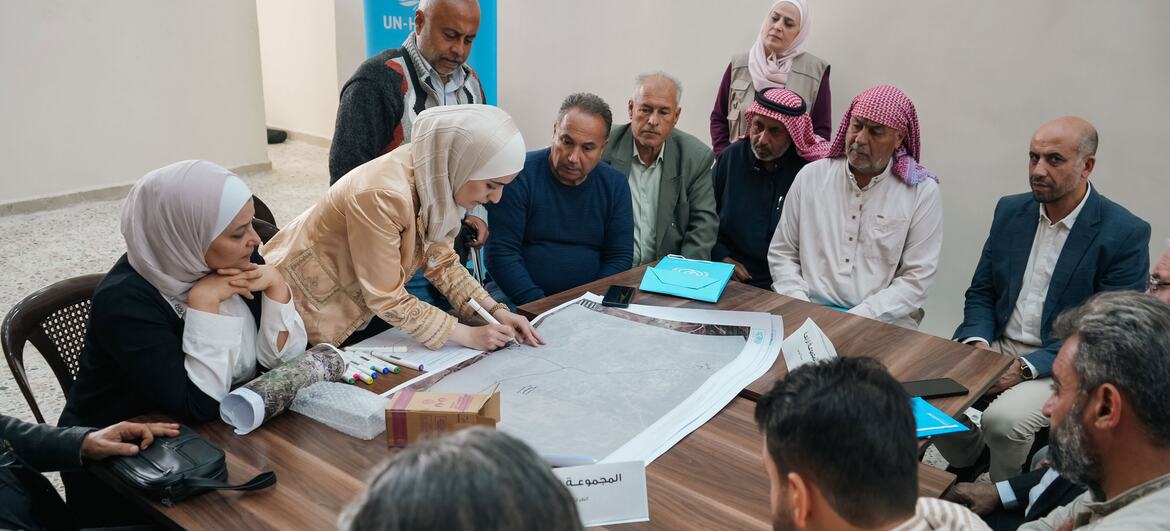
Participants at a UN workshop on recovery priorities, challenges and response planning /UN
Displacement And Humanitarian Needs Remain High
Humanitarian conditions remain difficult for many Syrians despite some limited improvements.
According to the UN humanitarian coordination office, recent clashes in the northeast displaced tens of thousands of people. Although many have since returned, around 130,000 individuals remain displaced across the governorates of Al-Hasakeh, Ar-Raqqa and Aleppo.
More than 90 percent of those affected are women and girls, many of whom are living in overcrowded camps or staying with host families already facing economic hardship.
Heavy flooding this week in Idlib and northern Latakia further compounded the crisis, killing two children and destroying or damaging around 2,000 tents sheltering displaced families.
Still, aid groups say access to some areas is gradually improving. UN teams have reached around 200,000 people in recent weeks, delivering assistance through more than 170 aid convoys.
Electricity supply has also reportedly resumed in the town of Ain al-Arab, also known as Kobane, following repairs to damaged infrastructure.
Political Transition Moves Forward
Attention is now turning to the next stage in Syria’s political transition: the formation of a new People’s Assembly.
Elections for most seats were held in October 2025, though additional seats, including those representing Raqqa, remain to be filled. Confirmation is still awaited regarding the appointment of 70 members by President Ahmed al-Sharaa and the date of the assembly’s opening session.
Cordone stressed that the success of the transition would depend on meaningful representation from Syria’s diverse communities and regions.
He also underscored the need to address long-standing issues such as the fate of missing persons and mechanisms for transitional justice.
Highlighting the contributions of Syrian women throughout years of conflict, the UN envoy said their participation in politics and civil society would be essential for building a more inclusive and stable future.
He concluded his remarks by praising the resilience of the Syrian people and expressing hope that continued cooperation between Syria and the United Nations would help lay the foundations for lasting peace and recovery.
They urged swift implementation of recent agreements to prevent renewed fighting, protect civilians and preserve fragile gains made during the country’s transition.
A country still on edge
One year into Syria’s post-Assad transition, nearly three million refugees and internally displaced people have returned home, a sign of cautious progress.
But UN officials cautioned that the country remains extremely fragile after more than a decade of war.
The ISIL/Da’esh terrorist group continues to pose a persistent threat, sectarian and ethnic tensions remain unresolved, and the presence of foreign fighters and unsecured detention facilities raises serious security concerns.
At the same time, humanitarian needs remain acute, with only about a quarter of the funding required for winter assistance secured, leaving millions without adequate support amid extreme cold.
Regional dynamics are adding further strain. UN officials warned that continued incursions by Israel in southern Syria undermine the country’s sovereignty and territorial integrity, and risk further destabilizing an already volatile environment.
Against this fragile backdrop, the situation in northern and northeastern Syria has deteriorated sharply in recent weeks.
Talks stall, fighting resumes
Repeated attempts at dialogue and mediation between the Syrian government and the Syrian Democratic Forces (SDF) have failed to prevent renewed violence, Khaled Khiari, UN Assistant Secretary-General for Political Affairs, told ambassadors.
A further round of talks earlier this month did not advance implementation of a March 2025 agreement aimed at integrating the SDF into state institutions, UN officials said. Shortly afterward, clashes erupted in SDF-controlled neighbourhoods of Aleppo, forcing tens of thousands of civilians to flee.
“Following several days of intense fighting…tens of thousands fled, most of whom have started to return, dozens were killed, hundreds were wounded, and persons are still missing,” he said.
Although a ceasefire and “full integration agreement” was announced on 18 January with mediation by the United States and other partners, implementation quickly faltered.
Fighting resumed after talks broke down the following day, and clashes were still being reported in parts of Al-Hasakeh governorate and around Ayn al-Arab, also known as Kobane.
ASG Khiari briefs the Security Council.
“We strongly appeal for both sides to immediately adhere to a ceasefire…and engage in fleshing out and implementing the details of this latest understanding swiftly and in a spirit of compromise,” Mr. Khiari said, warning of an “alarming humanitarian and protection crisis” if the violence continues.
He said recent government decrees recognizing the linguistic, cultural and citizenship rights of Syrian Kurds were “encouraging initiatives” but stressed that they must be followed by inclusive political processes to build trust and national cohesion.
Fragile gains, deep needs
The political tensions are unfolding against a backdrop of immense humanitarian strain.
Edem Wosornu, Director of Crisis Response at the UN Office for the Coordination of Humanitarian Affairs (OCHA), said recent fighting had once again exposed how vulnerable Syria remains after 14 years of war.
Clashes this month forced tens of thousands from their homes in Aleppo and triggered new displacement across Ar-Raqqa, Deir ez-Zor and Al-Hasakeh governorates.
As of 18 January, more than 13,000 people had fled Ar-Raqqa alone, many seeking refuge in overcrowded collective centres.
“The fighting has cut people off from clean water, some hospitals have been forced to close, and many children cannot attend school,” Ms. Wosornu said, adding that damaged roads, unexploded ordnance and winter storms were hampering aid deliveries.
OCHA Director Wosornu briefs the Security Council.
Displaced families are facing “bitter winter conditions,” she said, with urgent needs for shelter, food and heating. Heavy snow and extreme cold have affected nearly 160,000 people living in camps, damaging shelters and contributing to the deaths of two infants.
Despite access challenges, UN agencies and partners continue to deliver aid, including food, shelter, medical supplies and protection services. Emergency funding has been released to support displaced families, and reception centres have been established in Al-Hasakeh and Qamishli.
“Syria can make further progress,” Ms. Wosornu said, but this hinges on sustained humanitarian funding, increased investment in recovery and development, and active diplomacy to prevent further violence and protect civilians.
UN teams blocked from accessing Al Hol amid unrest
UN teams attempting to assess conditions at Al Hol camp in Syria’s northeast were unable to enter the site this week following its takeover by Syrian authorities, amid reports of looting and fires that left the situation tense and volatile.
Staff from UNHCR and UNICEF reached the camp on Tuesday and again on Wednesday but were prevented from accessing it due to security concerns. The teams nevertheless held constructive discussions with Syrian government representatives on site.
The Syrian authorities have indicated their willingness to provide security and other support to UNHCR and humanitarian partners to allow life-saving operations to continue.
The UN also stressed the need for any transfer of detention facilities holding suspected ISIL members from SDF control to the Syrian government to be carried out in an orderly manner and in line with international standards.
Al Hol camp, located in Hasakeh governorate, has for years housed tens of thousands of people — many of them women and children — including family members of suspected ISIL fighters, and has long been plagued by insecurity, humanitarian needs and limited access for aid agencies.
Climate disinformation: Commitment to promote information integrity and counter false narratives.
The final decision emphasises solidarity and investment, setting ambitious financial targets while leaving energy transition for later discussion. The burning of fossil fuels emits greenhouse gases that are by far the largest contributors to global warming, making this omission a point of concern for many nations, including negotiators from South America and the EU, as well as civil society groups.
Expectations were high that COP30’s final decision would include explicit reference to phasing out fossil fuels. More than 80 countries backed Brazil’s proposal for a formal ‘roadmap.’
A draft text had included it – until the final hours of talks. The adopted outcome refers only to the ‘UAE Consensus’, the COP28 decision calling for “transitioning away from fossil fuels.”
Before the final plenary, Brazilian scientist Carlos Nobre issued a stark warning: fossil fuel use must fall to zero by 2040 – 2045 at the latest to avoid catastrophic temperature rises of up to 2.5°C by mid-century. That trajectory, he said, would spell the near-total loss of coral reefs, the collapse of the Amazon rainforest and an accelerated melt of the Greenland ice sheet.
A closer look
After two weeks of intense negotiations, the adopted text calls for mobilizing at least $1.3 trillion per year by 2035 for climate action, alongside tripling adaptation finance and operationalizing the loss and damage fund agreed at COP28.
It also launches two major initiatives – the Global Implementation Accelerator and the Belém Mission to 1.5°C – to help countries deliver on their nationally determined contributions (NDCs), or national climate action plans, and adaptation plans.
For the first time, the decision acknowledges the need to tackle climate disinformation, pledging to promote information integrity and counter narratives that undermine science-based action.
Last week, Brazil’s President, Luiz Inácio Lula da Silva, opened the summit declaring it would be known as “the COP of truth,” and this landmark decision marks a significant step toward safeguarding public trust in climate policy – even as the absence of fossil fuel transition language underscores the complexity of energy negotiations.
Two new roadmaps
In the closing meeting, COP30 President André Corrêa do Lago acknowledged what was left out of the deal:
“We know some of you had greater ambitions for some of the issues at hand,” he said, adding, “I know the youth civil society will demand us to do more to fight climate change. I want to reaffirm that I will try not to disappoint you during my presidency.”
Reflecting on President Lula’s call at the opening of COP30 for ambition, Mr. do Lago announced plans to create two roadmaps: one to halt and reverse deforestation; and another to transition away from fossil fuels in a just, orderly and equitable manner, mobilizing resources for these purposes in a “just and planned manner.”
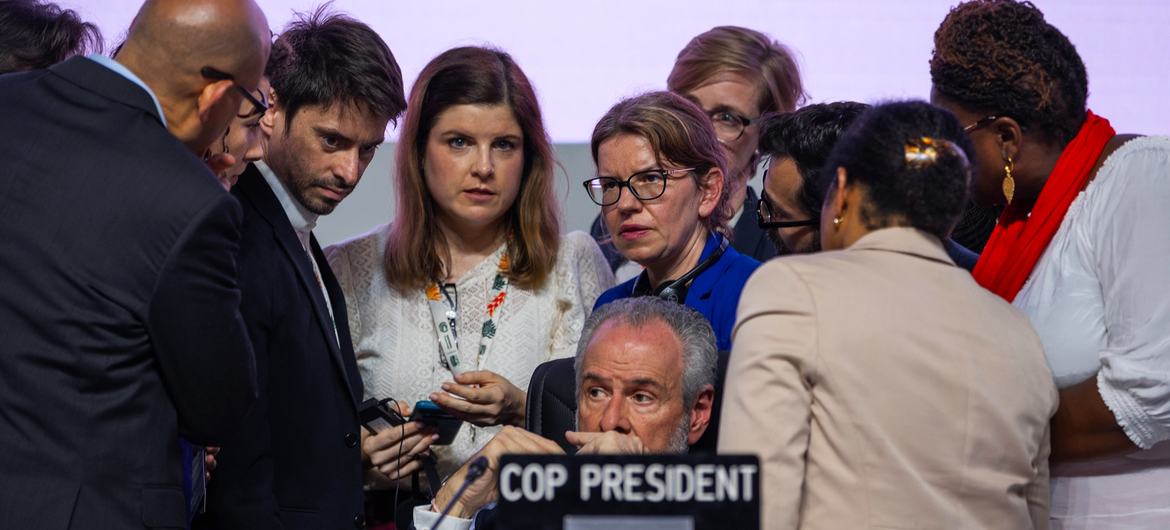
COP30 President André Corrêa do Lago (centre) confers with his team at the closing of the UN Climate Conference.
The road to consensus
The road to consensus at the latest Conference of the Parties to the UN Framework Convention on Climate Change (UNFCCC), as the annual COPs are formally known, was anything but smooth.
Late last week, Indigenous groups staged blockades demanding stronger protections for the Amazon, and late Thursday afternoon, a fire at the conference venue disrupted talks during a critical phase.
Negotiators worked through the night on Friday – to bridge gaps on finance and ambition, with Brazil’s presidency steering discussions toward a politically workable outcome focused on support and implementation of agreements from past COPs.
The UN chief said that COP30 delivered progress, such as the launch of the Global Implementation Accelerator to close ambition gaps and reaffirmed the UAE Consensus, including a just, orderly and equitable transition away from fossil fuels.
“But COPs are consensus-based – and in a period of geopolitical divides, consensus is ever harder to reach. I cannot pretend that COP30 has delivered everything that is needed.” Overshoot of 1.5°C is a stark warning: deep, rapid emission cuts and massive climate finance are essential. “COP30 is over, but the work is not,” he said.
Mr. Guterres vowed to keep pushing for higher ambition and solidarity, urging all who marched, negotiated and mobilized: “Do not give up. History – and the United Nations – are on your side.
Holding the line at 1.5 in ‘turbulent geopolitical waters’
UN climate chief Simon Stiell pointed to a series of major gains as COP30 closed in Belém: new strategies to accelerate Paris Agreement implementation, a push to triple adaptation finance, and commitments toward a just energy transition.
And despite what he called “turbulent geopolitical waters” – marked by polarization and climate denial – 194 nations stood together, “keeping humanity in the fight for a livable planet, determined to hold the line at 1.5°C.”
At the heart of this momentum is COP30’s flagship outcome: the Mutirão text, a sweeping deal that bundles four contentious negotiation tracks – from mitigation to finance and trade barriers – into a single, consensus-based agreement. Seventeen additional decisions were adopted alongside it.
The final document declares that the global shift toward low-emissions and climate-resilient development is “irreversible and the trend of the future.” It reaffirms that the Paris Agreement is working – and must “go further and faster” – strengthening the role of multilateral climate cooperation.
The text also recognizes the economic and social benefits of climate action, from growth and job creation to improved energy access, security and public health. Mr. Stiell pointed to a decisive trend: investments in renewable energy now outpace fossil fuels two to one – “a political and market signal that cannot be ignored,” he said.
A robust action agenda beyond negotiations
The Brazilian Presidency underscored that COP30’s success extends beyond negotiated agreements, highlighting a wave of voluntary commitments under the Action Agenda.
Among them:
Tropical Forests Forever Fund: Raised $5.5 billion and now includes 53 participating countries; at least 20 per cent of resources go directly to Indigenous Peoples and local communities.
Belém Health Action Plan: The first global initiative targeting climate-related health threats, launched with $300 million from 35 philanthropic organizations.
UNEZA Alliance: Public utility companies pledged $66 billion annually for renewable energy and $82 billion for transmission and storage.
Cities, regions and companies: A coalition spanning 25,000 buildings reported cutting over 850,000 tons of CO₂ in 2024.
Climate justice at the forefront
Countries also agreed to develop a just transition mechanism, enhancing cooperation, technical support and capacity-building.
Geir Pedersen told ambassadors that in Sweida governate, where sectarian violence in July also spurred conflict in the capital Damascus, the 19 July ceasefire has come under strain, but the conflict has not resumed so far.
However, “we are still seeing dangerous hostilities and skirmishes on the margins of Sweida, and violence could resume at any moment,” he said.
In northeast Syria, efforts to implement the 10 March agreement between the interim security forces and the mostly-Kurdish Syrian Democratic Forces (SDF) continue. Just this month, there have been spikes in violence between the two militaries in the Aleppo governorate.
While attempts to convene the two sides outside of the country have been unsuccessful, Mr. Pedersen welcomed reports of contacts between officials.
Despite these security incidents, Mr. Pedersen stressed that the situation has been relatively calm this month, applauding the efforts of those who have worked to tamp down hostilities.
However, in terms of the political situation, “the country remains deeply fragile and the transition remains on a knife-edge.”
Political transition?
After 13 years of civil war, Mr. Pedersen underscored the need for an inclusive, Syrian-led political transition that enables the Syrian people determine their own future peacefully, independently and democratically.
“Syrians need to feel that this transition is not a series of ad hoc arrangements and isolated institutions, but a clear and comprehensive path, based on inclusion and transparency, to implement the principles of resolution 2254,” he said.
To encourage the voluntary, safe return of refugees and internally displaced persons, Mr. Pedersen stressed the need for coordinated support to repair Syria’s depleted infrastructure.
“The best way to secure such support is through a genuine political transition that lays the path for long-term stability and sustainable governance. Indeed, without credible reforms, stronger institutions, and a firm commitment to the rule of law, international support risks being squandered or misdirected,” he stressed.
Humanitarian situation still dire
Amid the precarious military and political situation, 16 million Syrians across the country need humanitarian aid, according to Emergency Relief Coordinator Tom Fletcher.
Additionally, over 185,000 people have been displaced across Sweida, Dar’a, Rural Damascus and beyond.
“The overall situation is dire. We need to sustain urgent delivery of food, health, shelter, clean water, fuel, restoration of water and electricity infrastructure, education. In some areas, those arriving now outnumber the existing population. Services are overwhelmed,” said Mr. Fletcher.
Teams from the UN humanitarian aid coordination office (OCHA) have visited Sweida and other towns, delivering aid and assessing needs.
OCHA has also provided emergency food packages, flour and essential household items to tens of thousands of people.
However, insecurity and road closures have disrupted the supply of aid from the UN, NGO partners and the Syrian Arab Red Crescent.
“We need better humanitarian and commercial access. And most of all, we need safety,” Mr. Fletcher stressed, particularly referring to attacks on aid convoys, health facilities, medics and ambulances.
Drastic cuts
Nevertheless, “despite funding and security challenges, the UN and partners are delivering as much lifesaving support as we can with the resources we have,” reaching 3.5 million people on average each month, a noticeable increase from last year.
But with the 2025 humanitarian appeal in the country only 14 per cent funded, ongoing aid cuts in many Western capitals are projected to lead to reduced staffing of at least 40 per cent across the humanitarian community inside Syria.
The UN relief chief emphasised that without more funding, “we won’t be able to sustain these vital efforts, let alone expand them to more people who need them.”
Furthermore, while he urged humanitarian support, he also stressed that long-term development investment is needed in Syria “to reduce and ultimately end reliance on humanitarian aid.”
With support from the United Nations, the electricity grid on the central islands of Java, Madura, and Bali – home to over 160 million people – is now being upgraded and modernized to accommodate fluctuating energy loads from solar and wind power.
“As a result of our cooperation with the UN, we now have a blueprint for a smart grid and are working to enable it to seamlessly integrate electricity from renewables in line with national priorities,” said Evy Haryadi, Director of Transmission and System Planning at state-owned electricity company PT Perusahaan Listrik Negara (PLN). “This will represent a huge step forward in decarbonizing Indonesia’s energy system.”
As emphasized during a recent visit to Jakarta by the UN Secretary-General’s Special Advisor on Climate Action and Just Transition, Selwin Hart, the smart grid initiative—supported by the United Nations Office for Project Services (UNOPS)—is an integral part of the broader UN assistance in Indonesia to ensure a just energy transition.
Solar power is widely used on the islands of Java, Madura, and Bali.
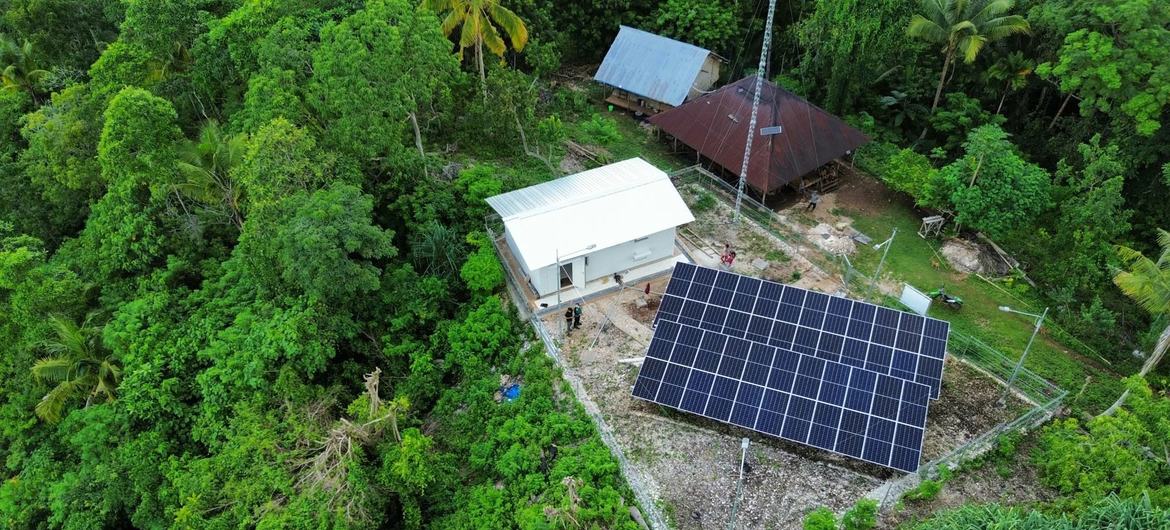
This includes work by the United Nations Development Programme (UNDP) to bring renewable energy to remote islands not connected to the national grid, and by the International Labour Organization (ILO) to support the government in developing green skills.
“The UN in Indonesia works in close partnership with the government to support its energy transition targets in line with the Sustainable Development Goals (SDGs),” said Gita Sabharwal, United Nations Resident Coordinator for Indonesia. “We provide fast response solutions and technical expertise to help accelerate progress toward government objectives in green energy.”
The country’s 2025–2034 Electricity Supply Business Plan, launched in May, outlines a strategic shift toward a cleaner and investment-driven energy future. It targets 42.6 GW of new renewable power capacity and 10.3 GW of storage, while limiting new fossil fuel capacity to 16.6 GW. The plan is designed to align Indonesia’s climate commitments with the SDGs and enhance national energy resilience.
The smart grid and, at its core, the control centre that manages electricity supply and demand, are crucial to this effort. The country expects a surge in renewable generation construction once the modernization of the JAMALI Control Center is completed.
Historically, power grids were designed to receive electricity from sources with relatively constant output—such as coal, natural gas, or hydropower. However, some renewable sources function differently: solar plants generate electricity only when the sun is shining, and wind power only when the wind is blowing. In a so-called “smart grid,” the control centre must be able to adjust electricity intake from renewables and balance it with stable sources like coal, based on real-time weather conditions and consumption patterns. It will also utilize large-scale batteries to store excess electricity—for example, solar energy generated during particularly sunny periods.
Established in the early 1980s, the JAMALI grid control center covers 79% of Indonesia’s generation capacity. The smart grid system design, delivered by UNOPS, enables the control centre to incorporate renewable energy forecasting capabilities and grid analysis tools to support stability and security, among other advanced features.
The detailed engineering design for the JAMALI Main Control Center includes plans to consolidate five regional control centres into two to improve efficiency while maintaining redundancy. UNOPS also completed the tendering process and vendor selection for the design’s implementation and is building the capacity of PLN staff involved in control centre operations to manage the new technology effectively.
From design to implementation
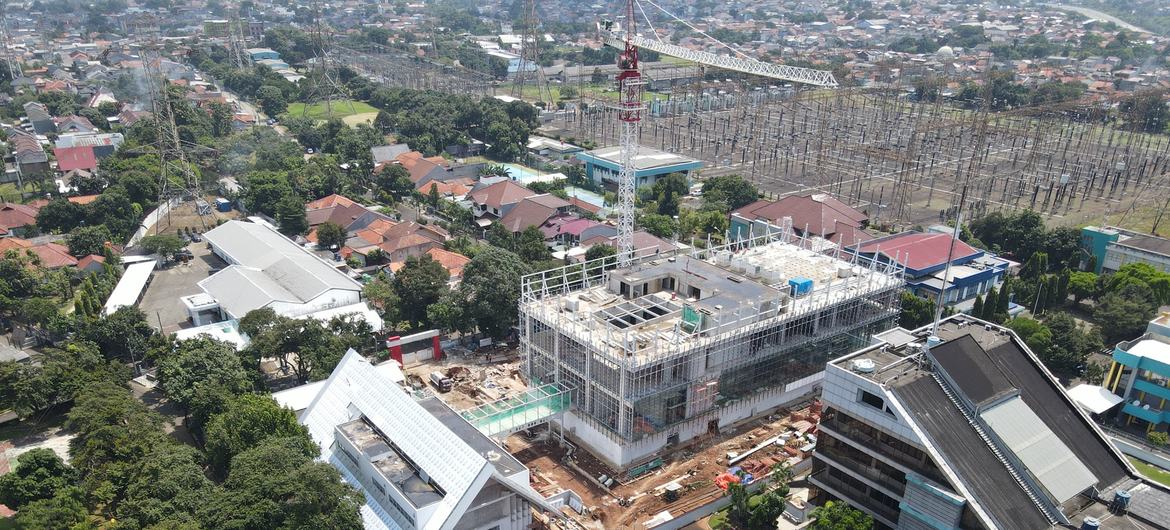
Construction workers and engineers are now hard at work at PLN’s campus in Depok, just outside Jakarta, implementing the design provided by UNOPS. Completion of the control centre is expected by the end of 2025. During this phase, UNOPS is responsible for monitoring the selected vendors who are constructing, installing, configuring, and ultimately commissioning the new centre.
Indonesia is modernizing its electricity grid.
“UNOPS has the project management expertise and know-how to continue supporting us and ensure the seamless and timely delivery of the project, in line with the original specifications,” said PLN’s Mr. Haryadi. “At the same time, we are building our internal capacity to eventually take over the task.”
The work is progressing on schedule. The new buildings are largely completed, and installation of the industrial monitoring system—central to the control centre’s operation—is about 40 per cent complete. Based on the success of the initiative, discussions are underway to replicate the design for the four control centres that manage electricity supply on other islands across the country.
UNOPS supports this modernization under the Southeast Asia Energy Transition Partnership (ETP), which provides technical expertise to partner countries in the region to help their national energy commitments in line with Paris Agreement and the SDGs. ETP is a multi-donor partnership, supported by the governments of Australia, Canada, France, Germany, the United Kingdom and philanthropic donors. ETP operates in Indonesia, the Philippines and Viet Nam, as well as at the ASEAN regional level, and works collaboratively to mobilize and coordinate resources to facilitate a just energy transition in the region.
“The control centre upgrade promises to be a game-changer for Indonesia’s energy mix,” Ms Sabharwal said. “Our support is an impactful example of the UN’s assistance in middle-income countries: working behind the scenes and providing core technical expertise, we support the government’s priority of energy security by fast-tracking the green transformation.”