

With support from the United Nations, the electricity grid on the central islands of Java, Madura, and Bali – home to over 160 million people – is now being upgraded and modernized to accommodate fluctuating energy loads from solar and wind power.
“As a result of our cooperation with the UN, we now have a blueprint for a smart grid and are working to enable it to seamlessly integrate electricity from renewables in line with national priorities,” said Evy Haryadi, Director of Transmission and System Planning at state-owned electricity company PT Perusahaan Listrik Negara (PLN). “This will represent a huge step forward in decarbonizing Indonesia’s energy system.”
As emphasized during a recent visit to Jakarta by the UN Secretary-General’s Special Advisor on Climate Action and Just Transition, Selwin Hart, the smart grid initiative—supported by the United Nations Office for Project Services (UNOPS)—is an integral part of the broader UN assistance in Indonesia to ensure a just energy transition.

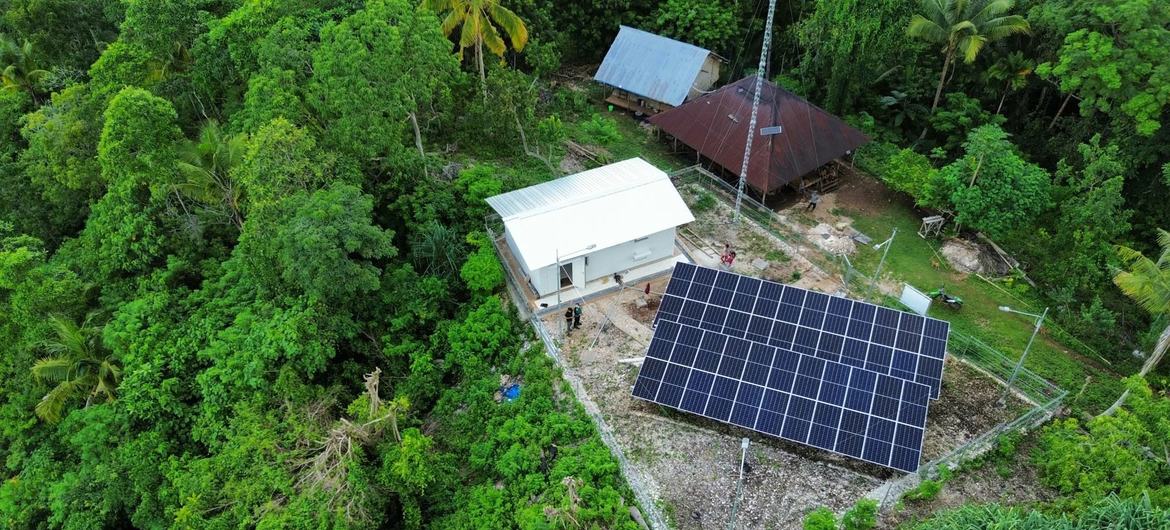
Solar power is widely used on the islands of Java, Madura, and Bali.
This includes work by the United Nations Development Programme (UNDP) to bring renewable energy to remote islands not connected to the national grid, and by the International Labour Organization (ILO) to support the government in developing green skills.
“The UN in Indonesia works in close partnership with the government to support its energy transition targets in line with the Sustainable Development Goals (SDGs),” said Gita Sabharwal, United Nations Resident Coordinator for Indonesia. “We provide fast response solutions and technical expertise to help accelerate progress toward government objectives in green energy.”
The country’s 2025–2034 Electricity Supply Business Plan, launched in May, outlines a strategic shift toward a cleaner and investment-driven energy future. It targets 42.6 GW of new renewable power capacity and 10.3 GW of storage, while limiting new fossil fuel capacity to 16.6 GW. The plan is designed to align Indonesia’s climate commitments with the SDGs and enhance national energy resilience.
The smart grid and, at its core, the control centre that manages electricity supply and demand, are crucial to this effort. The country expects a surge in renewable generation construction once the modernization of the JAMALI Control Center is completed.
Historically, power grids were designed to receive electricity from sources with relatively constant output—such as coal, natural gas, or hydropower. However, some renewable sources function differently: solar plants generate electricity only when the sun is shining, and wind power only when the wind is blowing. In a so-called “smart grid,” the control centre must be able to adjust electricity intake from renewables and balance it with stable sources like coal, based on real-time weather conditions and consumption patterns. It will also utilize large-scale batteries to store excess electricity—for example, solar energy generated during particularly sunny periods.
Established in the early 1980s, the JAMALI grid control center covers 79% of Indonesia’s generation capacity. The smart grid system design, delivered by UNOPS, enables the control centre to incorporate renewable energy forecasting capabilities and grid analysis tools to support stability and security, among other advanced features.
The detailed engineering design for the JAMALI Main Control Center includes plans to consolidate five regional control centres into two to improve efficiency while maintaining redundancy. UNOPS also completed the tendering process and vendor selection for the design’s implementation and is building the capacity of PLN staff involved in control centre operations to manage the new technology effectively.
From design to implementation
Construction workers and engineers are now hard at work at PLN’s campus in Depok, just outside Jakarta, implementing the design provided by UNOPS. Completion of the control centre is expected by the end of 2025. During this phase, UNOPS is responsible for monitoring the selected vendors who are constructing, installing, configuring, and ultimately commissioning the new centre.
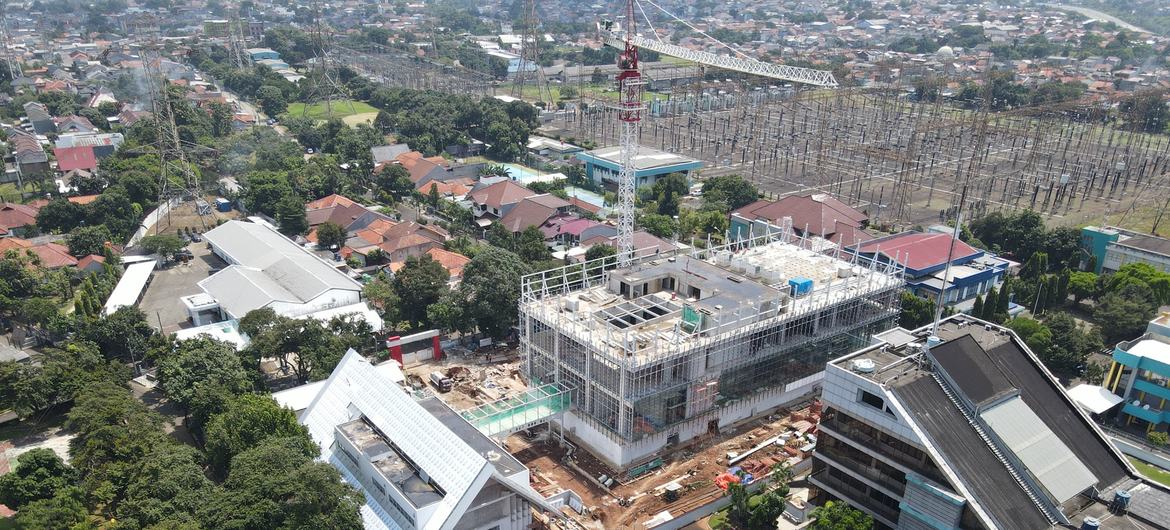
Indonesia is modernizing its electricity grid.
“UNOPS has the project management expertise and know-how to continue supporting us and ensure the seamless and timely delivery of the project, in line with the original specifications,” said PLN’s Mr. Haryadi. “At the same time, we are building our internal capacity to eventually take over the task.”
The work is progressing on schedule. The new buildings are largely completed, and installation of the industrial monitoring system—central to the control centre’s operation—is about 40 per cent complete. Based on the success of the initiative, discussions are underway to replicate the design for the four control centres that manage electricity supply on other islands across the country.
UNOPS supports this modernization under the Southeast Asia Energy Transition Partnership (ETP), which provides technical expertise to partner countries in the region to help their national energy commitments in line with Paris Agreement and the SDGs. ETP is a multi-donor partnership, supported by the governments of Australia, Canada, France, Germany, the United Kingdom and philanthropic donors. ETP operates in Indonesia, the Philippines and Viet Nam, as well as at the ASEAN regional level, and works collaboratively to mobilize and coordinate resources to facilitate a just energy transition in the region.
“The control centre upgrade promises to be a game-changer for Indonesia’s energy mix,” Ms Sabharwal said. “Our support is an impactful example of the UN’s assistance in middle-income countries: working behind the scenes and providing core technical expertise, we support the government’s priority of energy security by fast-tracking the green transformation.”