World News in Brief: Children at risk in South Sudan, Balochistan attacks, summit backs boost for undersea cable security

Clashes in Jonglei state since the start of 2026 have displaced at least 250,000 people, mainly in the north and centre of the state, cutting families off from lifesaving care in areas already suffering some of the highest malnutrition rates in the country.

Deadly risks

“We are extremely concerned for women and children impacted by these violent clashes,” said UNICEF Country Representative Noala Skinner. “A malnourished child without treatment is 12 times more likely to die.”

Access for aid agencies remains severely constrained, with restrictions on river, road and air travel. Six counties in Jonglei are already at, or close to, running out of therapeutic food, while 17 health facilities nationwide have closed due to conflict. 

UNICEF has also recorded 10 incidents of looting of health and nutrition supplies.

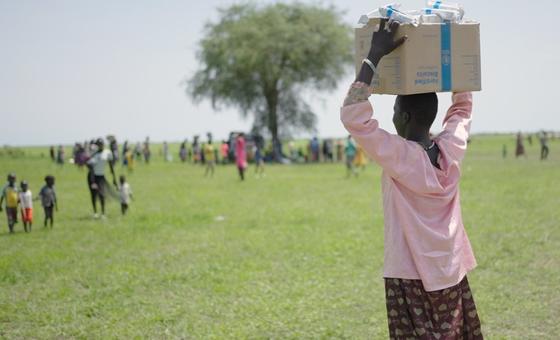
Despite the challenges, UNICEF said it is responding, delivering water purification equipment amid cholera concerns and sending malaria treatments, emergency health kits and therapeutic food to reach more than 10,000 people.

UNICEF condemns killing and injury of children in Balochistan attacks

UNICEF has expressed grave concern over reports that children were among those killed and injured during a wave of violent attacks in Pakistan’s southwestern province of Balochistan last weekend.

“Children cannot be targets nor collateral damage, and their lives must always be protected,” said UNICEF Representative in Pakistan Pernille Ironside, extending condolences to the families and communities affected. 

She warned that the escalation of violence is spreading fear, with children and families “bearing the heaviest burden”.

The attacks, which took place on 31 January, were also strongly condemned by the UN Security Council

In a press statement released on Tuesday, Council members described the incidents as “heinous and cowardly” acts of terrorism that left 48 people dead, including 31 civilians. 

Council expresses ‘deepest sympathy’

Civilian casualties reportedly included five women and three children. The so-called Balochistan Liberation Army separatist group has claimed responsibility. 

A senior local official told reporters that 145 members of the banned group had subsequently been killed by security forces.

The Council expressed its deepest sympathy to the victims’ families and to the Government and people of Pakistan, wishing the injured a full recovery. 

Global summit backs stronger protection for submarine cables

Governments and industry leaders from more than 70 countries have reaffirmed the need to protect submarine cables that carry the vast majority of the world’s digital traffic.

Meeting in Porto, Portugal, at the International Submarine Cable Resilience Summit 2026, participants adopted a declaration and recommendations aimed at strengthening cooperation to safeguard the global network of around 500 cables stretching more than 1.7 million kilometres.

Read our explainer on the summit and what’s at stake, here.

“When it comes to critical digital infrastructure like submarine cables, resilience is both an end-to-end imperative and a shared responsibility,” said ITU Secretary-General Doreen Bogdan-Martin, welcoming commitments to improve repair times, readiness and investment.

‘Meaningful impact’

The summit highlighted the importance of protecting connectivity for remote and underserved regions, which are particularly vulnerable to cable disruptions.

“I firmly believe [the advisory body] is already delivering concrete and meaningful impact,” said ANACOM Chairwoman Prof. Sandra Maximiano, noting the risks faced by countries and island communities with limited capacity to respond to outages.

The Porto meeting followed the inaugural summit in Abuja, Nigeria, as momentum builds for global action to protect what many experts see as the backbone of the digital economy.

Source link

Belém COP30 delivers climate finance boost and a pledge to plan fossil fuel transition

  • Climate disinformation: Commitment to promote information integrity and counter false narratives.

The final decision emphasises solidarity and investment, setting ambitious financial targets while leaving energy transition for later discussion. The burning of fossil fuels emits greenhouse gases that are by far the largest contributors to global warming, making this omission a point of concern for many nations, including negotiators from South America and the EU, as well as civil society groups.

Expectations were high that COP30’s final decision would include explicit reference to phasing out fossil fuels. More than 80 countries backed Brazil’s proposal for a formal ‘roadmap.’

A draft text had included it – until the final hours of talks. The adopted outcome refers only to the ‘UAE Consensus’, the COP28 decision calling for “transitioning away from fossil fuels.”

Before the final plenary, Brazilian scientist Carlos Nobre issued a stark warning: fossil fuel use must fall to zero by 2040 – 2045 at the latest to avoid catastrophic temperature rises of up to 2.5°C by mid-century. That trajectory, he said, would spell the near-total loss of coral reefs, the collapse of the Amazon rainforest and an accelerated melt of the Greenland ice sheet.

A closer look

After two weeks of intense negotiations, the adopted text calls for mobilizing at least $1.3 trillion per year by 2035 for climate action, alongside tripling adaptation finance and operationalizing the loss and damage fund agreed at COP28.  

It also launches two major initiatives – the Global Implementation Accelerator and the Belém Mission to 1.5°C – to help countries deliver on their nationally determined contributions (NDCs), or national climate action plans, and adaptation plans.

For the first time, the decision acknowledges the need to tackle climate disinformation, pledging to promote information integrity and counter narratives that undermine science-based action.  

Last week, Brazil’s President, Luiz Inácio Lula da Silva, opened the summit declaring it would be known as “the COP of truth,” and this landmark decision marks a significant step toward safeguarding public trust in climate policy – even as the absence of fossil fuel transition language underscores the complexity of energy negotiations.

Two new roadmaps

In the closing meeting, COP30 President André Corrêa do Lago acknowledged what was left out of the deal:  

“We know some of you had greater ambitions for some of the issues at hand,” he said, adding, “I know the youth civil society will demand us to do more to fight climate change. I want to reaffirm that I will try not to disappoint you during my presidency.”  

Reflecting on President Lula’s call at the opening of COP30 for ambition, Mr. do Lago announced plans to create two roadmaps: one to halt and reverse deforestation; and another to transition away from fossil fuels in a just, orderly and equitable manner, mobilizing resources for these purposes in a “just and planned manner.”

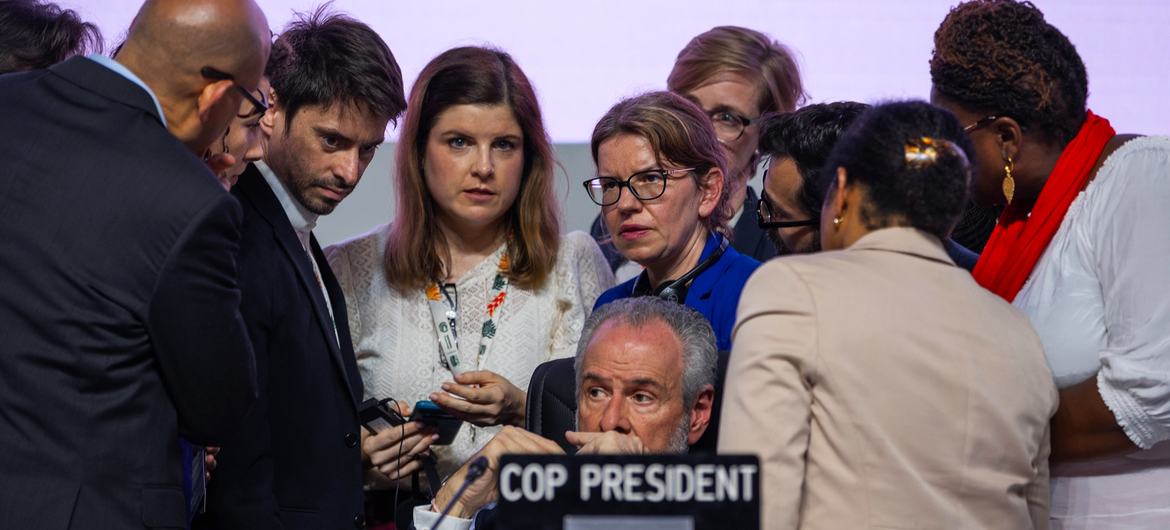
COP30 President André Corrêa do Lago (centre) confers with his team at the closing of the UN Climate Conference.

The road to consensus

The road to consensus at the latest Conference of the Parties to the UN Framework Convention on Climate Change (UNFCCC), as the annual COPs are formally known, was anything but smooth.  

Late last week, Indigenous groups staged blockades demanding stronger protections for the Amazon, and late Thursday afternoon, a fire at the conference venue disrupted talks during a critical phase. 

Negotiators worked through the night on Friday – to bridge gaps on finance and ambition, with Brazil’s presidency steering discussions toward a politically workable outcome focused on support and implementation of agreements from past COPs.

‘Multilateralism is alive’

From the G20 Summit in Johannesburg, UN Secretary-General António Guterres sent a clear message to COP30: At the gateway of the Amazon, Parties reached an agreement that shows nations can still unite to confront challenges no country can solve alone.  

The UN chief said that COP30 delivered progress, such as the launch of the Global Implementation Accelerator to close ambition gaps and reaffirmed the UAE Consensus, including a just, orderly and equitable transition away from fossil fuels.

“But COPs are consensus-based – and in a period of geopolitical divides, consensus is ever harder to reach. I cannot pretend that COP30 has delivered everything that is needed.” Overshoot of 1.5°C is a stark warning: deep, rapid emission cuts and massive climate finance are essential. “COP30 is over, but the work is not,” he said.  

Mr. Guterres vowed to keep pushing for higher ambition and solidarity, urging all who marched, negotiated and mobilized: “Do not give up. History – and the United Nations – are on your side.

Holding the line at 1.5 in ‘turbulent geopolitical waters’

UN climate chief Simon Stiell pointed to a series of major gains as COP30 closed in Belém: new strategies to accelerate Paris Agreement implementation, a push to triple adaptation finance, and commitments toward a just energy transition.

And despite what he called “turbulent geopolitical waters” – marked by polarization and climate denial – 194 nations stood together, “keeping humanity in the fight for a livable planet, determined to hold the line at 1.5°C.”

At the heart of this momentum is COP30’s flagship outcome: the Mutirão text, a sweeping deal that bundles four contentious negotiation tracks – from mitigation to finance and trade barriers – into a single, consensus-based agreement. Seventeen additional decisions were adopted alongside it.

The final document declares that the global shift toward low-emissions and climate-resilient development is “irreversible and the trend of the future.” It reaffirms that the Paris Agreement is working – and must “go further and faster” – strengthening the role of multilateral climate cooperation.

The text also recognizes the economic and social benefits of climate action, from growth and job creation to improved energy access, security and public health. Mr. Stiell pointed to a decisive trend: investments in renewable energy now outpace fossil fuels two to one – “a political and market signal that cannot be ignored,” he said.

A robust action agenda beyond negotiations

The Brazilian Presidency underscored that COP30’s success extends beyond negotiated agreements, highlighting a wave of voluntary commitments under the Action Agenda.

Among them:

  • Tropical Forests Forever Fund: Raised $5.5 billion and now includes 53 participating countries; at least 20 per cent of resources go directly to Indigenous Peoples and local communities.
  • Belém Health Action Plan: The first global initiative targeting climate-related health threats, launched with $300 million from 35 philanthropic organizations.
  • UNEZA Alliance: Public utility companies pledged $66 billion annually for renewable energy and $82 billion for transmission and storage.
  • Cities, regions and companies: A coalition spanning 25,000 buildings reported cutting over 850,000 tons of CO₂ in 2024.

Climate justice at the forefront

Countries also agreed to develop a just transition mechanism, enhancing cooperation, technical support and capacity-building.

Iraq unveils historic migration plan to boost development and stability

Unveiled on Wednesday, it creates new opportunities for work, education and family reunification, while strengthening migration governance and placing migration at the heart of stability and economic development.

It is being led by Iraq’s ministry for migration and the displaced, with the support of the International Organization for Migration (IOM) and the Government of the Netherlands – translating Iraq’s global commitments into national action.

Migration minister Evan Faeq Gabro said that it represents a “vision for Iraq’s future that upholds human dignity”, serves national interests, and supports the Global Compact for Migration.

Iraq is setting an example for the region and beyond, showing how national leadership and genuine partnership can turn migration into an engine for dignity, opportunity, and development,” said Ugochi Daniels, IOM’s  Deputy Director General for Operations.

Origin and destination

Iraq is both a country of origin and destination, with some two million nationals currently living abroad, while thousands more are weighing emigration.

In the past seven years, over 58,000 people have returned to Iraq, rebuilding their lives at home.

Meanwhile, the country also hosts some 370,000 migrant workers, mainly engaged in semi-skilled sectors such as construction and domestic work.

Iraq’s five-year National Plan to Promote Safe, Orderly and Regular Migration emphasises data-driven decision-making, stronger institutional coordination and calls for closer private sector involvement.

Stability and development

“This national plan demonstrates that when policies are grounded in evidence and shaped by people’s needs, migration can benefit migrants, communities, and the country as a whole,” said Ms Daniels.

Th new policy responds to Iraq’s current migration realities, framing migration as a tool for national development and stability, says IOM.

“Today, we are here to commit ourselves to ensuring that migration is about dignity, safety, and opportunity for migrants, their families, and the communities they join,” said Claudio Cordone, UN Deputy Special Representative in Iraq.

The plan outlines a vision for a future that upholds human dignity and serves the national interest.

World News in Brief: Guterres on India-Pakistan tensions, eastern DR Congo update, weather boost for locusts in Africa

UN Secretary-General Guterres has spoken to leaders on both sides on India-Pakistan tensions.

“This morning, he spoke separately by telephone with Muhammad Shebaz Sharif, the Prime Minister of the Islamic Republic of Pakistan, and he also spoke earlier in the day with Subrahmanyam Jaishankar, the Minister for External Affairs of the Republic of India,” said UN Spokesperson Stéphane Dujarric, briefing journalists at UN Headquarters in New York.

During the calls the UN chief reiterated his strong condemnation of the 22 April terrorist attack, noting “the importance of pursuing justice and accountability for these attacks through lawful means.”

He expressed major concern over “rising tensions between India and Pakistan and he also underscored the need to avoid a confrontation that could result in tragic consequences,” added Mr. Dujarric.

The Secretary-General also offered to help mediate in support of any de-escalation efforts.

Escalating violence displaces thousands in eastern DR Congo

Ongoing violence in eastern Democratic Republic of the Congo (DRC) is uprooting families, crippling essential services, and placing civilians at growing risk, the UN humanitarian affairs office (OCHA) warned on Tuesday.

Fresh fighting in South Kivu province has forced communities to flee and left at least 10 civilians dead in Walungu territory alone, according to local authorities. “The violence is disrupting both economic life and the delivery of urgently needed humanitarian aid,” said OCHA.

Multiple rape cases

In nearby Kalehe, Minova hospital has reported multiple cases of rape and physical assault in recent days amid worsening insecurity. Meanwhile, clashes in Fizi territory last week led to health centres being looted and schools burned, threatening already fragile public services.

OCHA urged all combatants to respect international humanitarian law and ensure the protection of civilians. “Humanitarian access must be safe and unhindered,” the agency stressed.

The surge in displacement comes as eastern DRC remains gripped by fighting between the M23 rebel group and government forces, particularly in North Kivu. Since January, the violence has displaced hundreds of thousands.

In Walikale territory, civilians are trapped in a dangerous cycle of displacement and return, OCHA said, calling for strengthened protection and support for affected communities.

Locust swarms can devastate crops and pastures in many parts of Africa and elsewhere.

Favourable weather fuels desert locust surge in North Africa

Unusually high levels of desert locust infestations have been reported during the current breeding season, raising alarms across affected regions, the UN Food and Agriculture Organization (FAO) warned on Tuesday.

“Desert locusts remain among the most devastating migratory pests on the planet,” said UN Spokesperson Stéphane Dujarric, emphasising the threat they pose to food security and livelihoods.

A single swarm of locusts can cover anywhere from one to several hundred square kilometres and may contain up to 80 million adult locusts. In just 1 km², they can eat as much food in a day as 35,000 people.

Feeding on crops and pastureland, they pose a threat to crops grown for both people and livestock, risking starvation in communities that depend on agriculture for survival.

Clement weather for pests

According to the FAO, favourable weather conditions have created suitable breeding grounds for the flying pests. Winds and rainfall patterns have facilitated the movement of desert locusts from the Sahel to North Africa.

The FAO recommends conducting intensive ground surveys across key areas where locust breeding is likely to occur.

The area spanning from south of the Atlas Mountains in Morocco, through the Sahara in Algeria, and extending to southern Tunisia and western Libya is particularly at risk.

“Surveys and control operations are particularly urgent in locations where winter and early spring rains have created suitable breeding conditions,” said Cyril Piou, the FAO’s Locust Monitoring and Forecasting Officer.

Early detection and rapid response are critical to preventing a wider crisis, the UN food agency underscores.

Source link