Haiti crisis at breaking point as gangs tighten grip ahead of transition deadline

With the political transition set to expire on 7 February, officials cautioned that escalating violence, entrenched criminal networks and mounting humanitarian needs risk pushing Haiti further into instability unless security and political efforts are urgently sustained.

Carlos Ruiz-Massieu, the head of the UN Integrated Office in Haiti (BINUH), said the country had entered a “critical phase” in efforts to restore democratic institutions, calling on Haitian actors to contain political fragmentation and prioritise elections.

“Let us be clear: the country no longer has time to waste on prolonged internal struggles,” he said, stressing the need for continuity of governance arrangements beyond the February deadline and sustained coordination to bring the transition to a close.

Mr. Ruiz-Massieu said recent steps toward elections were encouraging, citing the adoption of an electoral decree on 1 December and the publication of an calendar for going to the polls later that month.  

New provisions on voter registration, overseas voter participation and women’s representation could boost inclusivity if effectively implemented, he added.

Security still fragile

But progress on the political front is unfolding against a deteriorating security landscape.

Gangs continue to mount coordinated attacks, control key economic corridors and agricultural regions, and force mass displacement – stretching police and humanitarian capacity to the limit.

The murder rate in 2025 rose by nearly 20 per cent compared with 2024, he said.

Some security gains have been made. Police operations, supported by the Security Council-authorised Gang Suppression Force, have reopened roads in parts of Port-au-Prince and the Artibonite Department, while state presence around the capital’s Champ de Mars has been gradually restored.

Mr. Ruiz-Massieu cautioned, however, that such gains remain fragile and risk reversal without sustained pressure and basic service delivery.

Read our explainer on the situation in Hait: Why the crisis is deepening, and what comes next

Gangs reorganising and restructuring

The evolving violence reflects a deeper transformation of Haiti’s criminal landscape, according to John Brandolino, Acting Executive Director of the UN Office on Drugs and Crime (UNODC).

Once-fragmented gangs have reorganised into structured criminal networks with defined leadership, territorial ambitions and diversified revenue streams.

Coalitions such as Viv Ansanm have coordinated large-scale attacks on police, prisons and economic infrastructure, he said, allowing gangs to consolidate control over Port-au-Prince and strategic corridors into Artibonite and Plateau Central.

Extortion has become a core revenue source, alongside trafficking in drugs, weapons and ammunition.

Implications for regional security

UNODC said the crisis is increasingly regional, driven by adaptive arms-trafficking routes, illicit financial flows and corruption. Despite enforcement efforts, traffickers continue to shift routes through weaker ports and offshore transfers to evade embargo controls.

Both officials underscored the importance of the transition of the Multinational Security Support Mission into the Gang Suppression Force and the establishment of the UN Support Office in Haiti, calling for predictable funding and continued international backing.

Beyond security, the humanitarian situation remains dire. Around 6.4 million people require assistance, with Haiti among the least-funded humanitarian responses globally.

Source link

‘The world is watching’: Guterres and Lula urge unity as COP30 talks near deadline

Amid reports of deadlocks on fossil fuels, climate finance and other key issues, both leaders urged negotiators to act decisively on phasing out fossil fuels and boosting adaptation finance, insisting that fairness and ambition must guide the final hours of COP30.

Guterres: 1.5°C is the ‘non-negotiable red line’

Speaking to reporters on Thursday, Mr. Guterres urged countries to “follow the science and put people before profit,” calling for tripling adaptation finance and credible emissions cuts. “Ministers and negotiators must show leadership, boldness and good faith,” he said, stressing that 1.5°C remains “the only non-negotiable red line.”

He warned that an agreement must balance concerns over adaptation resources with the need to curb soaring emissions. For millions, he said, adaptation means “the difference between replanting or going hungry, between remaining on ancestral land or losing it forever.”

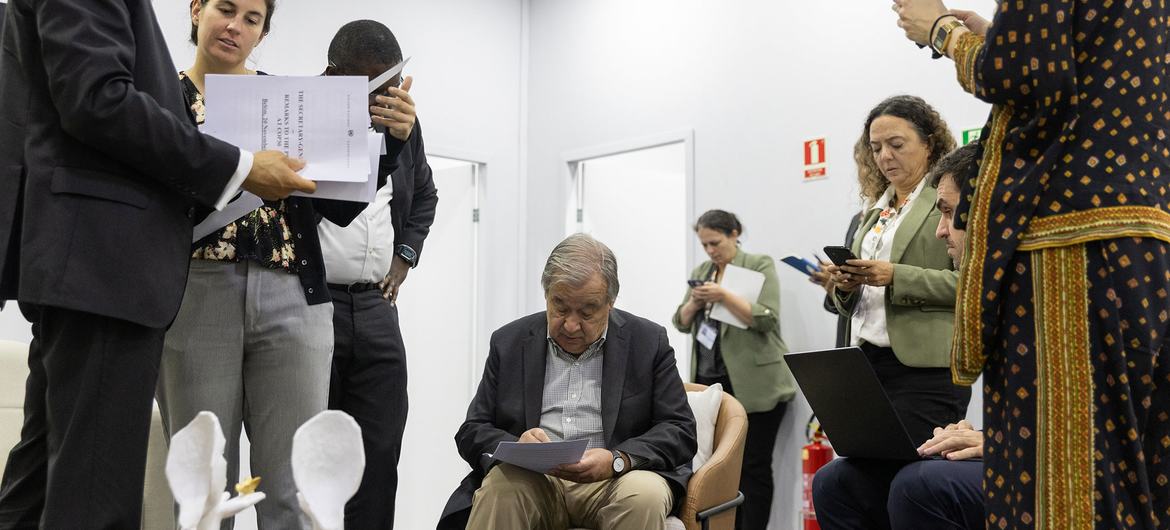
The UN Secretary-General António Guterres (centre) reviews documents with his colleagues at the UN Climate Conference in Brazil.

On fossil fuels, the UN chief called for a “just, orderly and equitable” transition, as agreed at COP28. “There can be no solution if there is not, at the same time, a just transition from fossil fuels to renewable energy,” he said, urging an end to “market distortions that favour fossil fuels” and disinformation “designed to sabotage the transition.”

A few hours after the Secretary-General’s press briefing, a fire broke out in a pavilion at the COP30 venue in Belém, forcing evacuations and briefly disrupting tense negotiations. Brazilian and UN security teams assisted in clearing the area. The blaze was quickly brought under control, and no injuries were reported. The cause of the fire was not immediately known. More here.

Lula: ‘We must start thinking about how to live without fossil fuels’

At a press conference Wednesday night, President Lula said any roadmap for the energy transition “must be taken seriously.” Brazil introduced the idea of a roadmap, he explained, “because we need to show society that we are serious. We do not want to impose anything on anyone, nor set deadlines. Each country must decide what it can do within its own timeframe and capacities.”

He added: “If fossil fuels generate [a majority of greenhouse] emissions, we must start thinking about how to live without them – and how to build that path. And I say this very comfortably, as the leader of a country that has oil, that extracts five million barrels a day.”

President Lula highlighted Brazil’s use of ethanol and biodiesel and called for oil companies, mining firms and the “super-rich” to contribute their share. He urged multilateral banks to stop charging “exorbitant interest rates” to African nations and the poorest countries in Latin America, converting part of those debts into investments.

The President praised public engagement at COP30, noting the 15 November ‘Peoples March’ was “exceptionally beautiful and orderly,” and celebrated record participation of 3,500 Indigenous people and “full participation” of women.

UN News is reporting from Belém, bringing you front-row coverage of everything unfolding at COP30.

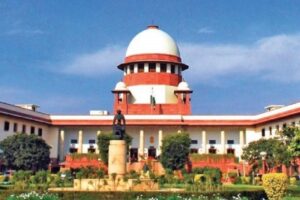
Electoral Bonds: SC asks SBI to declare all details by Thursday, March 21

On Monday, the Supreme Court issued directives to the State Bank of India (SBI) to disclose comprehensive details concerning electoral bonds. These details include the date of purchase and redemption, the names of purchasers and recipients, denominations, and alphanumeric numbers and serial bonds.

Furthermore, the court instructed SBI Chairman Dinesh Kumar Khara to submit an affidavit by 5 pm on Thursday, confirming the disclosure of all pertinent details in the bank’s possession and affirming that no information has been withheld.

Chief Justice DY Chandrachud emphasized the necessity for SBI to provide all available details, including alphanumeric and serial numbers of purchased bonds, to prevent potential future controversies. The court underscored the importance of transparency by mandating the filing of an affidavit to confirm the disclosure and absence of withheld information.

supreme court/IANS

Additionally, the Supreme Court dismissed a petition by the ‘Citizens Rights Trust’ seeking to pre-date the disclosure of bond details. Instead, the court directed SBI to disclose information from April 12, 2019, to Feb 15, 2024. The plea alleged the sale of 9,159 bonds worth ₹4,000 crores during this period.

The court declined pleas by industry bodies like Ficci and Assocham to defer the disclosure of bond numbers, asserting that anonymity cannot supersede the requirement for information disclosure.

During the proceedings, Solicitor General Tushar Mehta raised concerns about misinformation on social media regarding the court’s electoral bond judgment. He highlighted deliberate misrepresentation by petitioners in press interviews and emphasized a hidden agenda behind such actions. In response, the court reiterated its readiness to handle social media commentary, asserting its commitment to the rule of law and transparency.

In the previous hearing, the Supreme Court instructed the Election Commission to return sealed covers containing electoral bond information. The court directed the digitization of this data by 5 pm on Saturday and its subsequent public release in accordance with the court’s directives.