World News in Brief: Deadly strikes in Sudan, health systems in South Sudan near the brink, Guterres calls for unity ahead of Ramadan.

Over the past week, North Kordofan state recorded more than a dozen attacks in and around the towns of El Obeid, Bara, Rahad and Um Rawaba.  

In South Kordofan, suspected drone strikes hit health facilities in the state capital, Kadugli, and in Kuweik town, reportedly killing four medical workers, injuring more than 20 people. 

Concerns over the conflict continue to deepen after a report today from the UN Human Rights Office revealed the “sustained” and “systematic attacks” to civilians in the neighbouring Darfur region in late 2025 that may “amount to crimes against humanity”. 

Growing humanitarian concerns 

“The violence is triggering a new wave of displacement, with reports of many fleeing homes, in need food, health care and protection,” warned the Spokesperson for the Secretary-General Stéphane Dujarric on Friday. 

While the humanitarian situation in Dilling and Kadugli continues to deteriorate, he emphasised that “rapid, safe, unhindered and sustained humanitarian access is essential for us to scale up our response.” 

Commercial vehicles, telecommunications infrastructure and key transport routes have been affected the drone strikes, disrupting humanitarian movements and supply chains. 

Mr. Dujarric called for “the protection of humanitarian infrastructure, in line with international humanitarian law” and urged for more funding through UN aid coordination office OCHA to support displaced families across Sudan. 

Violence pushes South Sudan’s health system to the brink 

Since late December 2025, a devasting escalation of violence has swept across northern and central parts of South Sudan, the UN children’s agency (UNICEF) said on Friday. 

In Jonglei state alone, at least 280,000 people have been displaced – the majority being women and children.

“They fled with nothing. They are sleeping in displacement camps left over from the not-so-distant civil war – camps where there are barely any services. Others are out in the open, in remote locations, with nothing at all,” said UNICEF’s representative in South Sudan, Obia Acheng. 

Children were believed to make up 53 percent of those displaced.

“These children face killing and maiming. Recruitment into armed groups. Separation from their families. Gender-based violence. And profound psychological distress that will mark them for years,” Mr. Acheng emphasised.

Delivering for children

South Sudan’s health system is on the verge of collapse, with 11 health facilities attacked or looted since fighting intensified and many nutrition centres forced to close, UNICEF said.

Cholera cases have surged to 479 nationwide, with treatment centres overwhelmed and resources running low.

Around 825,000 children across Jonglei, Unity, and Eastern Equatoria states are now at risk of acute malnutrition — conditions that make children 12 times more likely to die without treatment.

Pregnant and nursing mothers are increasingly cut off from care, and humanitarian infrastructure is under assault.

Despite these grim numbers, UNICEF continues to run primary healthcare, nutrition, water and sanitation, and child protection programmes across the country. 

The UN Security Council also issued a statement expressing grave concern about the escalating violence in Jonglei, Eastern Equatoria, and throughout South Sudan. 

Members strongly called on all parties to de-escalate and immediately cease renewed hostilities and to resolve issues through peaceful dialogue.  

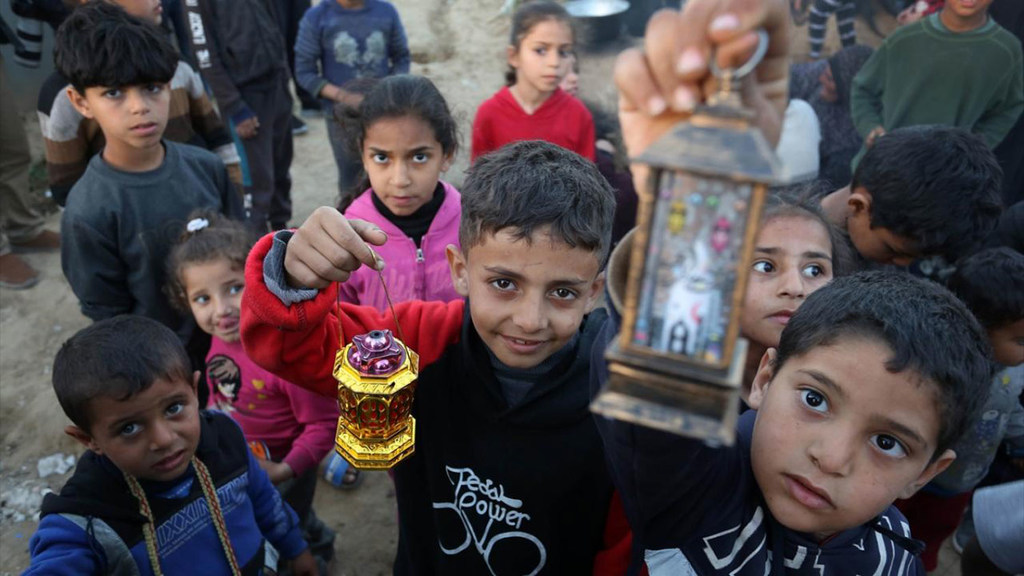
Children in Gaza hold lanterns to celebrate the advent of Ramadan. (file)

UN chief calls for unity and compassion ahead of Ramadan 

UN Secretary-General António Guterres has urged people worldwide to embrace the spirit of peace, compassion and solidarity as Muslims prepare to observe the holy month of Ramadan.  

“For Muslims around the world, the holy month of Ramadan is a sacred period of reflection and prayer. Ramadan also represents a noble vision of hope and peace.” Mr. Guterres said in a message ahead of the start on Tuesday.  

He noted, however, that for many — from Afghanistan to Yemen, Gaza, and Sudan — this vision of hope and unity remained distant amid conflict, hunger, and displacement. 

The UN chief called on the global community to bridge divides, deliver aid to those in need, and uphold human rights and dignity for all. 

“May this Holy Month inspire us to work as one to build a more peaceful, generous and just world for all people,” he said. 

Source link

‘The world is watching’: Guterres and Lula urge unity as COP30 talks near deadline

Amid reports of deadlocks on fossil fuels, climate finance and other key issues, both leaders urged negotiators to act decisively on phasing out fossil fuels and boosting adaptation finance, insisting that fairness and ambition must guide the final hours of COP30.

Guterres: 1.5°C is the ‘non-negotiable red line’

Speaking to reporters on Thursday, Mr. Guterres urged countries to “follow the science and put people before profit,” calling for tripling adaptation finance and credible emissions cuts. “Ministers and negotiators must show leadership, boldness and good faith,” he said, stressing that 1.5°C remains “the only non-negotiable red line.”

He warned that an agreement must balance concerns over adaptation resources with the need to curb soaring emissions. For millions, he said, adaptation means “the difference between replanting or going hungry, between remaining on ancestral land or losing it forever.”

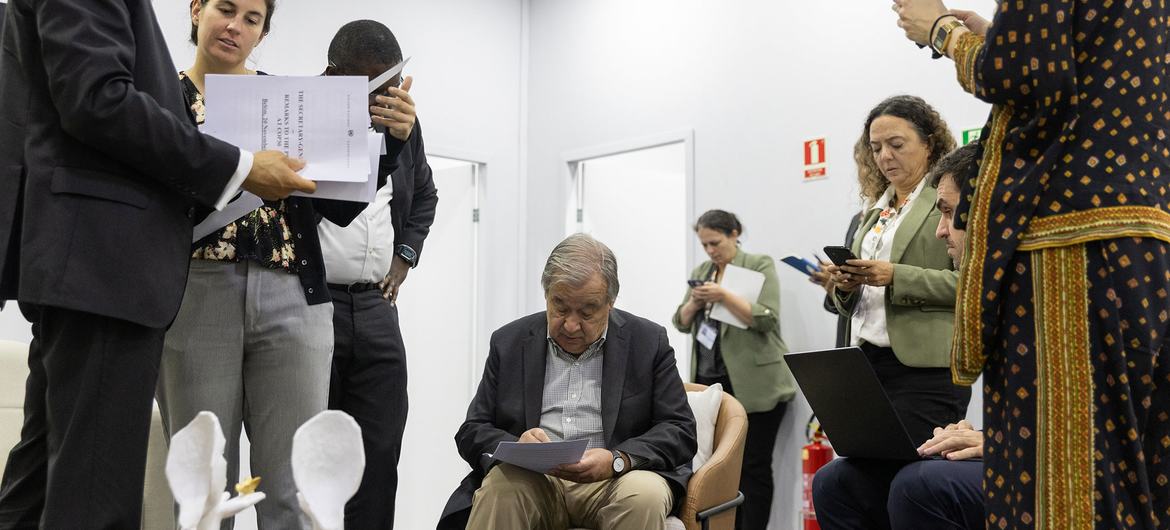
The UN Secretary-General António Guterres (centre) reviews documents with his colleagues at the UN Climate Conference in Brazil.

On fossil fuels, the UN chief called for a “just, orderly and equitable” transition, as agreed at COP28. “There can be no solution if there is not, at the same time, a just transition from fossil fuels to renewable energy,” he said, urging an end to “market distortions that favour fossil fuels” and disinformation “designed to sabotage the transition.”

A few hours after the Secretary-General’s press briefing, a fire broke out in a pavilion at the COP30 venue in Belém, forcing evacuations and briefly disrupting tense negotiations. Brazilian and UN security teams assisted in clearing the area. The blaze was quickly brought under control, and no injuries were reported. The cause of the fire was not immediately known. More here.

Lula: ‘We must start thinking about how to live without fossil fuels’

At a press conference Wednesday night, President Lula said any roadmap for the energy transition “must be taken seriously.” Brazil introduced the idea of a roadmap, he explained, “because we need to show society that we are serious. We do not want to impose anything on anyone, nor set deadlines. Each country must decide what it can do within its own timeframe and capacities.”

He added: “If fossil fuels generate [a majority of greenhouse] emissions, we must start thinking about how to live without them – and how to build that path. And I say this very comfortably, as the leader of a country that has oil, that extracts five million barrels a day.”

President Lula highlighted Brazil’s use of ethanol and biodiesel and called for oil companies, mining firms and the “super-rich” to contribute their share. He urged multilateral banks to stop charging “exorbitant interest rates” to African nations and the poorest countries in Latin America, converting part of those debts into investments.

The President praised public engagement at COP30, noting the 15 November ‘Peoples March’ was “exceptionally beautiful and orderly,” and celebrated record participation of 3,500 Indigenous people and “full participation” of women.

UN News is reporting from Belém, bringing you front-row coverage of everything unfolding at COP30.

With sustainable development under threat, Sevilla summit rekindles hope and unity

“The human consequences of rising debt burdens, escalating trade tensions and steep cuts to official development assistance have been brought into sharp relief this week,” she told the closing session of the pivotal gathering, amid sizzling temperatures across southern Spain.

Multilateralism at work

But against that backdrop, the conference has delivered a strong response – a unifying outcome document focused on solutions that reaffirms the Addis Ababa commitments made a decade ago, which seeks to “rekindle the sense of hope” through the Sustainable Development Goals (SDGs) and shows that multilateral cooperation still matters and still works, Ms. Mohammed said.

She welcomed host nation Spain’s commitment to help launch a new UN Sevilla Forum on Debt, calling it a crucial step in helping countries better manage and coordinate debt restructuring efforts.

“Sevilla will be remembered not as a landing zone, but as a launchpad for action, to improve livelihoods across the world,” said Carlos Cuerpo, host Spain’s chief finance minister, at the closing press conference.

Together, we have sent a strong message of commitment and trust in multilateralism that can yield tangible results to put sustainable development back on track.”

Li Junhua, UN Under-Secretary-General for Economic and Social Affairs and Secretary-General of the Conference said the week had proved the UN is “more than just a space for dialogue; it is a powerful platform for solutions that transform lives.”

“In Sevilla, we have demonstrated our collective will to confront the most urgent and complex financing challenges of our time,” the DESA chief underscored at the closing.

Concrete plan of action

Ms. Mohammed told the closing press conference delegates had made “a serious and long overdue attempt to confront the debt crisis” while aiming to close the massive financing gap for the 2030 Sustainable Development Goals (SDGs).

She reiterated the three main action areas for the Sevilla Commitment:

  • A major investment push to close the SDG financing gap
  • Concrete steps to address unsustainable debt burdens
  • A greater voice for developing countries in global financial decision-making

Alongside this agreement, over 100 new initiatives were launched under the Sevilla Platform for Action. These include a global hub for debt swaps, a “debt pause” alliance, and a solidarity levy on private jets and first-class flights to fund climate and development goals.

This platform has sparked new partnerships, innovative solutions that will deliver real change in people’s lives,” Ms. Mohammed said. “They’re not a substitute for broader funding commitments, but a sign that creative thinking is finally breaking through.”

Acknowledging criticism from civil society groups about limited access to official discussions, she pledged to push for greater inclusion. “We hear you,” she declared, adding that “this trust needs to be earned.”

Here’s a summary of key commitments going forward from Sevilla:

Tackling debt burdens:

  • Spain and the World Bank will lead a Debt Swaps for Development Hub to scale up debt-for-development deals.
  • Italy will convert €230 million in African debt into development investments.
  • A Debt Pause Clause Alliance of countries and development banks will suspend debt payments during crises.
  • The Sevilla Forum on Debt will help countries coordinate debt management and restructuring efforts.

Mobilising investment:

  • A Global Solidarity Levies coalition will tax private jets and premium flights to raise climate and SDG funds.
  • The SCALED platform will expand blended finance, backed by public and private partners.
  • FX EDGE and Delta will help scale up local currency lending through risk management tools.
  • Brazil and Spain will lead work on fairer taxation of the wealthy.
  • New technical assistance hubs will support project preparation and delivery.

Strengthening financial systems:

  • Country-led financing platforms will support national plans.
  • The UK-Bridgetown coalition aims to expand disaster financing.

Private sector role:

At the International Business Forum, companies pledged to increase impact investment, with $10 billion in projects showcased.

Source link