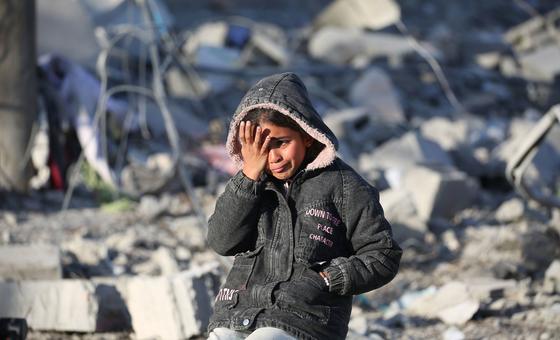
Gaza City: Daily bombardment, more displacement amid escalating military offensive

UN Spokesperson Stéphane Dujarric said people are once again on the move after Israel placed the entire city under displacement orders. Aid partners recorded more than 25,000 displacements between Sunday through Wednesday.

Some critical services have already been suspended while some humanitarian facilities have suffered severe damage, disrupting operations and the delivery of essential services.

Aid partners suspend activities

“Our partners working on health, report that some of them have had to suspend activities at primary healthcare centres, while partners working on nutrition say that 12 out of 49 outpatient therapeutic sites have halted services amid the ongoing airstrikes in Gaza City,” he said,

At least two community kitchens have also suspended operations, and three others have had to relocate within the city.

Furthermore, UN partners working on education are concerned that 95 temporary learning sites in northern Gaza serving about 25,000 children may be at imminent risk of closure due to displacement orders and ongoing insecurity.

Child malnutrition worsens

UN child rights agency UNICEF has also warned that child malnutrition in the Gaza Strip continues to worsen at an alarming rate. 

The percentage of children identified as acutely malnourished increased to 13.5 per cent in August, from 8.3 per cent in July – or 12,800 boys and girls.

Mr. Dujarric said UNICEF has been working to scale up the entry of essential nutrition supplies and distribute them, alongside nutrition partners, at about 140 sites across the Gaza Strip.

“While stocks of ready-to-use therapeutic food have recently increased, the current quantities of other critical nutrition supplies for infants and pregnant and breastfeeding women are wholly insufficient,” he said.

Meanwhile, almost half of all functioning hospitals are located in Gaza City, including half of all intensive care unit beds for the entire Gaza Strip, according to the World Health Organization (WHO).

With the Israeli offensive already underway, the Gaza Strip cannot afford to lose any of these remaining facilities, the UN agency said.

Impediments to aid delivery continue

These developments are happening as delays and impediments to humanitarian movements inside Gaza continue.

Missions still take long hours to complete, even when they are approved in advance by the Israeli authorities, meaning that teams have no choice but to wait on roads that are often dangerous or congested.

Additionally, the UN Office for the Coordination of Humanitarian Affairs (OCHA) has recently observed an increase in denials of the participation of Palestinian staff in missions, including both drivers and personnel.

Mr. Dujarric noted that denials are often communicated at the last minute, resulting in operational delays as alternatives must be quickly identified.

“What we need is full facilitation of the work and movement of humanitarian actors into and throughout the Gaza Strip. This must include unimpeded access to the north and to the south alike,” he said, adding that “every delay can cost lives.” 

Gaza: Looming offensive and restrictions on humanitarians

In the past 24 hours in Gaza, there have been more reports of casualties in shootings along aid convoy routes, where desperate crowds of civilians often wait to take supplies from the back of trucks.

Meanwhile, hostilities between Israeli forces and Palestinian armed groups are also escalating. In the past 24 hours, air strikes and shelling have occurred across five neighbourhoods in Gaza City, with reports of tanks and ground troops advancing.  

UN and partner officials in Gaza warned on Monday that the Israeli offensive would result in further mass displacement and “have a horrific impact on people already exhausted, malnourished, bereaved, displaced, and deprived of the basics needed for survival.”

Additionally, starvation persists in the enclave as supplies remain insufficient and inaccessible.  

Restrictions on international NGOs

OCHA also reported that the new requirements for international non-governmental organizations (NGOs) are preventing many humanitarian partners from bringing supplies into Gaza.  

To secure registration and bring in materials, international NGOs must share sensitive personal information about Palestinian employees, often contrary to their countries’ domestic legislation, which affects their ability to protect civilians.

Upcoming humanitarian work  

The UN and its NGO partners stressed that their teams will remain in Gaza City to provide life-saving support, reminding parties of their obligation to protect civilians, including humanitarian workers, and safeguard humanitarian infrastructure.

“Every day and every night, aid workers in Gaza courageously put themselves in harm’s way to keep others alive. At the same time, they also struggle to feed themselves and feed their own families,” said Spokesperson for the Secretary-General, Stéphane Dujarric, reporting on the situation in the context of World Humanitarian Day at Tuesday’s daily press briefing in New York.

“The world cannot look away while attacks on aid workers and on the very people they try to help have become routine.”

The humanitarian community welcomes the Israeli announcement that tents and shelter equipment will be allowed into Gaza, aiming to utilise this lifting of the ban to bring in tents, shelter materials and other items into the Gaza Strip. However, the UN and partners said it is deeply troubling that this lifting is in connection with a looming offensive.

They called for a significant scale-up of private sector operations and a full facilitation of deliveries from local and international humanitarian organizations, with supplies allowed to enter through all crossings. 

Guterres alarmed by Israeli plans to expand Gaza ground offensive

 “This will inevitably lead to countless more civilians killed and the further destruction of Gaza,” said UN Deputy Spokesperson Farhan Haq, responding to a journalist’s question during the regular media briefing in New York.

“What’s imperative now is an end to the violence, not more civilian deaths and destruction. Gaza is, and must remain, an integral part of a future Palestinian State.” 

The alert comes as the UN humanitarian team and other NGOs in the Occupied Palestinian Territory on Sunday condemned Israeli efforts to replace the aid delivery system with one where supplies would reportedly be funnelled through military hubs in the south.

This proposal would leave “large parts of Gaza…less mobile and (the) most vulnerable” without lifesaving supplies, aid chiefs insisted.

The Secretary-General continues to call for an immediate permanent ceasefire and the immediate and unconditional release of hostages in Gaza, said Mr. Haq.

Deadly attacks and looting

Meanwhile, airstrikes and other attacks continue across the Strip, where Israel has blocked the entry of aid and commercial supplies for more than two months.

Reports indicate that scores of people were killed and hundreds injured over the weekend, including children, the UN aid coordination office OCHA said on Monday.

OCHA noted that robbery and looting have become a daily reality in the Strip, especially in and around Gaza City, which is occurring in parallel with the depletion of supplies.

Businesses are being targeted, and there have also been attempts against UN warehouses.  In most cases the looters were stopped by guards, or the warehouses were already empty.

Water woes

Last week, OCHA reported that water pumping and sanitation systems in Beit Lahiya had gone down because fuel had run out. Services are still not back due to continuing shortages.

Furthermore, a major water line from Israel was damaged on Friday, cutting water supply to northern Gaza – including Gaza City – by half. Teams were only able to fix the problem on Sunday as the repair work required coordination with the Israeli authorities.

Also on Sunday, a UN team managed to retrieve some fuel from a station in Gaza City after the Israeli authorities facilitated their efforts to reach it. However, many reserves remain out of reach due to denial of access.

OCHA noted that in Rafah in southern Gaza, not a single attempt to retrieve fuel has been facilitated since 18 April.

The agency also reported that since Saturday, 19 out of 27 planned humanitarian movements within Gaza were denied outright.  Other attempts were initially given the go-ahead – but then impeded by forces on the ground. 

Source link