
Iran: UN urges ‘maximum restraint’ to avert more death, wider escalation

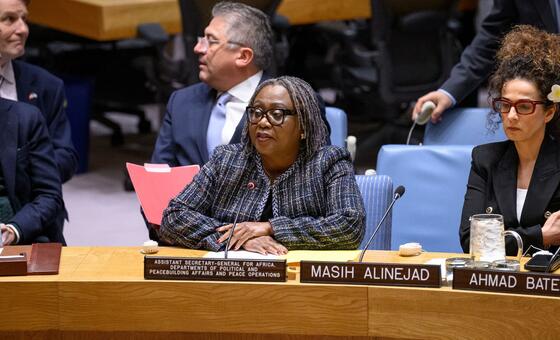
Assistant Secretary-General Martha Pobee briefed an emergency meeting of the Security Council in New York called by the United States to address the crisis.

Ms. Pobee described the situation in Iran as “fluid and deeply concerning”, noting that “protests continue, albeit reportedly at a smaller scale than last week.”

Against military strikes

She voiced alarm, however, over public statements suggesting possible military strikes on the country.

This external dimension adds volatility to an already combustible situation. All efforts must be undertaken to prevent any further deterioration,” she said.

Moreover, UN Secretary-General António Guterres “remains convinced that all concerns regarding Iran, including those related to the nuclear issue and ongoing protests, are best addressed through diplomacy and dialogue.”

He also “urges maximum restraint at this sensitive moment and calls on all actors to refrain from any actions that could lead to further loss of life or ignite a wider regional escalation.”

Largest protests in recent years

The protests erupted on 28 December after shopkeepers in the Iranian capital Tehran took to the streets to rail against the collapse of the national currency, soaring inflation and worsening living conditions.

Demonstrations quickly spread across the country, turning into mass anti-government protests – the largest since the movement sparked by the September 2022 death in custody of Kurdish woman Jina Amini who was arrested for allegedly violating hijab laws.

Authorities imposed a near-total communications blackout that is still largely in place.  Hundreds and even possibly thousands of protestors and bystanders have been killed, and more than 18,000 people are estimated to be detained, though the UN has not been able to verify these figures.

‘Terrorists’ and ‘rioters’ blamed

“The Government of Iran has stated that it was compelled to act after what it deemed ‘organized terrorists’ and ‘rioters’ infiltrated the protests and opened fire on both security forces and demonstrators, aiming to provoke foreign military intervention,” said Ms. Pobee.

“It has also blamed these elements for the killing of hundreds of civilians and members of the security forces.”

In a recent statement, the UN Secretary-General expressed deep concern over the reported excessive use of force by the authorities and upheld the rights to freedom of expression, association and peaceful assembly.

Civil society voices

Iranian journalist and political dissident Masih Alinejad was one of two civil society representatives invited to brief the Council.

“What is needed now to bring justice to those who order massacres in Iran is real and concrete action,” she said.

Iranian-American human rights activist and journalist Ahmad Batebi spoke about how he was arrested for protesting while a student and sentenced to death.

Mr. Batebi said that he was held in solitary confinement for two years, tortured, and forced to admit that he was a paid American spy.

US warns of wider repercussions

US Ambassador Mike Waltz stated that “the level of violence, the level of repression that the Iranian regime has unleashed on its own citizens…has repercussions for international peace and security.”

The Iranian people “are demanding their freedom like never before in the Islamic Republic’s brutal history,” he said, and underscored that President Donald Trump and the United States “stands by the brave people of Iran”.

He stressed that “the regime is solely responsible for the economic misery of the Iranian people and the repression of their freedom” and will be held accountable.

US ‘steering unrest’ in Iran, ambassador claims

Iran’s Deputy Permanent Representative Gholamhossein Darzi began his remarks by denouncing the two civil society briefers, saying they “represent the political agenda of the United States and Israeli regimes.”

Turning to the situation in Iran, the ambassador said that he was speaking on behalf of a “nation in mourning”.

“It is deeply regrettable that the representative of the United States regime, which requested this meeting, has today resorted to lies, distortions of facts and deliberate disinformation to conceal his country’s direct involvement in steering unrest in Iran towards violence,” he said.
Source link

Gaza: Aid insufficient to avert ‘widespread starvation’ as Israeli military ramp-up forces more people to flee

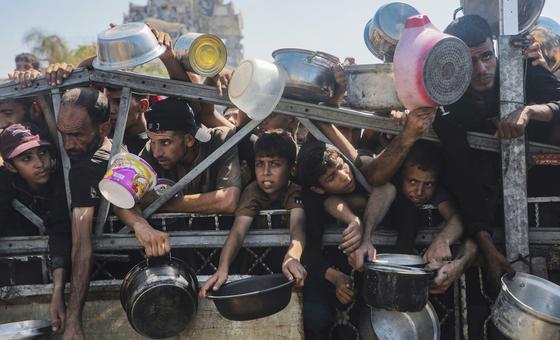
“The risk of starvation is everywhere in Gaza,” UN Human Rights Office spokesperson Thameen Al-Kheetan told reporters in Geneva.

“This is a direct result of the Israeli government’s policy of blocking humanitarian aid,” he said.

Mr. Al-Kheetan insisted that in the past few weeks, Israeli authorities have only allowed aid to enter in quantities that remain “far below what would be required to avert widespread starvation”.

The UN said on Monday that hunger-related deaths continue to be reported in the Strip, including among children.

More people displaced

As the Israeli army intensified its attacks in the north of the enclave, it has continued to issue displacement orders for Palestinians, Mr. Al-Kheetan said.

He noted that Gazans have been told to move to the Al-Mawasi area, despite continuing airstrikes and disastrous conditions there.

“Hundreds of thousands of Palestinians displaced to Al-Mawasi have little or no access to essential services and supplies, including food, water, electricity and tents,” he warned.

Deadly pursuit of aid

The OHCHR spokesperson stressed that reaching humanitarian aid “can be a deadly pursuit” with latest data indicating that 1,857 Palestinians were killed while seeking food from 27 May, when the US and Israel-backed militarized aid distribution scheme known as the Gaza Humanitarian Foundation started its operations.

Out of that number, he said that 1,021 were killed in the vicinity of the Gaza Humanitarian Foundation sites and 836 on the routes of supply trucks.

“Most of these killings appear to have been committed by the Israeli military,” Mr. Al-Kheetan said.

Asked how the situation could get even worse, Jens Laerke, the spokesperson for the UN humanitarian affairs coordination office (OCHA), said that “it has already gotten worse”, insisting on the devastating effects of the Israeli ban on the entry of shelter materials into the enclave.

While the Israeli authorities recently announced that they would lift the ban on shelter supplies, Mr. Laerke said that “the United Nations and our partners have as of last night not been able to bring in shelter materials following the Israeli announcement.”

“There’s a set of impediments that still needs to be addressed, including Israeli customs clearance,” he added.

Need for shelter

The UN said on Monday that according to partners’ estimations at least 1.35 million people in Gaza need emergency shelter.

Aid agencies have warned that tents being used in Gaza are worn out from prolonged sun exposure and frequent displacement.

Asked about the reasons given for the ban on shelter items, Mr. Laerke explained that in a conflict, some shelter items such as tentpoles can fall under the “dual-use regime” as they could be used for both civilian and military purposes.

“Shelter has been banned entry for about five months and in that period over 700,000 people have been displaced or re-displaced,” he said.

People forced to flee time and again often have to leave behind the tents that they have been provided, Mr. Laerke explained, which creates a challenge for aid workers “trying to respond to people where they are”.

The looming expansion of Israel’s military activities in Gaza City is another major concern for UN humanitarians, as it would again push thousands of people into a severely overcrowded area in the south of the Strip.

Asked about the impact of Israel’s plans to occupy Gaza City, Mr. Al-Kheetan underscored a “huge risk” for civilians.

“There are risks of mass displacement… more killings and more misery that we have already seen in the Gaza Strip,” he warned. “Among those who will be affected are the most vulnerable, people with disabilities, the injured, the children, women”, he concluded.

Response to prison video

In other developments, the human rights spokesman said that video footage showing Israeli National Security Minister Itamar Ben-Gvir berating and taunting Palestinian leader Marwan Barghouthi inside an Israeli jail was “unacceptable.”

He said the minister’s behaviour and the publication of the images constitute an attack on Mr. Barghouthi’s dignity.

He added that international law requires that all detainees be treated humanely, with dignity, and that their human rights be respected and protected.

“Such conduct by the minister responsible for the Israeli Prison Service may encourage violence against Palestinian detainees, enabling human rights violations in Israeli detention facilities,” he said

Source link

Lifting of Israeli blockade ‘the only way to avert mass starvation’ in Gaza: UNRWA chief

Philippe Lazzarini posted on social media saying that aid distribution “has become a death trap,” citing reports from international medical staff on the ground and local health authorities who reported at least 31 deaths and more than 150 injured as civilians were lining up to receive aid from the Israel and United States-backed Gaza Humanitarian Foundation – which bypasses existing aid agencies.

‘Humiliating system’

“A distribution point by the Israeli-American plan was put far south in Rafah,” Mr. Lazzarini said on X.

This humiliating system has forced thousands of hungry and desperate people to walk for tens of miles to an area that’s all but pulverized due to heavy bombardment by the Israeli army.”

He said aid delivery and distribution “must be at scale and safe. In Gaza, this can be done only through the United Nations including UNRWA.”

Gaza’s defence agency said Israeli forces had been responsible for the gunfire. The Gaza Humanitarian Foundation – which uses private contractors and involves Israel Defense Forces (IDF) to secure its sites – has strongly denied that civilians were fired on, accusing Hamas militants of misinformation.

Disputed events

The IDF said on social media that reports of them firing towards residents receiving aid from the foundation were false: “Findings from an initial inquiry indicate that the IDF did not fire at civilians while they were near or within the humanitarian aid distribution site.”

The IDF posted video which it said showed gunmen shooting at civilians collecting aid, adding that “Hamas is doing everything in its power to prevent the successful distribution of food in Gaza.”

Medical staff at Nasser hospital in nearby Khan Younis told media outlets that around 79 people were admitted on Sunday, mostly with gunshot wounds, along with the bodies of some of those killed. Journalists on the scene posted video footage of bodies being carried on carts along with wounded arrivals.

‘Lift the siege’

UNRWA chief Lazzarini called on Israel to lift the three-month old aid blockade and allow safe and unhindered access. “This is the only way to avert mass starvation including among one million children.”

Highlighting the difficulties of clearly establishing facts on the ground due to Israel’s ban on international media from entering the Gaza Strip, the UNRWA chief said that amid competing narratives and “disinformation campaigns in full gear,” the ban on eyewitness reporting must be lifted immediately.