UN Assembly president defends multilateralism, UN Charter in Davos

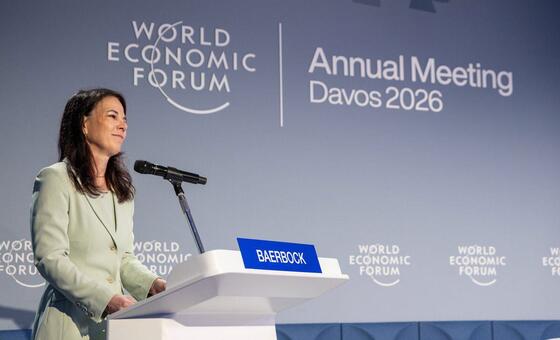
Speaking at the session Who Brokers Trust Now? at the World Economic Forum, Annalena Baerbock warned that multilateral institutions – long seen as the brokers of global trust – are under unprecedented strain as conflicts multiply and respect for international law erodes.

“Who brokers trust?” she asked. “In ordinary times, there would be a simple answer: multilateral institutions like the United Nations.” But, she added, these are “not ordinary times”.

Ms. Baerbock said the world is facing more conflicts than at any point in recent history. Since the start of 2026, she said, divisions have deepened further, leaving some Member States hesitant to act when circumstances demand principled conviction.

Voices that were once outspoken in their support for all the three pillars of the United Nations Charter – peace and security, sustainable development, and human rights – fall more and more silent in the face of their erosion,” she said.

The UN is not only under pressure but under outright attack.

Facts and truths not up for negotiation

Ms. Baerbock stressed that trust cannot exist without truth and shared facts – foundations she said are increasingly undermined by deliberate disinformation.

“Without facts, you can’t have truth. Without truth, you can’t have trust,” she said, quoting Nobel Peace Prize laureate Maria Ressa.

She cautioned that falsehoods are rarely accidental, but are often deployed to “weaponize mis- and disinformation”, while diplomatic silence in the face of obvious falsehoods only deepens mistrust.

We do not negotiate truths and facts,” Ms. Baerbock said. “We use them to negotiate, to broker trust.

She highlighted the risks posed by artificial intelligence, noting that while AI offers enormous benefits, it is also being used to blur the line between truth and lies. Deepfakes, she said, are “systematically attacking women”, citing figures showing that the overwhelming majority of such content is pornographic and targets women.

UN Charter – ‘world’s life insurance’

Ms. Baerbock also highlighted that trust is impossible without common rules, arguing that respect for international law is not naïve idealism but a matter of enlightened self-interest.

Trust is built on rules,” she said, likening the global system to competitive sports or markets where predictability and fairness are essential. “Why would you put your money into a business if the competition rules are totally unpredictable?

Recalling the founding of the United Nations 80 years ago, she said leaders at the time chose cooperation after witnessing the catastrophic consequences of a lawless international order.

The UN Charter, she added, remains “the world’s common life insurance”, just as a rules-based economic order underpins global business and investment.

A call for broad alliance

The General Assembly President concluded by calling for a broad alliance – spanning governments, businesses and regions – to stand up for the international order and defend shared principles, even when it is politically or economically costly.

“Trust is brokered by those who hold up the common rules and principles, even when it is hard,” she said. “By those who act when action is required…and by those who speak the truth, when silence or distortion would be easier.”

The challenge now, Ms. Baerbock emphasised, is whether today’s leaders can act with the same courage and conviction as those who built the post-war international system.

The founders of the United Nations understood that because they had seen what the alternative would mean, in a world where might makes right, there can be only one outcome: chaos and war.

Source link

Eighty years on, UN Charter marked by reflection, resolve – and a run

Under cooler skies after days of intense heat, the run ended where it all began, at the original UN Charter – the document that launched the Organization and reshaped the modern international order – now on display at UN Headquarters.

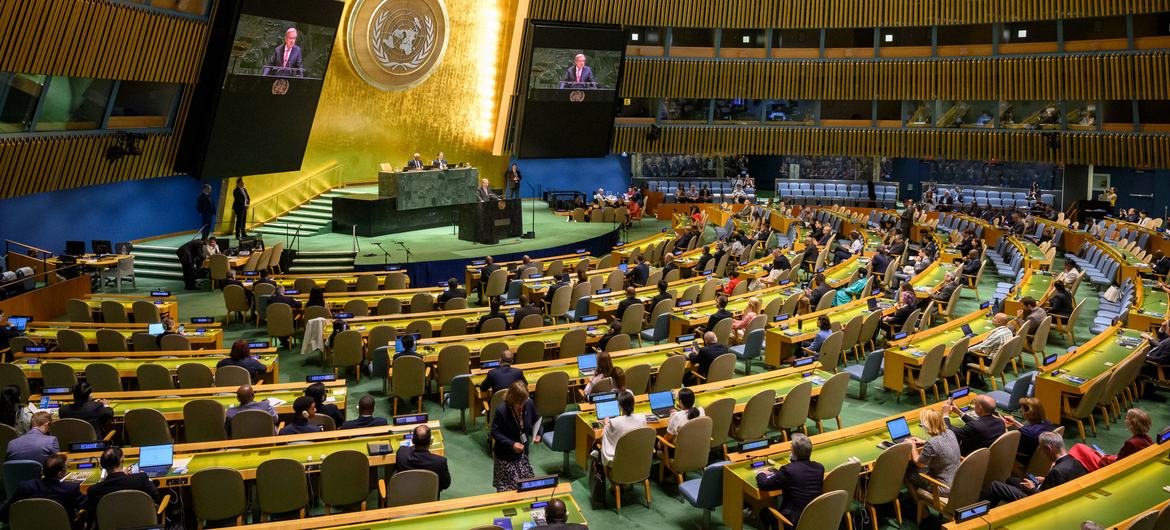
Inside the General Assembly Hall, delegates gathered to commemorate the 80th anniversary of its signing.

They reflected on the past eight decades in which the UN helped rebuild countries after the Second World War, supported former colonies’ independence, fostered peace, delivered aid, advanced human rights and development, and tackling emerging threats like climate change.

To save succeeding generations from the scourge of war

General Assembly President Philémon Yang described the moment as “symbolic” but somber, noting ongoing conflicts in Gaza, Ukraine and Sudan, and the growing challenges to multilateralism.

He urged nations to choose diplomacy over force and uphold the Charter’s vision of peace and human dignity: “We must seize the moment and choose dialogue and diplomacy instead of destructive wars.”

Secretary-General António Guterres echoed this call, warning that the Charter’s principles are increasingly under threat and must be defended as the bedrock of international relations.

The Charter of the United Nations is not optional. It is not an à la carte menu. It is the bedrock of international relations,” he said, stressing the need to recommit to its promises “for peace, for justice, for progress, for we the peoples.”

Carolyn Rodrigues-Birkett, Security Council President for June, emphasized the urgency of renewed collective action to address emerging global threats.

Let this 80th anniversary of the Charter be not just an occasion for reflection, but also a call to action,” she urged.

General Assembly commemorates 80th anniversary of the signing of UN Charter.

To unite our strength to maintain international peace and security

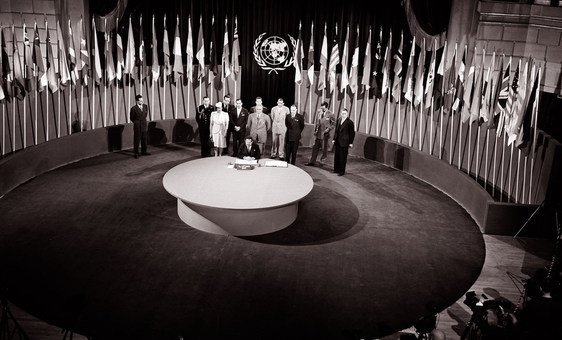
Eighty years ago, on 26 June 1945, delegates from 50 countries gathered in San Francisco to sign a document that would change the course of history.

Forged in the aftermath of the Second World War, by a generation scarred by the Great Depression and the Holocaust and having learnt the painful lessons of the League of Nations’ collapse, the Charter of the United Nations represented a new global pact.

Its preamble – “We the peoples of the United Nations” – echoed the determination to prevent future conflict, reaffirm faith in human rights, and promote peace and social progress.

That very document, preserved by the United States National Archives and Records Administration, has returned – for the first time in decades – to the heart of the institution it founded.

Now on public display at UN Headquarters through September, the original Charter stands as a powerful symbol: not just of a past promise, but of an enduring commitment to multilateralism, peace and shared purpose.

Video: UN Charter returns to UN Headquarters

To promote social progress and better standards of life

More voices – from the presidents of the Economic and Social Council (ECOSOC) and the International Court of Justice (ICJ) – also took the floor, reaffirming the enduring relevance of the Charter and the need to defend it.

Bob Rae, ECOSOC President, drew an arc through human history to underscore the UN’s relative youth – just eight decades old in a global context of millennia.

“We currently have the advantage of being able to lucidly look at what we have accomplished, while also recognizing our successes and failures,” he said, holding up a copy of the Charter once used by his father.

The United Nations is not a government and the Charter is not perfect,” he said, “but it was founded with great aspirations and hope.

ICJ President Judge Yuji Iwasawa reflected on the progress since 1945 and the challenges still facing the global community.

“In the 80 years since the drafters of the Charter set down their pens, the international community has achieved remarkable progress. However, it also faces many challenges,” he said. “The vision of the Charter’s drafters to uphold the rule of law for the maintenance of international peace and security, remains not only relevant but indispensable today.

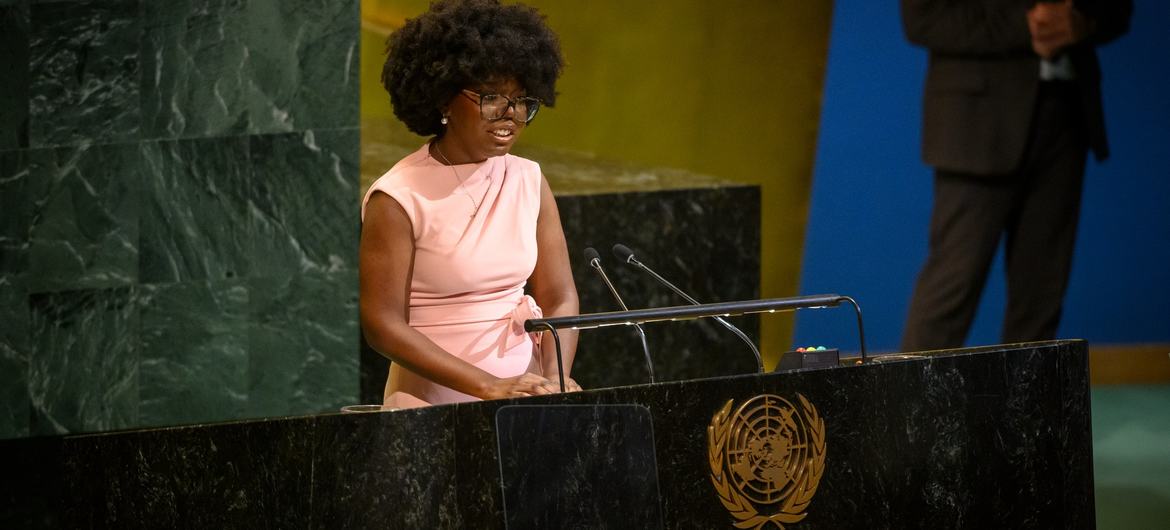
Jordan Sanchez, a young poet, speaks at the General Assembly during the commemoration of the 80th anniversary of the signing of the UN Charter.

To reaffirm faith in fundamental human rights

In a powerful reminder that the Charter speaks not only to the past but to future generations, Jordan Sanchez, a young poet took the stage.

Her spoken word piece, Let the Light Fall, evoked not declarations, but feelings of hope and vision for a better world.

“Let the light fall,” she began, “on fallen faces hidden in the shadow of scorn…where may the children run towards the light of your face, towards the warmth of your presence and the stillness of your peace.”

“There is no fear, only abundance, of safety, of security, of knowing there will always be enough light for me” she said, describing a dreamscape of Eden restored – not a paradise lost, but glimpsed in justice, fairness and shared humanity.

Let us be bold enough to look down and take it, humble enough to kneel down and bathe in it, loving enough to collect and share it, and childish enough to truly, truly believe in it.

The equal rights of men and women

As the world marks 80 years of the UN Charter, it’s worth remembering that its promise of equal rights for men and women was hard-won from the very start.

In 1945, just four women were among the 850 delegates who gathered in San Francisco to sign the document, and only 30 of the represented countries granted women the right to vote.

In a 2018 UN News podcast, researchers spotlighted these overlooked trailblazers – and asked why the women who helped shape the UN’s founding vision are so often left out of its story.

Listen to the podcast here.


Note: The subheads in this article are taken directly from the Preamble of the United Nations Charter, whose enduring language continues to guide the Organization’s mission.

Source link

80 years later, the UN Charter is a ‘living miracle,’ Secretary-General says

The UN Charter “is more than parchment and ink; it is a promise – of peace, dignity and cooperation among nations,” the Secretary-General said.

Almost 80 years after it was signed, Mr. Guterres underlined that the Charter was just the beginning, enshrining ideas and principles which the world works to implement on a daily basis.

Born from war

In the wake of the Second World War, representatives from almost 50 nations convened in San Francisco to put together an organization committed to the idea of “never again” — never again would a war of this magnitude devastate the world.

Instead, the world would choose peace and diplomacy, equality and prosperity.

“For a world mired in endless cycles of conflict and human suffering, the Charter and the principles it represented – dialogue, diplomacy, cooperation, and solidarity — was a path to a better, more peaceful, and prosperous future,” said UN General Assembly President Philémon Yang. The Charter was signed on 26 June 1945, almost exactly 80 years ago. However, it did not take effect until 24 October 1945 after the signatories’ legislative bodies had ratified it.

The Charter, which is considered an international treaty, is a legal instrument which binds all Member States to the principles and commitments laid out within it.

Since its ratification, the UN Charter has paved the way for other landmark international agreements including the 1948 Universal Declaration of Human Rights and the 2024 Pact for the Future.

“The decades since have only proven the Charter’s enduring legacy. It has shaped decades of progress — guided international action on decolonisation, protected human rights and promoted justice and sustainable development,” said Mr. Yang.

‘A living miracle’

The exhibit contextualizes the Charter as a document from the past which continues to live in our present and will help shape the future.

“As we look ahead, we would be wise to remember our past, celebrate our successes and build our future on the foundation of the UN Charter,” Mr. Yang said.

Mr. Guterres said that this exhibit is a moment for people to reflect on the artifacts of the UN’s founding — to see the photos, the videos and the documents which have shaped this global organization.

He acknowledged that while the world faces new challenges like climate change and technology, in addition to age-old challenges, the UN Charter can be a guiding force if the world is willing to carry the spirit of the Charter and its commitment to peace into the future.

“The UN is a living miracle — and the women and men of the United Nations bring this miracle to life every day and everywhere,” the Secretary-General said. 

Source link