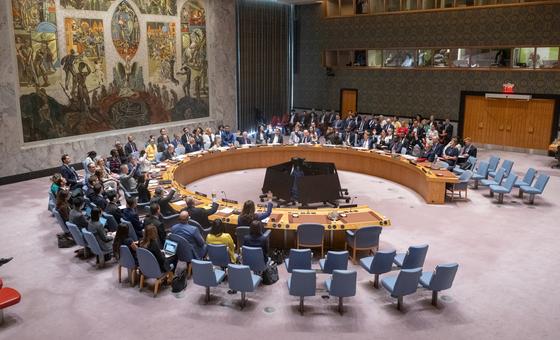
The text, sponsored by Pakistan and adopted unanimously, reiterated that all States “shall settle their international disputes by peaceful means through dialogue, diplomatic engagement and cooperation in such a manner that international peace and security, and justice, are not endangered.”
It also reiterated that nations must “refrain in their international relations from the threat or use of force against the territorial integrity or political independence of any state, or in any other manner inconsistent with the Purposes of the United Nations.”
Highlighting the need to prevent disputes from arising and escalating, the resolution further called on Member States to take “necessary measures for the effective implementation of Security Council resolutions for peaceful settlement of disputes.”
Mediation and preventive diplomacy
The text encouraged the Secretary‑General to ensure that the United Nations can “lead and support mediation and preventive diplomacy efforts,” while continuing to deploy his good offices.
It also took note “with appreciation” of the work of the UN’s Mediation Support Unit (MSU) and urged the Secretariat to ensure the availability of “well-trained, experienced, independent, impartial, and geographically and linguistically diverse mediation experts at all levels.”
The MSU is the UN system-wide focal point on mediation expertise and support, providing tailored operational support to peace and dialogue processes globally.
Participation of women and youth
The resolution also underscored the importance of integrating inclusive approaches to peaceful settlement of disputes; ensuring the full, equal and meaningful participation of women, and meaningful participation of youth in conflict prevention and dispute resolution efforts.
It also highlighted the role of regional and subregional organizations in complementing UN efforts, calling for enhanced information-sharing and cooperation.
The Council further requested that the Secretary‑General present “concrete recommendations for further strengthening the mechanisms for peaceful settlement of disputes” within one year, alongside plans for an open debate to review progress.
Under cooler skies after days of intense heat, the run ended where it all began, at the original UN Charter – the document that launched the Organization and reshaped the modern international order – now on display at UN Headquarters.
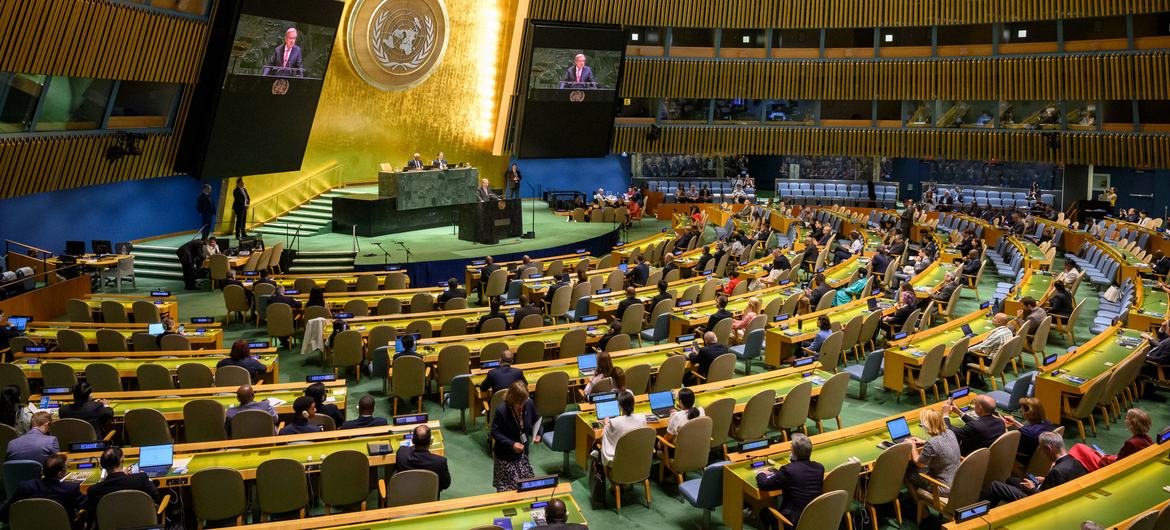
Inside the General Assembly Hall, delegates gathered to commemorate the 80th anniversary of its signing.
They reflected on the past eight decades in which the UN helped rebuild countries after the Second World War, supported former colonies’ independence, fostered peace, delivered aid, advanced human rights and development, and tackling emerging threats like climate change.
To save succeeding generations from the scourge of war
General Assembly President Philémon Yang described the moment as “symbolic” but somber, noting ongoing conflicts in Gaza, Ukraine and Sudan, and the growing challenges to multilateralism.
He urged nations to choose diplomacy over force and uphold the Charter’s vision of peace and human dignity: “We must seize the moment and choose dialogue and diplomacy instead of destructive wars.”
Secretary-General António Guterres echoed this call, warning that the Charter’s principles are increasingly under threat and must be defended as the bedrock of international relations.
“The Charter of the United Nations is not optional. It is not an à la carte menu. It is the bedrock of international relations,” he said, stressing the need to recommit to its promises “for peace, for justice, for progress, for we the peoples.”
Carolyn Rodrigues-Birkett, Security Council President for June, emphasized the urgency of renewed collective action to address emerging global threats.
“Let this 80th anniversary of the Charter be not just an occasion for reflection, but also a call to action,” she urged.
General Assembly commemorates 80th anniversary of the signing of UN Charter.
To unite our strength to maintain international peace and security
Eighty years ago, on 26 June 1945, delegates from 50 countries gathered in San Francisco to sign a document that would change the course of history.
Forged in the aftermath of the Second World War, by a generation scarred by the Great Depression and the Holocaust and having learnt the painful lessons of the League of Nations’ collapse, the Charter of the United Nations represented a new global pact.
Its preamble – “We the peoples of the United Nations” – echoed the determination to prevent future conflict, reaffirm faith in human rights, and promote peace and social progress.
That very document, preserved by the United States National Archives and Records Administration, has returned – for the first time in decades – to the heart of the institution it founded.
Now on public display at UN Headquarters through September, the original Charter stands as a powerful symbol: not just of a past promise, but of an enduring commitment to multilateralism, peace and shared purpose.
Video: UN Charter returns to UN Headquarters
To promote social progress and better standards of life
Bob Rae, ECOSOC President, drew an arc through human history to underscore the UN’s relative youth – just eight decades old in a global context of millennia.
“We currently have the advantage of being able to lucidly look at what we have accomplished, while also recognizing our successes and failures,” he said, holding up a copy of the Charter once used by his father.
“The United Nations is not a government and the Charter is not perfect,” he said, “but it was founded with great aspirations and hope.”
ICJ President Judge Yuji Iwasawa reflected on the progress since 1945 and the challenges still facing the global community.
“In the 80 years since the drafters of the Charter set down their pens, the international community has achieved remarkable progress. However, it also faces many challenges,” he said. “The vision of the Charter’s drafters to uphold the rule of law for the maintenance of international peace and security, remains not only relevant but indispensable today.”
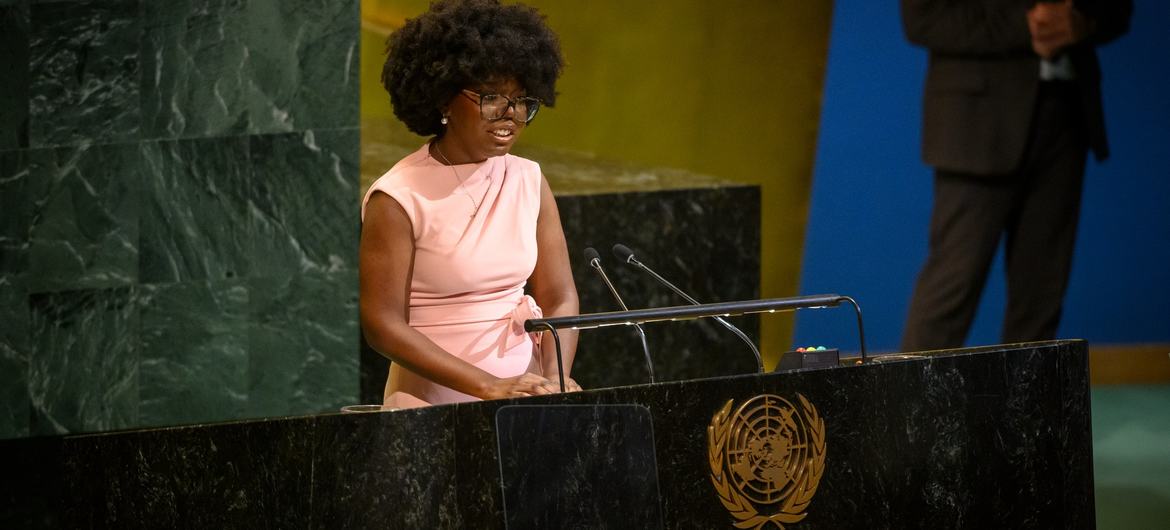
Jordan Sanchez, a young poet, speaks at the General Assembly during the commemoration of the 80th anniversary of the signing of the UN Charter.
To reaffirm faith in fundamental human rights
In a powerful reminder that the Charter speaks not only to the past but to future generations, Jordan Sanchez, a young poet took the stage.
Her spoken word piece, Let the Light Fall, evoked not declarations, but feelings of hope and vision for a better world.
“Let the light fall,” she began, “on fallen faces hidden in the shadow of scorn…where may the children run towards the light of your face, towards the warmth of your presence and the stillness of your peace.”
“There is no fear, only abundance, of safety, of security, of knowing there will always be enough light for me” she said, describing a dreamscape of Eden restored – not a paradise lost, but glimpsed in justice, fairness and shared humanity.
“Let us be bold enough to look down and take it, humble enough to kneel down and bathe in it, loving enough to collect and share it, and childish enough to truly, truly believe in it.”
The equal rights of men and women
As the world marks 80 years of the UN Charter, it’s worth remembering that its promise of equal rights for men and women was hard-won from the very start.
In 1945, just four women were among the 850 delegates who gathered in San Francisco to sign the document, and only 30 of the represented countries granted women the right to vote.
In a 2018 UN News podcast, researchers spotlighted these overlooked trailblazers – and asked why the women who helped shape the UN’s founding vision are so often left out of its story.
Listen to the podcast here.
Note: The subheads in this article are taken directly from the Preamble of the United Nations Charter, whose enduring language continues to guide the Organization’s mission.