

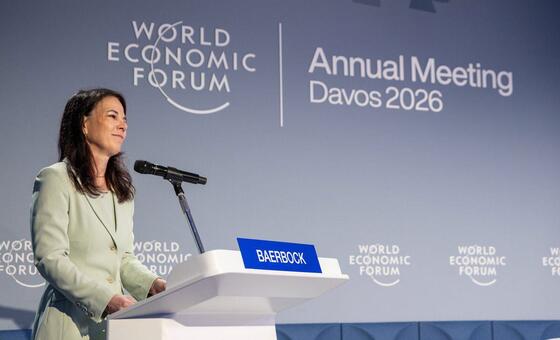

Speaking at the session Who Brokers Trust Now? at the World Economic Forum, Annalena Baerbock warned that multilateral institutions – long seen as the brokers of global trust – are under unprecedented strain as conflicts multiply and respect for international law erodes.
“Who brokers trust?” she asked. “In ordinary times, there would be a simple answer: multilateral institutions like the United Nations.” But, she added, these are “not ordinary times”.
Ms. Baerbock said the world is facing more conflicts than at any point in recent history. Since the start of 2026, she said, divisions have deepened further, leaving some Member States hesitant to act when circumstances demand principled conviction.
“Voices that were once outspoken in their support for all the three pillars of the United Nations Charter – peace and security, sustainable development, and human rights – fall more and more silent in the face of their erosion,” she said.
“The UN is not only under pressure but under outright attack.”
Facts and truths not up for negotiation
Ms. Baerbock stressed that trust cannot exist without truth and shared facts – foundations she said are increasingly undermined by deliberate disinformation.
“Without facts, you can’t have truth. Without truth, you can’t have trust,” she said, quoting Nobel Peace Prize laureate Maria Ressa.
She cautioned that falsehoods are rarely accidental, but are often deployed to “weaponize mis- and disinformation”, while diplomatic silence in the face of obvious falsehoods only deepens mistrust.
“We do not negotiate truths and facts,” Ms. Baerbock said. “We use them to negotiate, to broker trust.”
She highlighted the risks posed by artificial intelligence, noting that while AI offers enormous benefits, it is also being used to blur the line between truth and lies. Deepfakes, she said, are “systematically attacking women”, citing figures showing that the overwhelming majority of such content is pornographic and targets women.
UN Charter – ‘world’s life insurance’
Ms. Baerbock also highlighted that trust is impossible without common rules, arguing that respect for international law is not naïve idealism but a matter of enlightened self-interest.
“Trust is built on rules,” she said, likening the global system to competitive sports or markets where predictability and fairness are essential. “Why would you put your money into a business if the competition rules are totally unpredictable?”
Recalling the founding of the United Nations 80 years ago, she said leaders at the time chose cooperation after witnessing the catastrophic consequences of a lawless international order.
The UN Charter, she added, remains “the world’s common life insurance”, just as a rules-based economic order underpins global business and investment.
A call for broad alliance
The General Assembly President concluded by calling for a broad alliance – spanning governments, businesses and regions – to stand up for the international order and defend shared principles, even when it is politically or economically costly.
“Trust is brokered by those who hold up the common rules and principles, even when it is hard,” she said. “By those who act when action is required…and by those who speak the truth, when silence or distortion would be easier.”
The challenge now, Ms. Baerbock emphasised, is whether today’s leaders can act with the same courage and conviction as those who built the post-war international system.
“The founders of the United Nations understood that because they had seen what the alternative would mean, in a world where might makes right, there can be only one outcome: chaos and war.”