Rising hunger and displacement pose growing economic risk, UN tells Davos

The UN World Food Programme (WFP) has reported that an estimated 318 million people worldwide now face crisis levels of hunger or worse, with hundreds of thousands already experiencing famine-like conditions.

It cautioned that deep funding shortfalls are forcing it to cut rations and scale back assistance at a time of surging needs.

Current forecasts put WFP’s funding at just under half of its required $13 billion budget for 2026, leaving the agency able to reach about 110 million people – a third of those in need.

Combatting hunger yields dividends

“Hunger drives displacement, conflict, and instability and these not only threaten lives, but disrupt the very markets that businesses depend on,” said Rania Dagash-Kamara, WFP Assistant Executive Director for Partnerships and Innovation.

“The world cannot build stable markets on a foundation of 318 million hungry people.”

Ms. Dagash-Kamara, who is attending the forum, said the private sector has a direct stake in addressing food insecurity, calling on companies to invest in supply chains, technology and innovation that can help stabilize fragile markets and protect workforces.

WFP is urging business leaders in Davos to keep hunger and food security among their top priorities, invest in supply chain systems that strengthen fragile markets, and support food-related technologies that improve efficiency and resilience.

Displaced families in South Kivu, Democratic Republic of the Congo, receive food aid. (file photo)

Migration powers growth and development

The UN International Organization for Migration (IOM) is also taking its case to the annual forum in Switzerland, calling on political and business leaders to rethink migration as a driver of growth rather than a burden.

Migration is one of the most powerful drivers of development when managed responsibly,said IOM Director General Amy Pope.

“Mobility can unlock economic potential, help communities thrive independently, and provide lasting solutions to displacement, while respecting national sovereignty and human rights.”

Partnerships and innovation

IOM said partnerships with private companies and foundations are already helping realise that approach.  

This includes using artificial intelligence to improve health screening and labour market policies, and programmes that support vocational training, entrepreneurship and durable solutions for displaced people.

At Davos, the agency is also highlighting the role of diaspora communities as investors and innovators.

“By using remittances and diaspora capital to support business creation and digital financial access, IOM aims to open new markets and create jobs, while helping communities become more self-reliant,” the agency said.

Other senior UN officials attending the forum include President of the General Assembly Annalena Baerbock; WHO chief Tedros Adhanom Ghebreyesus; Alexander De Croo, Administrator of the UN Development Programme; UN High Commissioner for Refugees Barham Salih; and Rafael Mariano Grossi, Director-General of the International Atomic Energy Agency.

Source link

Gaza: Health system crumbles amid growing desperation over food, fuel

“Definitely, people get shot,” said Gaza-based medic Dr. Luca Pigozzi, WHO Emergency Medical Team Coordinator. “They are victim of blast injuries as well and bodily injuries.”

The WHO official’s comments follow reports of another mass casualty incident on Thursday, this time involving a strike on a market in the central city of Deir al Balah.

More than 20 people were killed and approximately 70 others were injured, said the UN aid wing, OCHA, with victims rushed to Al Aqsa Hospital, Nasser Medical Complex and two other health facilities.

Hundreds killed seeking food

In addition to the latest deadly incident, at least 410 Palestinians have been killed by the Israeli military while trying to fetch aid from controversial non-UN aid hubs supported by Israel and the United States, the UN human rights office, OHCHRsaid on Tuesday.

Providing high-quality medical care is very difficult in the war-torn occupied enclave today, “particularly because we are speaking about a high volume of patients every time”, Dr Pigozzi insisted.

Health needs are widespread and dramatic, with almost 50 per cent of medical stocks completely depleted.

WHO’s first medical shipment into Gaza on Wednesday was its first since 2 March, when Israel imposed a full blockade on the Strip.

In total, nine trucks carrying essential medical supplies entered the enclave with 2,000 units of blood and 1,500 units of plasma; all transited through the Kerem Shalom crossing. It is “only a drop in the ocean” of what is required, Dr Pigozzi said.

Aid obstacles remain

Speaking to journalists from Jerusalem, WHO’s Dr Rik Peeperkorn highlighted renewed difficulties in securing agreement from the Israeli authorities to allow more UN and partner agencies’ supply trucks into Gaza.

“That’s really unfortunate and should not happen, because you don’t want to see those desperate people, and specifically desperate young men, risking their lives to get some food either,” he said, amid reports of a chaotic rush for supplies at non-UN distribution points and of starving Gazans taking goods directly off lorries.

Before the Israeli blockade, the UN and its humanitarian partners demonstrated that their aid delivery system reached those most in need, insisted Dr Peeperkorn, WHO Representative in the occupied Palestinian territory. Today that is not the case because of repeated refusals by Israeli authorities to allow supplies into Gaza.

“Open the routes and make sure that we can get our supplies in,” he said. “The market needs to be flooded with food and non-food items and water, et cetera, et cetera, and including essential medicines in a most cost-effective manner.”

Denied entry

Since March, aid teams have encountered a 44 per cent denial rate, meaning that for every 10 staff requesting entry, “four to five of them are denied per rotation”, WHO’s Dr Pigozzi said.

Echoing that message, WHO spokesperson Christian Lindmeier insisted that people are starving, sick and dying across Gaza every day.

“They have been killed on the way trying to get medical help, they have been killed inside hospitals. Now, additionally, they are being killed on the way to get food items which are scarcely being provided,” he said.

“We have food and medical help minutes away across the border, sitting there and waiting for weeks and months by now. Just open the door.”

Gaza: UN warns of ‘weaponised hunger’ and growing death toll amid food chaos

Speaking to journalists in Deir al Balah on Saturday, Jonathan Whittall, who heads the UN humanitarian coordination office (OCHA) in Gaza and the West Bank, said: “The attempt to survive is being met with a death sentence.”

Since Israel eased its total blockade last month, more than 400 people are reported to have died trying to reach food distribution points.

We see a chilling pattern of Israeli forces opening fire on crowds gathering to get food,” Mr. Whittall said, noting many of these sites are in militarised zones. Others have been killed along access routes or while protecting aid convoys.

“It shouldn’t be this way,” he said. “There shouldn’t be a death toll associated with accessing the essentials for life.”

Empty warehouses, overwhelmed hospitals

Conditions across Gaza continue to deteriorate. Water wells have run dry or are located in dangerous areas, sanitation systems have collapsed, and disease is spreading rapidly.

“Our warehouses stand empty,” Mr. Whittall said. “Displaced families flee with nothing – and we have nothing to give them.”

Partially functioning hospitals are overwhelmed by near-daily mass casualty events. Some have been directly hit, while others are choked by fuel shortages and forced evacuation orders.

UNICEF reports more than 110 children are being treated for malnutrition every day. Mr. Whittall said humanitarian agencies are capable of reaching every family in the shattered enclave but are being systematically blocked. “We have a plan…but we are prevented from doing so at every turn.”

Death sentence

He described the situation as “weaponised hunger”, “forced displacement”, and “a death sentence for people just trying to survive”.

“This is carnage,” Mr. Whittall said. “It appears to be the erasure of Palestinian life from Gaza.”

He urged the international community to act: “We need a lasting ceasefire, accountability, and real pressure to stop this. This is the bare minimum.”

Societies grappling with a ‘silent but growing’ prison crisis

A decade ago, the UN General Assembly adopted the Nelson Mandela Rules — a set of 122 guidelines setting minimum standards for the treatment of prisoners, inspired by one of the world’s most influential former political prisoners – the South African civil rights icon, Nelson Mandela.

These rules aim to ensure safety, security and respect for human dignity, offering clear benchmarks for prison staff.

Despite this, prison systems worldwide continue to face deep-rooted challenges. The General Assembly  convened on Friday to discuss how to better protect societies from crime by focusing on rehabilitation and preparing inmates for life after prison.

Overcrowded cells

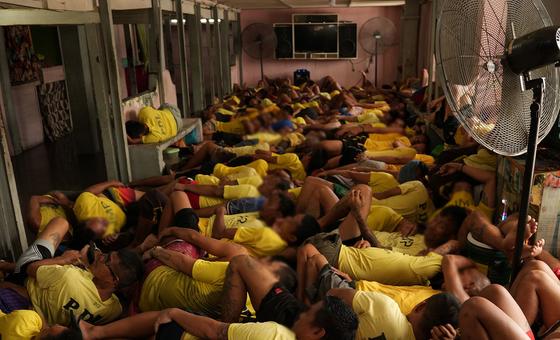
“Prison cells are overflowing,” said Ghada Waly, Executive Director of the UN Office on Drugs and Crime (UNODC), noting that 11.5 million people are currently imprisoned globally.

Overcrowding deprives people of their most basic rights, including access to healthcare, clean water and sanitation,” she warned. Yet prison services remain underfunded, under-prioritised and undervalued.

These systemic failures not only endanger inmates and staff but also weaken efforts to reintegrate former prisoners — posing risks for the wider community, added General Assembly President Philémon Yang.

Women behind bars

The number of women in prison has increased by 57 per cent over the past 20 years — nearly triple the rate of men.

Most systems are not equipped to meet their specific needs. “This is not safe. And this is not humane,” said Ms Waly.

Women in detention are especially vulnerable, facing greater risks of sexual violence, limited access to reproductive healthcare and separation from their children.

Time for bold reform

We need a bold vision — one that goes beyond bricks and bars to focus on people and their potential,” said Ms Waly, urging governments to reimagine how prisons are managed.

Handled responsibly, prisons can support public safety, justice and the rule of law. But today’s prison environments often remain dangerous and counterproductive.

UN officials stressed that rehabilitation must be at the heart of reforms, including support systems that reduce the likelihood of reoffending and help former prisoners reintegrate into society.

“The true measure of justice is not how we punish,” Mr Yang concluded, “but how we protect, rehabilitate, and build a better future for everyone, everywhere.” 

Source link

Gaza: UN relief chief welcomes growing support for aid teams to resume vital work

We value the support of more and more Member States who are joining our call: Let us work,” Mr. Fletcher said, his comments coinciding with the announcement that the US and Israeli-backed aid hub in southern Gaza operating independently of the UN had been suspended on Wednesday.

“The world is watching, day after day, horrifying scenes of Palestinians being shot, wounded or killed in Gaza while simply trying to eat,” Mr. Fletcher said.

New Security Council resolution

The development comes ahead of a Security Council meeting on Gaza on Wednesday seeking agreement on a draft resolution calling for an immediate ceasefire and the release of all remaining hostages taken during Hamas-led terror attacks in Israel on 7 October 2023.

The resolution push is the result of lobbying by the body’s 10 non-permanent Members. It remains to be seen if it will garner the support of the US and the four other countries that hold just five permanent seats on the 15-Member body: China, France, the UK and Russia. Any one of them could veto it.

Meanwhile in Gaza, local authorities on Wednesday claimed that at least 12 people including children had been killed in an Israeli strike on a school-turned-shelter in the southern city of Khan Younis.

In his appeal, Mr. Fletcher noted that medical teams had confirmed treating “hundreds of trauma cases” in recent days after footage showed chaotic scenes of Palestinians rushing to take food from the US and Israeli-run aid hubs in southern Gaza.

Yesterday alone, dozens were declared dead at hospitals after Israeli forces said they had opened fire,” Mr. Fletcher continued.

He insisted: “Open the crossings – all of them. Let in lifesaving aid at scale, from all directions. Lift the restrictions on what and how much aid we can bring in. Ensure our convoys aren’t held up by delays and denials.”

Aid teams highlight growing anxiety in Gaza after food is looted

“Fifteen World Food Programme trucks were looted late last night in Southern Gaza, while en route to WFP-supported bakeries,” the UN agency said. “These trucks were transporting critical food supplies for hungry populations waiting anxiously for assistance.”

The development is a blow to continuing efforts to help Gaza’s most vulnerable people after Israel allowed a limited number of aid trucks into Gaza earlier this week, following an 11-week total blockade.

Today, Gazans face “hunger, desperation and anxiety over whether more food aid is coming”, WFP said, noting that the uncertainty “is contributing to rising insecurity”.

“We need support from the Israeli authorities to get far greater volumes of food assistance into Gaza faster, more consistently and transported along safer routes, as was done during the ceasefire,” it insisted.

More to come on this developing story…

UN warns of growing humanitarian catastrophe in Gaza

In a statement released by the UN Humanitarian Country Team – which leads coordinated relief efforts across the Occupied Palestinian Territory – officials condemned Israeli efforts to dismantle the current aid system.

The team led by the UN’s top aid official in the region representing UN and non-governmental organizations (NGOs) both international and Palestinian, said Israeli plans would “contravene fundamental humanitarian principles” and deepen the suffering of civilians already enduring severe shortages of food, water, and medical care.

“Bakeries have shut. Community kitchens have closed. Warehouses stand empty. Children have gone hungry,” the statement said, describing the dire conditions facing the population.

The UN said Israeli authorities were attempting to impose a new aid distribution system that would funnel humanitarian supplies through military-controlled hubs, rather than allowing UN agencies and NGOs to operate independently.

‘Dangerous’ Israeli proposal

The proposal, the UN said, would leave “large parts of Gaza, including the less mobile and most vulnerable people,” without aid and would force civilians to enter militarised areas to access basic necessities.

This is dangerous, driving civilians into militarised zones to collect rations, threatening lives, including those of humanitarian workers,” the UN said, warning it would also exacerbate forced displacement across the strip.

According to news reports, the Israeli government has defended the policy as a security measure. At the same time, Israeli forces are planning to ramp up operations in central and southern Gaza.

On Saturday, call up notices were reportedly issued to thousands of Israeli military reservists, indicating a likely escalation of the offensive inside the Strip.

Guiding principles

The UN statement reaffirmed that aid operations must remain guided by the principles of “humanity, impartiality, independence and neutrality” and said all 16 UN entities and major humanitarian partners working in Gaza had endorsed this unified position.

“Humanitarian action responds to people’s needs, wherever they are,” the team said.

UN teams remain on the ground, “ready to again scale up the delivery of critical supplies and services” once the blockade is lifted. They urged global leaders to intervene and pressure Israel to reopen border crossings immediately.

“The time is now,” the UN said.

In a social media post on Sunday, the UN aid agency for Palestine refugees, UNRWA, pointed out that nearly a third of essential supplies for civilians in the Gaza Strip are out of stock while another third are projected to run out in under two months.

Source link