
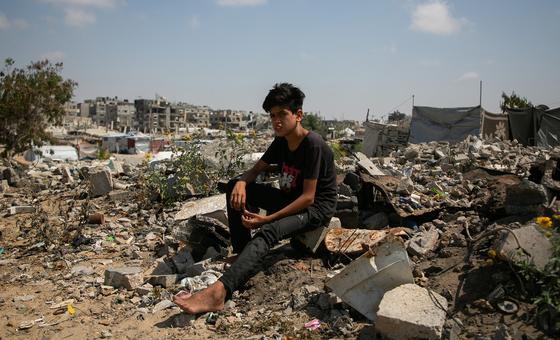
Humanitarians report more deaths, displacement and desperation in Gaza

“Every day brings more preventable deaths, displacement and desperation,” the agency said in a humanitarian update.

On Friday, Israeli authorities issued another displacement order, this time for parts of North Gaza.

OCHA said it continues to receive deeply troubling reports of malnourished children and adults being admitted to hospitals with insufficient resources available to treat them.

Fuel crisis deepens

The energy crisis in Gaza is also deepening, despite the resumption of limited fuel imports as the quantities that are entering – while critical for continuity – “remain at lower levels than what we were previously able to extract from dwindling internal reserves, which have now been fully depleted”.

The situation has forced solid waste collection to be paused in recent days, and additional wells have had to shut down, particularly in Deir Al-Balah.

“While specific health services, including dialysis, have reduced or shut down, others could go on for a few more days before they too will have to go dark,” OCHA warned.

“With every day that passes, people have less clean water and healthcare and more sewage flooding ground floors.”

Since the limited entry of fuel entry supplies resumed on 9 July, the UN has managed to send just over 600,000 litres of diesel to Kerem Shalom. On Thursday,

it was able to send 35,000 litres of much-needed benzene for the first time.

OCHA said these volumes are limited because Israel has allowed only 14 trucks over the past week. 

The agency stressed that to maintain lifesaving operations, hundreds of thousands of litres of fuel are needed every day. The limited fuel currently entering is primarily allocated to health, water and communications services as well as to power vehicles.

Humanitarian movements curtailed

Humanitarian movements inside Gaza also continue to be restricted.

On Thursday, seven out of 13 attempts to coordinate the movement of aid workers and supplies with the Israeli authorities were facilitated.

Teams were able to retrieve some fuel, collect some water, relocate generators, provide supplies related to hygiene and sanitation and transfer much-needed medical supplies.

The six remaining attempts were either outright denied or approved initially, but then faced obstacles on the ground.

End international media ban

Meanwhile, the head of the UN Palestine refugee agency UNRWA called on Friday for the ban on international media entering Gaza to be lifted.

“650 days of atrocities against civilians with no international media allowed in,” Philippe Lazzarini wrote in social media post, adding that over 200 Palestinian journalists have been killed during this time.

“Media ban fuels dis-information campaigns questioning first-hand data and accounts from eyewitnesses and international humanitarian organizations,” he said.

Source link

Gazans dying in search of food, ‘starkest illustration’ of their desperation

The fact that people are now dying every day trying to get food, I think is the starkest illustration of how desperate the situation is,” said Carl Skau, Deputy Executive Director at the UN agency, briefing journalists on his fourth visit to the war-torn enclave.

Earlier this year, food security experts reported that starvation is spreading in Gaza. The entire population, some two million people, is acutely food insecure and half a million are on the brink.

“If anything, it’s much worse now,” said Mr. Skau, who was in Gaza City, Deir Al-Balah and Khan Younis last week. 

Children going hungry

Malnutrition is also surging.  Some 90,000 children are in urgent need of treatment, according to UN child rights agency UNICEF

Today, one in three people goes hungry for days. Mr. Skau said he met many families who told him there are days when their children do not eat at all.

“But the days when they are eating it’s often a hot soup they get from us with just a few lentils or a few pieces of pasta, so certainly not enough,” he said, adding that some mothers discourage their children from playing to conserve energy.

The top official also addressed the widespread displacement in Gaza. In the past he met families who had been forced to flee two or three times, but now “I meet families who have moved two or three times in the past 10 days,” and some who have been uprooted upwards of 20 times. 

Trickle of aid

Meanwhile, outside of the recent 80-day aid blockade, humanitarian response “has never been more constrained.” The amount of assistance humanitarians are able to bring into Gaza is “just a fraction of what’s needed,” at a time when a kilo of wheat flour costs $25.

He added that the operating environment “is just impossible.” Active military operations are occurring in roughly 85 per cent of Gaza’s territory and teams “get stuck waiting for clearances and at checkpoints, often spending between 15 to 20 hours straight in their armoured vehicles trying to escort our convoys.”

Other obstacles include lack of fuel, spare parts for vehicles, and basic communications equipment.  

Engagement with Israel

Mr. Skau said WFP have been actively engaging with the Israeli authorities over the past few weeks and “there were commitments” around issues such as volumes of aid, faster humanitarian movements, and not having the Israel Defense Forces (IDF) present when convoys are moving.

“Now, obviously, the proof is in the pudding,” he said. “We need now to see delivery and implementation on those commitments, and so far, we have not seen enough progress.”

He noted that WFP were allowed to deliver aid through the north on Friday for the first time in several days, which was “a key issue.”

“It’s not only about getting enough volumes, but it’s also to be able to get in through the north because in the north we are able to deliver in a more orderly way,” he said.

He told journalists that “there have been issues with armed elements interfering” in the region, which is unacceptable, but stressed the importance of being able to deliver there “because we think that is the way to also help bring down the levels of desperation and prices.”

Ceasefire now

Mr. Skau stated that the minor progress regarding commitments “is not going to be enough to turn the tide of hunger,” underlining the urgent need for a ceasefire in Gaza.

During the ceasefire earlier this year, WFP facilitated the entry of more than 8,000 trucks into the enclave, opened 25 bakeries and hundreds of soup kitchens, and delivered food packages to more than 1.5 million people.

The agency was also able to stock its warehouses, meaning operations could continue for roughly half of the 80-day blockade.

“We are ready to do that again,” said Mr. Skau.  “We have enough food on the borders to deliver to the entire population for some two months. But obviously we need that ceasefire, and we need conditions within that ceasefire.”

Here, he stressed the need for a humanitarian protocol with a provision that allows for multiple routes and entry points into and inside Gaza – as well as a secure environment for delivery.

Later, Mr. Skau was asked about the talks with Israel.

“I sense the recognition that conditions need to improve,” he said.  “It was also recognised that the UN has a key role to play,” he added. 

“It was very clear in my engagement that they want the UN to continue to be the main track in delivery. 

“And certainly should there be a ceasefire, the indications were that they would want us to be ready to scale up and do what we did last time when we on Day One were ready to bring 600 trucks into Gaza.” 

Source link

Gaza: Health system crumbles amid growing desperation over food, fuel

“Definitely, people get shot,” said Gaza-based medic Dr. Luca Pigozzi, WHO Emergency Medical Team Coordinator. “They are victim of blast injuries as well and bodily injuries.”

The WHO official’s comments follow reports of another mass casualty incident on Thursday, this time involving a strike on a market in the central city of Deir al Balah.

More than 20 people were killed and approximately 70 others were injured, said the UN aid wing, OCHA, with victims rushed to Al Aqsa Hospital, Nasser Medical Complex and two other health facilities.

Hundreds killed seeking food

In addition to the latest deadly incident, at least 410 Palestinians have been killed by the Israeli military while trying to fetch aid from controversial non-UN aid hubs supported by Israel and the United States, the UN human rights office, OHCHRsaid on Tuesday.

Providing high-quality medical care is very difficult in the war-torn occupied enclave today, “particularly because we are speaking about a high volume of patients every time”, Dr Pigozzi insisted.

Health needs are widespread and dramatic, with almost 50 per cent of medical stocks completely depleted.

WHO’s first medical shipment into Gaza on Wednesday was its first since 2 March, when Israel imposed a full blockade on the Strip.

In total, nine trucks carrying essential medical supplies entered the enclave with 2,000 units of blood and 1,500 units of plasma; all transited through the Kerem Shalom crossing. It is “only a drop in the ocean” of what is required, Dr Pigozzi said.

Aid obstacles remain

Speaking to journalists from Jerusalem, WHO’s Dr Rik Peeperkorn highlighted renewed difficulties in securing agreement from the Israeli authorities to allow more UN and partner agencies’ supply trucks into Gaza.

“That’s really unfortunate and should not happen, because you don’t want to see those desperate people, and specifically desperate young men, risking their lives to get some food either,” he said, amid reports of a chaotic rush for supplies at non-UN distribution points and of starving Gazans taking goods directly off lorries.

Before the Israeli blockade, the UN and its humanitarian partners demonstrated that their aid delivery system reached those most in need, insisted Dr Peeperkorn, WHO Representative in the occupied Palestinian territory. Today that is not the case because of repeated refusals by Israeli authorities to allow supplies into Gaza.

“Open the routes and make sure that we can get our supplies in,” he said. “The market needs to be flooded with food and non-food items and water, et cetera, et cetera, and including essential medicines in a most cost-effective manner.”

Denied entry

Since March, aid teams have encountered a 44 per cent denial rate, meaning that for every 10 staff requesting entry, “four to five of them are denied per rotation”, WHO’s Dr Pigozzi said.

Echoing that message, WHO spokesperson Christian Lindmeier insisted that people are starving, sick and dying across Gaza every day.

“They have been killed on the way trying to get medical help, they have been killed inside hospitals. Now, additionally, they are being killed on the way to get food items which are scarcely being provided,” he said.

“We have food and medical help minutes away across the border, sitting there and waiting for weeks and months by now. Just open the door.”