
Hunger in Gaza: Women and children face death in search of food

“I used to easily receive aid distributed by the UN,” Abir Safi, a displaced person from the Zeitoun neighborhood of Gaza City, told UN News. “Now, we get nothing. I risk my life by going to the Zikim crossing and returning with an empty bag. All I want is to return to my children with some food.”

Ms. Safi said she never imagined that providing for her children would become a deadly adventure. After losing her husband in the war, she found herself alone, facing the responsibility of supporting her family amid deteriorating humanitarian conditions.

She was among thousands of citizens who gathered along Rashid Street in northern Gaza, which connects the Zikim crossing to northern Gaza, hoping to receive humanitarian aid.

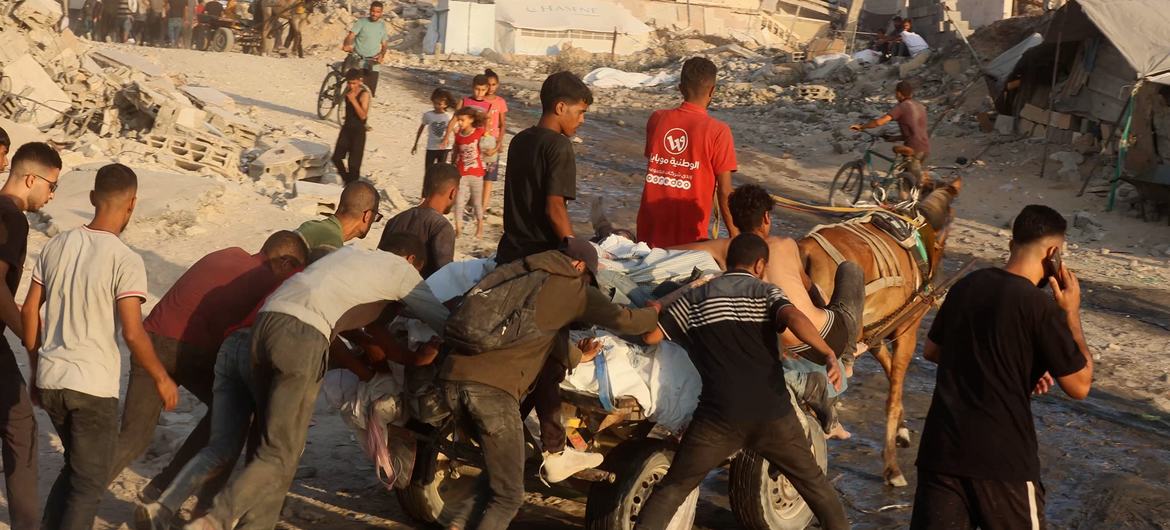
A horse-drawn cart carries the bodies of more than seven Palestinians killed while trying to reach aid.

‘Bullets over my head’

Our correspondent witnessed the arrival of thousands of Palestinians returning from a journey in search of food supplies. Thousands of emaciated bodies – men, women, and children – were caught in a scene that has become a daily occurrence. Everyone is running in search of the few aid trucks that reach northern Gaza.

The United Nations has the capacity and resources necessary to distribute aid in a safe, dignified manner to all those in need in the Gaza Strip. The organization continues to call for the lifting of restrictions imposed by the Israeli authorities on the entry and distribution of aid into Gaza.

The danger lies not only in the crowding and chaos, but also in the death that lurks around everyone. Fayza al-Turmisi, a displaced person from Shuja’iyya, described the horrific scene along Rashid Street in northern Gaza.

“They fire shells and bullets at us here. We are forced to lie on the ground. I hide among more than 200 men, and bullets fly over my head. If you raise your head, you get hit. If you stay on the ground, bullets fall around you.”
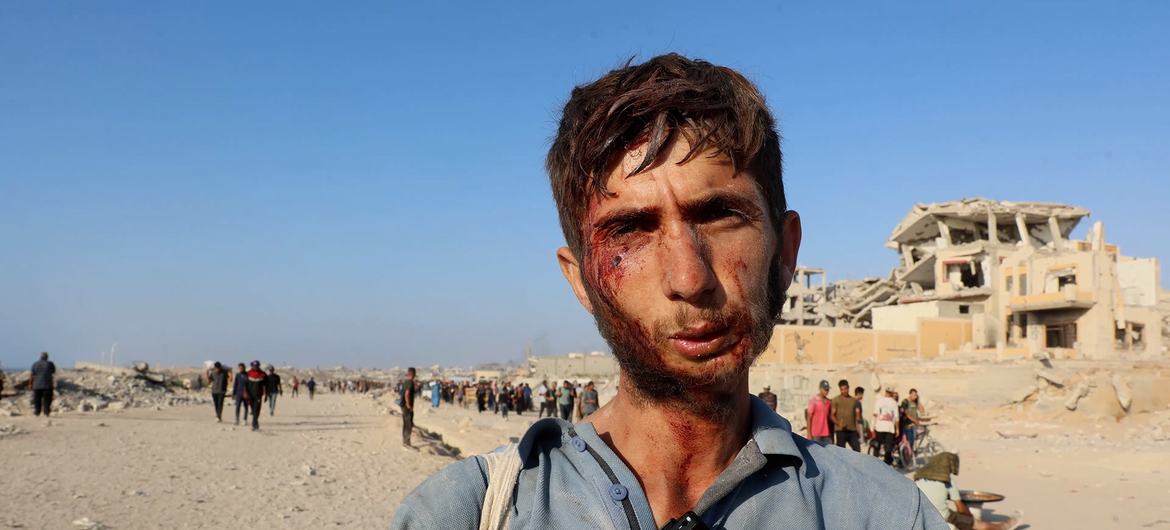
A young Gazan was injured while trying to obtain aid.

Between mourning and hunger

Mohammed Mudeiris, aged seven, said he lost his father in an airstrike just the day before. He doesn’t have the luxury of grieving for his father as he is now the sole breadwinner for his siblings.

Walking through the dense crowds, he extends his small hand, begging for a handful of flour to take back to his siblings.

“I am the eldest of my siblings,” he said. “My father was killed in an airstrike yesterday. I am trying to ask someone to give me a plate of flour or a meal from the aid that arrived today.”
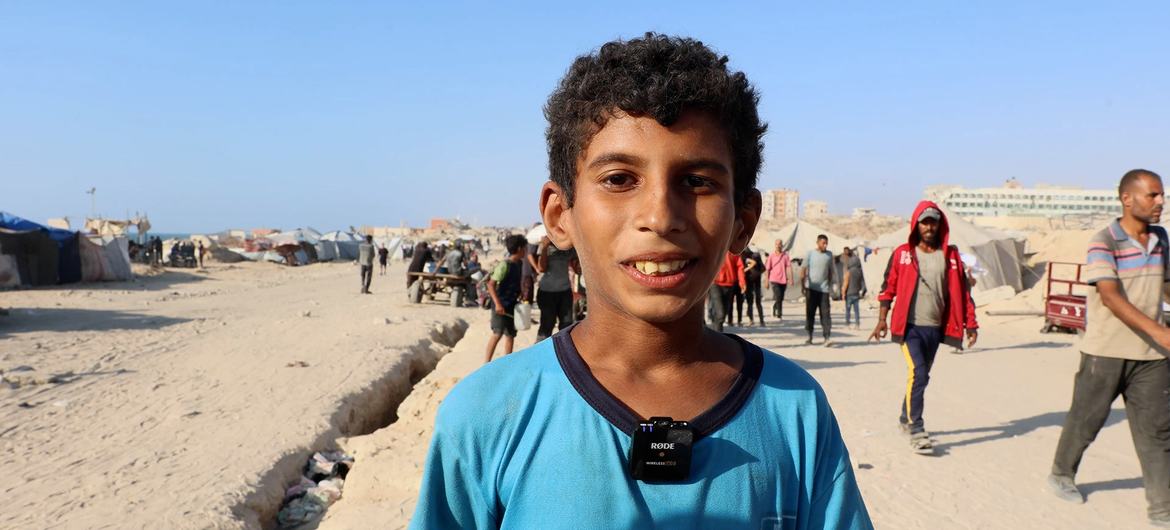
Mohammed Mudeiris, a child who lost his father in an Israeli airstrike, coming to secure food for his siblings from aid trucks arriving via the Zikim crossing.

‘I risk my life to bring food to my children’

The race for food is not limited to men. Women are forced to take this risk, driven by the responsibilities of motherhood and the needs of their children.

“I throw myself into danger to bring food for my children,” said Asma Masoud, who was displaced from northern Gaza.

“We never get our fair share of aid,” she said. “My husband is paralysed, and there are widows and women like me who cannot provide food for their children.”

Highlighting that some young people take the aid and sell it at exorbitant prices that she cannot afford to buy, Ms. Masoud called on the world to ensure “a fair distribution mechanism and to allow UNRWA [the UN agency for Palestine refugees] and international organizations to do so”.

Aid should be distributed via text messages so that every person in need receives their share, as was the case before, she said.

“But now, only a few people are profiting and selling the aid,” she stated. “We cannot tolerate that. It is an injustice.”
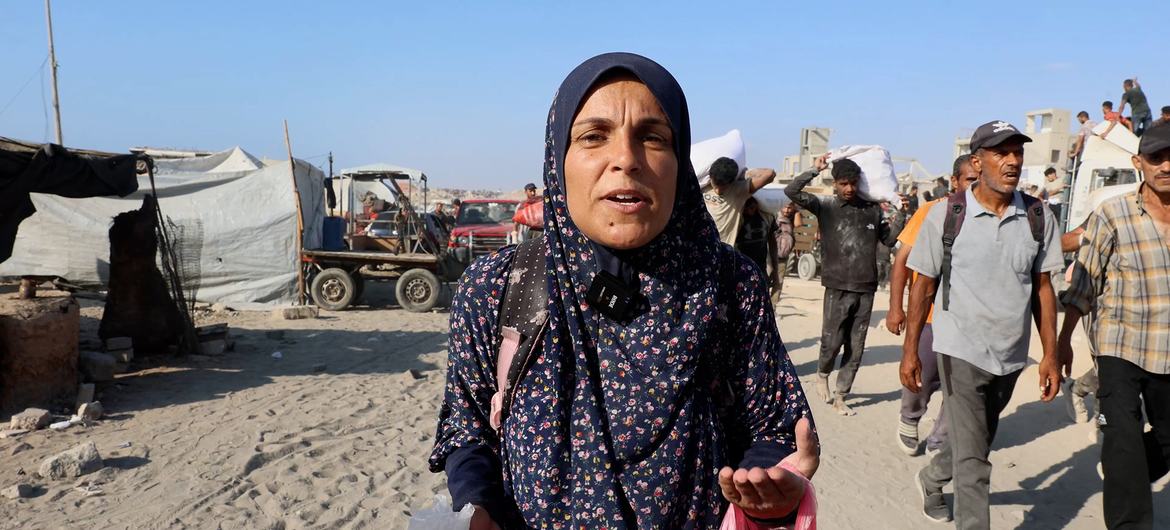
Asma Masoud, a displaced woman from northern Gaza, returning from a search for food.

‘I don’t know how I’m going to feed my children’

Ms. Safi agreed with Ms. Masoud, complaining that “the beneficiaries now are largely thieves.”

“I’ve lost a lot of weight, and all my health is gone,” Ms. Safi said. “I don’t know how I’m going to feed my children. I want to receive aid with dignity. Aid used to come through the United Nations, and I could easily go and receive it, but now I don’t receive anything.”

I want to receive aid with dignity.

This chaotic system leaves behind widows, women, the elderly and many other complex humanitarian cases, such as Maqboula Adas, who supports her injured husband and her son who has a broken leg.

“My husband is injured and cannot move,” she explained. “My eldest son has a broken leg, and I also have three daughters. No one supports us except God. Every day I go to try to get some flour. If it weren’t for that, they would have died of hunger.”
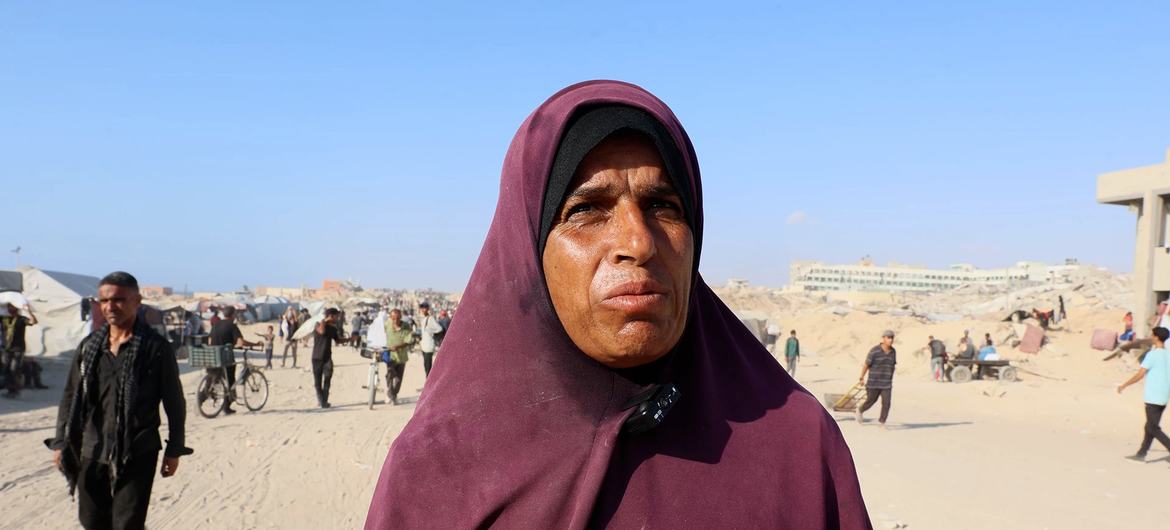
Maqboula Adas, a displaced woman from Shuja’iyya.

Carts carry corpses

At the height of this tragedy, macabre scenes emerge. Instead of carrying bags of flour, a horse-drawn cart transports the bodies of at least seven Palestinians who were killed while trying to get aid.

While some young men carried sacks of flour on their backs, ambulances bring the wounded and dead from the northern regions. The achievement of getting food aid comes at a heavy price.

One young man was injured in the head and face while trying to collect aid.

“I came to collect aid, but today wasn’t my day,” he said. “I will come again despite my injury, and I hope God will provide for me next time.”
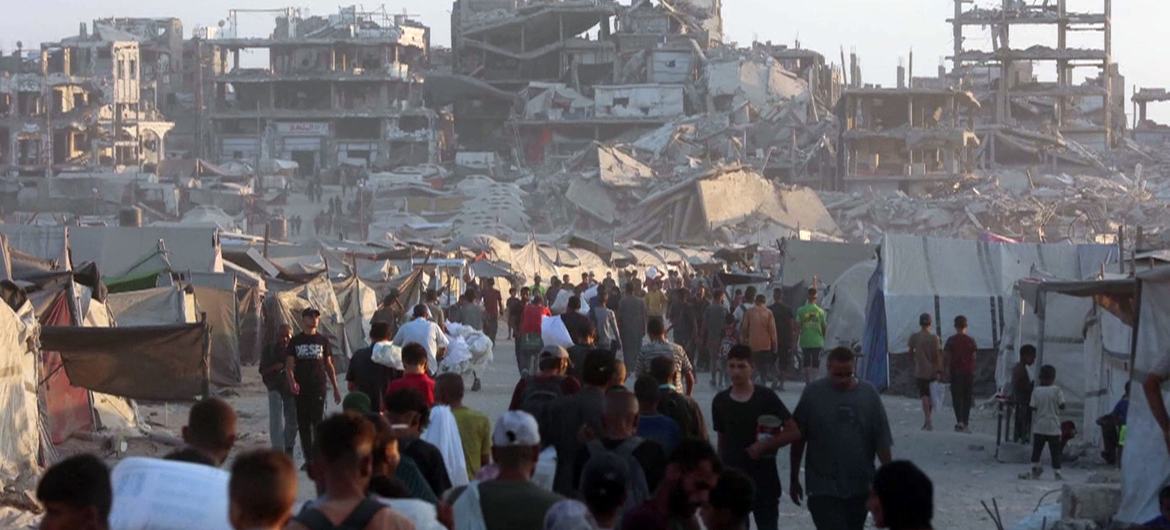
Thousands of Palestinians seeking aid arriving from the Israeli Zikim crossing in northern Gaza.

Risk of famine

Gaza is facing a severe risk of famine, with food consumption and nutrition indicators at their worst levels since the beginning of the current conflict, according to a warning issued by the Integrated Food Security Phase Classification (IPC). 

At least 147 deaths due to hunger and malnutrition have been reported, including 88 children. More than 28,000 cases of severe acute malnutrition have been recorded among children, according to reports from the World Health Organization and the World Food Programme.

Despite promises to facilitate the flow of aid, restrictions on the entry of food and fuel, along with ongoing attacks near the crossings, have prevented supplies from reaching those in need. In addition, the chaotic distribution of aid within Gaza has further complicated the situation and placed civilians at greater risk.

The UN human rights office (OHCHR) has documented the deaths of hundreds of people attempting to access aid amid ongoing gunfire and shelling near relief truck routes and military distribution points.
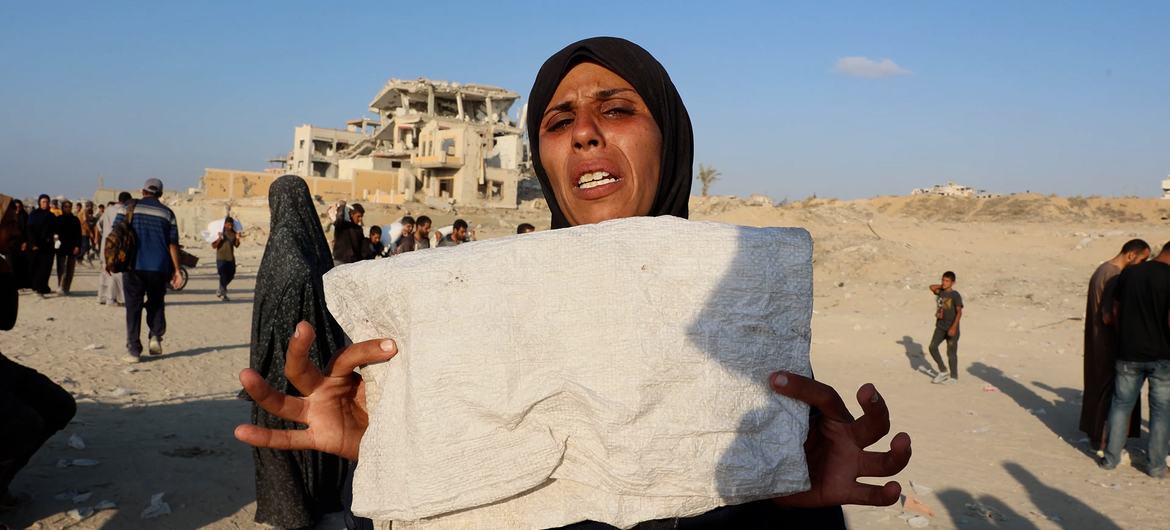
Abir Safi, a displaced woman from Al-Zaytoun neighbourhood.

‘If I get killed, who will take care of my children?’

Amidst this chaos, widow Enaam Siam, a mother of six, recounts her struggle for food.

“I am a widow and a mother of six orphaned children, one of whom is injured,” she said. “Every day, I go out amidst death to bring them food. I see the dead and wounded.”

She asked why aid is no longer delivered to warehouses and distributed via text message.

“If I am killed, who will take care of my children? There are thousands of women in a similar situation. We want safety, peace and a fair system that ensures aid reaches those in need.”

Source link

Gazans dying in search of food, ‘starkest illustration’ of their desperation

The fact that people are now dying every day trying to get food, I think is the starkest illustration of how desperate the situation is,” said Carl Skau, Deputy Executive Director at the UN agency, briefing journalists on his fourth visit to the war-torn enclave.

Earlier this year, food security experts reported that starvation is spreading in Gaza. The entire population, some two million people, is acutely food insecure and half a million are on the brink.

“If anything, it’s much worse now,” said Mr. Skau, who was in Gaza City, Deir Al-Balah and Khan Younis last week. 

Children going hungry

Malnutrition is also surging.  Some 90,000 children are in urgent need of treatment, according to UN child rights agency UNICEF

Today, one in three people goes hungry for days. Mr. Skau said he met many families who told him there are days when their children do not eat at all.

“But the days when they are eating it’s often a hot soup they get from us with just a few lentils or a few pieces of pasta, so certainly not enough,” he said, adding that some mothers discourage their children from playing to conserve energy.

The top official also addressed the widespread displacement in Gaza. In the past he met families who had been forced to flee two or three times, but now “I meet families who have moved two or three times in the past 10 days,” and some who have been uprooted upwards of 20 times. 

Trickle of aid

Meanwhile, outside of the recent 80-day aid blockade, humanitarian response “has never been more constrained.” The amount of assistance humanitarians are able to bring into Gaza is “just a fraction of what’s needed,” at a time when a kilo of wheat flour costs $25.

He added that the operating environment “is just impossible.” Active military operations are occurring in roughly 85 per cent of Gaza’s territory and teams “get stuck waiting for clearances and at checkpoints, often spending between 15 to 20 hours straight in their armoured vehicles trying to escort our convoys.”

Other obstacles include lack of fuel, spare parts for vehicles, and basic communications equipment.  

Engagement with Israel

Mr. Skau said WFP have been actively engaging with the Israeli authorities over the past few weeks and “there were commitments” around issues such as volumes of aid, faster humanitarian movements, and not having the Israel Defense Forces (IDF) present when convoys are moving.

“Now, obviously, the proof is in the pudding,” he said. “We need now to see delivery and implementation on those commitments, and so far, we have not seen enough progress.”

He noted that WFP were allowed to deliver aid through the north on Friday for the first time in several days, which was “a key issue.”

“It’s not only about getting enough volumes, but it’s also to be able to get in through the north because in the north we are able to deliver in a more orderly way,” he said.

He told journalists that “there have been issues with armed elements interfering” in the region, which is unacceptable, but stressed the importance of being able to deliver there “because we think that is the way to also help bring down the levels of desperation and prices.”

Ceasefire now

Mr. Skau stated that the minor progress regarding commitments “is not going to be enough to turn the tide of hunger,” underlining the urgent need for a ceasefire in Gaza.

During the ceasefire earlier this year, WFP facilitated the entry of more than 8,000 trucks into the enclave, opened 25 bakeries and hundreds of soup kitchens, and delivered food packages to more than 1.5 million people.

The agency was also able to stock its warehouses, meaning operations could continue for roughly half of the 80-day blockade.

“We are ready to do that again,” said Mr. Skau.  “We have enough food on the borders to deliver to the entire population for some two months. But obviously we need that ceasefire, and we need conditions within that ceasefire.”

Here, he stressed the need for a humanitarian protocol with a provision that allows for multiple routes and entry points into and inside Gaza – as well as a secure environment for delivery.

Later, Mr. Skau was asked about the talks with Israel.

“I sense the recognition that conditions need to improve,” he said.  “It was also recognised that the UN has a key role to play,” he added. 

“It was very clear in my engagement that they want the UN to continue to be the main track in delivery. 

“And certainly should there be a ceasefire, the indications were that they would want us to be ready to scale up and do what we did last time when we on Day One were ready to bring 600 trucks into Gaza.” 

Source link

Gaza: Search for food puts lives on the line

Since the end of May, aid distribution in Gaza has been carried out by a mechanism backed by Israel and the United States bypassing UN agencies and their established partners, which has been plagued by deadly incidents and chaos.

On Monday, UN partner the International Committee of the Red Cross (ICRC) reported that 29 casualties arrived at its field hospital in west Rafah that morning, eight of whom had died. 

Almost all had explosive trauma wounds, with two others suffering gunshot wounds. 

Forced to choose

“The UN reiterates that civilians must always be protected,” said Deputy Spokesperson Farhan Haq, speaking from Headquarters in New York.

No person, anywhere, should be forced to choose between risking one’s life and feeding one’s family.”  

Fuelling aid efforts

Meanwhile, fuel stocks in Gaza are dangerously low, putting further strain on critical services and humanitarian operations. 

Mr. Haq said that some 260,000 litres of fuel were looted in northern Gaza over the weekend.

Prior to this, the UN had repeatedly tried to reach these stocks to retrieve them, but the Israeli authorities denied these attempts – with 14 denials since 15 May. 

“Our attempts to reach fuel supplies in Rafah, in the south of Gaza, also continue to be denied,” he added.

“The UN warns that unless a solution is found in the coming days, the entire aid operation could come to a standstill.”

© UNRWA/Louise Wateridge

Palestinians who have taken refuge in a UNRWA school in Deir al-Balah camp in central Gaza are struggling to survive as they lack access to basic humanitarian needs in the central Gaza city of Deir al-Balah.

‘Desperate, starving people’

Mr. Haq also updated on efforts to bring desperately needed humanitarian assistance into the Gaza Strip, where the entire population, more than two million people, faces famine conditions.

On Monday, the UN led a mission to deliver supplies that entered the enclave via the Kerem Shalom border crossing to Gaza City, which was still ongoing. 

Since Israel allowed limited amounts of aid to enter on 19 May, the UN and partners have only been able to collect about 4,600 metric tonnes of wheat flour from Kerem Shalom.

“Most of it was taken by desperate, starving people before the supplies reached their destinations. In some cases, the supplies were looted by armed gangs,” he said.

Resume aid flow now

Mr. Haq emphasized that as the occupying power, Israel bears responsibility when it comes to public order and safety in Gaza. 

“That should include letting in far more essential supplies, through multiple crossings and routes, to meet humanitarian needs and help reduce looting,” he said.

UN partners working on food security estimate that between 8,000 and 10,000 metric tonnes of wheat flour is required to reach all families across Gaza with at least a single bag.

He stressed that “the sustained and unrestricted flow of aid into Gaza must resume as soon as possible.” 

Dangerous routes, driver shortages and delays

He said no missions to collect supplies from Kerem Shalom took place at the weekend as Israel informed that the crossing would remain closed on Friday and Saturday.

Humanitarians also continue to face major impediments that affect their ability to conduct these operations, including unacceptably dangerous routes, a severe shortage of vetted drivers, and delays.

West Bank update

Mr. Haq also touched on the situation in the occupied West Bank.

He said operations by the Israeli forces in the north have continued over the past week, destroying roads and disrupting Palestinians’ access to essential services. 

The UN and partners continue to respond, including by providing water, sanitation and hygiene assistance to tens of thousands of displaced Palestinians.