
UN peacekeeping patrols suspended along Lebanon-Israel Blue Line

The incident took place north of the Blue Line on Sunday morning and led to the suspension of more than a dozen UN peacekeeping activities for over nine hours, according to UN Spokesperson Stéphane Dujarric.

Toxicology tests

The IDF said that peacekeepers should stay clear of the area,” Mr. Dujarric told reporters in New York. He added that peacekeepers had supported the Lebanese army in collecting samples dropped, for a toxicology report.

As of Monday afternoon, the test results had not been received.

The Blue Line stretches for approximately 120 kilometres along Lebanon’s southern frontier and serves as a “line of withdrawal” confirming Israel’s withdrawal from southern Lebanon.

The UN reiterated concerns about flight movements across the Blue Line, saying such activities violate Security Council resolution 1701, which brought an end to the 2006 hostilities between Israel and Hezbollah, and outlines UNIFIL’s mandate.

The latest cessation of hostilities agreement between the two sides was signed in November 2024, after violence flared between Hezbollah and Israeli across the Blue Line following the commencement of the Gaza war.

Any activity that may put peacekeepers and civilians at risk is of serious concern,” Mr. Dujarric said. “We reiterate our call on all parties to fully comply with their obligations under resolution 1701.”

Wider concerns

The UN Interim Force in Lebanon (UNIFIL) said the incident also raised concerns about the potential impact of the unidentified substance on civilians, agricultural land and the longer-term return of residents to their homes and livelihoods near the Blue Line.

This is not the first time that the IDF has dropped unknown chemical substances from airplanes over Lebanon,” the mission said, reiterating its call on the IDF “to stop all such activities and work with peacekeepers to support the stability we are all working to achieve.”

Source link

World News in Brief: violence spurs displacement in Syria, Israeli forces cross the Blue Line in Lebanon, mall fire kills dozens in Iraq

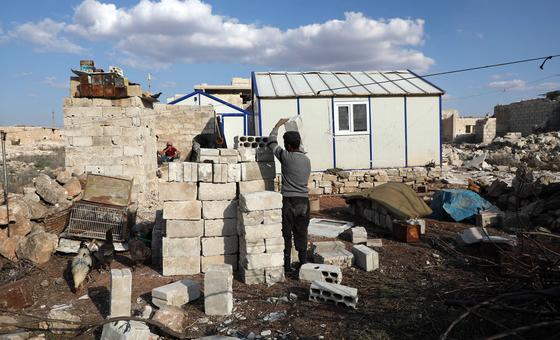
As of Thursday, nearly 2,000 families have been displaced from violence-affected areas in Sweida governate and are currently sheltering in a dozen collective sites. Many are unable to return home due to damage, looting or destruction of their homes.

The health systems in Sweida and neighbouring Dar’a governorate remain under critical strain, operating without power and facing severe supply shortages. Reports also suggest that at least two doctors were killed in the recent clashes, and some armed groups have occupied health facilities, putting patients and staff at risk.

Mobilisation amid constrained access

The UN and its partners are mobilising humanitarian assistance as security allows and working with authorities to facilitate access.

The World Health Organization (WHO) has dispatched 35 trauma and emergency surgery kits for 1,750 interventions, but many remain undelivered because of constrained access.  

“We urge all parties to protect people caught up in the violence, including by allowing them to move freely to seek safety and medical assistance,” said Associate Spokesperson for the Secretary-General Stephanie Tremblay at Thursday’s daily press briefing in New York.

She also stressed that security forces must respect applicable international law, norms and standards throughout their operations.

Lebanon: UN peacekeepers observe unauthorised Israeli activities  

Ms. Tremblay also reported that peacekeepers at the UN Interim Force in Lebanon (UNIFIL) continue to observe Israeli military activities in its area of operations.

On 16 July, Israeli soldiers crossed north of the Blue Line to conduct military exercises.  

UNIFIL peacekeepers have also heard several explosions, including one on 17 July near the Mission Headquarters in Naqoura.  

The “blue helmets” have additionally discovered unauthorized weapons and ammunition caches at one site, rocket launchers, rocket-propelled grenades, mortar rounds and ammunition boxes.  

Commitment to Lebanon

In response to recent observations the UN Special Coordinator for Lebanon, Jeanine Hennis-Plasschaert, and UNIFIL Head of Mission and Force Commander, Major General Diodato Abagnara, met with the Lebanese Army’s South Litani Sector Commander Brigadier General Nicolas Tabet in Tyre on 17 July.  

“Ms. Hennis-Plasschaert and General Abagnara underlined our commitment to supporting the implementation of Security Council resolution 1701, including strengthening State authority and helping restore stability in southern Lebanon,” Ms. Tremblay said.

As part of UNIFIL’s support, peacekeepers trained with Lebanese Armed Forces personnel in Tyre on 16 July, enhancing the operational competency of the Lebanese Army personnel.

Fire in Iraqi shopping mall

The United Nations has expressed condolences to the families of the victims of a tragic fire in the eastern Iraqi city of Kut on Wednesday.

According to news reports, the fire tore through the shopping centre – which opened only a week ago – leaving at least 61 people dead.  

“We express our strong solidarity with the people of Wasit Governorate in this profound loss,” Ms. Tremblay said.  

She also emphasised that the UN and its partners are ready to provide humanitarian assistance to help mitigate the tragedy’s impact.

Source link

Development is ‘the first line of defense against conflict,’ Guterres tells Security Council

Ambassadors met to debate how poverty, inequality, and underdevelopment are fuelling conflict and instability, at a time when hostilities are increasing and demand for humanitarian aid is rising as resources dwindle.  

Every dollar spent on prevention could save up to $103 in conflict-related costs, according to the International Monetary Fund (IMF). 

Sustainable development critical

Conflicts are proliferating and lasting longer, said Mr. Guterres. At the same time the global economy is slowing and trade tensions are rising, as aid budgets are being slashed while military spending soars. 

He warned that if current trends continue, two thirds of the world’s poor will live in conflict-affected or fragile countries by the end of this decade. 

“The message is clear,” he said.  “The farther a country is from sustainable and inclusive development, the closer it is to instability, and even conflict.”

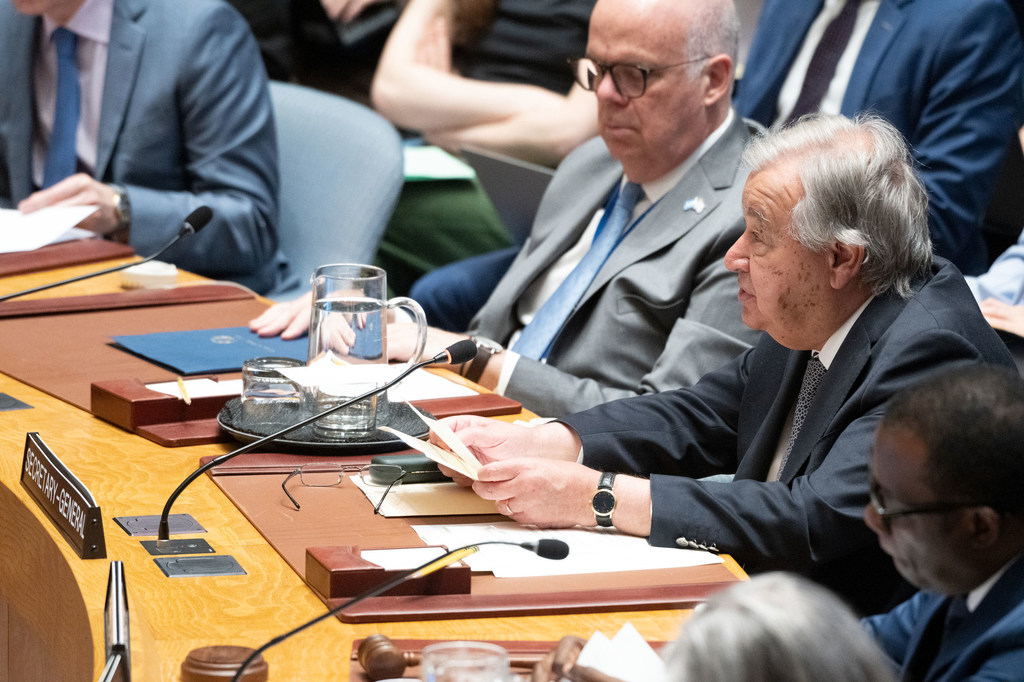
Secretary-General António Guterres briefs the Security Council meeting on Poverty, Underdevelopment, and Conflict.

Give peace a (fighting) chance

The Secretary-General highlighted how the UN has worked to advance the three pillars of peace, development and human rights.  

These efforts began with its establishment 80 years ago and continue today, “guided by the simple principle that prevention is the best cure for instability and conflict, and there is no better preventive measure than investing in development,” he said.

“Development gives peace a fighting chance. It’s the first line of defence against conflict. But right now, we’re losing ground,” he said, noting that “the engine of development is sputtering.”

World falling short

Currently, two-thirds of the targets under the Sustainable Development Goals (SDGs) are lagging 10 years after adoption. 

“The world is falling short by over $4 trillion annually in the resources developing countries need to deliver on these promises by 2030,” he added.

Furthermore, “developing countries are being battered and bruised by limited fiscal space, crushing debt burdens and skyrocketing prices.”

Fix the ‘engine’

The Secretary-General pointed to the fourth Conference on Financing for Development, which begins next week in Spain, as an important moment “to fix and strengthen this essential engine.”

He called for renewed commitments towards securing public and private finance for the areas of greatest need, providing urgent relief for debt-laden countries, and reforming the outdated global financial architecture.

The Council debate “could not be more prescient,” said Kanni Wignaraja, the UN Development Programme’s (UNDP) Assistant Secretary-General and Regional Director for Asia and the Pacific.

Break the cycle

Global human development has stalled just as violent conflicts have surged to levels not seen in eight decades, she said, before presenting three priorities for investment to help break the cycle, including protecting household economies.

“In fragile settings, where peace and security have been shattered, development that goes directly to the local level becomes the first line of peoples’ defence and survival. And their hope for recovery,” she said.

“From these local economies – where livelihoods are restored, water and electricity can flow again, women’s businesses in particular reopen, farmers can trade food, and there is basic finance to allow markets to stay afloat – from this, comes the resources to build back broken capabilities and resilience.”

Address systemic imbalances

The Chairperson of the African Union (AU) Commission, Mahmoud Youssouf Ali, recalled how the continent loses billions of dollars annually to conflict, which could be channelled into schools, hospitals, infrastructure and innovation.

He said the international community must also acknowledge that poverty and underdevelopment “are not confined within national borders” but are global challenges that require global response.

“If we are to uphold international peace and security, we must address the systemic imbalances – economic, political, and institutional – that continue to fuel deprivation, exclusion, and instability across regions,” he said.

In this regard, the AU called for enhanced support to African-led peace operations, particularly those deployed in regions where poverty and underdevelopment are deeply entrenched. 

Critical juncture requires collective action

The debate was convened by Guyana, which holds the rotating Council presidency this month.

The country’s Foreign Minister, Hugh Todd, remarked that with the world “at a critical juncture where the interlinkages between peace, security and development have never been more pronounced,” collective and decisive action is required.

He cautioned against “prioritizing only political solutions in conflicts where poverty and underdevelopment feature prominently,” as creating conditions for socio-economic stability and well-being are also critical for peace.

Mr. Todd urged countries to address issues such as lack of access to education, unemployment, exclusion, and greater participation of women and youth.

“Currently, the global youth population is the highest in history, with most young people concentrated in developing countries,” he said.

“For us to harness their full potential, they must be given adequate economic opportunities and be involved in decision making on peace and security.” 

Source link

Gaza: Search for food puts lives on the line

Since the end of May, aid distribution in Gaza has been carried out by a mechanism backed by Israel and the United States bypassing UN agencies and their established partners, which has been plagued by deadly incidents and chaos.

On Monday, UN partner the International Committee of the Red Cross (ICRC) reported that 29 casualties arrived at its field hospital in west Rafah that morning, eight of whom had died. 

Almost all had explosive trauma wounds, with two others suffering gunshot wounds. 

Forced to choose

“The UN reiterates that civilians must always be protected,” said Deputy Spokesperson Farhan Haq, speaking from Headquarters in New York.

No person, anywhere, should be forced to choose between risking one’s life and feeding one’s family.”  

Fuelling aid efforts

Meanwhile, fuel stocks in Gaza are dangerously low, putting further strain on critical services and humanitarian operations. 

Mr. Haq said that some 260,000 litres of fuel were looted in northern Gaza over the weekend.

Prior to this, the UN had repeatedly tried to reach these stocks to retrieve them, but the Israeli authorities denied these attempts – with 14 denials since 15 May. 

“Our attempts to reach fuel supplies in Rafah, in the south of Gaza, also continue to be denied,” he added.

“The UN warns that unless a solution is found in the coming days, the entire aid operation could come to a standstill.”

© UNRWA/Louise Wateridge

Palestinians who have taken refuge in a UNRWA school in Deir al-Balah camp in central Gaza are struggling to survive as they lack access to basic humanitarian needs in the central Gaza city of Deir al-Balah.

‘Desperate, starving people’

Mr. Haq also updated on efforts to bring desperately needed humanitarian assistance into the Gaza Strip, where the entire population, more than two million people, faces famine conditions.

On Monday, the UN led a mission to deliver supplies that entered the enclave via the Kerem Shalom border crossing to Gaza City, which was still ongoing. 

Since Israel allowed limited amounts of aid to enter on 19 May, the UN and partners have only been able to collect about 4,600 metric tonnes of wheat flour from Kerem Shalom.

“Most of it was taken by desperate, starving people before the supplies reached their destinations. In some cases, the supplies were looted by armed gangs,” he said.

Resume aid flow now

Mr. Haq emphasized that as the occupying power, Israel bears responsibility when it comes to public order and safety in Gaza. 

“That should include letting in far more essential supplies, through multiple crossings and routes, to meet humanitarian needs and help reduce looting,” he said.

UN partners working on food security estimate that between 8,000 and 10,000 metric tonnes of wheat flour is required to reach all families across Gaza with at least a single bag.

He stressed that “the sustained and unrestricted flow of aid into Gaza must resume as soon as possible.” 

Dangerous routes, driver shortages and delays

He said no missions to collect supplies from Kerem Shalom took place at the weekend as Israel informed that the crossing would remain closed on Friday and Saturday.

Humanitarians also continue to face major impediments that affect their ability to conduct these operations, including unacceptably dangerous routes, a severe shortage of vetted drivers, and delays.

West Bank update

Mr. Haq also touched on the situation in the occupied West Bank.

He said operations by the Israeli forces in the north have continued over the past week, destroying roads and disrupting Palestinians’ access to essential services. 

The UN and partners continue to respond, including by providing water, sanitation and hygiene assistance to tens of thousands of displaced Palestinians.