UN peacekeeping patrols suspended along Lebanon-Israel Blue Line

The incident took place north of the Blue Line on Sunday morning and led to the suspension of more than a dozen UN peacekeeping activities for over nine hours, according to UN Spokesperson Stéphane Dujarric.

Toxicology tests

The IDF said that peacekeepers should stay clear of the area,” Mr. Dujarric told reporters in New York. He added that peacekeepers had supported the Lebanese army in collecting samples dropped, for a toxicology report.

As of Monday afternoon, the test results had not been received.

The Blue Line stretches for approximately 120 kilometres along Lebanon’s southern frontier and serves as a “line of withdrawal” confirming Israel’s withdrawal from southern Lebanon.

The UN reiterated concerns about flight movements across the Blue Line, saying such activities violate Security Council resolution 1701, which brought an end to the 2006 hostilities between Israel and Hezbollah, and outlines UNIFIL’s mandate.

The latest cessation of hostilities agreement between the two sides was signed in November 2024, after violence flared between Hezbollah and Israeli across the Blue Line following the commencement of the Gaza war.

Any activity that may put peacekeepers and civilians at risk is of serious concern,” Mr. Dujarric said. “We reiterate our call on all parties to fully comply with their obligations under resolution 1701.”

Wider concerns

The UN Interim Force in Lebanon (UNIFIL) said the incident also raised concerns about the potential impact of the unidentified substance on civilians, agricultural land and the longer-term return of residents to their homes and livelihoods near the Blue Line.

This is not the first time that the IDF has dropped unknown chemical substances from airplanes over Lebanon,” the mission said, reiterating its call on the IDF “to stop all such activities and work with peacekeepers to support the stability we are all working to achieve.”

Source link

Peacekeeping: Lacroix warns of rising threats to ‘blue helmets’ in Middle East

Briefing journalists by video link from Jeddah following an extensive visit to the region, Jean-Pierre Lacroix, said there has been an uptick in dangerous incidents involving peacekeepers and the fragile environment in which missions are operating.

He added that UN missions are continuing to deliver on their mandates despite increasingly challenging conditions on the ground.

“There is no pre-drawdown mandate,” Mr. Lacroix said of the UN Interim Force in Lebanon (UNIFIL), stressing that the mission will continue to operate under its current authorisation until the end of December 2026.

UNIFIL, he said, remains focused on supporting the Lebanese Armed Forces (LAF) and advancing implementation of Security Council resolution 1701, which brought an end to hostilities between Israeli forces and Hezbollah in 2006.

Mr. Lacroix said cooperation with Lebanese authorities and the LAF remained “excellent,” and welcomed recent statements by the Government regarding progress in establishing operational control in the south, while acknowledging that “a number of things remain to be done.”

Increasing danger

At the same time, he expressed grave concern over a growing number of hostile incidents affecting UN peacekeepers, particularly those involving the Israeli Defense Forces.

“The frequency of these incidents has been quite high – it has been increasing,” he said, warning that several encounters “could have had very tragic consequences” for peacekeepers.

He said he had raised the issue with Israeli counterparts, stressing that “it is in no one’s interest to put the lives of peacekeepers at risk,” and reminded all parties of their responsibility to ensure the safety and security of UN personnel.

Mr. Lacroix also described widespread devastation in southern Lebanon, where entire villages and civilians remain unable to return to their homes, undermining prospects for recovery and reconstruction.

Beyond security risks, Mr. Lacroix highlighted the impact of funding shortfalls on peacekeeping operations, noting that UNIFIL and other missions have had to implement savings plans due to delayed or incomplete contributions by some Member States.

He praised peacekeepers for adapting under pressure, saying they had “succeeded in mitigating the impact” of financial constraints through innovation and operational adjustments.

Syria and regional dynamics

Turning to Syria, Mr. Lacroix said the UN Disengagement Observer Force (UNDOF) continues to carry out its mandate with strong backing from both the Security Council and Syrian authorities.

However, he noted that conditions on the ground have changed significantly since Israeli forces established positions inside the area of separation defined by the 1974 disengagement agreement.

Established in May 1974, following the Yom Kippur War, UNDOF is mandated to maintain the ceasefire between Israel and Syria, and supervise the areas of separation as provided in the 1974 agreement.

What we would want is a return to the situation where UNDOF would be the only military presence in the area of separation,” Mr. Lacroix said, describing recent talks between Israel and Syria, mediated by the United States, as “positive.”

UN Photo/Wolfgang Grebien

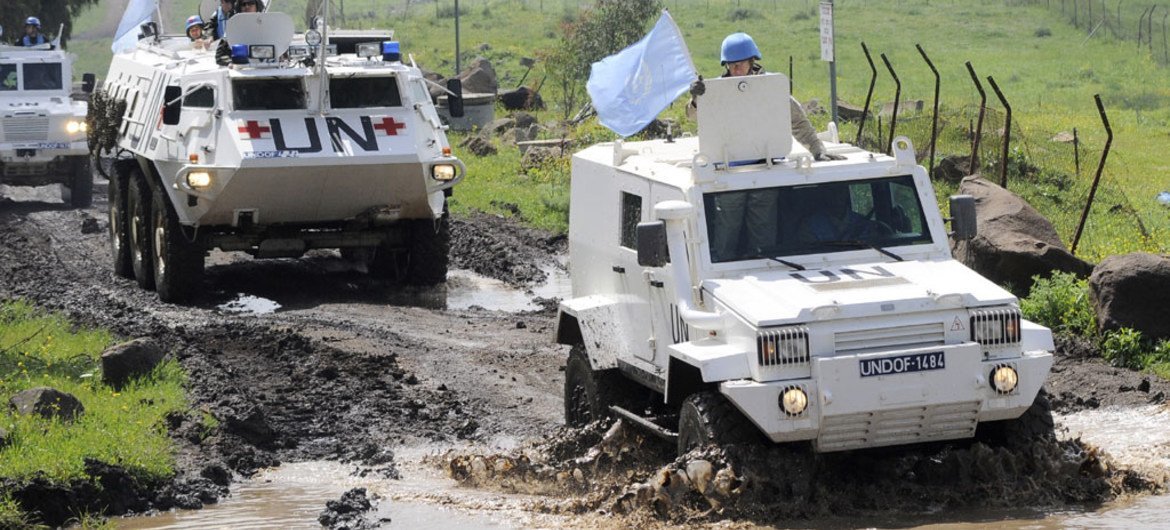
UNDOF peacekeepers on patrol in the Golan Heights.

Mine action and wider needs

He also underscored the growing importance of UN mine action efforts in Lebanon, Syria, Gaza and the Occupied Palestinian Territory overall, saying needs were “huge” and urging greater donor support.

We are willing to do more,” Mr. Lacroix said, stressing that additional resources would be critical to protect civilians and support recovery in conflict-affected areas.

World News in Brief: violence spurs displacement in Syria, Israeli forces cross the Blue Line in Lebanon, mall fire kills dozens in Iraq

As of Thursday, nearly 2,000 families have been displaced from violence-affected areas in Sweida governate and are currently sheltering in a dozen collective sites. Many are unable to return home due to damage, looting or destruction of their homes.

The health systems in Sweida and neighbouring Dar’a governorate remain under critical strain, operating without power and facing severe supply shortages. Reports also suggest that at least two doctors were killed in the recent clashes, and some armed groups have occupied health facilities, putting patients and staff at risk.

Mobilisation amid constrained access

The UN and its partners are mobilising humanitarian assistance as security allows and working with authorities to facilitate access.

The World Health Organization (WHO) has dispatched 35 trauma and emergency surgery kits for 1,750 interventions, but many remain undelivered because of constrained access.  

“We urge all parties to protect people caught up in the violence, including by allowing them to move freely to seek safety and medical assistance,” said Associate Spokesperson for the Secretary-General Stephanie Tremblay at Thursday’s daily press briefing in New York.

She also stressed that security forces must respect applicable international law, norms and standards throughout their operations.

Lebanon: UN peacekeepers observe unauthorised Israeli activities  

Ms. Tremblay also reported that peacekeepers at the UN Interim Force in Lebanon (UNIFIL) continue to observe Israeli military activities in its area of operations.

On 16 July, Israeli soldiers crossed north of the Blue Line to conduct military exercises.  

UNIFIL peacekeepers have also heard several explosions, including one on 17 July near the Mission Headquarters in Naqoura.  

The “blue helmets” have additionally discovered unauthorized weapons and ammunition caches at one site, rocket launchers, rocket-propelled grenades, mortar rounds and ammunition boxes.  

Commitment to Lebanon

In response to recent observations the UN Special Coordinator for Lebanon, Jeanine Hennis-Plasschaert, and UNIFIL Head of Mission and Force Commander, Major General Diodato Abagnara, met with the Lebanese Army’s South Litani Sector Commander Brigadier General Nicolas Tabet in Tyre on 17 July.  

“Ms. Hennis-Plasschaert and General Abagnara underlined our commitment to supporting the implementation of Security Council resolution 1701, including strengthening State authority and helping restore stability in southern Lebanon,” Ms. Tremblay said.

As part of UNIFIL’s support, peacekeepers trained with Lebanese Armed Forces personnel in Tyre on 16 July, enhancing the operational competency of the Lebanese Army personnel.

Fire in Iraqi shopping mall

The United Nations has expressed condolences to the families of the victims of a tragic fire in the eastern Iraqi city of Kut on Wednesday.

According to news reports, the fire tore through the shopping centre – which opened only a week ago – leaving at least 61 people dead.  

“We express our strong solidarity with the people of Wasit Governorate in this profound loss,” Ms. Tremblay said.  

She also emphasised that the UN and its partners are ready to provide humanitarian assistance to help mitigate the tragedy’s impact.

Source link

No green without blue: Young ocean explorers set sail for a sustainable future

In the old town of Nice, the 98-meter-long, three-masted barque arrived last week at Port Lympia, where UNOC3 is now under way. Built in 1914 and owned by Norway since 1921, the Statsraad Lehmkuhl – named for former Norwegian minister Kristofer Lehmkuhl – was refitted last year with state-of-the-art ocean science instruments, transforming it into a floating university.

Now, more than a century after its construction, the vessel has become a cutting-edge research platform, bringing together scientists, students, and explorers to unravel the ocean’s secrets.

This transformation is central to the ship’s second One Ocean Expedition, launched on April 11 from Bergen, Norway, with a mission to bridge ocean science, education, and sustainability. The expedition aims to raise awareness and share knowledge about the ocean’s crucial role in a sustainable future for all. It is expected to return to Bergen a year from now.

As part of the UN Decade of Ocean Science for Sustainable Development, a global initiative aimed at reversing the decline in ocean health, this expedition partnered with the ESA Advanced Training Course on ocean synergy remote sensing. Together, they assembled young talent from 28 countries to cross-reference ocean observations from space and sea, bridging the gap between satellite data and in-situ research.

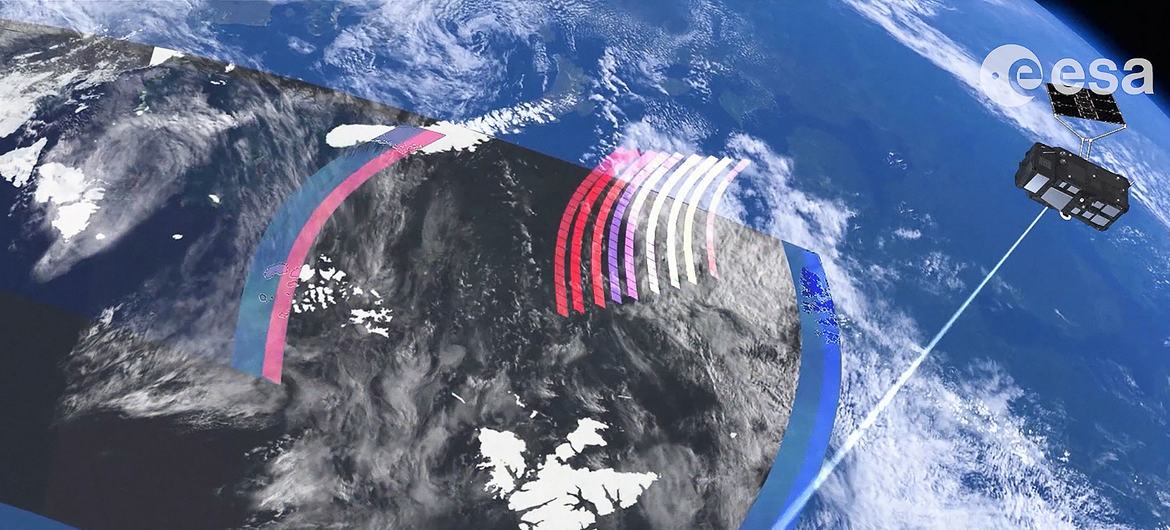
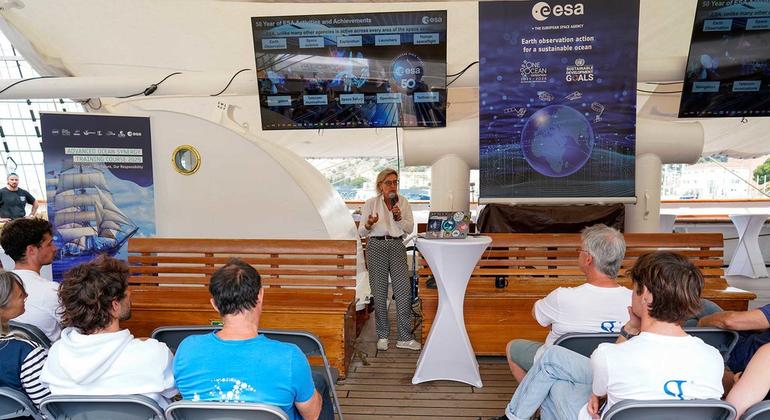
Demonstration of ESA satellite remote sensing.

Space-ocean synergy

“Marrying … the science, oceanographic and sailing traditions is the best way to get inside the ocean from the surface,” said Craig Donlon, the ESA ocean scientist who led the expedition. He also told UN News that real-time satellite data is used to guide on-board research and point students towards areas that need more and better measurement.

Each day, the ESA transmits space-collected data to the ship, delivering it approximately three and a half hours after processing. “Then we come to the captain, and we upset him by saying, we’ve just discovered this new thing, can please we move here?” laughs Mr. Donlon.

Student’s hard work bearing fruit

Mr. Donlon said that cutting-edge oceanographic instruments, including an acoustic Doppler current profiler (ADCP) to measure water movement, hydrophone arrays to capture underwater soundscapes, and Conductivity, Temperature, Depth (CTD) sensors to analyze seawater properties, work together to decode the ocean’s hidden dynamics.

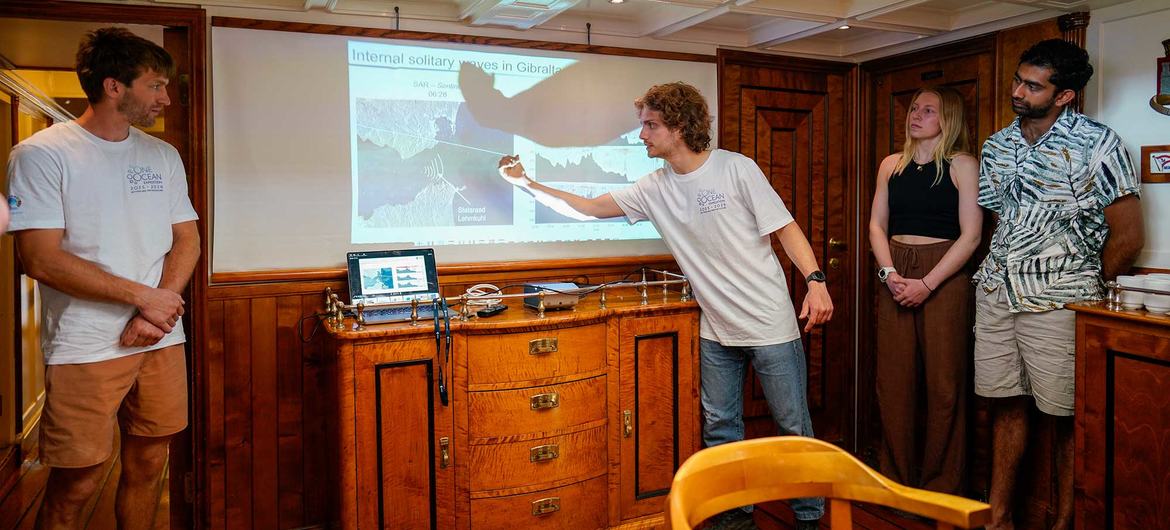
Leveraging these, the students can cross-pollinate between their findings in physics, biology, and air-sea interaction, working individually or in groups on projects including internal solitary waves, drifter trajectories and ocean biodiversity studies.

“It’s quite tough, because they have to work eight hours a day on deck, and the remaining time they have to eat and sleep, but they also find ways to work together,” Mr. Dolon explained. “They made a huge number of measurements […] it’s an amazing journey that they’ve made. We have nearly 15 terabytes of in-situ observations taken aboard this scientific vessel.”

He also spoke highly of the value of these works as evidence-based tools that can ensure the data sets sensibly underpin policies and promote ratification.

“It’s our one Ocean, and we must learn to live in harmony with its majesty because it’s beautiful but fragile. It’s not a global dumping ground. Our future ocean ambassadors, the students aboard this ship, will lead this endeavor,” he insisted.

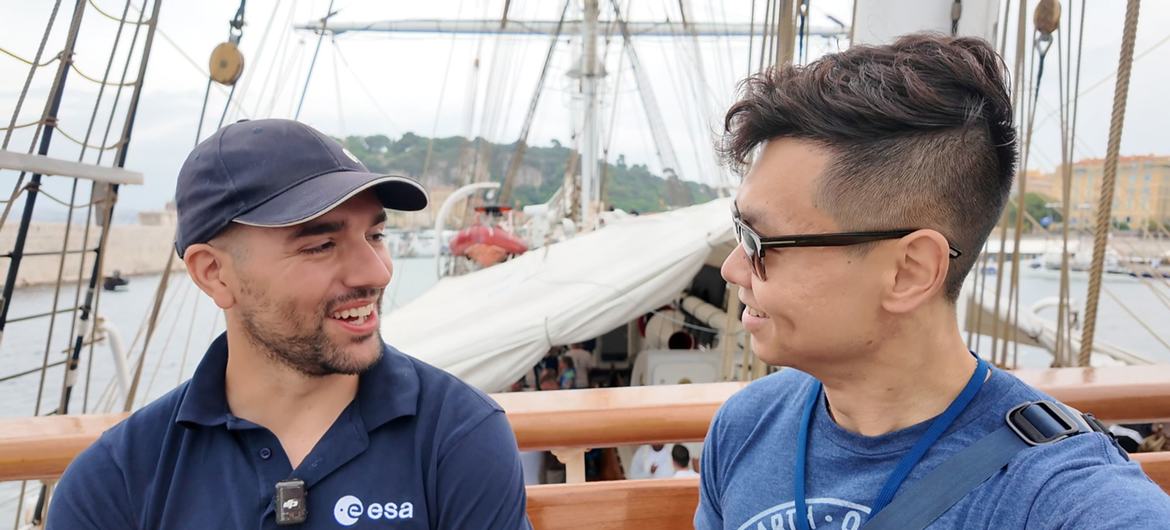
Pablo Álvarez, an ESA training astronaut, talks to UN News.

An astronaut’s blue ambition

Among these young explorers is Pablo Álvarez, an ESA training astronaut set to join the International Space Station before 2030. Before launching into orbit, he’s honing his skills and deepening his knowledge aboard this tall ship – trading the vastness of space for the mysteries of the sea.

He specializes in remote sensing of the ocean’s surface. By analyzing satellite imagery, such as patterns formed by sunlight reflecting off waves, known as ‘sun glitter’, he uncovers insights into surface roughness, wind behavior, and ocean dynamics. These key data points aid both marine scientists and astronauts studying Earth from afar, offering valuable clues that may help predict the ocean’s movement.

“In both fields [Ocean Science and Earth System Science] you’re moving the human knowledge a bit farther with everything you do,” added Mr. Álvarez, “I think it’s in our DNA to explore and to learn more about our environment, and the universe where we are living.” 

Lena Schaffeld (second from the right) is among students presenting their studies on board.

Women improve scientific study

Among the students aboard, Lena Schaffeld, from Germany, found the expedition particularly inspiring. She felt empowered knowing that female students outnumbered their male peers – a rare and meaningful shift in a field often dominated by men.

“I think we need a lot of women in science, especially ocean science. So, it’s quite nice to be one of them,” Ms. Schaffeld said proudly.

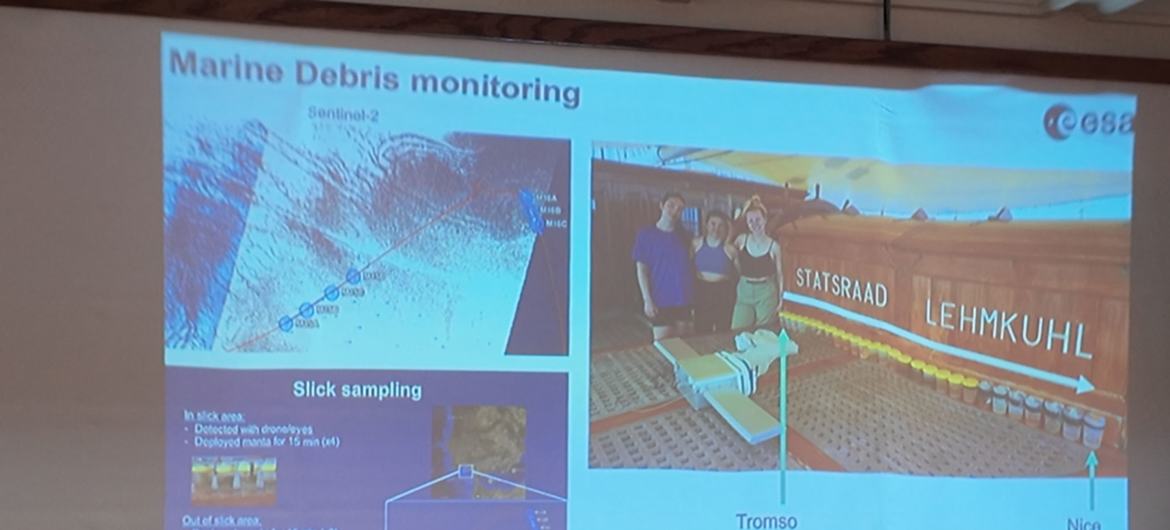
Focused on the increasing abundance and distribution of microplastic pollution in the ocean, Ms. Schaffeld went on to tell UN News that the journey has benefitted her studies as well. “We’ve been passing different seas. We’ve come from the Norwegian Sea and the Arctic Sea, towards the open Atlantic Ocean, and now into the Mediterranean,” she said.

The marine debris monitoring project is conducted by Lena Schaffeld with other two students.

Collecting data along the way, she said she has found more visible plastics in samples taken from the Mediterranean.

“Microplastics are pieces of plastic that are smaller than 5 millimeters, and most of them are invisible,” explained Ms. Schaffeld, who stressed that her work is just beginning and it’s too soon to draw any conclusions.

“Only after [the filtration process] and when I look under the microscope, which is going to happen at the end of this voyage, will we know how much plastic there actually is.”

Looking forward to further studying these samples, she said she will also try to explore ways to use satellite data to detect microplastics in the water, and to lay out a bigger picture about how plastic moves with the currents.

“The water is always moving and plastic on the surface moves along with these currents. So, we’re also going to be applying some numerical modeling to predict or even backtrack [to] where that plastic came from. It’s going to interesting,” she noted with hope.

‘A sustainable ocean is a necessity’

Many students on board the Statsraad Lehmkuhl expressed their gratitude to take part in the training course and to be able to share their stories and experiences as part of UNOC3.

“Bringing the ocean to the people is a job that we’ve tasked our students with,” stressed Mr. Donlon. “They’ve engaged with Peter Thomson, the United Nations Special Envoy (for the ocean). He gave us a mandate to run this course, and we’ve followed that mandate.”

In Mr. Donlon’s eyes, “the UNOC3 is the place where we come together. We discuss the most relevant topics, and we bring a ministerial element to that, to ratify evidence-based decisions”.

He said that he is convinced that the science-based decisions and discussions taking place at the Conference “will make lives and societies stronger”, while at the same time help to protect the environment for future generations. “A sustainable ocean is not a luxury; it is an absolute necessity. There can be no green unless we have a blue thriving ocean,” he reiterated.


Source link