Nuclear disarmament at breaking point as mistrust grows – but hope remains

Yet even as the architecture weakens, signs of progress – including nuclear-weapon-free zones and rising youth engagement – offer grounds for cautious hope, a UN researcher on nuclear non-proliferation has told UN News.

Gaukhar Mukhatzhanova, a fellow with the UN Institute for Disarmament Research (UNIDIR) – an autonomous institute studying disarmament and international security issues – said that decades of arms control built through painstaking negotiations are now at risk of unravelling.

“The situation right now is very difficult,” she added.  

“We are observing the disintegration of the arms control architecture that was built primarily through negotiations between [the then] Soviet Union – and subsequently Russia – and the United States.”

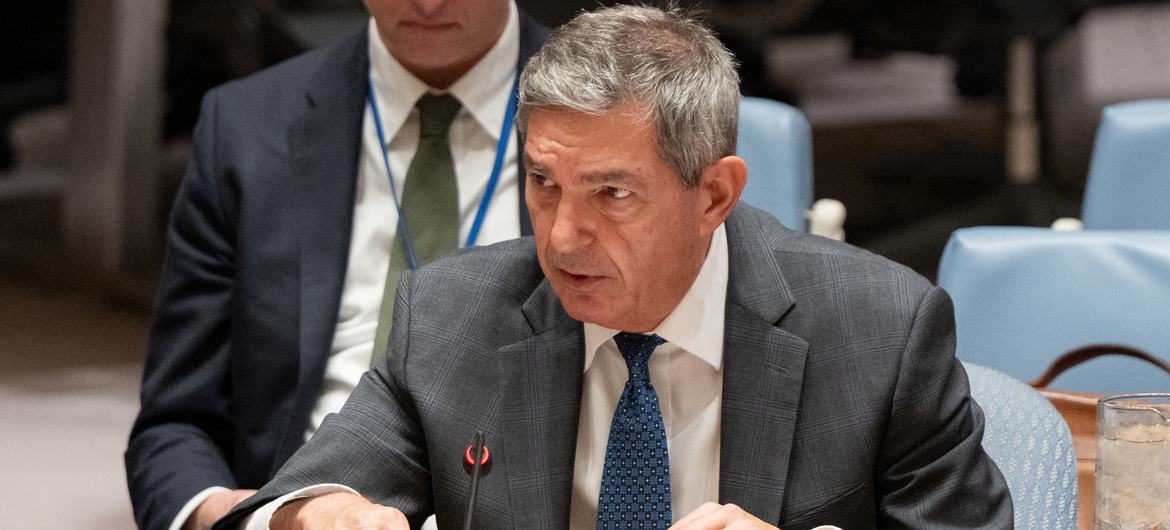
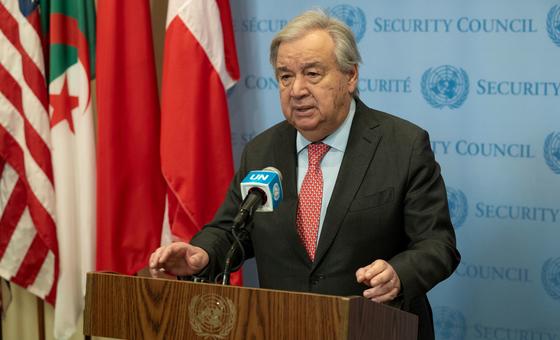
Gaukhar Mukhatzhanova, briefs the Security Council on nuclear disarmament and non-proliferation. (November 2025)

Arms control architecture under strain

That erosion has left the global non-proliferation regime increasingly fragile, with most Cold War-era agreements either abandoned or expired. The 2010 US-Russia New START accord – which capped deployed strategic nuclear warheads – expired this week without a successor in place.

While both American and Russian presidents acknowledged the dangers of a renewed nuclear arms race, no replacement for the New START is currently under negotiation.

This is a troubling backdrop for the next review conference of the Treaty on the Non-Proliferation of Nuclear Weapons (NPT), scheduled for April-May in New York, Ms. Mukhatzhanova said.

Opened for signature in 1968 and extended indefinitely in 1995, the NPT remains the only binding multilateral treaty requiring nuclear-weapon States to pursue disarmament.  

However, the political conditions that once made cooperation possible have deteriorated sharply, added Ms. Mukhatzhanova.

We are back to a period of severe mistrust between the major actors – arguably worse than during the Cold War,” she said.

We are back to a period of severe mistrust between the major actors – arguably worse than during the Cold War

Challenges and emerging risks

Statements by the US suggesting a possible resumption of certain forms of nuclear testing have raised alarm, even if limited to so-called “subcritical experiments” – highly explosive tests where no chain reaction is involved.

Such moves, Ms. Mukhatzhanova said, risk undermining the Comprehensive Nuclear-Test-Ban Treaty (CTBT) and reopening questions many hoped were settled.

“If full-scale explosive testing were to return,” she warned, “we are talking about a really drastic and very negative change – one that would open the door for others to resume nuclear testing.

New technology, new risks

Hypersonic weapons, autonomous systems and artificial intelligence are accelerating arms competition and increasing the risk of miscalculation.

The concern is that too much is left to the decision of a machine,” Ms. Mukhatzhanova said, warning that AI-driven early-warning systems could misinterpret data and trigger inadvertent escalation.

She noted recent UN resolutions calling for “meaningful human control” over nuclear-related technologies.

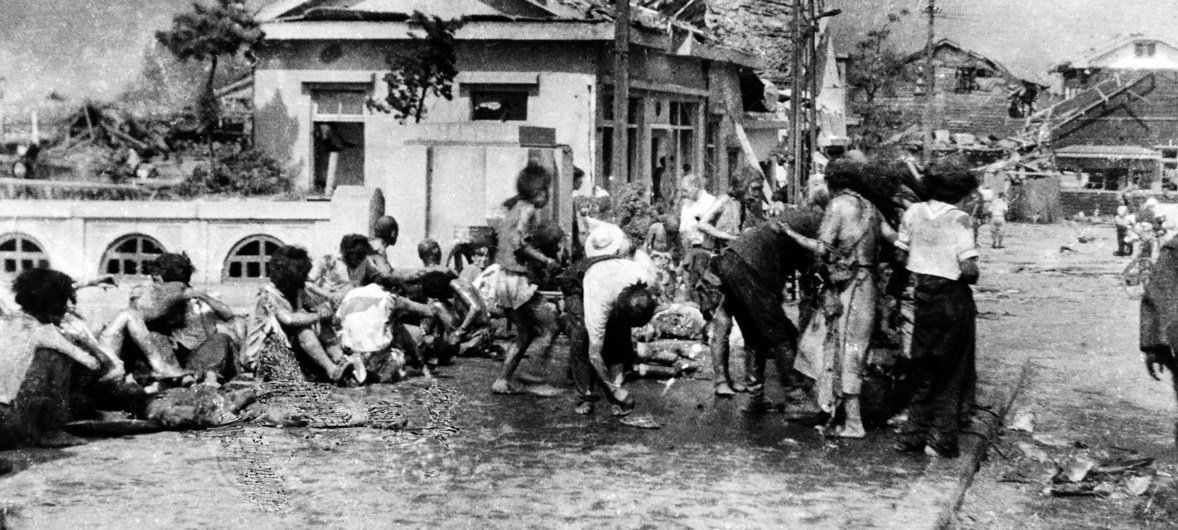
Hiroshima, shortly after a nuclear bomb was dropped on this city in August 1945.

Room for progress remains

Despite the grim outlook, she highlighted areas where progress continues.

Nuclear-weapon-free zones – covering Latin America and the Caribbean, Africa, Southeast Asia, the South Pacific and Central Asia – demonstrate how states can pursue security without nuclear weapons.

“They are a feel-good story,” she said, describing them as practical examples of cooperation even amid global tensions. The Central Asian zone stands out for its strong verification standards and links to broader non-proliferation commitments.

Young people engaging

Ms. Mukhatzhanova also pointed to growing engagement by younger generations, who increasingly question the long-standing narrative that nuclear weapons guarantee security.

They are ready to challenge that framing,” she said. “That gives me hope.

While the arms control system may be fraying, she argued that history shows it can be rebuilt.

Source link

Ukraine war keeps nuclear safety on a knife-edge, UN watchdog warns

Russian forces have been carrying out strikes on critical infrastructure amid freezing winter temperatures as their full-scale invasion approaches the four-year mark next month. 

IAEA Director-General Rafael Grossi said the electrical grid was again the target of military activity this past weekend, leading to significant impacts to several regions and nuclear power plant operations. 

Power lines down 

The fighting caused power lines linking Ukraine with neighbouring countries to be disconnected, which in turn knocked out supplies inside Ukraine.  

As a result, a unit at one nuclear power plant disconnected from the grid due to fluctuations and automatically shut down, while other units at other plants were forced to reduce power. 

The Chornobyl site – where the world’s worst nuclear disaster occurred in 1986 – experienced a complete loss of offsite power and relied on its emergency diesel generators for roughly an hour. 

‘Ever-present risks’ 

“This latest grid event in Ukraine is a stark reminder of the ever-present risks to nuclear safety and security arising from deteriorating grid conditions,” said Mr. Grossi. 

He stressed that extensive repairs are needed to improve the reliability of power supply to nuclear power plants and strengthen their resilience. 

“Once again, I call for maximum military restraint, as well as full observance of the Seven Indispensable Pillars to enable these essential repairs to take place.” 

Seven safety principles 

The IAEA developed the seven pillars for nuclear safety in Ukraine in March 2022, just weeks after the war began – the first time ever that armed conflict has occurred amid the facilities of a major nuclear power programme. 

Measures include maintaining the physical integrity of facilities, ensuring offsite power supply from the energy grid, and implementing effective radiation monitoring systems. 

Operating staff must also be able to fulfill their safety and security duties and to make decisions without any undue pressure. 

Vital inspections 

As military activity increases impacting the electricity grid in Ukraine, three IAEA teams are conducting a two-week mission visiting 10 substations critical to nuclear safety and security.  

The objective is to assess the continuing damage to the grid, review repair efforts and identify practical steps to strengthen the resilience of off-site power supplies to nuclear power plants.  

This marks the second IAEA mission in as many months.  A mission this past December confirmed the effects of cumulative impacts on nuclear power plant operations and staff conditions. 

Source link

UN chief warns of ‘grave moment’ as final US-Russia nuclear arms treaty expires

In a statement issued as the treaty expired at midnight GMT Thursday, he said the world was entering uncharted territory, with no remaining legally binding constraints on the nuclear arsenals of the United States and the Russia – the two countries that together hold the vast majority of the world’s nuclear weapons.

For the first time in more than half a century, we face a world without any binding limits on the strategic nuclear arsenals” of the two countries, he said.

The New START treaty – formally known as the Treaty on Measures for the Further Reduction and Limitation of Strategic Offensive Arms – was signed in 2010 and entered into force the following year.

It capped each side’s deployed strategic nuclear warheads at 1,550 and imposed limits on delivery systems such as intercontinental ballistic missiles and heavy bombers.

The agreement also included verification measures, including data exchanges, notifications and on-site inspections, designed to reduce mistrust and prevent miscalculation.

Tools for stability

Mr. Guterres said decades of nuclear arms control agreements – from the Cold War-era Strategic Arms Limitation Talks to New START – played a crucial role in preventing catastrophe and reducing global nuclear stockpiles.

Throughout the Cold War and in its aftermath, nuclear arms control between these governments helped prevent catastrophe,” he said, adding that such frameworks “built stability” and “prevented devastating miscalculation.”

The Secretary-General warned that the collapse of this system of restraint comes at a particularly dangerous time, as geopolitical tensions rise and the risk of nuclear weapon use is “the highest in decades.”

Reimagine arms control

But he added that the watershed also provides an opportunity to reimagine arms control for a changing security environment, welcoming statements from both US and Russian presidents acknowledging the dangers of a renewed nuclear arms race.

The world now looks to the Russian Federation and the United States to translate words into action,” Mr. Guterres said, urging both sides to return to negotiations “without delay” and to agree on a successor framework that restores verifiable limits, reduces risks and strengthens global security.

Source link

UN watchdog warns Ukraine war remains world’s biggest threat to nuclear safety

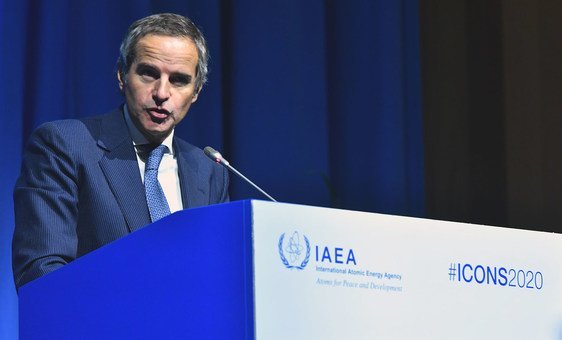
Addressing the International Atomic Energy Agency (IAEA) Board of Governors, Director General Rafael Grossi said the agency remains focused on preventing a nuclear accident as fighting continues to endanger critical infrastructure.

“The conflict in Ukraine is about to enter its fifth year,” Mr. Grossi said. “It continues to pose the world’s biggest threat to nuclear safety.

IAEA teams remain deployed at all nuclear power plants affected by the conflict and publish regular updates on nuclear safety and security conditions.

The Board of Governors is the IAEA’s main decision-making body, bringing together representatives of 35 countries to oversee nuclear safety, security and safeguards, and to guide the work of the UN nuclear watchdog. Its current membership includes, among others Russia, the United States, United Kingdom, and France.

Off-site power a critical safety lifeline

Mr. Grossi stressed that a central safety requirement is reliable off-site power – the electricity a plant receives from the national grid. Without it, nuclear sites must rely on backup systems to run cooling and other essential safety functions.

“There must be secure off-site power supply from the grid for all nuclear sites,” he said, pointing to the IAEA’s “Seven Pillars” guidance for nuclear safety during armed conflict, where off-site power is pillar number four.

He also cited Principle 3 of the IAEA’s Five Principles for protecting the Zaporizhzhya Nuclear Power Plant (ZNPP) that “all efforts should be made to ensure off-site power remains available and secure at all times.”

Mr. Grossi said both sets of guidance have broad international support, including from the parties directly involved, and that he has repeatedly called for adherence to them, including at the UN Security Council.

Progress at Zaporizhzhya amid ongoing risks

He reported recent progress at ZNPP, where Europe’s biggest plant was reconnected on 19 January to its last remaining 330-kilovolt backup power line after repairs were carried out under a temporary ceasefire negotiated with Ukrainian and Russian counterparts.  

The line had been damaged and disconnected since 2 January, reportedly due to military activity.

Until the reconnection, ZNPP relied on its last remaining 750-kilovolt main line to provide off-site power for safety systems needed to cool its six shutdown reactors and spent fuel pools. IAEA teams are also monitoring the plant’s ability to manage winter conditions, including keeping water in cooling and sprinkler ponds from freezing.

Beyond the plants themselves, Mr. Grossi warned that Ukraine’s electrical substations are also crucial to nuclear safety. “Damage to them undermines nuclear safety and must be avoided,” he said. An IAEA expert mission is now assessing 10 substations vital to nuclear safety amid ongoing strikes on the country’s power infrastructure.

Other nuclear sites also affected

IAEA teams have also reported military activity near other nuclear facilities, including the Chornobyl site, where damage to a critical substation disrupted multiple power lines and forced temporary reliance on emergency diesel generators. The affected lines have since been reconnected.

Mr. Grossi said the IAEA has shown how international institutions can help reduce risks and provide predictability in a volatile war. But, he added, technical measures have limits.

“The best way to ensure nuclear safety and security,” he said, “is to bring this conflict to an end.

Source link

Will AI kickstart a new age of nuclear power?

The world’s demand for electricity is soaring at an unprecedented pace. Projections indicate that by 2035, global consumption will surge by over 10,000 terawatt-hours, a figure matching the combined current usage of every advanced economy on Earth today.

A primary driver of this explosive growth is the rise of artificial intelligence. The technology is fueled by vast data centers, whose energy needs are staggering. A single medium-sized data center now consumes as much electricity as 100,000 homes. According to the International Energy Agency, demand from these facilities skyrocketed by more than 75% between 2023 and 2024. By 2030, they are expected to be responsible for over 20 percent of all electricity demand growth in advanced nations.

In the United States, the epicenter of the AI industry, the scale is even more pronounced. Forecasts suggest that before this decade ends, the power required for AI data processing will surpass the total combined electricity consumption of the country’s entire aluminium, steel, cement, and chemical manufacturing sectors.

The Nuclear Industry Sees Its Moment

Facing this daunting challenge, a unique summit took place last December. Policymakers, tech executives, and nuclear leaders from across the globe gathered at the International Atomic Energy Agency (IAEA) headquarters in Vienna. Their mission: to explore a symbiotic future where nuclear power enables AI’s expansion, and AI, in turn, innovates the nuclear sector.

The logic is rooted in AI’s relentless operational needs. Training a top-tier AI model can require tens of thousands of computer processors to run non-stop for months. Meanwhile, daily AI applications are spreading into every corner of society, from healthcare and transport to education and agriculture. Every digital interaction consumes power.

“We need clean, stable zero-carbon electricity that is available around the clock,” said Manuel Greisinger, a senior manager at Google focused on AI. “This is undoubtedly an extremely high threshold, and it is not achievable with wind and solar power alone. AI is the engine of the future, but an engine without fuel is almost useless. Nuclear energy is not only an option, but also an indispensable core component of the future energy structure.”


A Bullish Vision for Atomic Energy

This view is championed at the highest levels. IAEA Director General Rafael Mariano Grossi believes the nuclear industry is destined to be the bedrock of the AI revolution. “Only nuclear energy can meet the five needs of low-carbon power generation, round-the-clock reliability, ultra-high power density, grid stability and true scalability,” he declared.

The industry is mobilizing. Currently, 71 new reactors are under construction worldwide, adding to the 441 already operating. The United States, which hosts 94 plants has plans for ten more.

Tech giants are putting their money where their data is. Major companies have pledged support for the goal of trippling global nuclear capacity by 2050. In a landmark move, Microsoft signed a 20-year power purchase agreement that directly facilitated the restart of Unit One at Pennsylvania’s Three Mile Island nuclear plant.

The trend is worldwide. “Europe has the world’s densest digital corridors, with Frankfurt, Amsterdam and London as hubs,” explained Grossi. Traditional nuclear powers like France and the UK are reinvesting heavily, while newcomers like Poland are accelerating plans.

Russia remains a dominant exporter and developer of reactor technology. China is achieving parallel leadership, leading the world simultaneously in both AI development and the construction of new nuclear reactors. Japan is upgrading its data center infrastructure, and the United Arab Emirates has coupled its new nuclear program with ambitions to become a regional AI hub.

The Promise of Smaller, Faster Reactors

The urgent timeline is fueling interest in small modular reactors (SMRs). Unlike traditional mega-projects that take a decade to build, SMRs offer a nimble alternative.

“These kinds of reactors have a small footprint and upgraded safety systems, and can be deployed in nearby industrial areas, including data centre campuses,” Grossi said. “Tech companies that use them don’t have to worry about regional grid supply constraints or transmission losses. This will be a decisive advantage in areas where grid upgrades are slow.”

Though still emerging from the development phase, progress is swift. Google has signed a pioneering global agreement to purchase nuclear power from a fleet of SMRs, targeting operational status by 2030.

The search for reliable power is pushing boundaries. Google is also looking skyward, researching space-based solar networks to power massive machine-learning operations in orbit, taking advantage of constant, unfiltered sunlight. The company plans to launch two prototype satellites in early 2027 to test the concept.

Whether it’s reviving dormant reactors, betting on compact new designs, building traditional plants, or even gazing at the stars, the trajectory is clear. The world’s digital and energy futures are converging, pointing toward an energy system fundamentally reliant on nuclear power to sustain the civilization of tomorrow.

Training cutting-edge AI models requires tens of thousands of central processing units (CPUs) to run continuously for weeks or even months. At the same time, the daily application of artificial intelligence is expanding to almost all sectors such as hospitals, public administration, transportation, agriculture, logistics and education.

Every query, every simulation, every recommendation consumes power. “We need clean, stable zero-carbon electricity that is available around the clock,” says Manuel Greisinger, a senior manager at Google, focusing on AI. “This is undoubtedly an extremely high threshold, and it is not achievable with wind and solar power alone. AI is the engine of the future, but an engine without fuel is almost useless. Nuclear energy is not only an option, but also an indispensable core component of the future energy structure.”

A data centre in Ireland © Unsplash/Geoffrey Moffett


Bullish nuclear industry

Mr. Greisinger’s view is shared by IAEA Director General Manuel Grossi, who believes that the nuclear industry is destined to be the energy partner of the AI revolution. “Only nuclear energy can meet the five needs of low-carbon power generation, round-the-clock reliability, ultra-high power density, grid stability and true scalability,” he declared.

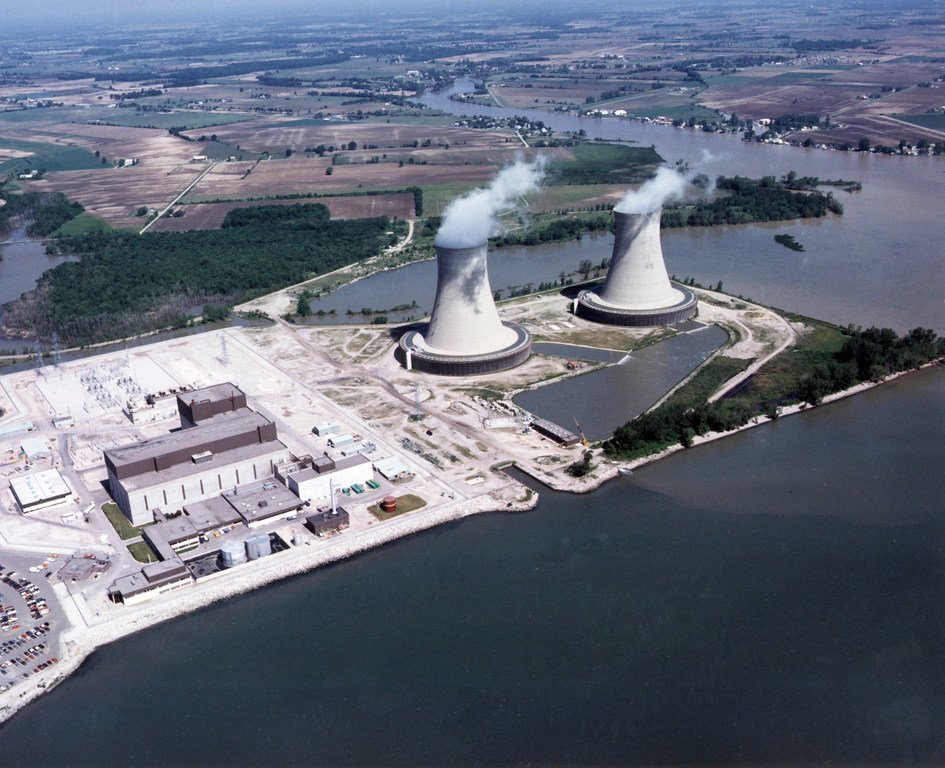
The nuclear industry appears to be in bullish mood. Seventy-one new reactors are under construction, adding to the 441 that are currently operating globally. Ten are scheduled to be built in the US, which is already home to 94 plants, the largest amount of any country.

The tech giants that are using the data centres have pledged to support the goal of at least tripling global nuclear power capacity by 2050. Microsoft, for example, has signed a 20-year power purchase agreement that allowed Unit One of the Three Mile Island nuclear power plant in Pennsylvania, USA, to be restarted.
NOAA/OAR/Great Lakes Environmental Research Laboratory

Russia, with a research base proficient in mathematics and computer science, remains the world’s largest exporter in the field of nuclear energy, and is a leading operator and developer of advanced reactor technology, whilst China is making major achievements in both AI and nuclear energy.

“AI technology and the construction of artificial intelligence data centres are advancing simultaneously, and the number of new nuclear reactors in the world also ranks first in the world during the same period,” said the UN nuclear agency chief.

Japan is investing heavily in building and upgrading data centres to meet growing demand whilst, in the Middle East, the United Arab Emirates has established a nuclear energy programme and has emerged as a regional AI hub.
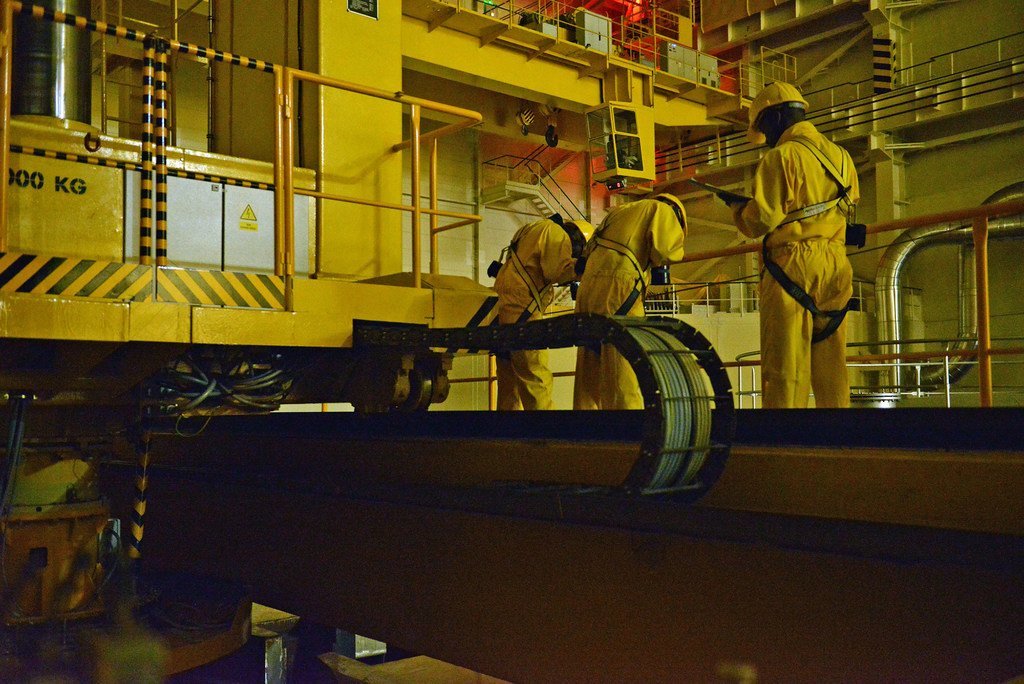
The IAEA supports training to ensure the safety of nuclear power plants like this one in the Czech Republic.

 

Tech Giants Bet on Mini-Reactors to Power AI Boom

The relentless growth of artificial intelligence is creating an energy crisis of its own. To feed the staggering power demands of massive data centers, the technology industry is turning to a new, compact solution: small modular reactors, or SMRs.

These next-generation nuclear units represent a stark departure from the traditional, colossal power plants that can take a decade to build and require enormous upfront investment. Instead, SMRs are designed to be leaner, safer, and faster to deploy.

“These kinds of reactors have a small footprint and upgraded safety systems, and can be deployed in nearby industrial areas, including data centre campuses,” explained Rafael Mariano Grossi, Director General of the International Atomic Energy Agency (IAEA). He highlighted a key advantage for tech companies, noting they “don’t have to worry about regional grid supply constraints or transmission losses. This will be a decisive advantage in areas where grid upgrades are slow, and interconnection queues are long.”

While SMR technology is still advancing from research into real-world application, momentum is building. The IAEA is actively collaborating with global regulators and the nuclear industry to clear the path for widespread deployment. The goal is to see these smaller units operating in large numbers to meet surging electricity demands.

Google’s Nuclear Energy Pact

In a landmark move, Google has signed a pioneering agreement to purchase nuclear energy generated from multiple small modular reactor, a first-of-its-kind deal globally. If development stays on track, the reactors could be supplying clean power to Google’s operations by 2030.

Not content with terrestrial solutions alone, Google is also gazing skyward. The company is investigating the potential of space-based solar networks, which would use unfiltered solar energy in orbit to power large-scale machine learning operations. To test the concept, two prototype satellites are scheduled for launch in early 2027, where their radiation tolerance and data processing capabilities will be put to the test.

From restarting shuttered plants to constructing giant new reactors, and from betting on miniature atomic units to capturing sunlight in space, the strategies vary wildly. Yet energy experts observe that all these paths converge on the same inevitable conclusion: building a future-proof energy system capable of supporting advanced civilization will require a foundation built largely upon nuclear power.

IAEA Chief Urges Countries to Recommit to Nuclear Non-Proliferation

He stressed that their support for the non-proliferation regime, the Nuclear Non-proliferation Treaty (NPT), and the IAEA, is crucial.

“I urge Member States to recommit to a system that has been one of the most important foundations for international peace, even during the tensest decades of our generation,” he said.

He noted that the conference comes at a time when “acts of terrorism, multiple military conflicts, and the erosion of nuclear norms are all happening against a growing gap between poverty and prosperity.”

Mr. Grossi went on to speak about the ways in which the IAEA is working to stop the spread of nuclear weapons and is putting nuclear science to good use, including for cancer treatment, food security, plastic pollution monitoring, disease detection, and artificial intelligence.

Nuclear safety around the world

Earlier this year, Syria agreed to cooperate with the IAEA, and just last week, the agency reached an agreement with Iran to resume the implementation of nuclear safeguards – technical measures used by the IAEA to ensure that if countries make advancements in nuclear technology, they do so for peaceful purposes.

“When the IAEA confirms the peaceful use of a State’s nuclear material, confidence over nuclear activities is established,” said Mr. Grossi.

Meanwhile, in Ukraine, where nuclear power plants are at risk from conflict, the IAEA has sent over 200 missions and is “present on the ground at all the sites.”

But more challenges remain. The Democratic People’s Republic of Korea (DPRK) continues its nuclear weapons programme, while even countries abiding by the NPT, the landmark international agreement meant to abolish nuclear weapons, are debating adding them.

“Think for a minute about a world where instead of a few, we would have 20 or 25 countries armed with nuclear weapons,” he warned.

Peaceful uses of nuclear science

Three years ago, the IAEA launched its flagship programme, Rays of Hope, becoming a “catalyst for real, substantial progress in cancer care.” Through the initiative, concrete actions have been taken in 40 countries: hospitals have been built, radiotherapy machines procured, and physicists trained.

Additionally, the IAEA’s joint programme with the UN Food and Agriculture Organization (FAO), Atoms4Food, is helping boost food security and reduce the environmental strain arising from agriculture.

“In a world of abundance, 700 million people should not have to go to bed hungry every night,” he said.

Mr. Grossi highlighted more ways in which the agency is benefiting the people and the planet, including through its initiative supporting many countries in addressing plastic pollution and waste, and another on improving global preparedness for diseases.

An optimistic outlook

With powerful tools like artificial intelligence and machine learning, “the future is too exciting to miss.”

Nuclear energy can power artificial intelligence infrastructure, while artificial intelligence can improve nuclear technology. To further explore this mutually beneficial relationship, the IAEA will organise the first ever symposium dedicated to the topic in December this year.

Fusion energy, which has been progressing thanks to public and private capital, is another technological development soon expected to take off.

“Every challenge is an opportunity,” concluded Mr. Grossi. “Peace is not simply the absence of conflict. It is dynamic, hopeful striving that I see in what we do all around the world.”

The 69th IAEA General Conference will take place from 15-19 September in Vienna, Austria, where over 3,000 participants are registered to attend.

Source link

Nuclear watchdog chief announces breakthrough on Iran monitoring

“Indispensable” monitoring by the International Atomic Energy Agency (IAEA) ended in June, agency chief Rafael Grossi said, when Israel and US-backed airstrikes targeted Iran’s nuclear power installations.

At the time, the Iranian authorities confirmed that the Natanz enrichment site had been “impacted” without affecting existing radiation levels, the top IAEA diplomat said.

Practical step forward

Now, “practical modalities” have been agreed to allow the resumption of inspection activities in Iran, Mr. Grossi told the agency’s board of governors in the Austrian capital. “This is an important step in the right direction,” he continued, before expressing his gratitude to Egypt for brokering the deal.

The development follows the 28 August announcement by France, Germany and the UK of their intention to reimpose UN sanctions on Iran within 30 days, under the so-called “snapback” mechanism contained in the Iranian nuclear agreement signed in July 2015 by the five permanent members of the UN Security Council, in addition to Germany, the EU and Iran.

Working in partnership

The new agreement – which was preceded by weeks of technical discussions in Tehran and Vienna over verification activities of “all facilities and installations in Iran”– came despite the decision by Iranian lawmakers on 25 June to suspend cooperation with IAEA, a move approved by the country’s President one week later.

At the time, Mr. Grossi noted that this domestic decision did not alter Iran’s international nuclear non-proliferation treaty (NPT) obligations.

Agreement remains in force

And earlier this week, he insisted that the NPT agreement remained in force as “the sole legally binding treaty governing the rights and obligations of the [IAEA] and Iran with respect to safeguards implementation in Iran”.

While acknowledging that his Iranian interlocutors had declared their willingness to remain part of the international non-proliferation movement, Mr. Grossi noted Tehran’s “concerns”.

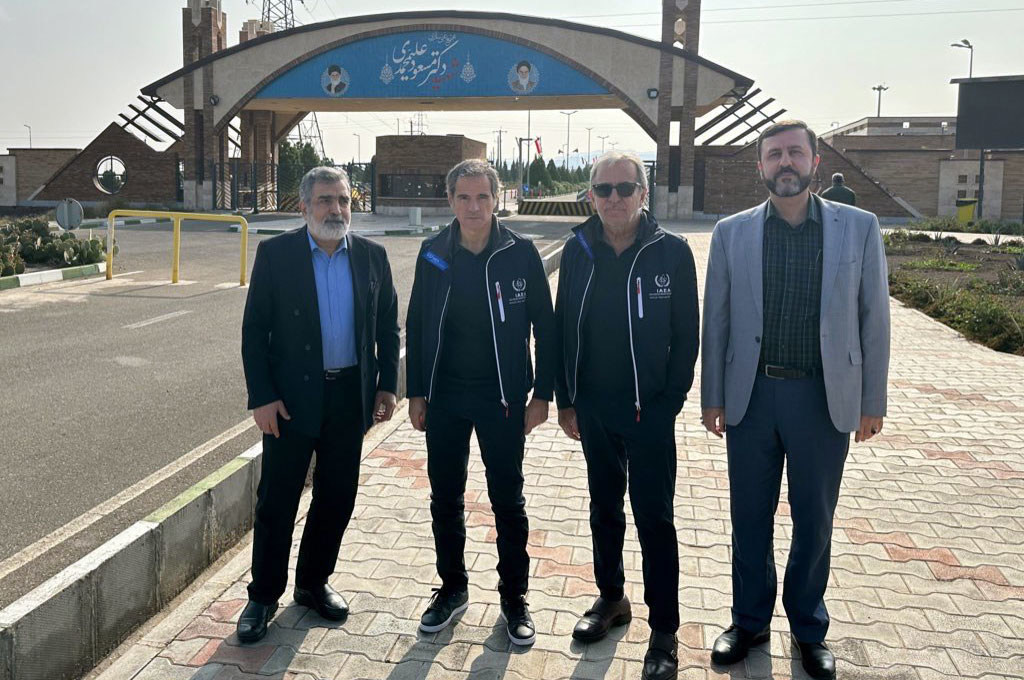
Nonetheless, the deal – sealed by Mr. Grossi and Iranian Foreign Minister Abbas Aragchi in Cairo on Monday – “provides for a clear understanding of the procedures for inspection, notifications and their implementation”, he insisted.

The agreement also “contemplates” reporting on all facilities targeted by Israel and the US in June “including the nuclear material present” in Iran, the IAEA chief continued.

“These practical steps…need to be implemented now,” he insisted. “There may be difficulties and issues to be resolved for sure, but we now know what we have to do and the elements at our disposal for these basic understandings to be implemented.”

Source link

A fourth generation nuclear survivor’s push for justice

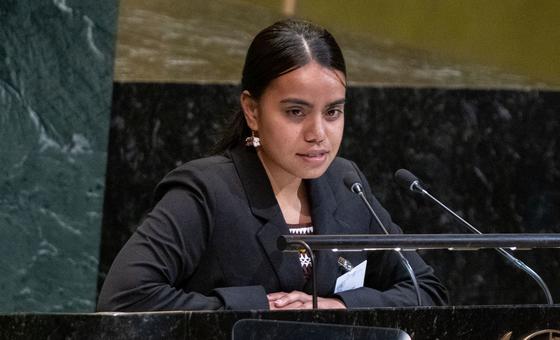
“We are not prepared to inherit a legacy of complacency, nor can we continue to live in the shadow of these weapons,” she told the commemoration inside the gilded UN General Assembly Hall.

As the Youth Representative of the Republic of Kiribati, Ms. Johnson is one of the many young people around the world whose ancestors have been affected by the toxic aftermath of nuclear tests.

After her speech to the General Assembly where she urged Member States to take action, Ms. Johnson spoke to UN News about the effects that the past has had on her family and community.

Devastating Consequences

Between 1957 and 1962, the United States and United Kingdom conducted nuclear weapon tests on Kiritimati Island, now part of Kirbati, resulting in devastating consequences for the local population. Ms. Johnson’s late grandfather, who lived on the island, was 14 years old when the testing began.

“They were all gathered in a small tennis court, and they were only given a thin blanket without real protection,” she said, describing the scene just ahead of the detonation.

“They used that to cover their eyes from the flashes of the bombing,” she added.

The radiation Johnson’s grandfather was exposed to led to serious health implications including hearing loss and cognitive decline. These impairments followed him for the remainder of his life and affect his descendants till this day.

“My dad’s two older sisters were born prematurely and died shortly after that,” she said. “And similar cases were also found in other families in the community.”

Beyond the devastating impact on the people of Kiritimati, the tests also caused lasting environmental damage. According to Ms. Johnson, specific type of fish on the island are believed to be radioactive and when eaten, can make people “sick and nauseous.”

Push for disarmament

To address the irreversible harm on behalf of the younger generation of Kiribati – and the world – she called on Member States to support an international trust fund meant to offer needed assistance for the victims of nuclear testing. The trust fund was first jointly proposed by Kiribati and Kazakhstan in 2022.

Kiribati is a member of the Coordination Committee of the Treaty on the Prohibition of Nuclear Weapons (TPNW), a landmark agreement aimed at eliminating the nuclear threat.

Articles 6 and 7 of the legally binding Treaty stipulate that signatory parties must provide assistance to those affected by nuclear weapons under their jurisdiction, or as a result of their actions.

‘The lives of many depend on this’

A fourth-generation nuclear testing survivor, Ms. Johnson’s deeply personal experience with the human, environmental and social impact of nuclear weapons has only made her more determined to pressure the international community to build on the treaty entering into force in 2021.

“For the sake of all the mothers, children and future generations, I urge everyone to join in the Treaty for the Prohibition of Nuclear Weapons because the lives of many are dependent on this.”

Learn more about the UN’s actions against nuclear testing and proliferation here

Source link

World News in Brief: Executions surge in Iran, nuclear test threat, Burkina Faso declares top official unwelcome

At least 841 people have been put to death by the Government of Iran since the beginning of the year, with ethnic minorities and migrants “disproportionately targeted”, said OHCHR spokesperson Ravina Shamdasani.

Some executions have been carried out publicly, she added, with seven reported this year based on available information: “The real situation might be different. It might be worse given the lack of transparency in the use of the death penalty.”

Imminent executions

Eleven people now face imminent execution; six have been charged with “armed rebellion” owing to their alleged membership of the Mojahedin-e-Khalq group.  

Five others are on death row in connection with their participation in the 2022 protests, following the death in police custody of Mahsa Amini, who was detained by Iran’s so-called morality police for not wearing her hijab correctly.  

Ms. Shamdasani reiterated calls from UN rights chief Volker Türk for Iran to impose a moratorium on the application of the capital punishment, as a step towards its abolition.

UN chief warns against ‘playing with fire’ as nuclear test threat looms

UN Secretary-General António Guterres has issued a stark warning on the International Day against Nuclear Tests, urging world leaders to halt the threat of renewed detonations.

“Stop playing with fire. Now is the time to silence the bombs before they speak again,” he said in his message, which coincides with the 80th anniversary of the first nuclear test on 16 July 1945 – in the New Mexico desert under the Manhattan Project.

A deadly legacy

Since then, more than 2,000 nuclear tests have been carried out worldwide.  

Atmospheric tests in the early decades of the nuclear era spread radioactive fallout across continents, contaminating land and seas, displacing communities and leaving survivors facing health crises passed down through generations.

The international day was declared by the UN General Assembly in 2009, following Kazakhstan’s closure of the Semipalatinsk test site.

It has since become a rallying point for governments, civil society and campaigners pressing for an end to nuclear testing and progress towards full disarmament.

Mr. Guterres stressed that nuclear testing remains a grave danger amid rising geopolitical tensions. He urged States to ratify the Comprehensive Nuclear-Test-Ban Treaty (CTBT), adopted by a large majority in 1996 but still not in force nearly three decades later.

“We must never forget the horrific legacy of over 2,000 nuclear tests,” the Secretary-General said. “The world cannot accept this.”

Burkina Faso declares UN Coordinator persona non grata  

The UN chief has expressed regret of the decision by authorities in Burkina Faso to declare the UN’s Resident and Humanitarian Coordinator in the country, Carol Flore-Smereczniak, persona non grata.

In a statement on Friday, António Guterres said that the transitional authorities had announced the diplomatic sanction declaring her unwelcome, on 18 August.

The UN chief expressed “full confidence” in her “professionalism and dedication and in the broader United Nations system in Burkina Faso.”

During her tenure, Ms. Flore-Smereczniak – who has now left the country – led UN efforts working closely with the Burkinabe authorities to support development initiatives and provide humanitarian assistance.

UN will continue to support Burkinabe

The statement stresses that the UN Charter makes clear the doctrine of persona non grata does not apply to UN officials, as staff members appointed by the Secretary-General are responsible solely to the Organization, and Member States undertake to respect their exclusively international character.

In line with the Charter, the United Nations enjoys privileges and immunities, including the right of its staff to remain and carry out their mandated work.

“Only the Secretary-General, as the Chief Administrative Officer of the Organization, has the authority to decide – after careful investigation – on the withdrawal of any United Nations official.”

Mr. Guterres reaffirmed the UN’s commitment to continue supporting the people of Burkina Faso, and to keep working with the national authorities.  

Source link

How nuclear technology can help fight seafood fraud

From mislabeled fish to hidden additives, deceptive practices are threatening livelihoods, food safety, and trust in what ends up on our plates.

Now, a new international initiative backed by the United Nations is using cutting-edge nuclear science to protect people and ensure the seafood they rely on is safe, authentic, and traceable.

Fishy business

Seafood consumption per capita has doubled since the 1960s and is projected to double again by 2050, with seafood fraud becoming a rising global concern.

While FAO estimates that the fisheries and aquaculture sector employs 62 million people in primary fish production, about 600 million livelihoods rely on fisheries and aquaculture. 

Seafood fraud ranges from substituting high-value species with cheaper alternatives to using unauthorised or undeclared additives. It can occur at any stage of the supply chain, especially as monitoring and traceability become more difficult due to supply chains growing increasingly complex.

To make sure seafood fraud does not slip through the net, national and international food control systems need robust and fit-for-purpose analytical methods

Nuclear technology

A joint project between the Food and Agriculture Organization (FAO) and the International Atomic Energy Agency (IAEA) is set to use nuclear technology to counter seafood fraud.  

Through its Joint FAO/IAEA Centre of Nuclear Techniques in Food and Agriculture, the IAEA is launching a five-year coordinated research project to help countries strengthen food control systems to detect and prevent seafood fraud.

The IAEA will use nuclear and related techniques to build scientific capacity, ensure product authenticity, and enhance resilience and transparency in seafood supply chains.

“This IAEA project provides Member States with a valuable opportunity to collaborate in combating fraud and de-risking the seafood supply chain using robust nuclear science-based tools,” said Debashish Mazumder from the Australian Nuclear Science and Technology Organization, a key partner of the IAEA on sustainable development issues.

Reeling in truth with atoms

The IAEA’s Food Safety and Control Laboratory supports countries in applying nuclear and related analytical techniques to facilitate trade in safe and authentic seafood, offering powerful tools for fraud detection.

One of the most effective methods to counter seafood fraud is stable isotope ratio analysis of light elements such as oxygen, which allows scientists to identify the geographical origin of the fish and verify whether it was wild-caught by reflecting environmental and ecological conditions in the fish’s biological tissues.

Used to authenticate seafood, nuclear technology serves as a powerful tool to combat seafood fraud, enhancing consumer protection, increasing trust in food control systems, and supporting fisherfolk to engage in sustainable aquatic resource management.  

Source link

‘Nuclear weapons have no place in our world,’ UN chief tells mayors in Nagasaki

Inspired by the hibakusha, survivors of the atomic bombings at the end of World War Two who turned their suffering into a powerful appeal for peace, António Guterres renewed his call for a world free of nuclear weapons in a video message to the 11th General Conference of Mayors for Peace in Nagasaki.

United against nuclear weapons, the conference is an opportunity for mayors from around the world to discuss and adopt key priorities in support of global denuclearisation.

‘No place in our world’

“Nuclear weapons have no place in our world,” said Mr. Guterres in his video-message, as they only offer the “illusion of safety and the certainty of devastation,” he said.

Calling for the total elimination of nuclear weapons, the Secretary-General urged all participants at the conference to “keep mobilising communities, inspiring young people, and building peace from the ground up.”

“I urge all States to recommit to nuclear disarmament,” he said.

A better world

I commend Mayors for Peace for your unwavering commitment to a better world,” said Secretary-General, as the organization aims at creating real momentum for the realisation of a peaceful world without nuclear weapons.

In honour of the hibakusha, and in the memory of the victims of Hiroshima and Nagasaki, Mr. Guterres made an impassioned call for action to end the nuclear threat once and for all.

Read more about the work of the hibakusha here in previous UN News coverage, and listen to this extraordinary story of survival in our Lid is On podcast:

Source link

Hiroshima, 80 years on: ‘Real change’ needed to end existential nuclear threat

While the city has been rebuilt, nuclear conflict remains a global threat, UN High Representative for Disarmament Affairs Izumi Nakamitsu said in remarks at the Hiroshima Peace Memorial.

It was the only structure left standing near the hypocentre of the bomb, which marked the first use of an atomic weapon in war.

Survivors, family members and representatives from international organizations and 120 countries were among the approximately 55,000 people who attended the ceremony, according to the Japanese Prime Minister’s Office.

Remembering the dead, honouring the survivors

“On this 80th anniversary, we remember those who perished. We stand with the families who carry their memory,” said Ms. Nakatmisu, delivering a message on behalf of UN Secretary-General António Guterres.

She paid tribute to the hibakusha – the term for those who survived Hiroshima and the atomic bombing of Nagasaki three days later – “whose voices have become a moral force for peace.”

“While their numbers grow smaller each year, their testimony — and their eternal message of peace — will never leave us,” she said.

UN Photo/Yoshito Matsushige

Injured civilians, having escaped the raging inferno, gathered on a pavement west of Miyuki-bashi in Hiroshima, Japan, at about 11 a.m. on 6 August 1945.

Rebuilding hope, sharing the vision

In a single moment on 6 August 1945, Hiroshima was reduced to ruins, tens of thousands were killed, “and humanity crossed a threshold from which there could be no return.”

In the aftermath, many believed the city would never recover and that nothing would grow, she said, but the population proved otherwise.

“You, the people of Hiroshima, didn’t just rebuild a city,” she said.  “You rebuilt hope. You nurtured a vision of a world without nuclear weapons. And you shared that vision with the world.”

Listen to our podcast with Japanese American author Kathleen Burkinshaw whose novel about a young hibakusha ‘The Last Cherry Blossom’ was inspired by her mother’s experience.

Duty to protect

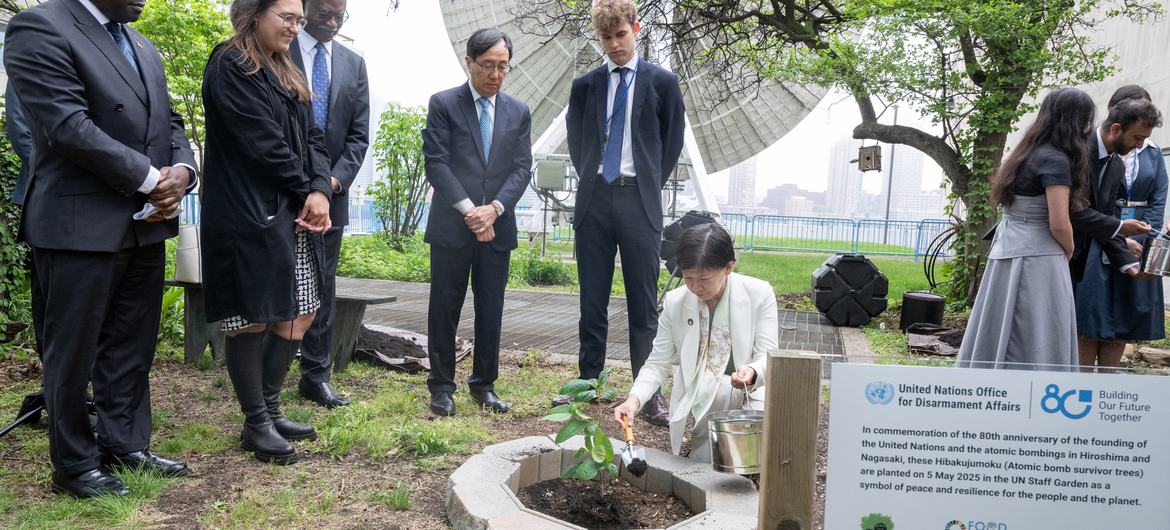
Ms. Nakamitsu noted that 2025 also marks 80 years since the UN was founded.  In May, saplings grown from the seeds of a persimmon tree that survived the bombing were planted at Headquarters in New York. 

“They are more than symbols of survival,” she said.  “They are living testaments to the strength of the human spirit — and of our shared duty to protect future generations from the horrors of nuclear annihilation.”

Furthermore, the UN anniversary is a reminder of why it was created in the first place – to prevent war, to uphold human dignity, and to ensure the tragedies of the past are never repeated.

“Yet, today the risk of nuclear conflict is growing,” she warned. “Trust is eroding. Geopolitical divisions are widening. And the very weapons that brought such devastation to Hiroshima and Nagasaki are once again being treated as tools of coercion.”

At the ceremony, Hiroshima’s Mayor Kazumi Matsui warned against the growing acceptance of nuclear weapons, according to media reports.  He cited the conflicts in Ukraine and the Middle East as examples.

Yet, signs of hope have emerged, according to the UN disarmament chief.  

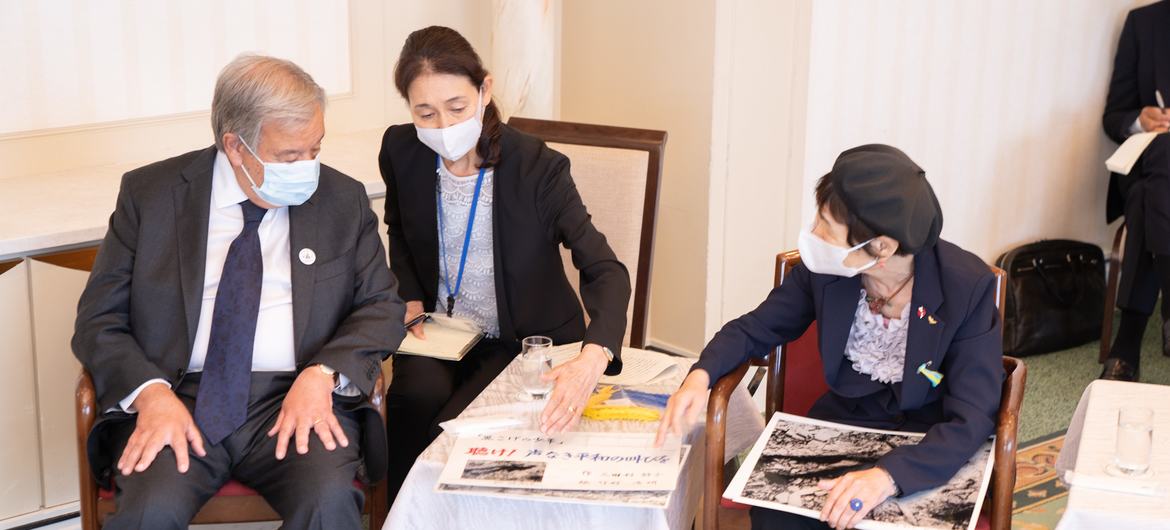
UN Secretary-General António Guterres met with hibakusha from Hiroshima and Nagasaki during a visit to Japan in 2022.

Abolish nuclear weapons

Last October, the Japanese anti-nuclear group Nihon Hidankyo – which represents the survivors of the bombings – was awarded the 2024 Nobel Peace Prize.  This came just weeks after countries meeting at the UN adopted the Pact for the Future, re-committing to a world free of nuclear weapons.

Ms. Nakamitsu insisted that “commitments must lead to real change by strengthening the global disarmament regime — in particular, the Treaty on Non-Proliferation of Nuclear Weapons, complemented by the momentum created by the Treaty on the Prohibition of Nuclear Weapons.” 

She urged countries to draw strength from both the resilience of Hiroshima and the wisdom of the hibakusha. 

“Let’s work to eradicate the threat of nuclear weapons by eradicating the weapons themselves,” she said.

“And let’s keep our pledge to the hibakusha, and ensure that their testimony and message of peace is carried forward. Remembering the past is about protecting and building peace today — and in the future.” 

Izumi Nakamitsu, UN High Representative for Disarmament Affairs (in white), during the tree planting ceremony at Headquarters to commemorate the 80th Anniversary of the founding of the United Nations and the atomic bombings in Hiroshima and Nagasaki.

Source link

World News in Brief: Violence in Haiti, rising insecurity in DR Congo, expert panel on nuclear war

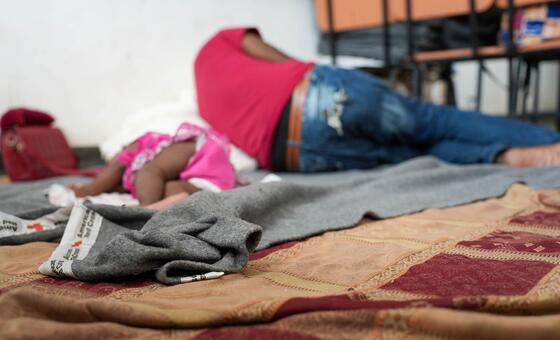
Displaced Haitians are dispersed among the 250 active displacement sites across the country, most of which are informal. Just over a fifth of these sites are managed by humanitarian organizations, meaning that many are living in precarious conditions.  

In June alone, more than 200 alerts were reported across displacement sites, over 80 per cent of which were related to essential needs such as lack of water, food, shelter or healthcare.

OCHA noted that nearly 1.3 million people are now internally displaced in Haiti, the highest number ever recorded in the country due to violence.

Constrained UN response

The UN and partners have supported more than 113,000 displaced Haitians this year, providing essential services such as water, shelter, sanitation and healthcare.

The humanitarian response is severely constrained by limited funding and persistent insecurity, hampering humanitarian access to the most affected areas and delaying the delivery of aid. 

Despite the challenges, the agency continues to work closely with Haitian authorities and humanitarian partners to coordinate relief efforts and mobilise additional resources to support displaced communities. 

DR Congo: Ongoing violence in the east drives displacement, impedes aid delivery

Ongoing violence in North and South Kivu provinces in the eastern Democratic Republic of the Congo (DRC) continues to claim the lives of civilians and to trigger new displacement. 

In North Kivu, UN partners on the ground in Rutshuru and Lubero territories reported that fighting between M23 and other armed groups was ongoing until Tuesday, resulting in eight civilian deaths and 42,500 displaced people as of earlier this week. 

Since early July, heavy clashes between M23 and other armed groups in South Kivu have also persisted, as local partners said the fighting has displaced at least 37,000 people from their homes. 

Aid access restrictions 

The surge in violence is making it harder for humanitarians to deliver assistance to vulnerable communities. 

While partners and teams on the ground are doing their best to maintain services for those affected, access restrictions and severe funding shortages pose significant obstacles. 

A humanitarian convoy coordinated by OCHA along the road between the provincial capital Bukavu and the city of Uvira, primarily planned for this Friday, has been postponed due to a lack of security guarantees on that route. 

Many UN partners on the ground are forced to scale back their operations, disrupting essential services for those in need. 

OCHA called on the international community to take urgent action to address these severe funding gaps and avert a humanitarian tragedy. 

New panel to examine the effects of a nuclear war

The UN Secretary-General has appointed an independent scientific panel of 21 experts to examine the physical and societal consequences of a nuclear war on a local, regional and planetary scale in the days, weeks and decades following such an event.

The creation of the panel, mandated by a General Assembly resolution, comes at a time when nuclear guardrails are being eroded and “the risk of nuclear war is higher than at any point since the depths of the Cold War,” UN deputy spokesperson Farhan Haq said on Friday during the daily media briefing from Headquarters in New York. 

The panelists will seek input from a wide range of stakeholders – including international and regional organizations, the International Committee of the Red Cross (ICRC), civil society and affected communities. 

Members will hold their first meeting in September and will submit a final report to the General Assembly in 2027. 

Source link

UN chief condemns Russian strikes on Ukraine, warns of nuclear safety risk

In a statement issued by his spokesperson, António Guterres expressed alarm over the dangerous escalation and the rising toll on civilians.

He reiterated that attacks against civilians and critical infrastructure are prohibited under international law and called for an immediate and unconditional ceasefire.

“These strikes disrupted the power supply to the Zaporizhzhia Nuclear Power Plant, once again underlining the ongoing risks to nuclear safety,” UN Spokesperson Stéphane Dujarric said.

“The Secretary-General reiterates his call for a full, immediate and unconditional ceasefire in Ukraine as a first step towards a just, comprehensive and sustainable peace, in line with the UN Charter, international law and relevant UN resolutions.”

Fragile situation

The airstrikes on Friday severed the nuclear plant’s last external power connection, forcing the ZNPP to rely on emergency diesel generators for more than three hours, according to the International Atomic Energy Agency (IAEA).

Power was eventually restored, but the incident marked the ninth time the plant has lost all off-site electricity since the full-scale invasion began in 2022.

Rafael Mariano Grossi, Director General of the nuclear watchdog, warned that the situation remains extremely fragile.

“What was once virtually unimaginable – that a major nuclear power plant would repeatedly lose all of its external power connections – has unfortunately become a common occurrence,” he said.

Nuclear safety deterioration

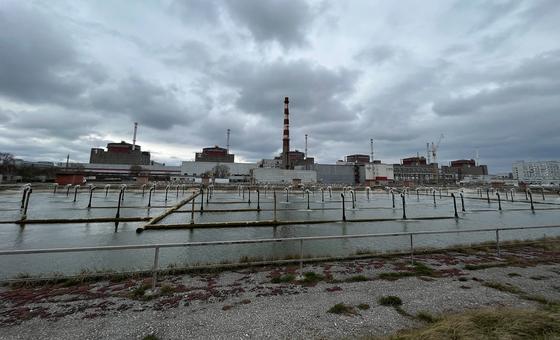
Located in southern Ukraine, the Zaporizhzhia plant is the largest nuclear power facility in Europe. Although its six reactors have been in cold shutdown since 2024, they still require electricity to cool reactor cores and spent fuel pools to prevent overheating and potential radioactive release.

During the blackout, 18 diesel generators were activated to maintain critical cooling functions. The plant has enough diesel on site for at least ten days, with contingency plans in place to secure further supplies if needed, IAEA reported.

The ZNPP has become dramatically more vulnerable since the war began. Prior to the conflict, it had access to ten external power lines; it now relies on just one.

IAEA teams remain based at the site and continue to monitor the situation closely.

Source link

Iran: Return to inspections top priority for UN nuclear agency

Rafael Mariano Grossi was speaking to reporters in Austria following a briefing to the Government in Vienna.

Israel began launching air and missile strikes against Iranian military and nuclear sites nearly two weeks ago, and the United States carried out surprise bombing raids on three Iranian uranium enrichment facilities this past weekend.

A ceasefire between Iran and Israel, announced on social media by US President Donald Trump on Monday night, is fragile but holding. 

However, the extent of damage to Iran’s enriched uranium stockpile remains unclear.

Iran says protective measures taken

Following the initial attacks, Iran informed the IAEA that it would take “special measures” to protect its nuclear materials and equipment.

Mr. Grossi told journalists that he has received a letter from the Iranian Foreign Minister which said protective measures have been taken.

“They did not get into details into what that meant, but clearly that was the implicit meaning of that. So, we can imagine that this material is there,” he said. To confirm this, and to evaluate the situation, “we need to return,” he added.

Inspections vital

On Wednesday, Iran’s parliament approved a bill to suspend cooperation with the IAEA, according to media reports, which has to be approved by the executive branch of the Government.

Mr. Grossi said he wrote to Foreign Minister Abbas Araghchi on Tuesday requesting that they meet “to analyze the modalities” for inspections to continue.

He stressed that the international community “cannot afford” for the inspection regime to be interrupted.

The IAEA chief was also asked about Iran’s plans to withdraw from the Non-Proliferation Treaty (NPT), a key international accord aimed at preventing the spread of nuclear weapons.

The move would be “very regrettable,” he said. “I hope this is not the case. I don’t think this would help anybody, starting with Iran. This would lead to isolation, all sorts of problems.” 

UN urges renewed diplomacy on Iran nuclear deal, hails Tehran-Tel Aviv ceasefire as ‘significant achievement’

Amid this relative calm, the United Nations has renewed its call for a diplomatic solution to the Iran nuclear issue, warning that the objectives of the Joint Comprehensive Plan of Action (JCPOA) – and the resolution that endorsed it – remain unmet.

Addressing a planned Security Council meeting on Tuesday to try and revive the deal amid the dramatic military escalation of the past 12 days, UN political affairs chief Rosemary DiCarlo said the fragile ceasefire announced by Donald Trump overnight provided “an opportunity to avoid a catastrophic escalation and achieve a peaceful resolution of the Iran nuclear issue.

The 2015 Iran nuclear deal – more formally known as the JCPOA and backed by the Security Council – offered Tehran sanctions relief in exchange for strict limits on uranium enrichment, stockpile levels and centrifuge use, alongside robust monitoring and verification by the International Atomic Energy Agency (IAEA).

But the accord has remained in limbo since the United States withdrew in 2018, followed by Iran’s rollbacks of its nuclear-related commitments.

With key provisions under resolution 2231 set to expire on 18 October – unless the Council decides otherwise – the UN’s top political official has warned that the window for reviving diplomacy is narrowing.

With less than four months before resolution’s remaining nuclear-related restrictions are set to expire on 18 October – unless extended by the Council – the UN’s top political official warned that the agreement’s key aims remain elusive.

Diplomacy kneecapped?

Ms. DiCarlo told ambassadors the recent surge in violence had significantly undermined diplomatic momentum.

The military escalation between Israel and Iran since 13 June and United States air strikes on Iran’s nuclear facilities on 21 June complicated prospects for achieving full implementation of resolution 2231,” Ms. DiCarlo said.

Iran’s strikes yesterday on a base in Qatar further exacerbated insecurity in an already tense region.

Despite five rounds of bilateral talks between Iran and the US, facilitated by Oman in recent months, Ms. DiCarlo noted that efforts “did not produce a way forward” to restore full JCPOA implementation.

A sixth round of talks was called off due to the outbreak of hostilities.

Meanwhile, the toll from the recent conflict has been sobering. According to Iranian authorities, at least 606 people were killed and more than 5,300 injured since hostilities erupted on 13 June. Israeli officials reported 28 deaths and nearly 1,500 injuries.

Time running out

While divisions persist, Ms. DiCarlo said JCPOA participants – China, France, Germany, Iran, Russia, and the United Kingdom – had all reiterated their commitment to finding a diplomatic solution.

In a joint statement shared with the Secretary-General in March, China, Iran and Russia stressed the importance of resolution 2231’s provisions and timelines. China separately proposed a “step-by-step and reciprocal approach” to settle the nuclear issue.

“Diplomacy, dialogue and verification remain the best option to ensure the exclusively peaceful nature of Iran’s nuclear programme,” Ms. DiCarlo said.

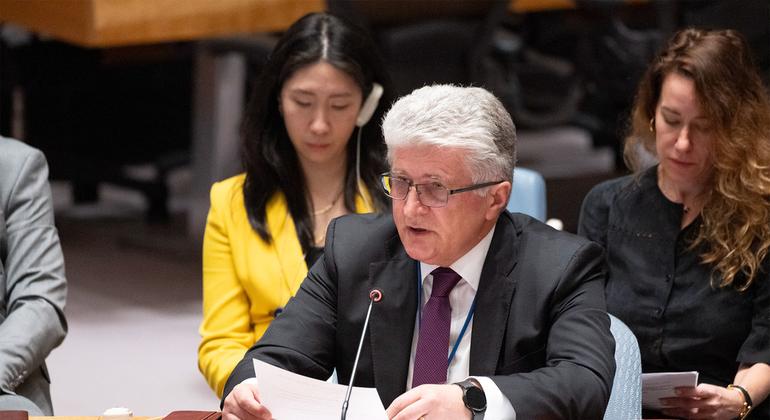
EU Ambassador Stavros Lambrinidis briefs the Security Council as the Coordinator of the Joint Commission established by the JCPOA.

Deal, not force, key to resolution: European Union

Echoing UN appeals for dialogue, the European Union stressed that “a lasting solution to the Iranian nuclear issue can only be through a negotiated deal, not military action.

Briefing the Council on behalf of EU High Representative Kaja Kallas, Ambassador Stavros Lambrinidis underscored the urgent need “to come back to a diplomatic solution.”

Ensuring that Iran does not acquire or develop a nuclear weapon remains a key security priority for the EU, he said.

He added that Iran’s accelerating nuclear activities and the absence of IAEA oversight – compounded by the economic fallout from US sanctions – have severely undermined the JCPOA, despite sustained EU efforts to preserve it through diplomacy.

Mr. Lambrinidis reaffirmed that diplomacy must prevail, with the IAEA remaining central to monitoring and verification efforts going forward.

US urges Iran to return to talks

Ambassador Dorothea Shea, Acting US Representative, said Iran’s increase in nuclear activity lacked “any credible civilian justification.”

Even after the IAEA Board of Governors found it noncompliant with nuclear safeguards, she noted, “it is regrettable that certain members of this Council have opted to turn a blind eye to, if not encourage, Iranian noncompliance.”

The US “will not turn a blind eye to Iran’s noncompliance and ongoing threat to regional stability,” she continued.

Ambassador Shea said the 21 June “precision operation effectively fulfilled our narrow objective – to degrade Iran’s capacity to produce a nuclear weapon,” after which President Trump coordinated a ceasefire between Iran and Israel.

“In this critical moment,” she concluded, “we must all urge Iran to seize this opportunity for peace and prosperity and abide by its international obligations.”

UK calls ceasefire a first step

UK Ambassador Barbara Woodward welcomed the ceasefire brokered by President Trump but warned that “the situation remains extremely fragile.”

Expressing that “now is the time for a return to diplomacy,” she urged Iran to engage in talks without delay, warning that its nuclear programme has exceeded “any credible civilian justification.”

She said all diplomatic levers will be deployed for a negotiated outcome and to “ensure Iran does not develop a nuclear weapon.”

Iran: Diplomacy can and must resolve differences

Iran’s Ambassador, Amir Saeid Iravani, said that his country “never initiated this war” and that “once the aggressors stopped their attacks, Iran stopped its lawful military response as well”.

Mr. Saeid also expressed his country’s strong commitment to diplomacy as the path through which differences can and should be resolved.

“Iran continues to believe that a diplomatic resolution to nuclear and sanction issues is possible,” Mr. Saeid said.

He called on the Security Council to condemn Israel’s and the United States’ attacks on Iran and their IAEA-protected nuclear facilities and work to ensure that they never happen again.

Ambassador Iravani added that Iran upheld Council resolution 2231 and the JCPOA, and that remedial measures were “fully consistent” with these two instruments.

Israel warns diplomacy with Iran has failed

Israeli Ambassador Danny Danon defended his country’s military operation against Iran, describing it as a necessary move to neutralise a “double existential threat” from Tehran’s nuclear and missile programmes.  

He said Israel achieved complete air superiority and removed key regime targets, acting in coordination with the US.

Ambassador Danon accused Iran of deceiving the world for years, using diplomacy as cover to advance its nuclear weapons programme.

“There is still time,” he said, “to take meaningful and decisive action to ensure that the threat of a nuclear Iran does not return stronger than before.”

“We are often told that diplomacy must be given a chance – it was given every chance, every round, every channel, every deadline – but so far it has failed, the regime in Tehran never had any intention of complying.”

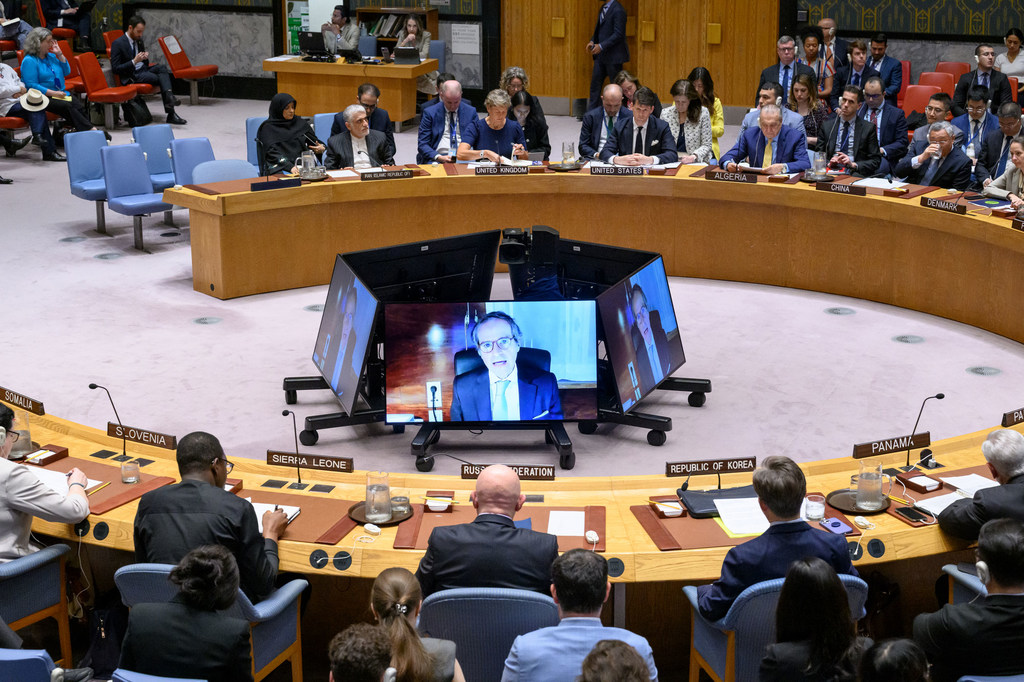
Video feed of the Security Council meeting.

Source link

Iran-Israel war: IAEA chief stresses need for strong new nuclear deal

“I welcome announcements on Iran situation. Resuming cooperation with [the International Atomic Energy Agency (IAEA)] is key to a successful agreement,” said Rafael Grossi, Director General of the (IAEA).

In a short online post on X, Mr. Grossi added that he had offered to meet Iranian Foreign Minister Abbas Araghchi on working together, “stressing this step can lead to a diplomatic solution to the long-standing controversy” over Iran’s nuclear programme.

Tehran prison concern

Meanwhile, the UN human rights office, OHCHR, insisted that a notorious Tehran prison known for holding dissidents should not be a target, a day after a reported Israeli strike on the complex.

OHCHR spokesperson Thameen Al-Kheetan told media in Geneva that Evin prison is not a military objective, according to the laws of war.

“Targeting it constitutes a grave breach of international humanitarian law”, he said.

OHCHR does not have specific details about what the alleged attack, Mr. Al- Kheetan said, but there have reportedly been fires inside the prison and a number of injuries.

Casualty count

An updated casualty count from the Iranian authorities on Tuesday indicated that 610 people have been killed including 49 women and 13 children since 13 June. That number includes two pregnant women and one infant along with 4,746 injured, including 185 women and 65 minors.

Seven hospitals, four health units and six emergency bases and nine ambulances have been damaged, the Iranian health authorities said.

Some 28 Israeli citizens have reportedly been killed by Iranian missile strikes to date.

Civilians must be protected

Political prisoners including journalists are held at Evin prison, but whether they are detained “arbitrarily” or in connection with “crimes they’ve actually committed”, the inmates must be protected, Mr Al-Kheetan insisted.

According to media reports on Tuesday, Iran said that it transferred all the inmates out of the prison after it was hit by an Israeli strike, moving them to other prisons around the capital in order to repair damage.

A fragile ceasefire proposed by the United States seemed to take hold briefly on Tuesday morning, before reports of further Iranian missile strikes on Israel, disputed by Tehran.

The conflict began with Israeli air attacks on 13 June and escalated over the weekend with US forces striking Iranian nuclear facilities. Hundreds of civilians have reportedly been killed in the Israeli airstrikes, while Iran’s retaliatory strikes killed close to 30 people in Israel.

Asked about signs of a crackdown on dissent by the Iranian authorities in the context of the Israeli and US military campaign against the country, the OHCHR spokesperson stressed that it was “difficult to verify information” coming from Iran, given the lack of access.

He confirmed seeing reports about Iranians being “arrested for cyber activities and publishing content related to the Israeli attacks on Iran, according to NGOs”.

Mr. Al-Kheetan also spoke of reports that nine men have been executed in Iran since Israel attacked the country on 13 June.

He called on the Iranian authorities to “completely respect the rights to freedom of expression and information, at all times”, insisting that journalists “must be able to do their work without any obstacles”.

Iranian citizens reportedly arrested and accused of espionage or collaboration with Israel “must have their full rights in terms of legal procedures and a fair trial”, he said.

“If these arrests are arbitrary, those persons must be freed immediately and unconditionally,” he concluded.

Human Rights Council concerns

On Monday, independent human rights experts reiterated their concerns about Iran’s “use of broadly defined national security offences, some of which are punishable by death”, in the context of recent reported executions on espionage charges.

Last week, the UN deputy human rights chief, Nada Al-Nashif, told the Human Rights Council that at least 975 people were executed in Iran last year – the highest number of reported executions since 2015.

She also briefed the Council on the use of torture in Iranian prisons and the ongoing targeting of minorities, journalists and human rights defenders.

Source link

Iran-Israel crisis: IAEA chief urges access to damaged nuclear sites

Rafael Grossi, head of the International Atomic Energy Agency (IAEA), was addressing the agency’s Board of Governors, amid fresh reports of new Israeli missile strikes on Iranian military sites in Tehran and elsewhere earlier on Monday. Iranian weapons fire has also been reported across Israel. 

Mr. Grossi – who also addressed an emergency meeting of the UN Security Council on Sunday – insisted that the agency’s weapons inspectors should return to Iran’s nuclear sites and account for their stockpiles.

There is particular concern about 400 kilogrammes of uranium enriched to 60 per cent by Iran.

Under the terms of a 2015 nuclear deal with the international community, Iran is permitted to enrich the naturally occurring radioactive material to less than four per cent.

“Craters are now visible at the Fordow site, Iran’s main location for enriching uranium at 60 per cent, indicating the use of ground-penetrating munitions; this is consistent with statements from the United States,” he told the IAEA Board of Governors. “At this time, no one including the IAEA, is in a position to have fully assessed the underground damage at Fordow.”

Mr. Grossi said that taking into account the highly explosive payload used in the US attacks, “very significant damage is expected to have occurred” to the highly sensitive centrifuge machinery used to enrich uranium at Fordow.

Several sites hit

Fordow is one of several nuclear-related sites across Iran that are known to have been damaged in the strikes by the United States, including those in Esfahan, Arak and Tehran.

In comments to the UN Security Council in New York on Sunday, the IAEA chief said that although radiation levels remained normal outside these nuclear facilities, deep concerns remained about Iran’s operational nuclear plant at Bushehr.

Any strike on Bushehr could trigger a massive radiation release across the region –  “the risk is real”, Mr. Grossi said.

Eleven days after Israel launched air and missile strikes at Iranian military and nuclear sites, some 430 people are believed to have been killed in Iran, most of them civilians.

According to Israeli reports, 25 people have been killed and more than 1,300 injured by Iranian missile strikes.

US strikes on Iran’s nuclear sites ‘marks perilous turn’: Diplomacy must prevail, says Guterres

After ten days of airstrikes initiated by Israel aimed at crippling Iran’s nuclear programme which have led to deadly daily exchanges of missile fire between Tehran and Tel Aviv, the UN chief said that diplomacy must now prevail.

We now risk descending into a rathole of retaliation after retaliation,” he said, responding to the US intervention overnight in support of Israel’s military campaign, which targeted three facilities involved in uranium enrichment.

Return to serious negotiations essential

We must act – immediately and decisively – to halt the fighting and return to serious, sustained negotiations on the Iran nuclear programme,” Mr. Guterres added.

He told ambassadors the citizens of the wider Middle East region could not endure yet another cycle of destruction. Demanding a ceasefire, he also put Iran on notice that it must “fully respect” the Non-Proliferation Treaty on the development of nuclear weapons as a cornerstone of peace and security worldwide.

Iran has consistently denied the allegation from Israel and others that its ambitions are to become a nuclear armed State, versus developing atomic energy for purely peaceful purposes.

Israel, the US and Iran face a stark choice. “One path leads to a wider war,” the UN chief continued, “deeper human suffering and serious damage to the international order. The other leads to de-escalation, diplomacy and dialogue.”

Grossi warns of major risks following strikes

The head of the UN’s atomic energy watchdog, the IAEA, warned ambassadors the recent military strikes by Israel and now the US on nuclear sites in Iran have badly compromised safety and could pose serious risks if the situation worsens.

International Atomic Energy Agency Director General Rafael Grossi said the attacks had caused “a sharp degradation in nuclear safety and security”, even though there had been no radiation leaks which could potentially impact the public so far.

The IAEA chief warned ambassadors that if the short window of opportunity to return to dialogue closes then the destruction could be “unthinkable” while the global nuclear non-proliferation regime “as we know it could crumble and fall.”

Mr. Grossi confirmed that Iran’s main enrichment facility at Natanz had suffered major damage, including to key power infrastructure and underground halls containing uranium materials.

He said the main concern inside the site was now chemical contamination, which can be dangerous if inhaled or ingested.

Massive radiation leak still possible

He also listed damage at other nuclear-related sites across the country, including Esfahan, Arak and Tehran, adding that while radiation levels outside remained normal, the attacks had raised alarm over Iran’s operational nuclear plant at Bushehr.

Mr. Grossi warned that any strike on Bushehr could trigger a massive radiation release across the region. “The risk is real,” he said. “Military escalation threatens lives and delays the diplomacy that’s needed to resolve this crisis.”

He urged all sides to show restraint and said the IAEA stood ready to send experts back in to help monitor and protect damaged nuclear sites.

Senior political affairs official: ‘No military solution’

Assistant Secretary-General for Political Affairs Miroslav Jenča told ambassadors that the world is facing “a dangerous moment” following the US bombing mission, as Iran considers potential retaliation.

He warned the council that the region risks being “engulfed in further instability and volatility”, with “no military solution to this conflict”.

Mr. Jenča confirmed extensive damage at Iranian sites, citing open-source satellite imagery and Iranian reports that tunnels and buildings at the Fordow nuclear facility had been hit. He urged Tehran to grant IAEA inspectors access “as soon as safety conditions allow”.

Death toll mounting

Hostilities between Iran and Israel are now into their tenth day, and Mr. Jenča said the humanitarian toll is mounting. “Most [of the 430 killed in Iran] have been civilians,” he noted, while also citing Israeli reports of 25 dead and over 1,300 injured.

He also flagged growing threats from non-State armed groups, including the Houthis in Yemen, warning that their retaliation could widen the conflict. Iran’s parliament, meanwhile, has voiced support for closing the crucial trading route through the narrow Strait of Hormuz.

The world will not be spared from the ramifications of this dangerous conflict,” Mr. Jenča said, urging countries to act in line with international law and the UN Charter.

Source link