People dying from lack of aid every day in Gaza: WFP official

Ross Smith, director of emergency preparedness and response, briefed journalists in New York in the wake of a deadly incident on Sunday in which dozens of civilians were killed and injured while waiting to access food as a WFP convoy was entering northern Gaza.

“Yesterday’s incident is one of the greatest tragedies we’ve seen for our operations in Gaza and elsewhere while we’re trying to work,” he said, speaking from Rome.

“And it’s completely avoidable, and it’s an absolute tragedy,” he added.

Famine conditions and malnutrition

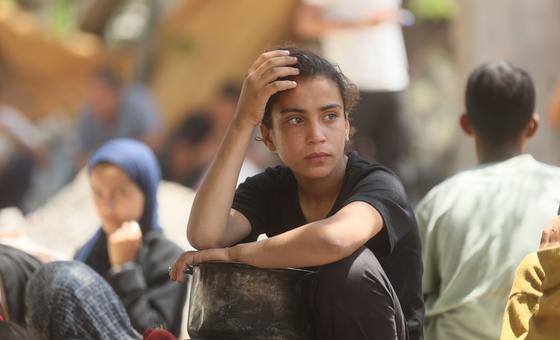
Gaza’s population stands at roughly 2.1 million and earlier this year, food security experts warned that one in five people faces starvation.

Mr. Smith said WFP assessments show that a quarter of the population is facing famine-like conditions. Almost 100,000 women and children are suffering from severe acute malnutrition and need treatment as soon as possible.

Pointing to reports, he said “people are dying from lack of humanitarian assistance every day, and we are seeing this escalate day by day.” 

He stressed that food assistance, and humanitarian assistance more broadly, are “the only solution at the moment” for Gaza.

Minimum operating conditions

Mr. Smith said humanitarians have a set of minimum operating conditions that need to be in place for them to work effectively.

These include crossing points into Gaza, “proper routing” inside the enclave so that teams can move independently, and the entry of more than 100 trucks of aid a day.

“We also need to have no armed actors near food distribution points, near our convoys, and near the movement of those convoys from one place to another,” he continued, while underscoring the need to reach people where they are and not in otherwise predetermined locations.

“And I would say above all that we have had agreements in principle on these things, but we have not had adherence to these in practice in Gaza itself. And this is really where the breakdown is, and it’s where we see incidents like (yesterday) take place,” he said.

Ceasefire now

Mr. Smith also highlighted the critical need for a ceasefire “so that we can move effectively.”

In response to a journalist’s question, he said WFP moved more than 200 trucks of assistance per day into Gaza during the ceasefire earlier this year. Since mid-May, it has been able to move less than 10 per cent of what is needed.

He said the UN agency has enough stocks pre-positioned outside Gaza to supply the entire population for two months “if we can get a ceasefire and if we can move.” 

Source link

Lack of cooperation from Iran hampers nuclear checks, says atomic energy watchdog

Rafael Grossi, Director-General of the International Atomic Energy Agency (IAEA), said on Monday that Iran’s growing stockpile of highly enriched uranium and unresolved questions about its programme remain serious issues.

Unless and until Iran assists the agency in resolving the outstanding safeguards issues, the Agency will not be in a position to provide assurance that Iran’s nuclear programme is exclusively peaceful,” he said.

He was addressing IAEA’s Board of Governors, which comprises 35 countries – including France, Russia, the UK and the US.

Lack of credibility

Mr. Grossi further noted that Iran had failed to provide technically credible explanations for the presence of man-made uranium particles at three undeclared sites – Varamin,  Marivan and Turquzabad – despite years of consultations.

Based on its assessments, IAEA can conclude that these three locations were part of a structured nuclear programme that operated until the early 2000s and involved undeclared nuclear material, he said.

“The agency also concludes that Iran did not declare nuclear material and nuclear-related activities at these three undeclared locations in Iran…as a consequence of this, the Agency is not in a position to determine whether the related nuclear material is still outside of safeguards.”

The situation is exacerbated by the country’s decision to stop implementing some provisions of its Safeguards Agreement, a legal requirement under international law, he added, urging Tehran to urgently restore transparency and comply with international obligations.

Highly enriched uranium

Mr. Grossi also expressed alarm at the rapid accumulation of over 400 kilogrammes of highly enriched uranium, which has serious implications.

Given the potential proliferation implications, the agency cannot ignore [this],” he said.

While commending Egypt’s recent diplomatic efforts to mediate between Iran and the United States, Mr. Grossi stressed that only a diplomatic solution, backed by IAEA verification, could restore trust.

He said the agency stands ready to verify any future agreement between the two sides.

“The effect of a stabilised situation in Iran with regards to its nuclear programme will be immediate and bring the Middle East one big step closer to peace and prosperity,” he said.

‘Clear violations’ in DPR Korea

Turning to the Democratic People’s Republic of Korea (DPRK), Mr. Grossi said the IAEA continues to monitor nuclear activity remotely, despite being denied direct access to the country.

North Korea’s five-megawatt electrical reactor at Yongbyon “likely continues” to be operating in its seventh cycle, while reprocessing of irradiated fuel has likely resumed at the Radiochemical Laboratory.

He noted ongoing construction at a new building with similarities to the Kangson enrichment site and said the light water reactor at Yongbyon remains active.

“The continuation and further development of the DPRK’s nuclear programme are clear violations of relevant UN Security Council resolutions and are deeply regrettable,” he said, adding that IAEA stands ready to play its role in verifying the DPRK’s nuclear programme.

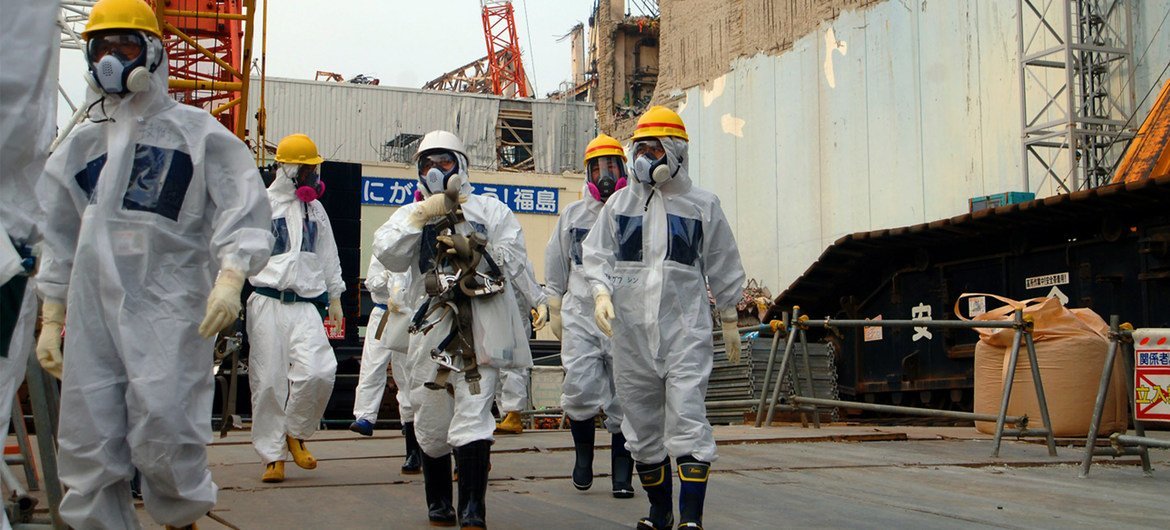
IAEA experts depart Unit 4 of Fukushima Daiichi Nuclear Power Station. (April 2013 photo).

Monitoring discharge in Japan

Mr. Grossi said the IAEA continues to monitor the controlled release of ALPS-treated water from the Fukushima Daiichi Nuclear Power Station in Japan, which suffered major damage in a 9.1 magnitude earthquake and tsunami in March 2011.

In April this year, IAEA and international experts collected and analysed diluted samples ahead of discharge.

“The IAEA has maintained its independent monitoring and analysis efforts, confirming that tritium concentrations in the discharged batches remain far below operational limits and align with the international safety standards,” Mr. Grossi said.

‘Precarious situation’ in Ukraine

Director-General Grossi also highlighted the precarious situation at Ukraine’s Zaporizhzhya Nuclear Power Plant, where all six reactors remain in cold shutdown amid continued military activity.

A full damage assessment is also underway at Chernobyl, which was the site of a drone strike and ensuing fire in February that resulted in “significant damage” to a confinement arch that is critical to maintaining long-term safety at the site.

The power plant suffered a massive nuclear accident in 1986 and has since been encased in a protective structure to contain radioactive material and prevent its release.

“As the military conflict moves further into its fourth year, Ukraine needs support, and the IAEA is providing it,” Mr. Grossi said, reaffirming the Agency’s commitment to supporting Ukraine’s nuclear infrastructure during wartime and throughout the eventual post-war reconstruction.

Source link