
France Joins UK, Canada, Australia and Portugal in Recognising Palestinian Statehood

France joins UK, Canada, Australia and Portugal in recognising Palestinian statehood at UN-backed conference

United Nations/New York: UN Secretary-General António Guterres on Monday reiterated that nothing can justify the October 7, 2023 Hamas attacks on Israel, nor the “collective punishment” inflicted on the Palestinian people in their aftermath. Calling for an “immediate” ceasefire in Gaza, he urged the release of all hostages and the opening of safe, unconditional and unhindered humanitarian corridors.

Speaking at the resumed international conference on Palestine, co-chaired with Saudi Arabia, Guterres warned that the viability of a two-state solution is being undermined by “relentless” settlement expansion, the “creeping threat of annexation” and a surge in settler violence in the West Bank.

“The time for peace has come because we are just a few moments away from no longer being able to seize peace,” he told delegates. “Let’s be clear: statehood for the Palestinians is a right, not a reward. Denying it would be a gift to extremists everywhere.”

France Backs Palestinian Statehood

The conference, held after the General Assembly overwhelmingly endorsed the first phase outcome declaration in July, saw fresh diplomatic momentum. The United Kingdom, Canada, Australia and Portugal formally recognised the State of Palestine on Sunday. French President Emmanuel Macron announced that Paris would follow suit, a declaration that drew lengthy applause.

“The recognition of the legitimate rights of the Palestinian people takes nothing away from the rights of the people of Israel, which France has supported from Day One,” Macron said. “This recognition is the only solution that will allow Israel to live in peace.”

Saudi Foreign Minister Faisal bin Farhan Al Saud praised the countries that had recognised Palestine and urged others to “take a similar historic step.” Such recognition, he said, would “support efforts towards the implementation of the two-State solution, achieve permanent and comprehensive peace in the Middle East, and create a new reality of stability and prosperity.”

ALSO READ: London’s Far-Right Rally Sends Shockwaves Through South Asian Communities

UN General Assembly President Annalena Baerbock acknowledged scepticism around the two-state formula, noting that the UN’s earliest resolutions on the issue date back to its founding years. But she stressed that pursuing the alternative would mean conceding to “evil” and risk “the end of this institution.”

“This is not a naïve wish,” Baerbock insisted. “The international community is committed not only to the principle of two states but to identifying tangible, timebound and irreversible steps for its realisation, backed by decisive measures and international guarantees.”

The conference underscored a growing shift among Western powers towards recognising Palestinian statehood, even as conditions on the ground remain volatile. For Guterres and other leaders, the message was clear: without urgent steps, the two-state solution risks slipping out of reach, with grave consequences for peace and security in the Middle East and beyond.

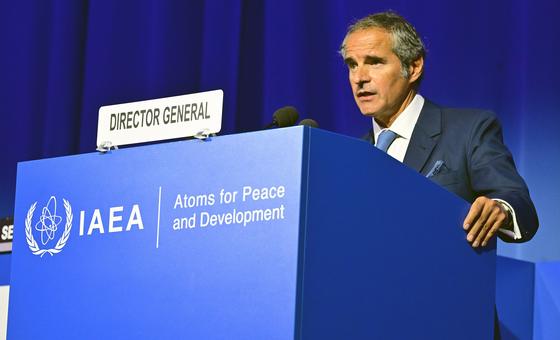
IAEA Chief Urges Countries to Recommit to Nuclear Non-Proliferation

He stressed that their support for the non-proliferation regime, the Nuclear Non-proliferation Treaty (NPT), and the IAEA, is crucial.

“I urge Member States to recommit to a system that has been one of the most important foundations for international peace, even during the tensest decades of our generation,” he said.

He noted that the conference comes at a time when “acts of terrorism, multiple military conflicts, and the erosion of nuclear norms are all happening against a growing gap between poverty and prosperity.”

Mr. Grossi went on to speak about the ways in which the IAEA is working to stop the spread of nuclear weapons and is putting nuclear science to good use, including for cancer treatment, food security, plastic pollution monitoring, disease detection, and artificial intelligence.

Nuclear safety around the world

Earlier this year, Syria agreed to cooperate with the IAEA, and just last week, the agency reached an agreement with Iran to resume the implementation of nuclear safeguards – technical measures used by the IAEA to ensure that if countries make advancements in nuclear technology, they do so for peaceful purposes.

“When the IAEA confirms the peaceful use of a State’s nuclear material, confidence over nuclear activities is established,” said Mr. Grossi.

Meanwhile, in Ukraine, where nuclear power plants are at risk from conflict, the IAEA has sent over 200 missions and is “present on the ground at all the sites.”

But more challenges remain. The Democratic People’s Republic of Korea (DPRK) continues its nuclear weapons programme, while even countries abiding by the NPT, the landmark international agreement meant to abolish nuclear weapons, are debating adding them.

“Think for a minute about a world where instead of a few, we would have 20 or 25 countries armed with nuclear weapons,” he warned.

Peaceful uses of nuclear science

Three years ago, the IAEA launched its flagship programme, Rays of Hope, becoming a “catalyst for real, substantial progress in cancer care.” Through the initiative, concrete actions have been taken in 40 countries: hospitals have been built, radiotherapy machines procured, and physicists trained.

Additionally, the IAEA’s joint programme with the UN Food and Agriculture Organization (FAO), Atoms4Food, is helping boost food security and reduce the environmental strain arising from agriculture.

“In a world of abundance, 700 million people should not have to go to bed hungry every night,” he said.

Mr. Grossi highlighted more ways in which the agency is benefiting the people and the planet, including through its initiative supporting many countries in addressing plastic pollution and waste, and another on improving global preparedness for diseases.

An optimistic outlook

With powerful tools like artificial intelligence and machine learning, “the future is too exciting to miss.”

Nuclear energy can power artificial intelligence infrastructure, while artificial intelligence can improve nuclear technology. To further explore this mutually beneficial relationship, the IAEA will organise the first ever symposium dedicated to the topic in December this year.

Fusion energy, which has been progressing thanks to public and private capital, is another technological development soon expected to take off.

“Every challenge is an opportunity,” concluded Mr. Grossi. “Peace is not simply the absence of conflict. It is dynamic, hopeful striving that I see in what we do all around the world.”

The 69th IAEA General Conference will take place from 15-19 September in Vienna, Austria, where over 3,000 participants are registered to attend.

Source link