Tech Giants Bet on Mini-Reactors to Power AI Boom

The relentless growth of artificial intelligence is creating an energy crisis of its own. To feed the staggering power demands of massive data centers, the technology industry is turning to a new, compact solution: small modular reactors, or SMRs.

These next-generation nuclear units represent a stark departure from the traditional, colossal power plants that can take a decade to build and require enormous upfront investment. Instead, SMRs are designed to be leaner, safer, and faster to deploy.

“These kinds of reactors have a small footprint and upgraded safety systems, and can be deployed in nearby industrial areas, including data centre campuses,” explained Rafael Mariano Grossi, Director General of the International Atomic Energy Agency (IAEA). He highlighted a key advantage for tech companies, noting they “don’t have to worry about regional grid supply constraints or transmission losses. This will be a decisive advantage in areas where grid upgrades are slow, and interconnection queues are long.”

While SMR technology is still advancing from research into real-world application, momentum is building. The IAEA is actively collaborating with global regulators and the nuclear industry to clear the path for widespread deployment. The goal is to see these smaller units operating in large numbers to meet surging electricity demands.

Google’s Nuclear Energy Pact

In a landmark move, Google has signed a pioneering agreement to purchase nuclear energy generated from multiple small modular reactor, a first-of-its-kind deal globally. If development stays on track, the reactors could be supplying clean power to Google’s operations by 2030.

Not content with terrestrial solutions alone, Google is also gazing skyward. The company is investigating the potential of space-based solar networks, which would use unfiltered solar energy in orbit to power large-scale machine learning operations. To test the concept, two prototype satellites are scheduled for launch in early 2027, where their radiation tolerance and data processing capabilities will be put to the test.

From restarting shuttered plants to constructing giant new reactors, and from betting on miniature atomic units to capturing sunlight in space, the strategies vary wildly. Yet energy experts observe that all these paths converge on the same inevitable conclusion: building a future-proof energy system capable of supporting advanced civilization will require a foundation built largely upon nuclear power.

IAEA Chief Urges Countries to Recommit to Nuclear Non-Proliferation

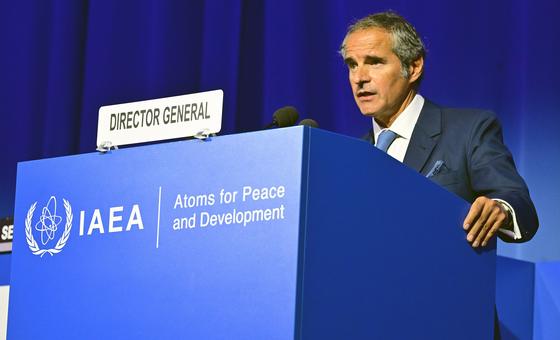
He stressed that their support for the non-proliferation regime, the Nuclear Non-proliferation Treaty (NPT), and the IAEA, is crucial.

“I urge Member States to recommit to a system that has been one of the most important foundations for international peace, even during the tensest decades of our generation,” he said.

He noted that the conference comes at a time when “acts of terrorism, multiple military conflicts, and the erosion of nuclear norms are all happening against a growing gap between poverty and prosperity.”

Mr. Grossi went on to speak about the ways in which the IAEA is working to stop the spread of nuclear weapons and is putting nuclear science to good use, including for cancer treatment, food security, plastic pollution monitoring, disease detection, and artificial intelligence.

Nuclear safety around the world

Earlier this year, Syria agreed to cooperate with the IAEA, and just last week, the agency reached an agreement with Iran to resume the implementation of nuclear safeguards – technical measures used by the IAEA to ensure that if countries make advancements in nuclear technology, they do so for peaceful purposes.

“When the IAEA confirms the peaceful use of a State’s nuclear material, confidence over nuclear activities is established,” said Mr. Grossi.

Meanwhile, in Ukraine, where nuclear power plants are at risk from conflict, the IAEA has sent over 200 missions and is “present on the ground at all the sites.”

But more challenges remain. The Democratic People’s Republic of Korea (DPRK) continues its nuclear weapons programme, while even countries abiding by the NPT, the landmark international agreement meant to abolish nuclear weapons, are debating adding them.

“Think for a minute about a world where instead of a few, we would have 20 or 25 countries armed with nuclear weapons,” he warned.

Peaceful uses of nuclear science

Three years ago, the IAEA launched its flagship programme, Rays of Hope, becoming a “catalyst for real, substantial progress in cancer care.” Through the initiative, concrete actions have been taken in 40 countries: hospitals have been built, radiotherapy machines procured, and physicists trained.

Additionally, the IAEA’s joint programme with the UN Food and Agriculture Organization (FAO), Atoms4Food, is helping boost food security and reduce the environmental strain arising from agriculture.

“In a world of abundance, 700 million people should not have to go to bed hungry every night,” he said.

Mr. Grossi highlighted more ways in which the agency is benefiting the people and the planet, including through its initiative supporting many countries in addressing plastic pollution and waste, and another on improving global preparedness for diseases.

An optimistic outlook

With powerful tools like artificial intelligence and machine learning, “the future is too exciting to miss.”

Nuclear energy can power artificial intelligence infrastructure, while artificial intelligence can improve nuclear technology. To further explore this mutually beneficial relationship, the IAEA will organise the first ever symposium dedicated to the topic in December this year.

Fusion energy, which has been progressing thanks to public and private capital, is another technological development soon expected to take off.

“Every challenge is an opportunity,” concluded Mr. Grossi. “Peace is not simply the absence of conflict. It is dynamic, hopeful striving that I see in what we do all around the world.”

The 69th IAEA General Conference will take place from 15-19 September in Vienna, Austria, where over 3,000 participants are registered to attend.

Source link

Guterres condemns deadly attack in Jammu and Kashmir

UN Spokesperson Stéphane Dujarric, responding to inquiries, emphasised the Secretary-General’s condemnation of the attack.

Media reports indicate that a gunman opened fire on a group of people near Pahalgam, in the region’s south, leaving more than two dozen dead.

Mr. Guterres extends his heartfelt condolences to the bereaved families, said Mr. Dujarric, underscoring “that attacks against civilians are unacceptable under any circumstances.”

Jammu and Kashmir has been disputed by India and Pakistan, since the end of British rule in the late 1940s.

Source link

Russia-Ukraine War: Kyiv becomes major target again, 11 killed in air strikes

On Monday, Russia pounded cities across Ukraine during rush hour, killing civilians and knocking out power and heat, in apparent revenge strikes after President Vladimir Putin declared a blast on Russia’s bridge to Crimea to be a terrorist attack.

Cruise missiles tore into busy intersections, parks and tourist sites in the center of downtown Kyiv with an intensity unseen even when Russian forces attempted to capture the capital early in the war, reported Reuters.

Belarusian President Alexander Lukashenko said he had ordered troops to deploy with Russian forces near Ukraine in response to what he said was a clear threat to Belarus from Kyiv and its backers in the West.

At least 11 people were reported killed and scores injured, with warning of even more “severe retaliation” in the event of further Ukrainian attacks. “Let there be no doubt,” Putin said in televised comments addressed to his security council, “if attempts at terrorist attacks continue, the response from Russia will be severe.”

Many of the locations hit by cruise missiles and kamikaze drones in the midst of the morning rush hour appeared to be solely civilian sites or key infrastructure, including the country’s electric grid, apparently chosen to terrorise Ukrainians.

As the scale of Monday morning’s assault emerged, Moscow faced a chorus of international condemnation with EU foreign policy chief, Josep Borrell, saying such acts have “no place” in the 21st century”.

The UN’s secretary general, António Guterres, said he was “deeply shocked” by Russia’s most widespread air strikes since the start of the Ukraine war, a spokesperson said.

In a statement, the UN spokesperson Stéphane Dujarric said:”This constitutes another unacceptable escalation of the war and, as always, civilians are paying the highest price.”

Due to the war, some 7.6 million Ukrainian refugees have scattered around Europe since Russian President Vladimir Putin sent troops over the border, but many are having difficulty finding jobs and homes.

The European Commission unveiled a new online tool to help Ukrainians find a job as the bloc looks to extend its protection for those displaced.

Jaishankar in US, to push for Security Council reforms

External Affairs Minister S. Jaishankar begins his 10-day tour of the United States on Sunday that will be marked by another attempt to infuse new life into the stalled UN Security Council reforms process and steady bilateral ties with the US rocked by differences over Ukraine and a massive upkeep package for Pakistan’s F-16 fighter aircraft.

Jaishankar will spend the first and longer part of the visit in New York, attending the annual high-level meetings of the UN General Assembly and meeting counterparts in bilaterals and multilaterals such as the BRICS (with Brazil, China and South Africa), G-4 (with Japan, German and Brazil), IBSA (with Brazil and South Africa) and SAARC (with all other south Asian countries).

The minister will head out to Washington DC on September 25 for the second and last leg of the tour for bilateral meetings, including with his counterpart Antony Blinken and other senior officials of the Joe Biden administration. He will also meet industry leaders and Indian Americans, some of whom have felt disappointed by New Delhi’s refusal to condemn Russia’s invasion of Ukraine.

The highlights of Jaishankar’s UNGA meetings will be his address to a group of developing countries from Asia, Africa, Latin America, the Caribbean and Small Island called L69, which is focussed on the reform of the UN Security Council.

The meeting will be based on the theme “Reinvigorating Multilateralism and Achieving Comprehensive Reform of the UN Security Council”.

The UNSC reforms process has moved at a snail’s pace since formal discussions started as Intergovernmental Negotiations. The last expansion of the elite club took place in 1965 with the addition of four non-permanent seats, taking the total to 15 — five permanent members and 10 non-permanent members.

India, which is now serving its eighth two-year term as a non-permanent member, wants a permanent berth in the expanded council, but it has watched the process drag with mounting irritation, which shows through the stronger language used by its leaders to demand progress.

The United States is planning to put its weight behind the process at UNGA.

“We will be having discussions with our P3 colleagues (with the other two permanent members France and the United Kingdom) as well as others on the way forward,” US Ambassador to UN, Linda Thomas-Greenfield, had told reporters last week, adding, “The President will present a bit more on this in his speech. Secretary Blinken will also be engaging this week on the commitments we’ve made and how we see the process moving forward.”

Jaishankar may also meet for the first time — or, as is most likely — not meet his Pakistani counterpart Bilawal Bhutto at the conference of SAARC ministers. The annual ritual is marked by Pakistan’s efforts to stage a showdown with the Indian delegation and minister.

In Washington, Jaishankar is scheduled to meet his counterpart Blinken and others in the backdrop of the recent differences over Ukraine and the proposed US aid package of $450 million to Pakistan to furbish its F-16s.

The US had pressed India to condemn the Russian invasion and not increase its oil purchase from Russia so as to not allow Moscow any relief from the severe economic sanctions the West has imposed.

India had done neither, not until later, when Prime Minister Narendra Modi publicly told Russian President Vladimir Putin during their recent meeting on the sidelines of the Shanghai Cooperation Organisation (SCO) summit in Samarkand, “Today’s era is not of war.”

The remarks, which were noted approvingly by the US media, may pre-empt some of the tough discussions — “frank” exchanges, as they are invariably noted in press communiques — that could have taken place otherwise.

The Ukraine war has added an unforeseen and unwelcome wrinkle to a relationship that’s seen remarkable progress in recent years. Strategic cooperation — considered central to the relationship — has seen a sharp upswing with quick and frequent meetings of the Quad.

A US package of $450 million for Pakistan’s F-16s was seen unkindly by New Delhi. Defence Minister Rajnath Singh had conveyed the government’s concern in a telephone call to his counterpart Lloyd Austin. The US took no note of it in its readout of the call.

Jaishankar is a veteran of India’s ties with the US as former Ambassador to this country, and may have authored large parts of it. The next 10 days may prove to be another masterclass in diplomacy from India’s top diplomat.


UN General Assembly Session: Biden to present plan on Security Council Expansion

At next week’s high-level UN General Assembly (UNGA) meeting, US President Joe Biden will present a ideas for moving forward the Security Council reform process that includes expanding it, according to Washington’s Permanent Representative Linda Thomas-Greenfield.

Giving a basic outline of US plans for “moving the needle forward” on reforms, she said on Friday that “the President will present a bit more on this in his speech”.

“We will advance efforts to reform the UN Security Council that includes forging consensus around sensible and credible proposals to expand Security Council membership,” Thomas-Greenfield, who is a member of Biden’s cabinet, said while briefing reporters about the country’s priorities for the Assembly session, which will draw leaders from several countries.

“We will be having discussions with our P3 colleagues as well as others on the way forward,” she said using the acronym “P3” for the three Western permanent members, the US, Britain and France.

President Joe Biden.(photo:Instagram)

Secretary of State Antony Blinken “will also be engaging this week on the commitments we’ve made and how we see the process moving forward”, she said.

“And we will have further discussions with other member states on how we can just move the needle on this so that we can make some progress on UN reform and Security Council reform.”

Thomas-Greenfield confirmed that Biden would address the Assembly on September 21, a break with the tradition of the US President as the second speaker after Brazil at the opening of the annual high-level session known as the General Debate that starts on September 20.

This is because Biden is scheduled to be in London on Monday for Queen Elizabeth’s funeral.

Prime Minister Narendra Modi is staying away from the UN meeting this year, as are Presidents Xi Jinping of China and Vladimir Putin of Russia, who all met this week in Samarkand, Uzbekistan, at the 22nd Shanghai Cooperation Organisation Summit.

French President Emmanuel Macron will be in New York at the UN meeting and UK Prime Minister Liz Truss will make her debut there on the world stage following her election last week.

While the US, along with Britain and France, supports India getting a permanent seat on the Council, Washington’s agenda for reforms is broader.

Thomas-Greenfield laid out what she said were six new principles for the Council, one of which is expanding its membership.

Another relates to Russia blocking the Council from acting on its invasion of Ukraine and its fallout by using its veto power.

“Bilateral disputes must never be an excuse for obstructing the Council’s mandate or forgoing one’s responsibilities,” she said.

She proposed drastically cutting down the use of vetoes, tagging on the assurance that “we will refrain from the use of the veto except in rare, extraordinary circumstances”.

She pointed out that since 2009, Russia has cast 26 vetoes, in 12 of which China joined it, while the US had only used it only four times during that period.A

Another principle Thomas-Greenfield proposed was bringing transparency to the Council while enhancing cooperation.

“Council members should engage frequently and substantively with the General Assembly and other UN bodies and UN member states”, she said.

“These principles are the start of a dialogue, one that President Biden, Secretary Blinken, and myself and so many others will pick up and take into our conversations during High-Level Week and in the weeks ahead.

“Our hope is to rally the world behind the Charter that we all committed to 77 years ago in San Francisco, and together, we will work to shape and reform it and the system it has created for the future,” she said.

Her adding the key qualifiers “sensible and credible” to the Council expansion proposal opens it to several suggestions.

The ideas for reform that have been proposed by several countries and groups include adding permanent members with veto power or without it (which India is amenable to); instead only giving extended terms beyond the current two years to some elected members, and expanding only non-permanent membership under present terms.

The other issue is which countries get the permanent memberships.

It is a touchy matter for the US which is uneasy about certain countries from the African or Arab block getting permanent seats just as China and Russia are leery about the possible elevation of some countries.

Pakistan raises accidental missile issue at UN; China, US support direct talks

Despite India’s clarification, Pakistan Foreign Minister Shah Mahmood Qureshi chose to complain to UN Secretary-General Antonio Guterres on what he said was the “blatant violation of Pakistans airspace by the ‘accidental’ firing of a missile by India on March 9”, reports said.

India’s Defence Ministry had given clarification that in the course of routine maintenance on March 9, a technical malfunction led to the accidental firing of a missile that landed inside the territory of Pakistan.

However, Pakistan said “multiple shortcomings and technical lapses of a serious nature in India’s management of strategic weapons” was “irresponsible conduct” and needed to be addressed by the international community, including the UN Security Council. Islamabad also insisted on a joint probe of the incident.

Meanwhile, the US and China have urged India and Pakistan to hold direct talks for reducing tensions as both are nuclear-armed nations. “We continue to support direct dialogue between India and Pakistan on issues of concern,” a US State Department official said on Monday, though Washington said it sees no wrong intention behind the mishap.

Zhao Lijian, a spokesperson for China’s Foreign Ministry said, “We called on relevant countries to have dialogue and communication as soon as possible and launch a thorough investigation into this incident,” spokesman Zhao Lijian told reporters in Beijing.