
UN chief ‘gravely alarmed’ by US bombing of Iranian nuclear sites

“I am gravely alarmed by the use of force by the United States against Iran today,” said the UN chief, reiterating that there is no military solution.

This is a dangerous escalation in a region already on the edge – and a direct threat to international peace and security.”

President Donald Trump delivered a televised address to the nation from the White House at 10pm local time and said that Iran’s nuclear facilities at Fordo, Natanz and Isfahan had been “totally obliterated” describing the long-range bombing raid as a “spectacular military success.”

President Trump called on Iran’s leadership to now “make peace” and return to negotiations over its nuclear programme or suffer a far greater wave of attacks.

Iranian authorities have yet to confirm the extent of the damage to the three sites in central Iran. Earlier in the day, Iran’s foreign minister reportedly warned the US against any involvement in the Iran-Israel conflict which erupted on 13 June.

Deadly strikes

At least 430 Iranians are believed to have been killed during waves of strikes since then with around 3,500 injured, according to figures from the Iranian health ministry.

In Israel, 24 civilians have died in the retaliatory attacks according to local authorities with more than 400 missiles reportedly fired towards the country.

B-2 bombers were involved in the US strikes, President Trump confirmed, dropping so-called “bunker buster” bombs on the uranium enrichment site at Fordow which is buried deep inside a mountain south of the capital Tehran.

‘Avoid a spiral of chaos’

In his statement, the Secretary-General reiterated his concerns voiced in the Security Council during Friday’s emergency meeting on the crisis that the conflict “could rapidly get out of control – with catastrophic consequences for civilians, the region, and the world.”

He called on all Member States to de-escalate the situation which threatens the stability of the Middle East and beyond, calling for everyone to uphold their obligations under the UN Charter and international law.

At this perilous hour, it is critical to avoid a spiral of chaos,” he added calling for an immediate return to negotiations between the warring parties.

There is no military solution. The only path forward is diplomacy. The only hope is peace.”

Source link

Monitoring Iran and promoting peaceful nuclear use – IAEA role explained

The International Atomic Energy Agency (IAEA) dates back to 1957 and was set up in response to global fears following the first use of nuclear and atomic weapons and alarm over the advent and spread of nuclear technology. An autonomous part of the United Nations system, it works on issues as varied as food safety, cancer control and sustainable development – and also on promoting peaceful uses of nuclear energy.

Another principal responsibility, perhaps less well understood, is the  agency’s framework of nuclear ‘safeguards’ agreements. These agreements are voluntarily entered into by countries and are key to preventing the spread of nuclear weapons by independently verifying whether countries are meeting their non-proliferation commitments. As of 2024, some 182 countries have safeguards  agreements with the IAEA.

IAEA Director General Rafael Mariano Grossi delivers remarks on the military action launched by Israel which includes attacks on nuclear facilities in Iran.

In a June 9 address to the agency’s board, IAEA Director General Rafael Grossi laid out troubling findings, raising fresh concerns about Iran’s compliance with global nuclear agreements.

“Iran has repeatedly either not answered” IAEA requests “or not provided technically credible answers,” Mr. Grossi told the 35-nation board on Monday. Additionally, he said, Iran has sought to “sanitise the locations,” which the agency has now concluded were part of a “structured” nuclear programme in the early 2000s.

“Unless and until Iran assists the agency in resolving the outstanding safeguards issues, the Agency will not be in a position to provide assurance that Iran’s nuclear programme is exclusively peaceful,” he said.

Mr. Grossi expressed alarm at the rapid accumulation of over 400 kilogrammes of highly enriched uranium, which has serious implications (highly enriched uranium is one of the necessary components for the creation of a nuclear bomb).

The statement to the board underlined the significant role the IAEA plays in Iran, which can be broken down into four main areas.

1. Monitoring

The agency uses safeguard agreements under the Nuclear Non-Proliferation Treaty (NPT), a key international accord designed to prevent the spread of nuclear weapons. The vast majority of safeguards agreements are those that have been concluded by the IAEA with non-nuclear-weapon States. However, safeguards are implemented in three States that are not party to the NPT – India, Pakistan and Israel – on the basis of item-specific agreements they have concluded with the IAEA.

As a non-nuclear armed signatory to the treaty, Iran is banned from acquiring nuclear weapons and is required to allow the IAEA to inspect and verify all nuclear materials and activities, including at short notice, if asked.

The agency regularly inspects Iran’s nuclear facilities, including sites like Natanz, Fordow, and Isfahan. The aim is to ensure that nuclear materials are only used for peaceful means and are not diverted for weapons use.

On 9 June, Mr. Grossi noted that man-made uranium particles had been found at three more, undeclared sites (Varamin, Marivan and Turquzabad). Iran, he said, had failed to provide “technically credible explanations” for the presence of the particles, despite years of consultations.

Rafael Grossi (on screen), Director General of the International Atomic Energy Agency (IAEA), briefs the UN Security Council meeting on Iran.

2. Reporting

The agency regularly reports to its Board of Governors on the nuclear activities of Iran (and other countries), using methods such as inspections, monitoring equipment, environmental sampling, and satellite imagery to gather data and prepare technical reports. In the case of countries under special scrutiny – such as Iran – these reports are typically issued every quarter.

If Iran – or any non-nuclear weapon country party to the NPT – fails to comply with the IAEA’s requirements (for example, by limiting access or not explaining the presence of uranium particles), the agency can report Iran to the UN Security Council, which may lead to diplomatic pressure, sanctions or calls for further negotiations.

IAEA Director General Rafael Grossi (2nd left) visiting the Natanz and Fordow nuclear facilities.

3. Diplomatic engagement

The IAEA frequently calls for diplomatic solutions and emphasises the importance of dialogue to resolve concerns about Iran’s nuclear intentions. Director General Grossi has engaged directly with Iranian authorities and international stakeholders to maintain communication and transparency.

Addressing the Security Council on June 13, Mr. Grossi said that his agency was in constant contact with the Iranian Nuclear Regulatory Authority to assess the status of affected facilities and determine broader impacts on nuclear safety and security.

4. Safety and security oversight

This is a critical part of the IAEA’s broader mission to prevent nuclear accidents, ensure that nuclear energy is used for peaceful purposes, and protect people and the environment.

The IAEA works with the Iranian authorities to ensure that nuclear facilities like Natanz, Fordow, and Esfahan operate safely, by assessing the design and operation of the facilities, monitoring radiation protection measures, and evaluating emergency preparedness.

After the June 2025 Israeli strikes, the IAEA confirmed that Natanz had been impacted but reported no elevated radiation levels. However, it emphasised that any military attack on nuclear facilities is a violation of international law and poses serious risks to safety and the environment.

Atomic watchdog says Iran not complying with nuclear safeguards

The development follows serious warnings from the head of the International Atomic Energy Agency (IAEA) earlier this week that inspectors have been unable to determine whether Iran’s nuclear programme was “exclusively peaceful” – as per the terms of the 2015 nuclear deal from which the United States subsequently withdrew.

A fresh round of negotiations between Washington and Tehran is slated to begin on Saturday in Oman, according to news reports, amid heightened geopolitical tensions linked to rumours of an impending Israeli attack on Iran.

Following Thursday’s resolution vote by the IAEA’s board of governors – which passed by a vote of 19 for, three against and 11 abstentions – Iran’s atomic energy body reportedly announced plans to open a new uranium enrichment plant and increase production of enriched fissile material.

Growing concerns

The draft for Thursday’s resolution highlights serious and growing concerns since at least 2019 that Iran had failed to cooperate fully with the UN agency’s inspectors.

Tehran has “repeatedly” been unable to explain and demonstrate that its nuclear material was not being diverted for further enrichment for military use, the draft text maintains.

Iran has also failed to provide the UN agency with “technically credible explanations for the presence of [man-made] uranium particles” at undeclared locations in Varamin, Marivan and Turquzabad, it continues.

“Unfortunately, Iran has repeatedly either not answered, or not provided technically credible answers to, the agency’s questions,” IAEA chief Grossi said on Monday. “It has also sought to sanitize the locations, which has impeded Agency verification activities.”

According to Mr. Grossi, Tehran has stockpiled 400 kilogrammes of highly enriched uranium.

Given the potential proliferation implications, the agency cannot ignore [this],” he told the UN agency’s governing board on Monday.

Source link

Lack of cooperation from Iran hampers nuclear checks, says atomic energy watchdog

Rafael Grossi, Director-General of the International Atomic Energy Agency (IAEA), said on Monday that Iran’s growing stockpile of highly enriched uranium and unresolved questions about its programme remain serious issues.

Unless and until Iran assists the agency in resolving the outstanding safeguards issues, the Agency will not be in a position to provide assurance that Iran’s nuclear programme is exclusively peaceful,” he said.

He was addressing IAEA’s Board of Governors, which comprises 35 countries – including France, Russia, the UK and the US.

Lack of credibility

Mr. Grossi further noted that Iran had failed to provide technically credible explanations for the presence of man-made uranium particles at three undeclared sites – Varamin,  Marivan and Turquzabad – despite years of consultations.

Based on its assessments, IAEA can conclude that these three locations were part of a structured nuclear programme that operated until the early 2000s and involved undeclared nuclear material, he said.

“The agency also concludes that Iran did not declare nuclear material and nuclear-related activities at these three undeclared locations in Iran…as a consequence of this, the Agency is not in a position to determine whether the related nuclear material is still outside of safeguards.”

The situation is exacerbated by the country’s decision to stop implementing some provisions of its Safeguards Agreement, a legal requirement under international law, he added, urging Tehran to urgently restore transparency and comply with international obligations.

Highly enriched uranium

Mr. Grossi also expressed alarm at the rapid accumulation of over 400 kilogrammes of highly enriched uranium, which has serious implications.

Given the potential proliferation implications, the agency cannot ignore [this],” he said.

While commending Egypt’s recent diplomatic efforts to mediate between Iran and the United States, Mr. Grossi stressed that only a diplomatic solution, backed by IAEA verification, could restore trust.

He said the agency stands ready to verify any future agreement between the two sides.

“The effect of a stabilised situation in Iran with regards to its nuclear programme will be immediate and bring the Middle East one big step closer to peace and prosperity,” he said.

‘Clear violations’ in DPR Korea

Turning to the Democratic People’s Republic of Korea (DPRK), Mr. Grossi said the IAEA continues to monitor nuclear activity remotely, despite being denied direct access to the country.

North Korea’s five-megawatt electrical reactor at Yongbyon “likely continues” to be operating in its seventh cycle, while reprocessing of irradiated fuel has likely resumed at the Radiochemical Laboratory.

He noted ongoing construction at a new building with similarities to the Kangson enrichment site and said the light water reactor at Yongbyon remains active.

“The continuation and further development of the DPRK’s nuclear programme are clear violations of relevant UN Security Council resolutions and are deeply regrettable,” he said, adding that IAEA stands ready to play its role in verifying the DPRK’s nuclear programme.

IAEA experts depart Unit 4 of Fukushima Daiichi Nuclear Power Station. (April 2013 photo).

Monitoring discharge in Japan

Mr. Grossi said the IAEA continues to monitor the controlled release of ALPS-treated water from the Fukushima Daiichi Nuclear Power Station in Japan, which suffered major damage in a 9.1 magnitude earthquake and tsunami in March 2011.

In April this year, IAEA and international experts collected and analysed diluted samples ahead of discharge.

“The IAEA has maintained its independent monitoring and analysis efforts, confirming that tritium concentrations in the discharged batches remain far below operational limits and align with the international safety standards,” Mr. Grossi said.

‘Precarious situation’ in Ukraine

Director-General Grossi also highlighted the precarious situation at Ukraine’s Zaporizhzhya Nuclear Power Plant, where all six reactors remain in cold shutdown amid continued military activity.

A full damage assessment is also underway at Chernobyl, which was the site of a drone strike and ensuing fire in February that resulted in “significant damage” to a confinement arch that is critical to maintaining long-term safety at the site.

The power plant suffered a massive nuclear accident in 1986 and has since been encased in a protective structure to contain radioactive material and prevent its release.

“As the military conflict moves further into its fourth year, Ukraine needs support, and the IAEA is providing it,” Mr. Grossi said, reaffirming the Agency’s commitment to supporting Ukraine’s nuclear infrastructure during wartime and throughout the eventual post-war reconstruction.

Source link

DPR Korea ploughing ahead with nuclear and ballistic missile programme

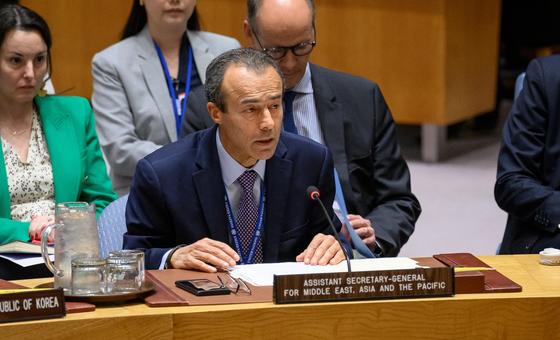
Briefing ambassadors in the Security Council on Wednesday, Assistant Secretary-General Khaled Khiari described a troubling pattern of weapons testing and growing nuclear ambition from DPRK – more commonly known as North Korea.

This includes the launch of an intercontinental ballistic missile (ICBM) in October 2024 and an intermediate-range hypersonic missile last January.

Meanwhile, the International Atomic Energy Agency (IAEA) has reported “open displays” of undeclared uranium enrichment at Yongbyon and Kangson.

“These events have been accompanied by statements reiterating the DPRK’s intention to further develop nuclear and ballistic missile capabilities, including tactical nuclear warheads, military reconnaissance satellites, and the construction of a ‘nuclear-powered strategic missile submarine’,” Mr. Khairi said.

North Korea’s persistent pursuit of nuclear weapons and ballistic missile programmes – in violation of multiple Security Council resolutions – “continues to undermine the global nuclear disarmament and non-proliferation regime,” he warned.

Ensuring compliance

Mr. Khiari reiterated the UN’s call for compliance with the Treaty on the Non-Proliferation of Nuclear Weapons (NPT) and IAEA safeguards, calling on DPRK to sign and ratify the Comprehensive Nuclear-Test-Ban Treaty.

He also echoed Secretary-General António Guterres’ call for all countries to ensure that their relations with the DPRK “entirely abide” by the relevant Council sections.

We recall the obligations for all Member States to implement the relevant sanctions measures,” he said.

Broader security risks

He also noted broader regional tensions, warning that the Korean Peninsula “remains tense,” amid heightened military activity, limited dialogue between north and south – and the growing nuclear risk.

He cautioned that the potential for miscalculation is increasing and urged renewed diplomatic efforts toward sustainable peace and the complete, verifiable denuclearization of the Korean Peninsula.

These must be anchored in dialogue and diplomacy, Mr. Khiari said.

Addressing humanitarian needs

Beyond the security situation, Mr. Khiari urged ambassadors not to forget the reportedly dire humanitarian situation in the country.

We reiterate the call on the DPRK to facilitate the return of the UN Country Team to strengthen support for its people and advance the 2030 Agenda for Sustainable Development,” he said.

Source link