
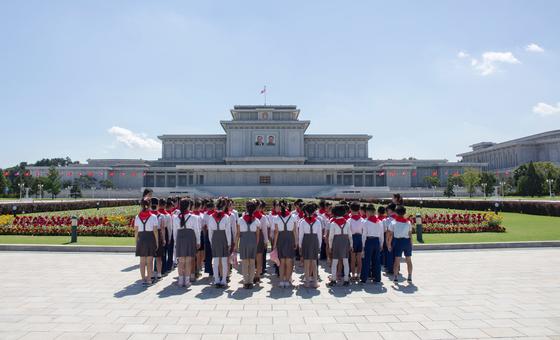
DPR Korea: UN report finds human rights situation still dire, a decade on

The rights office, OHCHR, interviewed 314 witnesses who left the DPRK – more commonly known as North Korea – and consulted with several organizations and experts to evaluate the human rights conditions there since 2014.

The situation has not improved, and in many cases has worsened, “bringing even more suffering to the population,” said Spokesperson Liz Throssell, briefing journalists in Geneva.

James Heenan, head of the office working on DPRK, highlighted the severity of the human rights violations, where even a minor offence can result in punishment.

Killed for sharing shows online

We do have credible evidence that individuals have been executed – not  just for watching K-dramas. The crime is for distributing at a certain level, foreign information, foreign media,” he said.

The report found that new laws, policies and practices have been leading to increased surveillance and control over citizens, some of whom have ended up in forced labour camps, as political prisoners.

Working in ‘shock brigades’

In a form of forced labour called “shock brigades,” Authorities in Pyongyang have reportedly used thousands of orphans and street children to work in coal mines and other environments, exposing them to hazardous materials and long working hours, the UN report said.

Mr. Heenan further added that school children are also used to do “backbreaking” work collecting harvests and while they were supposed to be in class.

“The Government says that this is sort of a curriculum to help them learn life skills. But the information we’ve had for many years now is that it meets the qualification of forced labour because the children have no choice,” he said.

The physically demanding and dangerous work of the brigades is also undertaken by people in the military or prison system, as well as by workers from mainly poor families who wish to become party members or improve their social status.

Deaths are reportedly frequent under these conditions but rather than increasing safety measures, the DPRK publicly glorifies deaths as a sacrifice to the leader, according to the report.

Death penalty widely used

In 2014 and 2015, many senior officials were reportedly executed for “anti-State acts,” the report says.

While this trend later decreased, escapees said that from 2020, execution has been used for the distribution of unauthorized media, drugs and economic crimes, prostitution, pornography, trafficking and murder.

Since 2015, there have been six new laws allowing the use of the death penalty for offenses such as a vaguely defined “anti-state” propaganda.

Interviewees said they also witnessed public executions over the last decade. The report explains that the government has organised public trials and executions to instil fear in the population and as a deterrent.

“To block the people’s eyes and ears, they strengthened the crackdowns,” one of the witnesses told OHCHR.

Not enough progress

Escapees expressed that some improvements had been made in the treatment of people in detention facilities. North Korea has also ratified two more human rights treaties, but the report ultimately concludes that it is far from adhering to its obligations under international law.

The DPRK remains more isolated than any other nation, further adding to the difficulty of monitoring and implementing fair human rights standards.

What we have witnessed is a lost decade,” said UN human rights chief Volker Türk. “And it pains me to say that if DPRK continues on its current trajectory, the population will be subjected to more of the suffering, brutal repression and fear that they have endured for so long.”
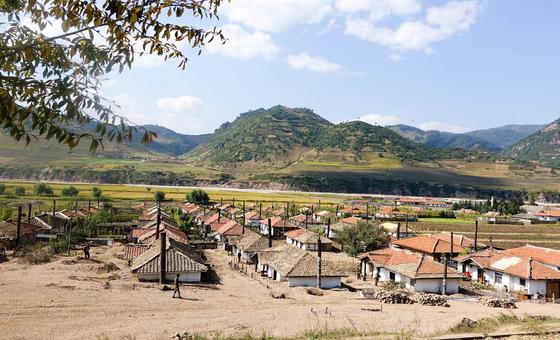
Source link

‘Silence is complicity,’ warns activist who fled DPR Korea

When they eventually did, her mother said to her, “If you are going to die anyway, better to be shot crossing the two-mile border than starve here.”

Shortly thereafter they fled from the Democratic People’s Republic of Korea, more commonly known as North Korea.

Ms. Kim gave testimony to the UN General Assembly on Tuesday during a meeting convened to discuss human rights abuses and violations in DPRK: “The human rights situation in the country has been of grave concern for years, and, in many respects, is deteriorating,” Ilze Brands Kehris, Assistant Secretary-General for Human Rights, told delegates.

The representative from DPRK denounced the meeting, insisting that the information presented was a “fabrication.”

Wide-ranging abuses

North Koreans have been forced to exist in “absolute isolation” for many years, according to UN Special Rapporteur on human rights for the country, Elizabeth Salmón.

The independent UN Human Rights Council-appointed expert said this isolation has exacerbated the impact of multiple rights violations which include forced labour systems, infringement on freedom of expression and movement, torture and the forced disappearance of hundreds of thousands of civilians.

The DPRK has also denied entry to humanitarian aid despite UN data which suggests that it is desperately needed – 11.8 million people, or 45 per cent of the population, are estimated to be undernourished and more than half the population lacks adequate sanitation.

Instead of social services, Pyongyang has prioritized militarisation, exacerbating human rights violations, said the Special Rapporteur.

“As the DPRK expands its extreme militarization policies, it exacerbates the extensive reliance on forced labour and quota systems, showing how peace, security and human rights are strongly interrelated,” Ms. Salmón said.

‘Please do not turn away’

Ms. Kim pleaded with delegates and UN officials to take action.

Please do not turn away from the innocent lives being lost in North Korea and elsewhere. Silence is complicity,” she said.

Ms. Kehris noted that the international community has taken many steps in past decades to address ongoing human rights abuses in the DPRK but that these actions have failed the change the status quo.

“Given the gravity and scale of the violations, and inability or unwillingness of the [DPRK] to pursue accountability, international accountability options must be considered, including referral of the situation to the International Criminal Court,” she said.

Despite such challenges, the senior official did note that Pyongyang has shown “increased willingness” to engage with her office, OHCHR.

In September, OHCHR is due to present a report to the Human Rights Council which will make new proposals on improving the situation.

In her remarks, Ms. Salmón insisted that long-term accountability for the DPRK must go hand in hand with peace.

“Peace is a foundation for human rights. Human rights cannot thrive without peace. In this rapidly developing political climate, we must act together to prevent geopolitical tensions from destabilizing the Korean Peninsula,” she said.

Hope for the future

It has been more than 25 years since Ms. Kim fled: “One day, I hope to return to North Korea, hand in hand with my daughters, to show them a North Korea not defined by control and fear but filled with freedom and hope,” she said.

Source link

DPR Korea ploughing ahead with nuclear and ballistic missile programme

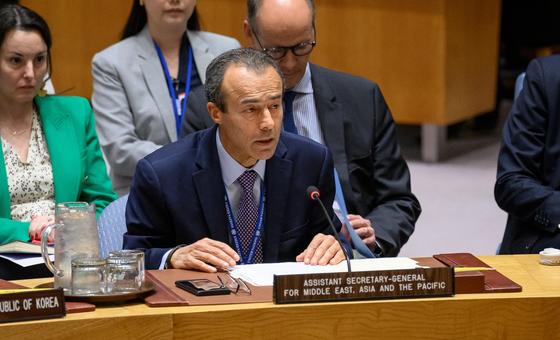
Briefing ambassadors in the Security Council on Wednesday, Assistant Secretary-General Khaled Khiari described a troubling pattern of weapons testing and growing nuclear ambition from DPRK – more commonly known as North Korea.

This includes the launch of an intercontinental ballistic missile (ICBM) in October 2024 and an intermediate-range hypersonic missile last January.

Meanwhile, the International Atomic Energy Agency (IAEA) has reported “open displays” of undeclared uranium enrichment at Yongbyon and Kangson.

“These events have been accompanied by statements reiterating the DPRK’s intention to further develop nuclear and ballistic missile capabilities, including tactical nuclear warheads, military reconnaissance satellites, and the construction of a ‘nuclear-powered strategic missile submarine’,” Mr. Khairi said.

North Korea’s persistent pursuit of nuclear weapons and ballistic missile programmes – in violation of multiple Security Council resolutions – “continues to undermine the global nuclear disarmament and non-proliferation regime,” he warned.

Ensuring compliance

Mr. Khiari reiterated the UN’s call for compliance with the Treaty on the Non-Proliferation of Nuclear Weapons (NPT) and IAEA safeguards, calling on DPRK to sign and ratify the Comprehensive Nuclear-Test-Ban Treaty.

He also echoed Secretary-General António Guterres’ call for all countries to ensure that their relations with the DPRK “entirely abide” by the relevant Council sections.

We recall the obligations for all Member States to implement the relevant sanctions measures,” he said.

Broader security risks

He also noted broader regional tensions, warning that the Korean Peninsula “remains tense,” amid heightened military activity, limited dialogue between north and south – and the growing nuclear risk.

He cautioned that the potential for miscalculation is increasing and urged renewed diplomatic efforts toward sustainable peace and the complete, verifiable denuclearization of the Korean Peninsula.

These must be anchored in dialogue and diplomacy, Mr. Khiari said.

Addressing humanitarian needs

Beyond the security situation, Mr. Khiari urged ambassadors not to forget the reportedly dire humanitarian situation in the country.

We reiterate the call on the DPRK to facilitate the return of the UN Country Team to strengthen support for its people and advance the 2030 Agenda for Sustainable Development,” he said.

Source link

New Year’s Eve Celebrated Around the World

Come New Year’s Eve, display of fireworks to revelers displaying the joyous mood mark the night of December 31 every year. Throughout the world the celebration begin with New Zealand and Australia reporting it first and New York or California joining the party much later in the day.

New Zealand:

A giant digital clock on Auckland’s landmark Sky Tower will show the countdown to New Year with people joining the spree shouting the seconds down to midnight. This is the first New Year Celebration every year to report with horns blared and crowds cheered as the tower goes up in lights varying from green to red to white in colour accompanied by fireworks.

Australia:

In Australia, Sydney’s famed harbour hosts pyrotechnics followed by waterfall of multicoloured fireworks in the sky, witnessed more than a million people off the Harbour Bridge.

Japan:

It’s holiday mood in Japan with most of the offices empty and cities virtually deserted. The New Year’s eve is celebrated by Tokyoites with children by releasing balloons from the top of the Tokyo Tower. Otherwise, millions of people leave cities for hometowns in trains. Temple ceremonies come to life on the New Year’s eve with the bronze bells ringing in the new year.

South Korea:

South Koreans too mark New Year’s Eve with traditional bell ringing ceremonies in Buddhist temples, with fireworks and music accompanied by pubic shows and performances in cities. On this day, several North Korean refugees, usually gather near the border to wish for a united Korea one day.

Malaysia

It is the fireworks time and celebrations on top of Kuala Lumpur’s landmark, Petronas Twin Towers, make the New Year’s Eve celebration in Malaysia comparable with the ‘Ball Drop’ at Times Square in New York.

China

China celebrates New Year’s Eve hosting performances and fireworks near Beijing’s Forbidden City in the Imperial Ancestral Temple in Beijing. Those at home are usually glued to TV broadcast of a gala from the National Stadium, known to most as the iconic Bird’s Nest.

Philippines

Fireworks mark both the revelry and tragedy of Filipinos on New Year Eve over the years. Traditionally Filipinos eat “media noche” on the midnight as others try thier hands at fireworks to make the loudest noise possible in Manila. After 2015 New Year Eve tragedy that injured about 850, shopping malls are holding the fireworks display to discourage individuals firing crackers in the city. Even the annual procession called the Black Nazarene, or carrying a black wooden statue of Jesus Christ, is being held a day earlier now to avoid injuries due to left over crackers on the streets.

Thailand

Following the demise of King Bhumbol, the New Year Eve will not be held in Thailand, which is observing one year mourning. Some of the canceled events include the Central World’s New Year Countdown Party & Beer Garden, the annual Patong Carnival, no fireworks at Wat Arun (Temple of Dawn) this year, and the New Year celebrations in Pattaya.

India:

Delhi, known for its showcase culture, will see many youngsters celebrating the New Year’s Eve on the streets dancing in an inebriated status while the police try to keep an eye on motorcyclists and drunk vehicle drivers. Usually Rashtrapati Bhavan is illuminated on the New Year’s Eve and 5-star hotels hold special events with live bands, dancing and plenty of drinks.

United Arab Emirates

In Dubai, the world’s second tallest building Burj Khalifa will be fitted with 400,000 LED lights and 1.6 tons of fireworks planned on every New Year’s Eve.

Gaza Strip

Palestinia hardly celebrates the New Year as Gaza’s Islamist Hamas rulers have banned New Year celebrations in the Palestinian territory and hotels and restaurants were not allowed to hold parties for three days, a day before the New Year and a day after the New Year.

France

The Champs Elysee in Paris is usually the centre of New Year’s Eve celebrations every year though last year it was not held due to November terrorist attacks in the city. It is likely that the Elysee may bring back the revelry of the New Year this time.

Belgium

Brussels, the capital of Belgium, canceled last year’s New Year’s Eve fireworks due to fear of terrorist attack but this year, it may be resumed though at a scaled down level.

United Kingdom

Fireworks in London are the most watched scenes around the world over the New Year’ Eve until the New York Ball drop takes place. Spectacular fireworks in London, Edinburgh and other big cities mark the event but police keep a tab on those without tickets.

Brazil

Remember the Copacabana beach in Rio de Janeiro, Brazil? It’s here the giant Christ statue will be lighted to say goodbye to 2016 and welcome 2017. Last year’s New Year’s Eve show was illuminated by 24 tons of fireworks spanning over 16 minutes. Music shows, samba dances and revelers mark the day with their performance.

US – New York

Come to New York on New Year’s Eve and watch the historic Ball Drop at Times Square at the midnight. Nearly one million people watch the event every year and big music bands including Luke Bryan, Charlie Puth, Demi Lovato and Carrie Underwood would perform. The descent of a glittering crystal ball from a rooftop flagpole marks the fireworks.