
UN rights mission condemns civilian toll in deadly missile strikes on Ukraine

At least 24 people were reported killed and over 300 injured – including 32 children – when ballistic missiles struck Ukraine’s Dnipro and Odesa regions on Monday and Tuesday, the UN Human Rights Monitoring Mission in Ukraine (HRMMU) said on Wednesday.

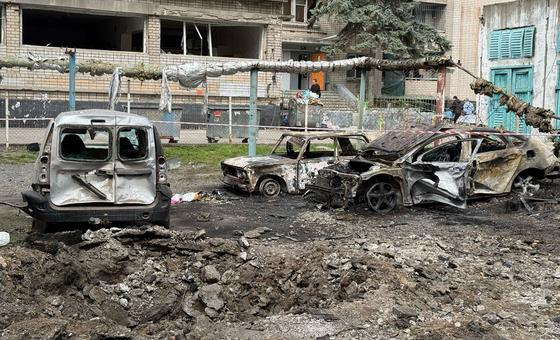
The attacks destroyed homes, schools, hospitals, and other civilian infrastructure, and left hundreds wounded.

“The attacks struck during the day when civilians were at work, on trains, or at school,” said Danielle Bell, head of HRMMU.

“The timing alone made the high number of civilian casualties entirely foreseeable.”

On 23 June, two ballistic missiles launched by Russian forces hit Lyceum No. 1, a middle school in Bilhorod-Dnistrovskyi, Odesa region. Although the school year had ended, staff and students were present for administrative work. The strike killed three educators and injured 14 others, including two boys.

The school, which served over 700 students, sustained critical damage.

No military objective

HRMMU, which visited the attacks sites, reported no evidence of military presence at the school, and people confirmed that no military presence had been stationed there.

“The school in Bilhorod-Dnistrovskyi was not a military objective,” Ms. Bell said.

“Yet it was hit by two ballistic missiles, killing educators and injuring children.”

The following day, 24 June, missiles struck an industrial area of Dnipro city at around 11 AM local time. The blast shattered windows in nearby schools, hospitals and residential buildings.

HRMMU confirmed that two dormitories were hit, injuring numerous residents. A nearby passenger train was also impacted – windows blown out by the shockwave – injuring more than 20 travellers, according to a UN monitor onboard.

A troubling trend

These strikes followed a series of other attacks in June that have resulted in significant civilian harm, including in Kyiv city on 17 and 23 June, according to the human rights mission.

Civilian casualties in the first five months of 2025 were nearly 50 percent higher than during the same period last year, with increases typically seen during the summer months.

“Ballistic missiles, when used in densely populated areas, cause predictable and widespread harm to civilians, as demonstrated by these recent attacks,” Ms. Bell said.

“The rising civilian casualties reflect the severity of that risk.”
Source link

DPR Korea ploughing ahead with nuclear and ballistic missile programme

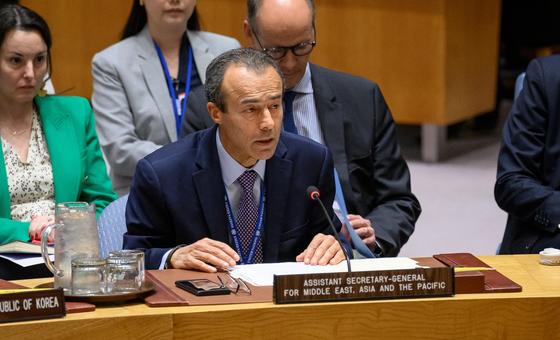
Briefing ambassadors in the Security Council on Wednesday, Assistant Secretary-General Khaled Khiari described a troubling pattern of weapons testing and growing nuclear ambition from DPRK – more commonly known as North Korea.

This includes the launch of an intercontinental ballistic missile (ICBM) in October 2024 and an intermediate-range hypersonic missile last January.

Meanwhile, the International Atomic Energy Agency (IAEA) has reported “open displays” of undeclared uranium enrichment at Yongbyon and Kangson.

“These events have been accompanied by statements reiterating the DPRK’s intention to further develop nuclear and ballistic missile capabilities, including tactical nuclear warheads, military reconnaissance satellites, and the construction of a ‘nuclear-powered strategic missile submarine’,” Mr. Khairi said.

North Korea’s persistent pursuit of nuclear weapons and ballistic missile programmes – in violation of multiple Security Council resolutions – “continues to undermine the global nuclear disarmament and non-proliferation regime,” he warned.

Ensuring compliance

Mr. Khiari reiterated the UN’s call for compliance with the Treaty on the Non-Proliferation of Nuclear Weapons (NPT) and IAEA safeguards, calling on DPRK to sign and ratify the Comprehensive Nuclear-Test-Ban Treaty.

He also echoed Secretary-General António Guterres’ call for all countries to ensure that their relations with the DPRK “entirely abide” by the relevant Council sections.

We recall the obligations for all Member States to implement the relevant sanctions measures,” he said.

Broader security risks

He also noted broader regional tensions, warning that the Korean Peninsula “remains tense,” amid heightened military activity, limited dialogue between north and south – and the growing nuclear risk.

He cautioned that the potential for miscalculation is increasing and urged renewed diplomatic efforts toward sustainable peace and the complete, verifiable denuclearization of the Korean Peninsula.

These must be anchored in dialogue and diplomacy, Mr. Khiari said.

Addressing humanitarian needs

Beyond the security situation, Mr. Khiari urged ambassadors not to forget the reportedly dire humanitarian situation in the country.

We reiterate the call on the DPRK to facilitate the return of the UN Country Team to strengthen support for its people and advance the 2030 Agenda for Sustainable Development,” he said.

Source link