World News in Brief: Executions surge in Iran, nuclear test threat, Burkina Faso declares top official unwelcome

At least 841 people have been put to death by the Government of Iran since the beginning of the year, with ethnic minorities and migrants “disproportionately targeted”, said OHCHR spokesperson Ravina Shamdasani.

Some executions have been carried out publicly, she added, with seven reported this year based on available information: “The real situation might be different. It might be worse given the lack of transparency in the use of the death penalty.”

Imminent executions

Eleven people now face imminent execution; six have been charged with “armed rebellion” owing to their alleged membership of the Mojahedin-e-Khalq group.  

Five others are on death row in connection with their participation in the 2022 protests, following the death in police custody of Mahsa Amini, who was detained by Iran’s so-called morality police for not wearing her hijab correctly.  

Ms. Shamdasani reiterated calls from UN rights chief Volker Türk for Iran to impose a moratorium on the application of the capital punishment, as a step towards its abolition.

UN chief warns against ‘playing with fire’ as nuclear test threat looms

UN Secretary-General António Guterres has issued a stark warning on the International Day against Nuclear Tests, urging world leaders to halt the threat of renewed detonations.

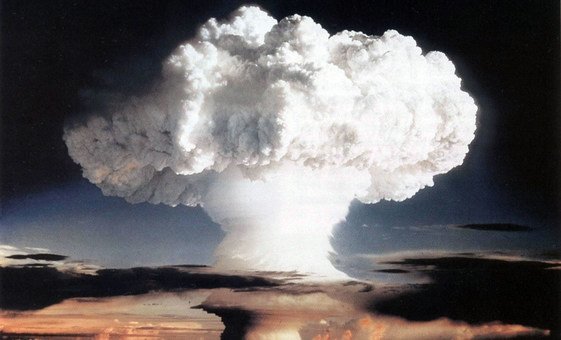
“Stop playing with fire. Now is the time to silence the bombs before they speak again,” he said in his message, which coincides with the 80th anniversary of the first nuclear test on 16 July 1945 – in the New Mexico desert under the Manhattan Project.

A deadly legacy

Since then, more than 2,000 nuclear tests have been carried out worldwide.  

Atmospheric tests in the early decades of the nuclear era spread radioactive fallout across continents, contaminating land and seas, displacing communities and leaving survivors facing health crises passed down through generations.

The international day was declared by the UN General Assembly in 2009, following Kazakhstan’s closure of the Semipalatinsk test site.

It has since become a rallying point for governments, civil society and campaigners pressing for an end to nuclear testing and progress towards full disarmament.

Mr. Guterres stressed that nuclear testing remains a grave danger amid rising geopolitical tensions. He urged States to ratify the Comprehensive Nuclear-Test-Ban Treaty (CTBT), adopted by a large majority in 1996 but still not in force nearly three decades later.

“We must never forget the horrific legacy of over 2,000 nuclear tests,” the Secretary-General said. “The world cannot accept this.”

Burkina Faso declares UN Coordinator persona non grata  

The UN chief has expressed regret of the decision by authorities in Burkina Faso to declare the UN’s Resident and Humanitarian Coordinator in the country, Carol Flore-Smereczniak, persona non grata.

In a statement on Friday, António Guterres said that the transitional authorities had announced the diplomatic sanction declaring her unwelcome, on 18 August.

The UN chief expressed “full confidence” in her “professionalism and dedication and in the broader United Nations system in Burkina Faso.”

During her tenure, Ms. Flore-Smereczniak – who has now left the country – led UN efforts working closely with the Burkinabe authorities to support development initiatives and provide humanitarian assistance.

UN will continue to support Burkinabe

The statement stresses that the UN Charter makes clear the doctrine of persona non grata does not apply to UN officials, as staff members appointed by the Secretary-General are responsible solely to the Organization, and Member States undertake to respect their exclusively international character.

In line with the Charter, the United Nations enjoys privileges and immunities, including the right of its staff to remain and carry out their mandated work.

“Only the Secretary-General, as the Chief Administrative Officer of the Organization, has the authority to decide – after careful investigation – on the withdrawal of any United Nations official.”

Mr. Guterres reaffirmed the UN’s commitment to continue supporting the people of Burkina Faso, and to keep working with the national authorities.  

Source link

World News in Brief: Casualties in Ukraine, Burkina Faso aid helicopter blast, Uganda urged to release opposition leaders

The monthly total also marked a three-year high, topping June’s figure, with HRMMU verifying civilian deaths and injuries in 18 of Ukraine’s 24 regions.  

“For the second month in a row, the number of civilian casualties in Ukraine hits a new three-year high,” said Danielle Bell, Head of HRMMU.

“Only the first three months after the Russian Federation launched its full-scale invasion of Ukraine saw more killed and injured than in this past month,” she added.  

Rising toll 

Numbers for the first seven months of 2025 were 48 per cent higher than in the same period last year.

Long-range weapons, including missiles and suicide drones, accounted for nearly 40 per cent of casualties. On 31 July, Kyiv saw its deadliest attack since the start of the full-scale invasion, with 31 people killed, including five children, when a missile struck a residential building.

Short-range drones alone caused 24 per cent of casualties, reflecting a sharp rise since mid-2024, as documented in a bulletin published by HRMMU in June 2025.  

The steepest monthly increase came from aerial bombs, which killed 67 and injured 209 in July, compared with 114 casualties in June. Strikes hit a penal colony in Zaporizhzhia and an apartment building in Donetsk, killing at least 21 people in total.

“Whether you are in a hospital or a prison, at home or at work, close to or far away from the frontline, if you are in Ukraine today, you are at risk of getting killed or injured by the war,” Ms. Bell said. 

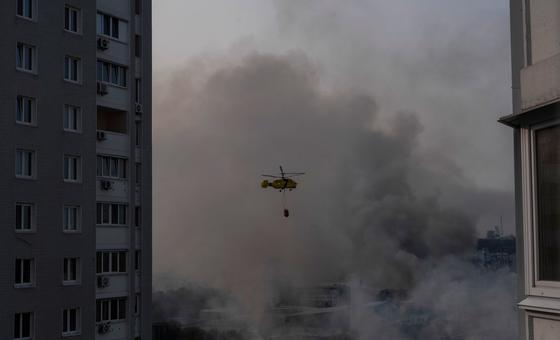
Burkina Faso: Blast hits near UN aid helicopter in Solle

A UN chartered helicopter delivering food aid to the town of Solle in northwest Burkina Faso was caught in an explosion shortly after landing on Tuesday, injuring two people.

The aircraft, chartered by the World Food Programme (WFP), had just unloaded humanitarian supplies when the blast occurred nearby. One crew member and a Government partner were hurt and are now receiving medical treatment.

The helicopter sustained only minor damage and was moved to safety, WFP said. Flights to Solle have been temporarily halted while authorities investigate the incident.

Critical operation

In conflict-affected areas of Burkina Faso, WFP’s humanitarian air operations are critical for delivering life-saving assistance to hard-to-reach communities most in need.  

WFP aims to assist 315,000 of the most vulnerable people during the lean season from June to August, when families have exhausted their food stocks.

In a statement, WFP reaffirmed the agency’s “unwavering commitment to support populations in need and to reach the most remote communities with humanitarian assistance.”

Rights office urges Uganda to release opposition leaders on bail

The UN human rights office (OHCHR) on Wednesday expressed serious concern at repeated denials of bail in Uganda for opposition leader Kizza Besigye and his associate Obeid Lutale.

Both individuals have been denied bail three times since they were abducted in neighbouring Kenya and returned to Uganda last November. 

In dismissing their latest request, the High Court found them ineligible for mandatory bail merely because they had been detained in civil prison for less than the 180 days required to qualify for release, a duration that did not account for their prior deprivation of liberty following their abduction and forced return.

“We urge the authorities to reconsider the decision and grant them bail, and to ensure that any legal proceedings against them are fully in line with international human rights law,” said OHCHR spokesperson Liz Throssell.

Human rights concerns  

The UN human rights office in Uganda closed its operations there in 2023 after the Government decided to end cooperation with OHCHR.  

At the time, High Commission Volker Türk expressed concern about the run-up to the 2026 elections, amid an increasingly hostile environment impacting human rights defenders, civil society actors and journalists.

Other UN human rights mechanisms also condemned laws criminalizing same sex relations and the call for the use of the death penalty for convicted offenders. 

Source link