World News in Brief: Typhoon generation, disability rights in Myanmar, new refugee-led climate fund

After slamming into the island nation on 9 November with winds of around 185 kilometres per hour (or 115 miles per hour) leaving at least six dead, Super Typhoon Fung-wong hit homes, schools and access to health services across 16 regions, UNICEF reported on Thursday.

The archipelago has already been exhausted by multiple climate-related and geophysical shocks this year. Just days ago, more than 200 people died in the Typhoon Kalmaegi disaster.

From one crisis to another

“Children and their families are barely climbing out of one crisis before another strikes, pushing them back to zero,” said UNICEF Philippines Representative Kyungsun Kim.

The agency is carrying out joint assessments with the authorities and partners to determine the highest needs.

In addition to providing life-saving support, UNICEF prioritises child-centred climate policies, climate-resilient social services and mobilising climate financing to safeguard communities from natural shocks.

UN launches first refugee-led green fund to restore land and cut carbon

The UN refugee agency, UNHCR, has launched the Refugee Environmental Protection Fund, the first major refugee-led initiative using carbon finance to tackle deforestation, promote clean energy and create green jobs.

The new fund will start projects in Uganda and Rwanda, aiming over the next decade to restore more than 100,000 hectares of land and bring clean energy access to 1 million people.

Seeded in Uganda and Rwanda

In Uganda’s Bidibidi and Kyangwali settlements, activities will include reforestation, seedling production and the rollout of cleaner cooking technologies, expected to cut over 200,000 tonnes of CO₂ each year and create thousands of jobs for refugees and host communities.

In Rwanda’s Kigeme camp, the project will rehabilitate degraded hillsides, promote safer cooking for 15,000 people and support sustainable livelihoods through nursery management and soil conservation.

Revenues from verified carbon credits will be reinvested in local environmental projects, ensuring communities share the benefits.

“Refugees often live on the front lines of extreme weather,” said Siddhartha Sinha, UNHCR’s Head of Innovative Financing. “This fund helps them protect the land they depend on.”

Expansion is already being explored in Brazil and Bangladesh, linking environmental recovery with long-term community resilience.

Daily fight for survival for people with disabilities in Myanmar

Soldiers loyal to Myanmar’s military junta have reportedly executed, tortured and sexually assaulted persons with disabilities, trapping many in a daily fight for survival, according to a new report issued by the independent UN human rights expert for Myanmar.

Since seizing power in 2021, Myanmar’s military has ruled by force, violently targeting opposition, protests, ethnic minorities, and especially persons with disabilities, said Special Rapporteur Tom Andrews on Thursday.

Burned alive

“Dozens of persons with disabilities have been burned alive in their own homes as junta forces carried out campaigns of mass arson throughout the country,” he added.

Deep-rooted religious and cultural beliefs continue to perpetuate the isolation and disenfranchisement of people with disabilities in Myanmar, leaving them trapped in a vicious cycle of repression and discrimination, underscored the report.

“The widespread belief that impairments result from misdeeds in a past life not only fuels discrimination but is also internalised by persons with disabilities, leading many to withdraw from community life out of shame and an erosion of personal dignity”, said Mr. Andrews. 

Nevertheless, a remarkable network of organisations, many led by persons with disabilities, continue to work against all odds to provide essential services and defend the rights of persons with disabilities.

“As a distracted world fixes its attention on other crises and conflicts, the situation of persons with disabilities in Myanmar has truly become a hidden crisis within a forgotten humanitarian catastrophe,” said the independent expert.

“It is critical that the world pay attention.”

Independent experts and Special Rapporteurs are appointed by the UN Human Rights Council to report on specific human rights issues. They serve in a personal capacity and are not UN staff. 

Cosmic girls: UN nurtures next generation of space professionals

Now 18, she’s involved in aerospace projects with other young women through the Shakthi SAT initiative and she’s keen to explore the intersection between computer engineering and science, particularly artificial intelligence (AI), autonomous robotics and embedded systems that control satellites, drones and rockets.

“I’m learning things I once only dreamed of, and we’re going to launch our own satellite. How cool is that!” she told UN News.

But, prospects at home in Nepal, an impoverished nation with a nascent space industry, are very limited.

“Our parents usually don’t want us to pursue ‘risky’ careers,” she said.

‘My interest is to make humans multiplanetary’

As a little girl growing up in Hasselt, Belgium, Kaat DeGros thought becoming an astronaut in the highly competitive, male-dominated space field would never happen.

Today, at 15, she’s already designed her own sustainable research base on Mars, hailed by the Oxford Academy of Excellence.

“My interest is to make humans multiplanetary,” she said.

Demystifying space careers

A new partnership between the Space4Women project of the UN Office for Outer Space Affairs (UNOOSA) and the Cosmic Girls Foundation is bringing together young women and girls like Ms. Maharjan and Ms. DeGros from across the globe to explore how they can shape the future of space and thrive in diverse roles, from space economics and law to engineering, policy and innovation.

Over 30 girls participated in a global webinar in late July on “demystifying space careers: not just astronauts”, the first in a series of collaborations to unite UNOOSA’s global reach and Cosmic Girls’ grassroots network.

Two women leaders, a space economist at the European Bank for Reconstruction and Development and legal officer at the Kenya Space Agency, shared practical advice on how to enter the sector regardless of background and fielded questions on academic and professional paths, networking, accessing resources and dealing with rejection.

NASA astronauts Tracy Caldwell Dyson, Dorothy Metcalf-Lindenburger, Naoko Yamazaki and Stephanie Wilson pose for a photo at the International Space Station.

Building a space ecosystem

The girls left with several messages: be your own cheerleader, seek out mentors and allies, stay disciplined but follow your passion and join space communities.

“We are building an ecosystem that equips girls worldwide with STEM skills, astronaut training and the mindset to innovate for humanity’s future among the stars,” said Mindy Howard, founder and chief executive officer of the Netherlands- and US-based Cosmic Girls Foundation.

The partnership will influence policymakers to adopt a new vision of the space sector where men and women are equal partners, said UNOOSA programme officer Anne-Claire Grossias.

“It’s a very human-focused project. Through this connection we can move forward toward gender equality,” she explained.

Landmark study: Space sector still gender blind

Despite progress in recent years, women are still significantly under-represented in the field, especially in leadership roles. Only 11 per cent of astronauts have been women, and they represent just 30 per cent of the workforce in public space sector organizations, according to the Space4Women project’s 2024 landmark study on gender equality.

Ensuring a meaningful role for women not only fuels productivity and profit; it leads to greater global collaboration, consensus-building and lasting peace, the study found.

The idea for the survey was conceived at the 2023 Space4Women Expert Meeting. The meeting united global experts to prepare the UN’s first gender mainstreaming toolkit to help space organizations dismantle gender bias and discriminatory practices and create environments where women can succeed alongside male colleagues in space science, technology, innovation and exploration.

Mindy Howard during parabolic flight training.

Fostering the female astronaut pipeline

Since its inception in 2017, the Space4Women project has worked with committed space sector professionals to mentor over 270 girls from 68 countries.

Ms. Howard, a mentor since 2020, has brought together nearly 1,000 girls from 139 countries through her Cosmic Girls educational and networking forum. With programme partners in Africa, Asia, Europe, the Americas and Oceania, the Cosmic Girls Foundation has launched the first global competition to train six girls, one from each continent, with the rocket science knowledge, life skills and mental preparedness to become astronauts. The grand prize for one will be a trip to space.

“The competition is such a dream come true,” said Ms. DeGros. “It gave me hope that I will succeed as an astronaut and astrophysicist.”

Building confidence in a safe environment

Supporting girls from an early age in a welcoming, nurturing environment is crucial to help them gradually test the waters and bring much-needed feminine traits and collaborative approaches for problem-solving to the field, said Ms. Howard.

“Girls are often told by their parents they are not good enough, not smart enough. This is a safe environment for them to hone their skills, which will help them later on,” she said.

Already they are feeling confident.

“This feels like something extraordinary – a real step towards a future I once thought was out of reach,” said Ms. Maharjan.

“I think there will be equality in space exploration in not so long of a time,” added Ms. DeGros.

London’s Far-Right Rally Sends Shockwaves Through South Asian Communities

A fourth generation nuclear survivor’s push for justice

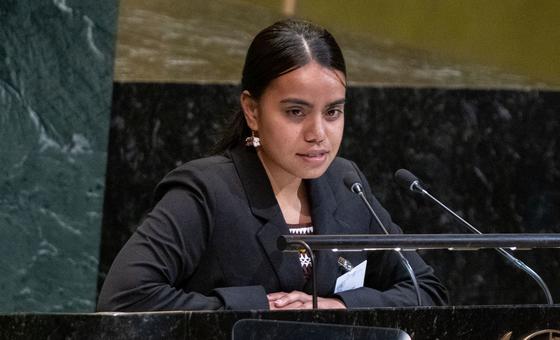
“We are not prepared to inherit a legacy of complacency, nor can we continue to live in the shadow of these weapons,” she told the commemoration inside the gilded UN General Assembly Hall.

As the Youth Representative of the Republic of Kiribati, Ms. Johnson is one of the many young people around the world whose ancestors have been affected by the toxic aftermath of nuclear tests.

After her speech to the General Assembly where she urged Member States to take action, Ms. Johnson spoke to UN News about the effects that the past has had on her family and community.

Devastating Consequences

Between 1957 and 1962, the United States and United Kingdom conducted nuclear weapon tests on Kiritimati Island, now part of Kirbati, resulting in devastating consequences for the local population. Ms. Johnson’s late grandfather, who lived on the island, was 14 years old when the testing began.

“They were all gathered in a small tennis court, and they were only given a thin blanket without real protection,” she said, describing the scene just ahead of the detonation.

“They used that to cover their eyes from the flashes of the bombing,” she added.

The radiation Johnson’s grandfather was exposed to led to serious health implications including hearing loss and cognitive decline. These impairments followed him for the remainder of his life and affect his descendants till this day.

“My dad’s two older sisters were born prematurely and died shortly after that,” she said. “And similar cases were also found in other families in the community.”

Beyond the devastating impact on the people of Kiritimati, the tests also caused lasting environmental damage. According to Ms. Johnson, specific type of fish on the island are believed to be radioactive and when eaten, can make people “sick and nauseous.”

Push for disarmament

To address the irreversible harm on behalf of the younger generation of Kiribati – and the world – she called on Member States to support an international trust fund meant to offer needed assistance for the victims of nuclear testing. The trust fund was first jointly proposed by Kiribati and Kazakhstan in 2022.

Kiribati is a member of the Coordination Committee of the Treaty on the Prohibition of Nuclear Weapons (TPNW), a landmark agreement aimed at eliminating the nuclear threat.

Articles 6 and 7 of the legally binding Treaty stipulate that signatory parties must provide assistance to those affected by nuclear weapons under their jurisdiction, or as a result of their actions.

‘The lives of many depend on this’

A fourth-generation nuclear testing survivor, Ms. Johnson’s deeply personal experience with the human, environmental and social impact of nuclear weapons has only made her more determined to pressure the international community to build on the treaty entering into force in 2021.

“For the sake of all the mothers, children and future generations, I urge everyone to join in the Treaty for the Prohibition of Nuclear Weapons because the lives of many are dependent on this.”

Learn more about the UN’s actions against nuclear testing and proliferation here

Source link

‘Catastrophic birth outcomes’ in Gaza threaten a whole generation, warns UN agency

In the first half of 2025, only 17,000 births were recorded, according to Gazan health authorities, representing a 41 per cent decline in Gaza’s birth rate over the past three years, the agency said.  

Additionally, 220 mothers died – more than 20 times the total number of maternal deaths in 2022 – while at least 20 newborns died within 24 hours of birth.

“Every mother and child deserves the right to a safe birth and a healthy start to life. What we are witnessing is a systematic denial of these fundamental rights, pushing an entire generation to the brink,” said Laila Baker, regional director for the Arab States at UNFPA.

These conditions come amidst an ongoing Israeli bombardment of Gaza which has displaced the entire Palestinian population at least once and reportedly killed over 60,000.  

Something treatable becomes a death sentence 

UNFPA said that the systematic targeting of a health care system already on the brink of collapse is creating an untenable situation for mothers and newborns.  

The majority of hospitals and health facilities have been damaged or destroyed with medicine stocks running severely low and medical equipment severely damaged.  

Ambulance services are also facing severe impediments, meaning that women giving birth face extreme challenges accessing healthcare. In this context, treatable complications during birth become death sentences.  

“The scale of suffering for new mothers and their babies in Gaza is beyond comprehension,” Ms. Baker said.  

Preventable loss

UNFPA said it has 170 trucks at the border between Israel and Gaza – and has since March 2025 – which contain lifesaving supplies such as ultrasounds machines, portable incubators and maternity kits. However, they have not been allowed into the Strip.  

The agency urged Israel to allow “unimpeded, sustained and demilitarized” humanitarian aid into Gaza including fuel, medical supplies and nutritional support.  

“Every moment lost means more preventable loss of life and unimaginable suffering for the most vulnerable,” UNFPA said.  

Celebrating the potential and promise of the largest youth generation ever

Secretary-General António Guterres said empowering young people in a fair and hopeful world reaffirms the UN promise that every person has the right to make informed choices about their lives and futures.

While many young people face economic uncertainty, gender inequality, health challenges, the climate crisis and a spike in conflicts – they are still leading with courage, conscience and clarity, “calling for systems that uphold their rights and support their choices,” he said in his message.

“Let’s listen to what young people want and support them in exercising their rights, making their own choices and enjoying a hopeful future,” said Natalia Kanem, Director of the UN sexual and reproductive rights agency, formally known as the UN Population Fund (UNFPA).

An inclusive future

“Young people are not just thinking about their future children – they are thinking about the world those children will inherit,” one youth activist told UNFPA.

Mr. Guterres urged countries to invest in policies that will ensure young people have access to education, healthcare, and promoting the protection of reproductive rights.

Let us stand with young people and build a future where every person can shape their destiny in a world that is fair, peaceful and full of hope,” he said. 

2025 award winners

Each year, the Committee for the UN Population Award honours an individual and/or institution in recognition of outstanding contributions to population and reproductive health questions and to their solutions.

On this World Population Day, the 2025 recipients were recognised for their groundbreaking work in empowering women and addressing critical challenges facing demographic growth.

The winner in the individual category, Varshan Deshpande who founded Dalit Mahila Vikas Mandal, tirelessly works to empower women at the community level in India, by building vocational skills, connecting them to vital resources and services, and fostering financial independence.

The winner in the institutional category, the International Union for the Scientific Study of Population (IUSSP), has played a pivotal role in advancing population science and policy, notably by helping establish regional population associations in Asia, Africa, and Latin America.

Watch our interview with Natalia Kanem who is stepping down as UNFPA’s Director after more than eight years.

Source link