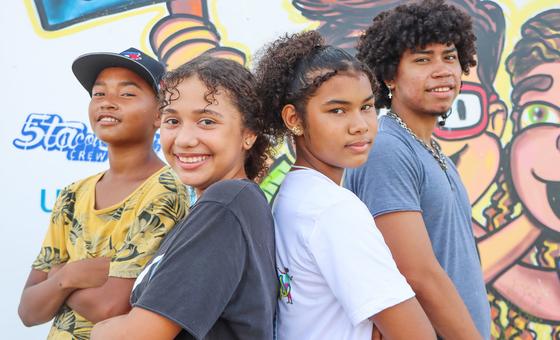
Celebrating youth: ‘When young people take the lead, everyone gains’

But after a decade of armed conflict and amidst a severe economic depression, educational toy imports have become way too expensive for many classrooms in Yemen.

Shadia and Fatima, two young entrepreneurs in Yemen, identified this gap after participating in a training course run by the UN Development Programme (UNDP). They decided to begin a youth-led business called Dorri which would create sensory learning tools from locally sourced wood and fabric.

Alone, Dorri will not bring peace to Yemen, nor will it single handedly solve the fact that over a third of youth in Yemen are unemployed. But, according to one of the principals whose kindergarten received the toys, Dorri represents the creative potential of Yemen’s youth.

“When young people take the lead, everyone gains — children, families, schools and entire communities,” the principal said.

Youth in peacebuilding

August 12 is the International Day of Youth, a day which highlights the integral role that 1.9 billion young people worldwide play in creating sustainable futures.

This year, the day is particularly significant according to Felipe Paullier, the UN Assistant Secretary-General for Youth Affairs, because it coincides with other notable dates, including the 10th anniversary of a Security Council resolution affirming the vital role that youth play in advancing peace.

“Young people are leading change with purpose, from local campaigns to global peace efforts, building trust between cultures and creating lasting impact,” Mr. Paulier said.

Creating prosperous livelihoods

By 2050, the people who are currently under 25 will compose over 90 per cent of the global workforce, making their training and education vital to the economy and a prosperous peace.

However, in contexts plagued by conflict or in communities which face displacement, this training and education can be next to impossible to achieve.

Elijah, a Sudanese refugee who is now 27, arrived at a refugee camp in Kenya in 2015 after fleeing violence in his home country. Education proved impossible for him – while he tried to attend school for a few years, he ultimately dropped out because he could not afford the school fees.

But training was very feasible: in his informal facility – which specialises in electronic repair – he has already trained 15 young people like himself. He still hopes to do more.

“My dream is to open the biggest electronics repair facility in Kakuma that will serve the community and also empower young people without a source of livelihood to take care of themselves,” Elijah said.

An intergenerational approach

Mr. Paullier emphasised that empowering youth at a local level must entail more than just supporting initiatives like Elijah’s – rather, genuine empowerment lies in “real trust.”

“Meaningful youth participation means engaging youth as equal partners. It means intergenerational collaboration because investing in youth is not just about the future. It is about the world we live in today,” he said.

In Myanmar, this sort of intergenerational knowledge exchange has taken on a unique form – theatre. Ongoing conflict in this country has upended many livelihoods and created ripe conditions for gender-based violence.

A group of 18 young people in Mon State have formed a performance group which doubles as an educational initiative. Together, they write, direct and put on plays for neighbouring communities of all ages which discuss themes like domestic abuse.

At one performance about ongoing domestic violence, an elderly woman in the front row turned to her neighbour.

“This is my story too,” she said.

Through these performances, the young people have created a forum for an intergenerational conversation: “We’re not just performers — we are community educators, and this stage is our platform for change,” said La Min Cho, one of the performers.

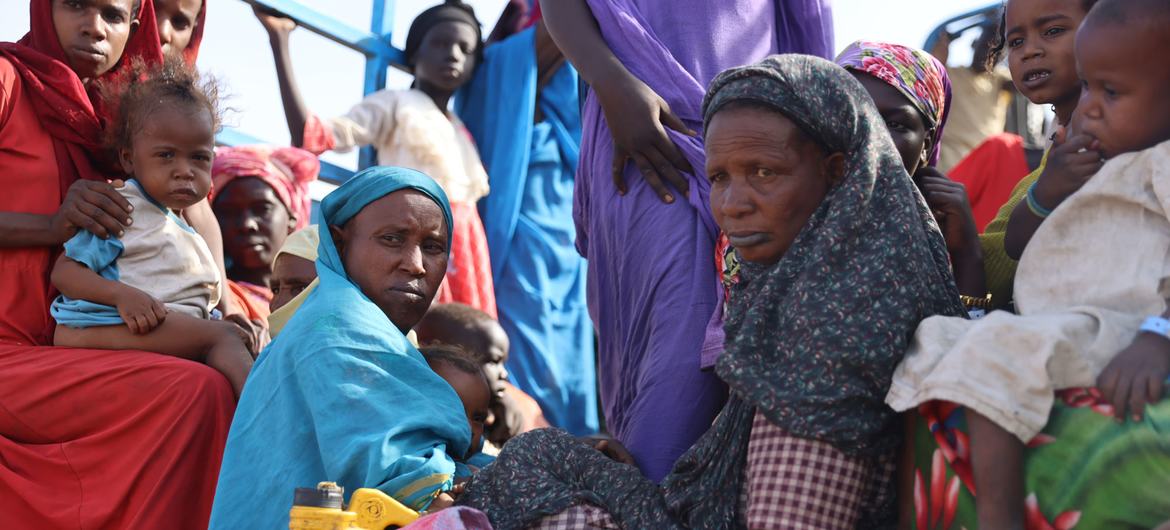
Sudanese refugees in the UN-run transit centre in Renk, South Sudan.

Danger of tokenism

Despite the Security Council’s resolution, young people tend to remain excluded from policy-making decisions. Or if they are included, their participation is sometimes “tokenistic.”

Areej Hussein, the founder of a grassroots feminist organization in Sudan, has experienced the frustration of having her advocacy simply be a symbol for those in power.

“Women and girls are not just victims of war – we are peacebuilders…Enough of using women as slogans. It is time to truly listen to their leadership,” she said.

Ms Hussein has worked to change this in Sudan by mobilising women from all walks of life and empowering them to tell their stories.

And she is not alone – many young people are working around the world to change this. But for each of them, their approach to affecting real change is slightly different.

For Shadia and Fatima, it was tactile toys. Elijah inspires refugees…And for Yie Tone, the answer was theatre. “We may not have the power to change policies, but we do have the power on this stage to change our communities to a safe and equal society,” Mr. Tone said.

Source link

Women and girls of African descent: celebrating contributions, recognizing challenges

It recognizes their immense contributions to society but also acknowledges the challenges they face due to the double burden of racism and sexism.

Although woman and girls of African descent embody strength, resilience, and untapped potential, they remain among the most marginalized groups globally due to the intersection of racial, gender, and socio-economic discrimination.

For example, they suffer alarming maternal mortality rates, according to the UN’s reproductive health agency, UNFPA. Oftentimes, cases are not related to income or education, but rather to racism and structural inequality stemming from a legacy of slavery and colonialism.

“The good news though, is these things are not irreversible,” Patricia DaSilva, a senior programme adviser with the agency told UN News.

“We can fix them. We have the solutions for many of the problems that we are facing in terms of maternal health for women and girls of African descent.”

Data and solutions

UNFPA advocates for stronger health systems and investment in midwifery programmes, culturally sensitive training for healthcare providers, and improvements in data collection.

The agency also invests in partnerships, such as an initiative in the Pacific region of Colombia, home to large communities of people of African descent.

“We have worked with the traditional midwives for them to integrate ancestral knowledge with modern health practices. And this includes supporting accurate birth registration,” she said.

“It sounds like a really simple thing, but when you are in a remote community without access to technology, without access to administrative offices, it becomes this really, really important issue.”

Agents of change

Ms. DaSilva upheld the theme for the International Day, which focuses on women and girls of African descent as leaders, not just beneficiaries.

“I think it is important that the international community, the global community, understands that women and girls of African descent are not recipients of aid.  They are leaders. They are innovators. They are agents of change,” she said.

“We have an opportunity and even an obligation and a responsibility to support the efforts to resource their solutions, to elevate their voices and continue to really double our efforts to dismantle the structural barriers that continue to impede their progress.”

The first celebration of the International Day coincides with the start of the Second International Decade for People of African Descent, which runs through 2034.

Source link

Celebrating the potential and promise of the largest youth generation ever

Secretary-General António Guterres said empowering young people in a fair and hopeful world reaffirms the UN promise that every person has the right to make informed choices about their lives and futures.

While many young people face economic uncertainty, gender inequality, health challenges, the climate crisis and a spike in conflicts – they are still leading with courage, conscience and clarity, “calling for systems that uphold their rights and support their choices,” he said in his message.

“Let’s listen to what young people want and support them in exercising their rights, making their own choices and enjoying a hopeful future,” said Natalia Kanem, Director of the UN sexual and reproductive rights agency, formally known as the UN Population Fund (UNFPA).

An inclusive future

“Young people are not just thinking about their future children – they are thinking about the world those children will inherit,” one youth activist told UNFPA.

Mr. Guterres urged countries to invest in policies that will ensure young people have access to education, healthcare, and promoting the protection of reproductive rights.

Let us stand with young people and build a future where every person can shape their destiny in a world that is fair, peaceful and full of hope,” he said. 

2025 award winners

Each year, the Committee for the UN Population Award honours an individual and/or institution in recognition of outstanding contributions to population and reproductive health questions and to their solutions.

On this World Population Day, the 2025 recipients were recognised for their groundbreaking work in empowering women and addressing critical challenges facing demographic growth.

The winner in the individual category, Varshan Deshpande who founded Dalit Mahila Vikas Mandal, tirelessly works to empower women at the community level in India, by building vocational skills, connecting them to vital resources and services, and fostering financial independence.

The winner in the institutional category, the International Union for the Scientific Study of Population (IUSSP), has played a pivotal role in advancing population science and policy, notably by helping establish regional population associations in Asia, Africa, and Latin America.

Watch our interview with Natalia Kanem who is stepping down as UNFPA’s Director after more than eight years.

Source link