Chad: Africa’s refugee haven struggles with its own stark challenges

Here’s what you need to know:

Fighting and dire humanitarian conditions triggered by the conflict that erupted among rival militaries in Sudan in April 2023 have so far displaced 14 million people, spilling over to the country’s seven bordering neighbour nations, according to the UN.

Few places are feeling the effects of the ongoing war as acutely as Chad, which is now Africa’s largest refugee host per capita, according to the UN refugee agency, UNHCR.

“Chad’s generous welcome of refugees is a powerful act of solidarity,” said UN High Commissioner for Refugees Barham Salih

But, as landlocked Chad has welcomed more than 900,000 Sudanese refugees across its eastern border since the start of the conflict, 40 per cent of its own population already needs humanitarian assistance.

Why it matters  

Often called the “Babel Tower of the world”, reflecting its more than 200 ethnic groups and 100 languages, Chad’s challenges are multifaceted.

With over 42 per cent of the population living below poverty, the country is among the poorest in the world. 

Now hosting over 1.5 million refugees, Chad continues to keep its borders with Sudan open while also battling climate and security shocks.

Floods and food insecurity 

The word Chad translates in a local language as “large body of water,” and reflects the cultural importance of Lake Chad, which gives the country its name. 

As the lake continues to shrink due to climate change and other issues, the country has endured large floods that have devasted its food security. 

In 2024 alone, floods destroyed more than 432,000 hectares of crops, equivalent to over 600,000 football fields, affected nearly two million people and exposed gaps in water and sanitation infrastructure, with cholera outbreaks reported in July last year. 

With a rapidly growing population, Chad far exceeds its resource capacity at a time when malnutrition rates are alarmingly high.

An estimated two million Chadian children aged six to 59 months are suffering or expected to suffer acute malnutrition between October 2025 and September 2026, including nearly 484,000 children expected to suffer severe acute malnutrition, according to the global hunger monitor – the Integrated Food Security Phase Classification.

Security pressures

The security landscape is equally concerning. 

Violent extremist groups, including Boko Haram and its affiliates, have continued to drive insecurity in the Lake Chad Basin, displacing over 250,000 people

Security forces patrol in Adré in Chad.

In the north, trafficking networks and illegal coal mining overlap with gender-based violence and exploitative child labour.

With 87 per cent of the total refugee population in Chad being women and children, these concerns continue to increase. 

What the UN is doing

Since April 2023, Chad’s Government and UNHCR assisted 67 per cent of those fleeing war-torn Sudan to relocate to extended and newly established settlements, where refugees and host communities benefit from the services delivered by humanitarian teams.

UN agencies and partners continue to respond to provide humanitarian assistance, including in Chad and war-torn Sudan.

On 19 February, the UN Security Council will convene to discuss the ongoing crisis in Sudan, focusing on the need to end the fighting and alleviate suffering, particularly concerning the widespread violence against women and girls in the country.

As for needs, the UN emergency relief agency, OCHA, released its Humanitarian Action Plan 2026, which shows that the number of people in need in Chad decreased by 42 per cent, but continues to remain high.

The Action Plan calls for $986 million and aims to help 3.4 million people, including $540million dedicated to refugees alone. The UN Spokesperson, Stéphane Dujarric said on Wednesday, “We and our partners will focus our efforts on the most impacted regions including in the east, the Lake Province and parts of the south.” 

Radwa Abdelkarim, a 37-year-old mother of six, fled to Chad in June 2023 after “the war took everything.” 

“We lost our money, our relatives and neighbours,” she said. “Some were killed, others disappeared and are still missing.” 

Safely out of Sudan, Ms. Abdelkarim combined her entrepreneurial skills with cash assistance from UNHCR to start baking and selling bread from her home in Farchana refugee settlement, and has since opened two grocery stores, a restaurant, and employs 12 other refugees.

“I support [refugee women] so that we can grow together and no one is left behind,” she said. “It is important to stand with our brothers and sisters, to help them heal.”

Source link

Women and girls of African descent: celebrating contributions, recognizing challenges

It recognizes their immense contributions to society but also acknowledges the challenges they face due to the double burden of racism and sexism.

Although woman and girls of African descent embody strength, resilience, and untapped potential, they remain among the most marginalized groups globally due to the intersection of racial, gender, and socio-economic discrimination.

For example, they suffer alarming maternal mortality rates, according to the UN’s reproductive health agency, UNFPA. Oftentimes, cases are not related to income or education, but rather to racism and structural inequality stemming from a legacy of slavery and colonialism.

“The good news though, is these things are not irreversible,” Patricia DaSilva, a senior programme adviser with the agency told UN News.

“We can fix them. We have the solutions for many of the problems that we are facing in terms of maternal health for women and girls of African descent.”

Data and solutions

UNFPA advocates for stronger health systems and investment in midwifery programmes, culturally sensitive training for healthcare providers, and improvements in data collection.

The agency also invests in partnerships, such as an initiative in the Pacific region of Colombia, home to large communities of people of African descent.

“We have worked with the traditional midwives for them to integrate ancestral knowledge with modern health practices. And this includes supporting accurate birth registration,” she said.

“It sounds like a really simple thing, but when you are in a remote community without access to technology, without access to administrative offices, it becomes this really, really important issue.”

Agents of change

Ms. DaSilva upheld the theme for the International Day, which focuses on women and girls of African descent as leaders, not just beneficiaries.

“I think it is important that the international community, the global community, understands that women and girls of African descent are not recipients of aid.  They are leaders. They are innovators. They are agents of change,” she said.

“We have an opportunity and even an obligation and a responsibility to support the efforts to resource their solutions, to elevate their voices and continue to really double our efforts to dismantle the structural barriers that continue to impede their progress.”

The first celebration of the International Day coincides with the start of the Second International Decade for People of African Descent, which runs through 2034.

Source link

‘Very limited time to react’: Texas flash floods expose challenges in early warning

The UN World Meteorological Organization (WMO) said that the tragedy highlights growing global challenges around extreme rainfall, warning dissemination and community preparedness.

Flash floods are the most lethal form of flooding, responsible for over 5,000 deaths annually and 85 per cent of all flood-related fatalities worldwide, according to WMO data, and result in economic losses of more than $50 billion annually.

Unlike slow-onset river floods, flash floods leave very limited time for reaction,” the agency said in a news release on Wednesday.

That makes accurate short-term forecasting and community preparedness essential.

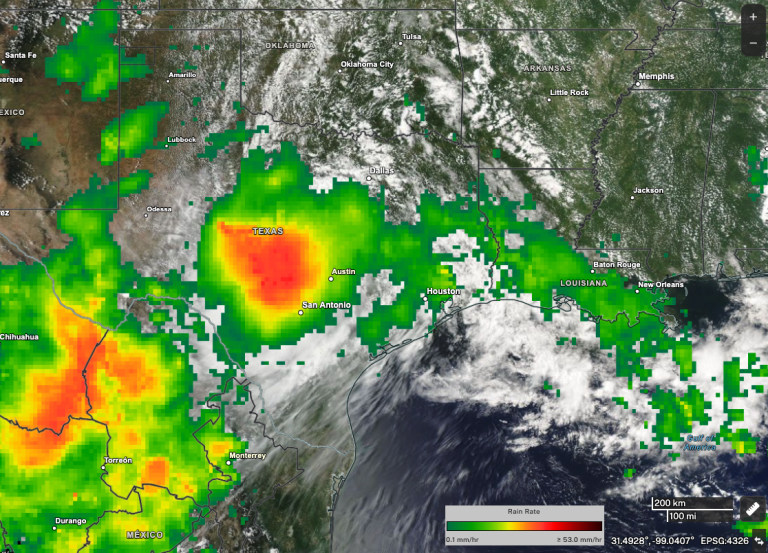
One-day precipitation totals from NASA’s IMERG multi-satellite precipitation product show heavy rainfall over central Texas on July 4, 2025.

Months of rains in hours

Overnight 3 into 4 July, torrential rains – up to 46 centimetres (about 18 inches) in a matter of hours – sent a wall of water surging through Kerr County’s Guadalupe River basin at around 4 AM, catching many residents and vacationers off guard.

The US National Weather Service issued timely alerts – including a flash flood watch more than 12 hours in advance, upgraded to a flash flood emergency about three hours before impact.

The warnings were disseminated by Weather Radio, emergency management systems and television and radio stations, but many people, including hundreds of children at summer camps, were not reached in time.

Floodwaters surged dramatically as the Guadalupe River rose nearly 8 metres (about 26 feet) in about 45 minutes.

Among the hardest hit was the all-girls summer camp, Camp Mystic, along the river, where at least 27 campers and counsellors died, according to media reports. Texas state authorities report that more than 160 people remain missing.

The disaster has triggered one of the largest search-and-rescue efforts in state history.

More frequent and severe floods

Flash floods are not new, but their frequency and intensity are increasing in many regions due to rapid urbanization, land-use change and a warming climate.

A warmer atmosphere holds more moisture and so this means that extreme rainfall events are becoming more frequent,” WMO said.

The Texas disaster joins a string of recent catastrophic floods. In 2022, flash floods in Pakistan killed over 1,700 people and displaced millions. In 2024, floods in Europe, the Middle East and Africa saw $36 billion in economic damages.

And just this week, a flash flood along the Nepalese-Chinese border swept away the main bridge linking the two countries.

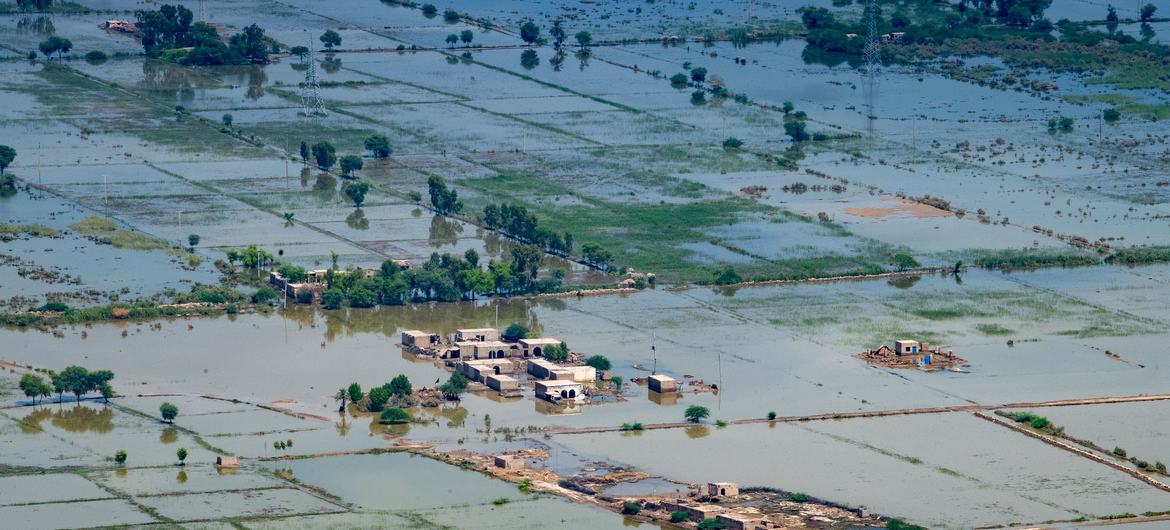
In September 2022, Pakistan was hit by devastating flooding which left large swathes of the country under water.

Supporting countries

To help countries predict such hazards, WMO operates the Flash Flood Guidance System, a real-time forecasting platform used in over 70 countries. It integrates satellite data, radar, and weather models to detect local flash flood threats and supports training programs to build national capacity.

Beyond technology, the agency plays a convening role by building national capacity, certifying experts, and facilitating real-time coordination between forecasting agencies and disaster managers.

Source link

Guterres welcomes election of Pope Leo ‘at a time of great global challenges’

His Holiness Pope Leo XIV – born Robert Francis Prevost – is the first person from the United States to lead the Catholic Church, although he also holds Peruvian citizenship after working in the Latin American country for many years.

He was selected by cardinals voting at the Vatican and later greeted thousands gathered in St. Peter’s Square with a message of peace.

Strong voices needed

Mr. Guterres extended heartfelt congratulations to the new pontiff and Roman Catholics everywhere. 

 “The election of a new Pope is a moment of profound spiritual significance for millions of faithful around the world, and it comes at a time of great global challenges,” he said.

 “Our world is in need of the strongest voices for peace, social justice, human dignity and compassion.”

Building on the legacy

 The Secretary-General said he looks forward to building on the long legacy of cooperation between the UN and the Holy See – nurtured most recently by the late Pope Francis – to advance solidarity, foster reconciliation, and build a just and sustainable world for all.

 “It is rooted in the first words of Pope Leo,” he noted.  “Despite the rich diversity of backgrounds and beliefs, people everywhere share a common goal: May peace be with all the world.”

© FAO/Giuseppe Carotenuto

António Guterres, UN Secretary-General (fourth from right) greets an official in front of St. Peter’s Basilica at the funeral of Pope Francis.

Pope Leo, 69, was born and grew up in the midwestern city of Chicago and spent years working as a missionary in Peru, before becoming a bishop and then rising to head the international Order of St. Augustine.

He became a cardinal in 2023 and went on to run the Vatican office that selects and manages Catholic bishops worldwide. 

He succeeds Pope Francis – the first Pope from Latin America – who died in April after serving for 12 years.

Following his death, the UN Secretary-General recalled that “Pope Francis was a transcendent voice for peace, human dignity and social justice” who “leaves behind a legacy of faith, service and compassion for all — especially those left on the margins of life or trapped by the horrors of conflict.” 

Source link

OpenAI’s $6.6 Billion Funding Boosts Future Tech Trajectory Avenues Despite Challenges

OpenAI has shattered records by securing a monumental $6.6 billion in funding, a move that could elevate its valuation to an eye-popping $157 billion. This latest round, fueled by a diverse group of investors, positions the AI powerhouse at the forefront of global tech innovation despite undergoing significant internal shifts.

Investor Confidence Amidst Executive Changes

The timing of this funding round is noteworthy, as it comes during a period of organizational restructuring and leadership changes. Notably, the sudden departure of Chief Technology Officer Mira Murati has not dampened investor enthusiasm.

In fact, investor confidence remains robust, with heavyweights such as Thrive Capital, Khosla Ventures, and Microsoft doubling down on their backing. Microsoft’s ongoing support further strengthens its partnership with OpenAI, while Nvidia’s entry as a new investor signals its increasing stake in the future of AI.

The $6.6 billion was raised through convertible notes, with conversion to equity contingent on a structural overhaul. This transformation would shift OpenAI from its original non-profit framework to a for-profit entity, eliminating the cap on investor returns and marking a significant departure from its foundational principles.

Despite these shifts, the appeal of OpenAI’s vision—pioneering artificial general intelligence (AGI)—keeps investors bullish.

Financial Trajectory and Strategic Goals

OpenAI’s financial projections offer insight into why investor confidence remains high. The company anticipates generating $3.6 billion in revenue this year, with expectations of a sharp leap to $11.6 billion in 2025.

While the company currently faces operating losses exceeding $5 billion, these ambitious growth targets suggest that investors are betting on a long-term payoff as OpenAI continues to monetize its technological innovations.

To add further momentum, Thrive Capital has negotiated an additional $1 billion option for 2025, should OpenAI meet its revenue milestones, signaling even more future investment potential.

A Global Investor Lineup

A diverse set of global investors has further bolstered OpenAI’s financial position. SoftBank, Fidelity, and Abu Dhabi’s MGX are all contributing to the company’s future growth. Additionally, OpenAI plans to launch a tender offer to allow employees to sell their shares—an internal move that could increase liquidity, following similar initiatives earlier this year when employees sold shares at an $86 billion valuation.

Apple, a notable tech giant, opted out of this funding round despite early talks. The reasons behind its decision remain unclear, but its absence stands in contrast to the enthusiasm from other tech heavyweights.

Long-Term Vision: AGI and Commercialization

OpenAI’s long-term ambitions center on developing AGI, a form of artificial intelligence that would surpass human cognitive abilities. As the company edges closer to this goal, it is simultaneously scaling its revenue through commercialization, with its signature product, ChatGPT, now boasting 250 million weekly active users. OpenAI’s rapid rise in both valuation—from $14 billion in 2021 to a projected $157 billion—and revenue has outstripped even the most optimistic forecasts.

The next few years will be pivotal as OpenAI navigates its path to profitability while maintaining its bold pursuit of AGI. This dual strategy has resonated with investors, who view the company as a cornerstone of the future AI landscape, capable of reshaping industries from healthcare to finance.

A High-Stakes Future?

OpenAI’s record-breaking funding round marks a significant chapter in its meteoric rise. While internal restructuring and personnel changes raise questions, they have not shaken investor confidence. The substantial capital injection highlights faith in the company’s vision and its ability to lead the AI revolution.

As OpenAI marches toward its ultimate goal of AGI and balances commercialization with groundbreaking research, all eyes will be on how it leverages its newfound funding to secure its place as a transformative force in global technology. The stakes are higher than ever, and OpenAI’s next steps could shape the future of artificial intelligence for years to come.