
AI ‘moving at the speed of light’ warns Guterres, unveiling recommendations for UN expert panel

“AI is moving at the speed of light,” said UN Secretary-General António Guterres, underscoring the urgency of regulating the breakthrough technology. “We need shared understandings to build effective guardrails, unlock innovation for the common good, and foster cooperation. The Panel will help the world separate fact from fakes, and science from slop.”

The roots of the Panel stretch back to 2023, in the wake of the release of ChatGPT in the United States and other pioneering technology, heralding a new era in the field of artificial intelligence. 

Mr. Guterres convened a group of leading technologists and academics and tasked them with advancing recommendations for safe governance. 

After a series of in-depth discussions, the experts came back with a vision for an approach to AI governance that could benefit humanity. Amongst the ideas was the creation of the International Scientific Panel – independent but supported by the UN.

The Panel, says Mr. Guterres, will be the “first global, fully independent scientific body dedicated to helping close the AI knowledge gap and assess the real impacts of AI across economies and societies.”

Panellists will exchange ideas, run “deep dives” into priority areas such as health, energy and education, and share the latest leading-edge research.

Diverse candidates

On Wednesday, Mr. Guterres and Amandeep Gill, his Special Envoy on Technology, informed journalists that the names of 40 prospective members  would be submitted to the General Assembly, which will have the ultimate say over the panel’s membership.

Mr. Gill said the experts on the list were chosen for their globally recognised expertise in AI. Geographical representation and gender balance also came into play.

The nominees – 19 women and 21 men – include Sonia Livingstone (United Kingdom), a professor at the London School of Economics and an advisor on media literacy and rights in the digital environment; Balaraman Ravindran (India), head of the Department of Data Science and AI at the Indian Institute of Technology in Madras; and Maria Ressa (Philippines), the renowned journalist and Nobel Peace Prize laureate.

Finding consensus

With its large and diverse membership, diverging attitudes towards regulation and growing geopolitical tensions, the ability to forge consensus could prove challenging.

But Mr. Gill pointed out that, even during the Cold War, scientists from across the world were able to work together on issues of international importance. “It’s one of the value-adds of the United Nations to provide those mechanisms where scientific understanding, common understanding can be advanced,” he said.

The General Assembly is expected to make the final decision on membership on 12 February, and the Panel’s first report is due to be delivered by July.

Source link

World News in Brief: Violence in Haiti, rising insecurity in DR Congo, expert panel on nuclear war

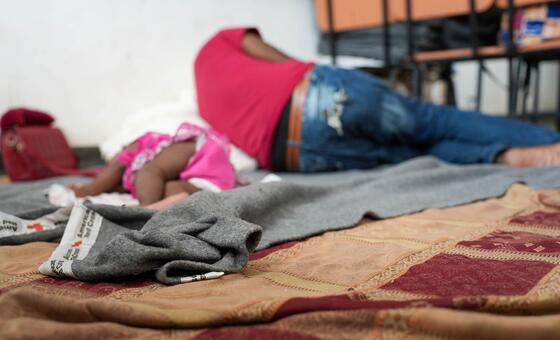
Displaced Haitians are dispersed among the 250 active displacement sites across the country, most of which are informal. Just over a fifth of these sites are managed by humanitarian organizations, meaning that many are living in precarious conditions.  

In June alone, more than 200 alerts were reported across displacement sites, over 80 per cent of which were related to essential needs such as lack of water, food, shelter or healthcare.

OCHA noted that nearly 1.3 million people are now internally displaced in Haiti, the highest number ever recorded in the country due to violence.

Constrained UN response

The UN and partners have supported more than 113,000 displaced Haitians this year, providing essential services such as water, shelter, sanitation and healthcare.

The humanitarian response is severely constrained by limited funding and persistent insecurity, hampering humanitarian access to the most affected areas and delaying the delivery of aid. 

Despite the challenges, the agency continues to work closely with Haitian authorities and humanitarian partners to coordinate relief efforts and mobilise additional resources to support displaced communities. 

DR Congo: Ongoing violence in the east drives displacement, impedes aid delivery

Ongoing violence in North and South Kivu provinces in the eastern Democratic Republic of the Congo (DRC) continues to claim the lives of civilians and to trigger new displacement. 

In North Kivu, UN partners on the ground in Rutshuru and Lubero territories reported that fighting between M23 and other armed groups was ongoing until Tuesday, resulting in eight civilian deaths and 42,500 displaced people as of earlier this week. 

Since early July, heavy clashes between M23 and other armed groups in South Kivu have also persisted, as local partners said the fighting has displaced at least 37,000 people from their homes. 

Aid access restrictions 

The surge in violence is making it harder for humanitarians to deliver assistance to vulnerable communities. 

While partners and teams on the ground are doing their best to maintain services for those affected, access restrictions and severe funding shortages pose significant obstacles. 

A humanitarian convoy coordinated by OCHA along the road between the provincial capital Bukavu and the city of Uvira, primarily planned for this Friday, has been postponed due to a lack of security guarantees on that route. 

Many UN partners on the ground are forced to scale back their operations, disrupting essential services for those in need. 

OCHA called on the international community to take urgent action to address these severe funding gaps and avert a humanitarian tragedy. 

New panel to examine the effects of a nuclear war

The UN Secretary-General has appointed an independent scientific panel of 21 experts to examine the physical and societal consequences of a nuclear war on a local, regional and planetary scale in the days, weeks and decades following such an event.

The creation of the panel, mandated by a General Assembly resolution, comes at a time when nuclear guardrails are being eroded and “the risk of nuclear war is higher than at any point since the depths of the Cold War,” UN deputy spokesperson Farhan Haq said on Friday during the daily media briefing from Headquarters in New York. 

The panelists will seek input from a wide range of stakeholders – including international and regional organizations, the International Committee of the Red Cross (ICRC), civil society and affected communities. 

Members will hold their first meeting in September and will submit a final report to the General Assembly in 2027. 

Source link

Indian Cabinet Approves International Solar Alliance

The Indian Cabinet, chaired by Prime Minister Narendra Modi has given its ex-post facto approval to the proposal of Ministry of New & Renewable Energy (MNRE) for ratification of ISA’s Framework Agreement by India.

ISA was launched jointly by the Prime Minister of India and the President of France on 30th November, 2015 at Paris on the side-lines of the 21st CoP meeting of the United Nations Framework Convention on Climate Change.

The ISA will strive to bring together more than 121 solar resource rich nations for coordinated research, low cost financing and rapid deployment.

The foundation stone of the ISA Headquarters was laid at Gwal Pahari, Guragaon in Haryana. India has already committed the required support of operationalization of ISA. ISA will put India globally in a leadership role in climate and renewable energy issues. It will also give a platform to showcase its solar programmes.

The Agreement was opened for signature on the sidelines of 22nd CoP meeting at Marrakesh, Morocco. The Agreement invokes the Paris Declaration on ISA and encapsulates the vision of the prospective member nations. UNDP and World Bank have already announced their partnership with the ISA. Till now, 25 nations have signed the Framework Agreement.