
Four years after Taliban fighters retook the capital Kabul on 15 August 2021, gender equality agency UN Women is warning that the situation for women and girls in Afghanistan is increasingly untenable.
And without urgent action, this untenable reality will become normalised and women and girls will be fully excluded.
“The Taliban is closer than ever to achieving its vision of a society that completely erases women from public life,” UN women said in a press release on Monday.
UN Women’s warning came just as the UN Assistance Mission in Afghanistan (UNAMA) released its latest report on the human rights situation between May and June, detailing harshening enforcement of regulations against women and death threats against female humanitarians.
A society which is against them
The edicts which the Taliban have passed restricting women and girls’ rights interact together to create an inescapable cycle which relegates women to private spaces and increases their vulnerability.
In most cases, including for humanitarian workers, women are not allowed to move freely in public without being accompanied by a mahram, or a male guardian.
In its report, UNAMA noted a change in the enforcement of mahram requirements, with the de facto Taliban authorities instructing private businesses and health clinics to refuse services to all women who were not accompanied by a mahram.
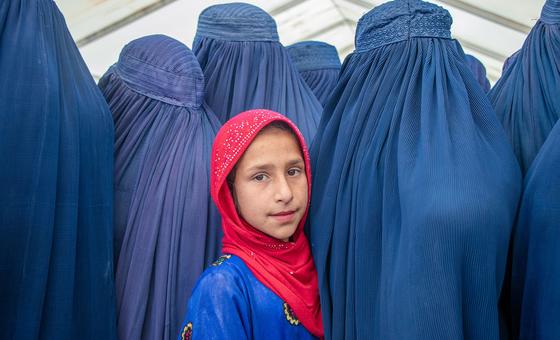
In certain regions, the authorities have also begun to strictly enforce hijab regulations, including by requiring women to wear a chador, a full body covering. In Herat, if they were not doing so, women are being banned from public spaces.
Out of opportunities
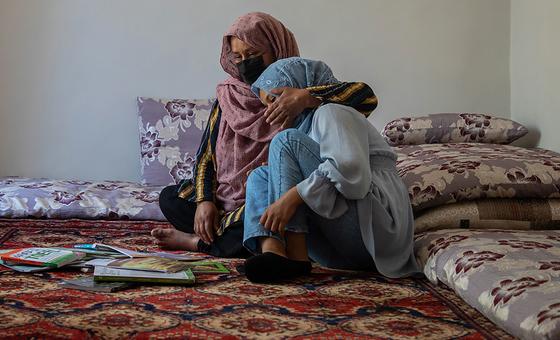
In addition to impeding women’s movements in public spaces, the Taliban has also banned women and girls from secondary and higher education.
Taken together, these two edicts have profound ramifications at all levels of society. Now, not only is it functionally impossible for women to receive educational degrees, it is also unduly difficult for them to get jobs and enter into training programmes.
As a result, over 78 per cent of Afghan women are not in education, employment or training.
This means that almost half of the work force is not contributing to the economy in measurable ways, a huge problem for a country whose economy has been devastated by sanctions and climate shocks.
UNAMA’s report noted that the de facto authorities continue to affirm that Islam permits women to work – even as other edicts seem to discourage it.
An unhealthy cycle
But it’s not just the economy which is suffering. In some cases, these edicts can literally be a matter of life or death.
“The results are devastating. Women are living shorter, less healthy lives,” the UN agency said.
Take healthcare for instance. If women are not allowed to enter higher education, they cannot become doctors. And if women are banned from receiving treatment from male doctors – which they are in certain regions – they cannot expect to live healthy lives.
UN Women estimates that impediments to receiving healthcare for women in Afghanistan will increase maternal mortality by 50 per cent by 2026.
Child marriage is also becoming more common, and women are increasingly subjected to violence, inside and outside of their homes. In some cases, de facto authorities were the ones involved in or enforcing forced marriages.
Solidarity in Afghanistan
It is not just in public that women’s voices are being excluded – 62 per cent of women feel that they cannot even influence decisions at home. This comes amidst a curtailing of expression rights more generally, with many private media outlets closing and social media accounts being monitored, according to the UNAMA report.
UN Women emphasises that despite having little to hope for, Afghan women remain resilient. They continue to look for moments of solidarity and hope for a different future.
In May, some women working for the UN were subjected to explicit death threats in relation to their work, but they continue to deliver lifesaving and life-building services.
One woman whose grassroots leadership organization lost all of its funding in 2022 continues to work to support women in smaller ways.
“I will continue to stand strong as a woman, supporting other Afghan women. I go to remote areas and collect [women’s] stories, listen to their problems and this gives them hope. I try my best and that also gives me hope,” she said.
A dangerous precedent
In total, since 2021, almost 100 edicts which restrict how women and girls move through society have been instituted and enforced. In four years, not a single one has been overturned.
Susan Ferguson, UN Women’s representative in Afghanistan, said that this lack of progress must be understood beyond the Afghan context.
“This is not only about the rights – and futures – of Afghan women and girls. It’s about what we stand for as a global community,” Ms. Ferguson said.
“If we allow Afghan women and girls to be silenced, we send a message that the rights of women and girls everywhere are disposable. And that’s an immensely dangerous precedent.”