World News in Brief: IOM warning for Sudan returnees, Nipah virus alert for India, food security in Afghanistan

They did so despite extensive damage to housing, basic services, vital infrastructure, and an uncertain future. 

The highest number of returns were recorded in Khartoum State, where more than 1.3 million people have made the journey home, followed by nearby Aj Jazirah State, according to IOM’s latest data.

Pockets of security

IOM says the number of returnees is rising, signaling pockets of perceived relative security in parts of the country. 

Overall, 83 per cent of returnees had been internally displaced, while 17 per cent returned from neighbouring countries, including Egypt, South Sudan, and Libya, as well as from the Gulf States. 

However, across areas in Darfur and Kordofan where violence continues to escalate, increased displacement has been recorded.

IOM warns that without adequate resources and renewed efforts toward peace, millions of families will remain trapped in protracted displacement and instability.

WHO: India on alert with two cases of Nipah virus in January

India has confirmed two cases of the sometimes-fatal Nipah virus this month in the eastern state of West Bengal, according to an update by the World Health Organization (WHO). 

This is the seventh documented Nipah outbreak in India and the third in West Bengal, following outbreaks in 2001 and 2007.

The infected individuals are a male and a female nurse working at the same private hospital. As of last week, the male patient is recovering, while the female patient remains in critical condition.

Nipah is a virus transmitted mainly from bats to humans, sometimes through contaminated food or close contact. It can also spread from animals such as pigs to humans, and in some cases between people.

Nipah virus infection can range from asymptomatic illness to severe respiratory disease and fatal encephalitis.

Low transmission risk

 Historically, Nipah outbreaks in the WHO Southeast Asia Region have been limited to Bangladesh and India, occurring sporadically or in small clusters. There have been no known instances of international spread through travel.

WHO says India has demonstrated its capacity to manage previous outbreaks well and public health measures are currently being implemented.

As of 27 January, no additional cases have been detected. The national government has deployed an outbreak response team to West Bengal to work closely with state authorities.

For Nipah, no licensed vaccine or treatment is currently available, making early detection and prevention essential.

$100 Million initiative launched to strengthen food security in Afghanistan

In Afghanistan, the UN food agency (FAO) and the Asian Development Bank (ADB) are implementing a $100 million initiative to bolster food and nutrition security and restore agricultural livelihoods for more than one million vulnerable people over the next two years.

Backbone of the economy

Although agriculture remains the backbone of Afghanistan’s rural economy, it continues to face challenges such as low productivity, restricted market opportunities, and repeated natural disasters. 

The project will reach over 151,000 households – that’s just over a million people – including returnees, host communities, and disaster-affected families. 

With millions of Afghans already facing mounting pressures and at risk of slipping into deeper acute food insecurity and malnutrition, there is an urgent need for sustained investment that goes beyond emergency response to strengthen long-term resilience.

In 2026, 17.4 million people are projected to face acute food insecurity, including 4.7 million classified as being in the emergency phase – just one away from famine conditions. 

FAO has supported about 5.6 million people since 2022. 

Through its partnership with ADB, millions more rural households will gain the tools and resources needed to produce food, safeguard livestock, and secure their families’ nutrition.

Source link

Tsunami alert highlights worth of global early warning system

While the UN-backed International Atomic Energy Agency (IAEA) reported 
that there had been no damage to Japan’s nuclear facilities after an 8.8 magnitude quake was recorded off Russia’s Kamchatka Peninsula, coastal communities have been taking no chances and evacuating to higher ground or moving further inland.

Alerts were sent out within a few minutes of the Russia quake, the UN Office for Disaster Risk Reduction (UNDRR) confirmed. Although the authorities have now downgraded the threat across Japan as waves of 1.3 metres (4ft 2in) have been recorded, the advice is for people to stay in shelters until the danger diminishes from continuing sea surges.

“It is very complex; we are observing the tsunami data in real time, so we need people to stay at the shelter until the tsunami is completed,” said tsunami engineer Professor Fumihiko Imamura from Tohoku University.

Deadly legacy

In the Asian island nation, memories are still raw from the 11 March 2011 Tohoku earthquake and tsunami which killed more than 18,000 people.

Just last year, the 7.6 magnitude Noto quake left approximately 500 dead and damaged 150,000 homes.

The disaster also caused a major accident at the Fukushima Daiichi Nuclear Power Plant, forcing tens of thousands of people from their homes. 

Today’s developments come amid reports that the latest earthquake was among the 10 most powerful ever recorded, hence why the authorities are monitoring its impact so closely.

So far, alerts have been triggered off the west coast of the United States, in South America from Chile to Mexico and from Papua New Guinea to Vanuatu in the Pacific. 

A 8.8 magnitude earthquake is a very large earthquake,” explained Kamal Kishore, Special Representative of the UN Secretary-General for Disaster Risk Reduction. 

“As you go from magnitude eight to nine, or seven to eight, at every step the strength of the earthquake increases exponentially. So, an earthquake which is magnitude eight as opposed to seven would be 30 times bigger.” 

Faster than a jet liner

Speaking to UN News, Mr. Kishore highlighted the huge distances tsunamis can cover, picking up enormous energy they then dump on coastal communities. 

Their progress can be as fast as a passenger jet and can be tracked by deep sea pressure change sensors, or tsunameters, that are connected to surface buoys which relay information in real time to satellites. This data is then modelled by national weather centres, influencing whether alerts are issued.

“It’s a real threat because the tsunamis travel really fast from one coast to the other,” continued Mr. Kishore. “The Indian Ocean tsunami of 2004 was one of the most devastating in our memory, which travelled from all the way from the coast of Indonesia to the Sri Lankan shores within a little over an hour.”

Lessons learned

In addition to the coordination role of UNDRR in the global early warning system, other UN entities also closely involved include the World Meteorological Organization (WMO) and the Intergovernmental Oceanographic Commission of the UN agency for Education, Science and Culture (UNESCO-IOC).  

The IOC’s role is critical in making sure that countries that use tsunami-tracking instrumentation follow the same standard. 

These efforts are in line with the UN Secretary-General’s Early Warnings for All initiative to ensure that everyone on Earth is protected from hazardous weather, water or climate events through lifesaving early warning systems.

Today, one in three people – and mainly in least developed countries and Small Island Developing States – lacks access to adequate multi-hazard early warning systems.

“Tsunami prevention really highlights how important it is to have multilateral action” such as sharing data to run the algorithms behind wave modelling systems, insisted the UN’s Mr. Kishore. 

“There are countries which are separated by thousands of kilometres of ocean, but they are affected by the same hazard,” he continued. 

“If you do not share information on observing these hazards, not just in the location where they have occurred, but on what is happening in the intermediate locations in the ocean…we will not be able to warn our citizens.”  

Source link

‘Very limited time to react’: Texas flash floods expose challenges in early warning

The UN World Meteorological Organization (WMO) said that the tragedy highlights growing global challenges around extreme rainfall, warning dissemination and community preparedness.

Flash floods are the most lethal form of flooding, responsible for over 5,000 deaths annually and 85 per cent of all flood-related fatalities worldwide, according to WMO data, and result in economic losses of more than $50 billion annually.

Unlike slow-onset river floods, flash floods leave very limited time for reaction,” the agency said in a news release on Wednesday.

That makes accurate short-term forecasting and community preparedness essential.

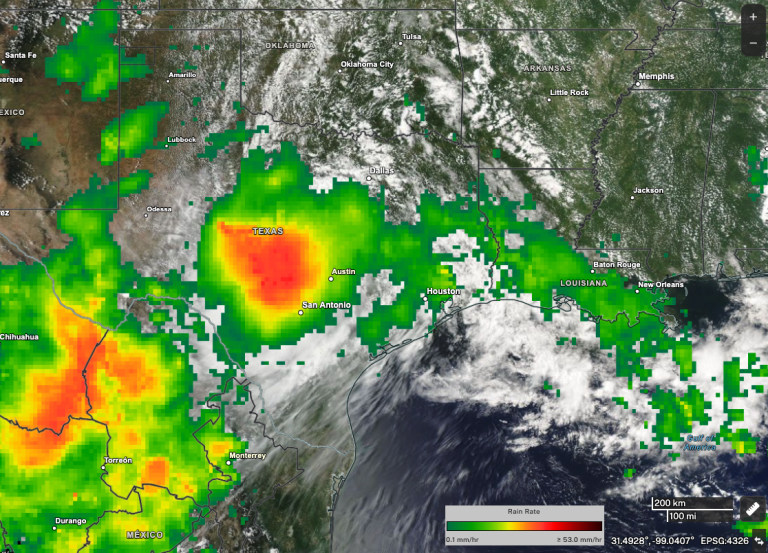
One-day precipitation totals from NASA’s IMERG multi-satellite precipitation product show heavy rainfall over central Texas on July 4, 2025.

Months of rains in hours

Overnight 3 into 4 July, torrential rains – up to 46 centimetres (about 18 inches) in a matter of hours – sent a wall of water surging through Kerr County’s Guadalupe River basin at around 4 AM, catching many residents and vacationers off guard.

The US National Weather Service issued timely alerts – including a flash flood watch more than 12 hours in advance, upgraded to a flash flood emergency about three hours before impact.

The warnings were disseminated by Weather Radio, emergency management systems and television and radio stations, but many people, including hundreds of children at summer camps, were not reached in time.

Floodwaters surged dramatically as the Guadalupe River rose nearly 8 metres (about 26 feet) in about 45 minutes.

Among the hardest hit was the all-girls summer camp, Camp Mystic, along the river, where at least 27 campers and counsellors died, according to media reports. Texas state authorities report that more than 160 people remain missing.

The disaster has triggered one of the largest search-and-rescue efforts in state history.

More frequent and severe floods

Flash floods are not new, but their frequency and intensity are increasing in many regions due to rapid urbanization, land-use change and a warming climate.

A warmer atmosphere holds more moisture and so this means that extreme rainfall events are becoming more frequent,” WMO said.

The Texas disaster joins a string of recent catastrophic floods. In 2022, flash floods in Pakistan killed over 1,700 people and displaced millions. In 2024, floods in Europe, the Middle East and Africa saw $36 billion in economic damages.

And just this week, a flash flood along the Nepalese-Chinese border swept away the main bridge linking the two countries.

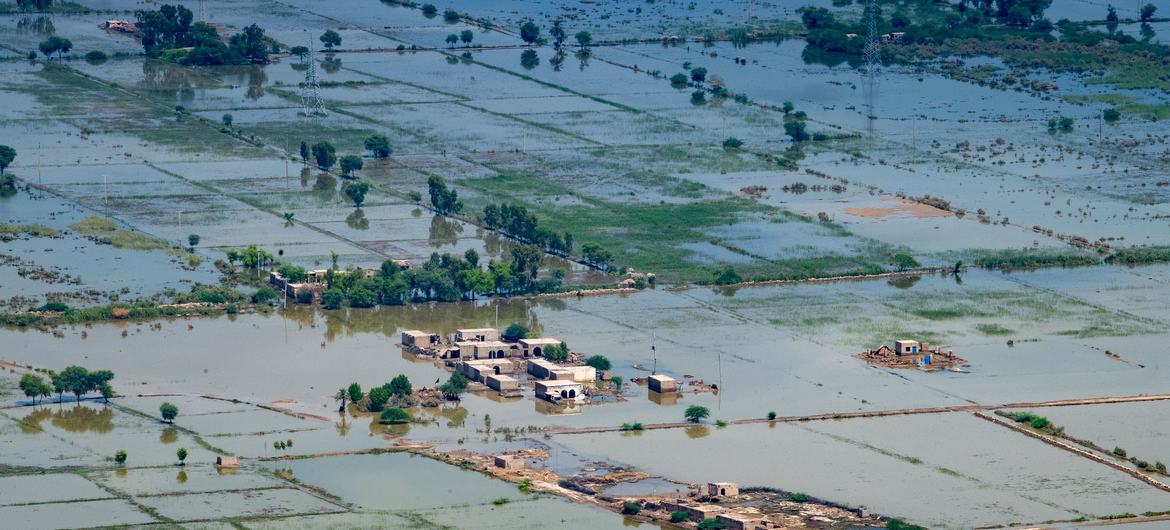
In September 2022, Pakistan was hit by devastating flooding which left large swathes of the country under water.

Supporting countries

To help countries predict such hazards, WMO operates the Flash Flood Guidance System, a real-time forecasting platform used in over 70 countries. It integrates satellite data, radar, and weather models to detect local flash flood threats and supports training programs to build national capacity.

Beyond technology, the agency plays a convening role by building national capacity, certifying experts, and facilitating real-time coordination between forecasting agencies and disaster managers.

Source link

UN alarmed after warning shots fired at foreign diplomats in the West Bank

Media reports said soldiers fired warning shots near the diplomats, who were on an official visit to view humanitarian conditions around the camp where a major Israeli military operation has been ongoing since January. 

The mission was hosted by the Palestinian Authority and approved by Israel, however it strayed from the approved route, media reports said, citing a statement by the Israel Defense Forces (IDF). 

Diplomats from more than 20 countries were in the group, along with staff from the UN agency that assists Palestine refugees, UNRWANo injuries were reported.

Diplomats must be respected

UN Spokesperson Stéphane Dujarric was asked about the incident during his regular media briefing from New York.  

He said Secretary-General António Guterres was alarmed by reports that “the IDF fired what they called warning shots” at diplomatic and UN personnel.

“It is clear that diplomats who are doing their work should never be shot at, attacked in any way, shape or form, and their safety, their inviolability, must be respected at all times,” he said.

Any use of force against them is unacceptable, and we urge the Israeli authorities to conduct a thorough investigation, to share those findings with us, and to take any measures that would prevent any other such incident to take place.”

‘Lax use of excessive force’

UNRWA Director of Affairs in the West Bank, Roland Friedrich, spoke out against the Israeli military’s actions.

This incident is a stark reminder of the lax use of excessive force routinely deployed by Israeli Security Forces in the West Bank, often with lethal consequences,” he said in a tweet.

He noted that “while the West Bank is not a war zone,” 137 Palestinians have been killed there since January in occupation-related violence.

“The IDF has said they are investigating the incident. However, claims such as ‘mistakenly identifying [the delegation] as a threat’ and firing ‘warning shots’ do not fully capture the severity of today’s events,” he said.

“This raises serious concerns over the way rules of engagement are applied to unarmed civilians,” he added.

Meanwhile, several countries have voiced their condemnation. Germany’s foreign ministry issued a statement calling for Israel to investigate the matter.

“The Federal Foreign Office strongly condemns this unprovoked fire. We can count ourselves lucky that nothing more serious occurred,” it said.

Jenin camp situation

The UN continues to highlight the situation at the Jenin camp and elsewhere in the West Bank.  

Mr. Friedrich said access to the camp “has been near-impossible” since Israel launched Operation ‘Iron Wall’ on 21 January. All residents have been forcibly displaced and UNRWA services there have been fully suspended. 

He called for safe humanitarian access to the camp to be restored, while those displaced must be allowed to return immediately.  

What is Cyclone Sagar?

Indian Met Department has issued an alert to Tamil Nadu, Kerala, Karnataka, Goa, Maharasthra and the Lakshadweep over the cyclone ‘Sagar’, which is building up over the Arabian Sea with potential to hit the coastal region of northern Indian Ocean on Saturday.

Formerly known as 01A, Tropical Cyclone Sagar, quickly formed in the Indian Ocean and strengthened into a tropical storm on May 16 at 3:35 a.m. IST as shown in the resolution imaging captured by the spectroradiometer aboard NASA’s Aqua satellite.

It showed thunderstorms at minus 80 degrees Celsius, which means very strong storms with a potential for heavy rainfall in the Arabian Sea with maximum sustained winds near 46 miles per hour (40 knots). Located near 13.0 degrees north latitude and 48.6 degrees east longitude, or approximately 229 nautical miles east of Aden, Yemen.

When captured NASA-NOAA’s Suomi NPP satellite appeared more organized and has been strengthening since May 17. On Friday, May 18 the Visible Infrared Imaging Radiometer Suite (VIIRS) instrument aboard NASA-NOAA’s Suomi NPP satellite captured a true-color image of Tropical Cyclone Sagar showing the center above the Gulf of Aden, affecting Yemen and Somalia.

At 1:30 p.m IST, the Tropical Cyclone Sagar was centered near 11.6 degrees north latitude and 45.9 degrees east longitude, approximately 89 nautical miles southeast of Aden, Yemen, registering maximum sustained winds up at 69 mph (50 knots/111 kph). Currently, Sagar is moving to the west-southwest at 6.9 mph (6 knots/11.1 kph).

Sagar is likely to threaten Yemen, Somalia and Djibouti with waves as high as 17 feet, before hitting the Indian west coast on Saturday. The Indian Meteorological Department (IMD) has issued an advisory that said: “Strong winds reaching upto 75-85 kmph and 95 kmph covering the Gulf of Aden and adjoining south-western Arabian Sea area are very likely duting the next 12 hours. It may then gradually decrease ato 65-75 kmph during the next 12 hours.”

Fishermen are advised not to venture into the high seas of the Gulf of Aden or west-central and south-west Arabian Sea in the next 48 hours.

IMF Sees Subdued Growth, Warns of Stagnation, Rise in Protectionism

With global growth subpar at 3.1% in 2016, with slight increase to 3.4% next year, persistent stagnation in advanced economies could further fuel anti-trade sentiment with calls for protectionism in developed economies, said IMF in its latest outllok that may send warning bells to India and China.

Global economic growth will remain subdued this year following a slowdown in the United States and Britain’s vote to leave the European Union, the IMF said in its October 2016 World Economic Outlook.

Growth in emerging Asia, and especially India, continues to be resilient, it said. India’s gross domestic product is projected to expand 7.6% this year and next, the fastest pace among the world’s major economies. The IMF urged India to continue reform of its tax system and eliminate subsidies to provide more resources for investments in infrastructure, education, and health care.

On global economy, IMF chief economist Maurice Obstfeld said: “We have slightly marked down 2016 growth prospects for advanced economies while marking up those in the rest of the world."

The 2016 report highlighted the precarious nature of the recovery in 8 years after the global financial crisis. It raised the specter that persistent stagnation, particularly in advanced economies, could further fuel populist calls for restrictions on trade and immigration. Obstfeld said such restrictions would hamper productivity, growth, and innovation.

"It is vitally important to defend the prospects for increasing trade integration," Obstfeld, said. “Turning back the clock on trade can only deepen and prolong the world economy’s current doldrums.”

To support growth in the near term, the central banks in advanced economies should maintain easy monetary policies, spend more on education, technology, and infrastructure, counteract waning potential growth through structural reforms and reduce barriers to market entry, IMF said.

The world economy will expand 3.1% this year, the IMF said, unchanged from its July projection. Next year, growth will increase slightly to 3.4% on the back of recoveries in major emerging market nations, including Russia and Brazil.

Advanced economies will expand just 1.6 %in 2016, less than last year’s 2.1 %pace and down from the July forecast of 1.8 percent.

The IMF marked down its forecast for the United States this year to 1.6 percent, from 2.2% in July, following a disappointing first half caused by weak business investment and diminishing pace of stockpiles of goods. U.S. growth is likely to pick up to 2.2% next year as the drag from lower energy prices and dollar strength fades.

Further increases in the Federal Reserve’s policy rate “should be gradual and tied to clear signs that wages and prices are firming durably,” the IMF said.

Uncertainty following the “Brexit’’ referendum in June will take a toll on the confidence of investors. U.K. growth is predicted to slow to 1.8 % this year and to 1.1%in 2017, down from 2.2% last year.

The euro area will expand 1.7%this year and 1.5% next year, compared with 2% growth in 2015.

“The European Central Bank should maintain its current appropriately accommodative stance,” the IMF said. “Additional easing through expanded asset purchases may be needed if inflation fails to pick up.”

Growth in Japan, the world’s number 3 economy, is expected to remain subdued at 0.5% this year and 0.6% in 2017. In the near term, government spending and easy monetary policy will support growth; in the medium term, Japan’s economy will be hampered by a shrinking population.

In emerging market and developing economies, growth will accelerate for the first time in six years, to 4.2 percent, slightly higher than the July forecast of 4.1 percent. Next year, emerging economies are expected to grow 4.6 percent.

In China, policymakers will continue to shift the economy away from its reliance on investment and industry toward consumption and services, a policy that is expected to slow growth in the short term while building the foundations for a more sustainable long-term expansion. Still, China’s government should take steps to rein in credit that is “increasing at a dangerous pace’’ and cut off support to unviable state-owned enterprises, “accepting the associated slower GDP growth,” the IMF said.

China’s economy, the world’s second largest, is forecast to expand 6.6 %this year and 6.2% in 2017, down from growth of 6.9 % last year.

“External financial conditions and the outlook for emerging market and developing economies will continue to be shaped to a significant extent by market perceptions of China’s prospects for successfully restructuring and rebalancing its economy,’’ the IMF said.

Sub-Saharan Africa’s largest economies continue to struggle with lower commodity revenues, weighing on growth in the region. Nigeria’s economy is forecast to shrink 1.7 %in 2016, and South Africa’s will barely expand. By contrast, several of the region’s non-commodity exporters, including Côte d’Ivoire, Ethiopia, Kenya, and Senegal, are expected to continue to grow at a robust pace of more than 5 %this year.

Economic activity slowed in Latin America, as several countries are mired in recession, with recovery expected to take hold in 2017. Venezuela’s output is forecast to plunge 10 %this year and shrink another 4.5 %in 2017. Brazil will see a contraction of 3.3 %this year, but is expected to grow at 0.5 %in 2017, on the assumption of declining political and policy uncertainty and the waning effects of past economic shocks.

Countries in the Middle East are still confronting challenging conditions from subdued oil prices, as well as civil conflict and terrorism.