‘Very limited time to react’: Texas flash floods expose challenges in early warning

The UN World Meteorological Organization (WMO) said that the tragedy highlights growing global challenges around extreme rainfall, warning dissemination and community preparedness.

Flash floods are the most lethal form of flooding, responsible for over 5,000 deaths annually and 85 per cent of all flood-related fatalities worldwide, according to WMO data, and result in economic losses of more than $50 billion annually.

Unlike slow-onset river floods, flash floods leave very limited time for reaction,” the agency said in a news release on Wednesday.

That makes accurate short-term forecasting and community preparedness essential.

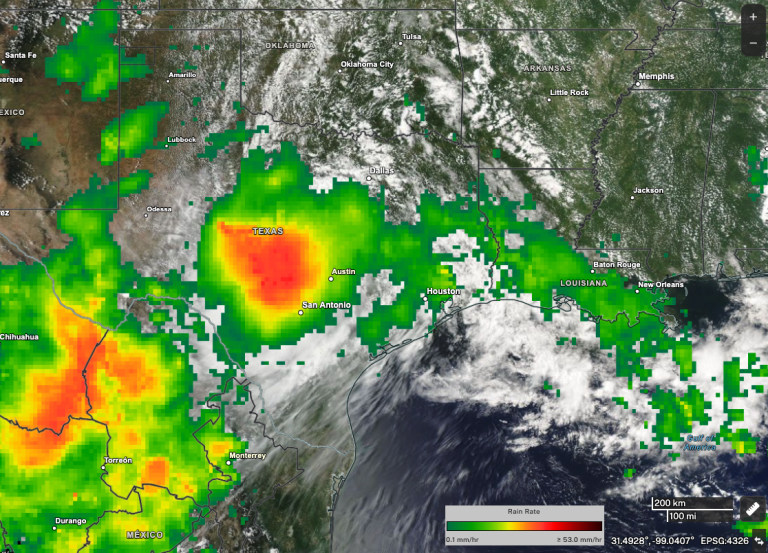
One-day precipitation totals from NASA’s IMERG multi-satellite precipitation product show heavy rainfall over central Texas on July 4, 2025.

Months of rains in hours

Overnight 3 into 4 July, torrential rains – up to 46 centimetres (about 18 inches) in a matter of hours – sent a wall of water surging through Kerr County’s Guadalupe River basin at around 4 AM, catching many residents and vacationers off guard.

The US National Weather Service issued timely alerts – including a flash flood watch more than 12 hours in advance, upgraded to a flash flood emergency about three hours before impact.

The warnings were disseminated by Weather Radio, emergency management systems and television and radio stations, but many people, including hundreds of children at summer camps, were not reached in time.

Floodwaters surged dramatically as the Guadalupe River rose nearly 8 metres (about 26 feet) in about 45 minutes.

Among the hardest hit was the all-girls summer camp, Camp Mystic, along the river, where at least 27 campers and counsellors died, according to media reports. Texas state authorities report that more than 160 people remain missing.

The disaster has triggered one of the largest search-and-rescue efforts in state history.

More frequent and severe floods

Flash floods are not new, but their frequency and intensity are increasing in many regions due to rapid urbanization, land-use change and a warming climate.

A warmer atmosphere holds more moisture and so this means that extreme rainfall events are becoming more frequent,” WMO said.

The Texas disaster joins a string of recent catastrophic floods. In 2022, flash floods in Pakistan killed over 1,700 people and displaced millions. In 2024, floods in Europe, the Middle East and Africa saw $36 billion in economic damages.

And just this week, a flash flood along the Nepalese-Chinese border swept away the main bridge linking the two countries.

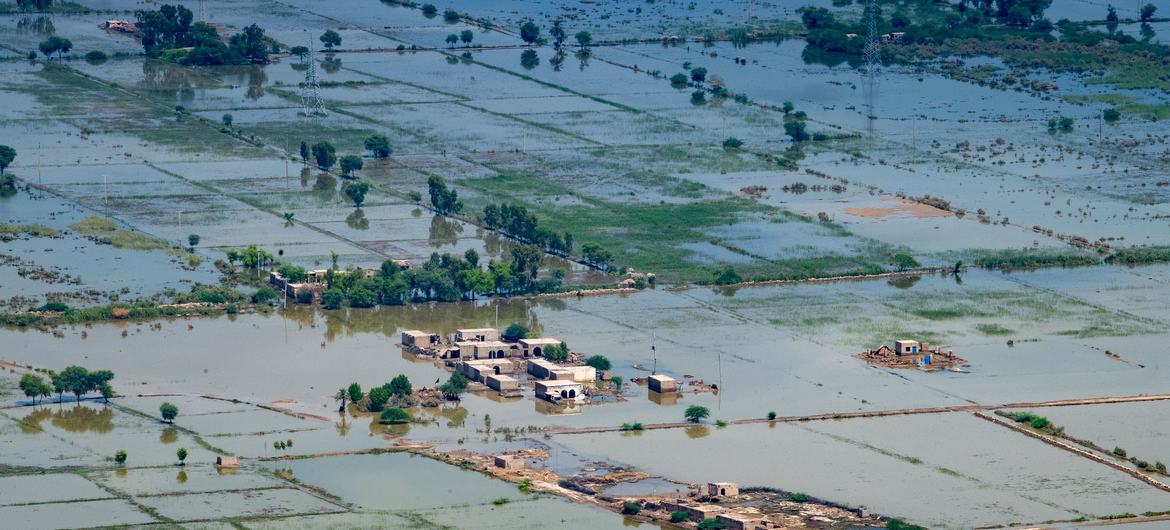
In September 2022, Pakistan was hit by devastating flooding which left large swathes of the country under water.

Supporting countries

To help countries predict such hazards, WMO operates the Flash Flood Guidance System, a real-time forecasting platform used in over 70 countries. It integrates satellite data, radar, and weather models to detect local flash flood threats and supports training programs to build national capacity.

Beyond technology, the agency plays a convening role by building national capacity, certifying experts, and facilitating real-time coordination between forecasting agencies and disaster managers.

Source link

Take a deep breath, your smartphone could help measure blood oxygen levels at home [Details]

First, pause and take a deep breath.

When we breathe in, our lungs fill with oxygen, which is distributed to our red blood cells for transportation throughout our bodies. Our bodies need a lot of oxygen to function, and healthy people have at least 95% oxygen saturation all the time.

Conditions like asthma or COVID-19 make it harder for bodies to absorb oxygen from the lungs. This leads to oxygen saturation percentages that drop to 90% or below, an indication that medical attention is needed.

In a clinic, doctors monitor oxygen saturation using pulse oximeters — those clips you put over your fingertip or ear. But monitoring oxygen saturation at home multiple times a day could help patients keep an eye on COVID symptoms, for example.

In a proof-of-principle study, University of Washington and University of California San Diego researchers have shown that smartphones are capable of detecting blood oxygen saturation levels down to 70%. This is the lowest value that pulse oximeters should be able to measure, as recommended by the U.S. Food and Drug Administration.

The technique involves participants placing their finger over the camera and flash of a smartphone, which uses a deep-learning algorithm to decipher the blood oxygen levels. When the team delivered a controlled mixture of nitrogen and oxygen to six subjects to artificially bring their blood oxygen levels down, the smartphone correctly predicted whether the subject had low blood oxygen levels 80% of the time.

In a proof-of-principle study, University of Washington and University of California San Diego researchers have shown that smartphones are capable of detecting blood oxygen saturation levels down to 70%. The technique involves having participants place their finger over the camera and flash of a smartphone, which uses a deep-learning algorithm to decipher the blood oxygen levels from the blood flow patterns in the resulting video./Photo:Dennis Wise/University of Washington

“Other smartphone apps that do this were developed by asking people to hold their breath. But people get very uncomfortable and have to breathe after a minute or so, and that’s before their blood-oxygen levels have gone down far enough to represent the full range of clinically relevant data,” said co-lead author Jason Hoffman, a UW doctoral student in the Paul G. Allen School of Computer Science & Engineering. “With our test, we’re able to gather 15 minutes of data from each subject. Our data shows that smartphones could work well right in the critical threshold range.”

Another benefit of measuring blood oxygen levels on a smartphone is that almost everyone has one.

“This way you could have multiple measurements with your own device at either no cost or low cost,” said co-author Dr. Matthew Thompson, professor of family medicine in the UW School of Medicine. “In an ideal world, this information could be seamlessly transmitted to a doctor’s office. This would be really beneficial for telemedicine appointments or for triage nurses to be able to quickly determine whether patients need to go to the emergency department or if they can continue to rest at home and make an appointment with their primary care provider later.”

The team recruited six participants ranging in age from 20 to 34. Three identified as female, three identified as male. One participant identified as being African American, while the rest identified as being Caucasian.

To gather data to train and test the algorithm, the researchers had each participant wear a standard pulse oximeter on one finger and then place another finger on the same hand over a smartphone’s camera and flash. Each participant had this same set up on both hands simultaneously.

“The camera records how much that blood absorbs the light from the flash in each of the three color channels it measures: red, green and blue,” said Wang, who also directs the UC San Diego DigiHealth Lab. “Then we can feed those intensity measurements into our deep-learning model.”

Each participant breathed in a controlled mixture of oxygen and nitrogen to slowly reduce oxygen levels. The process took about 15 minutes. For all six participants, the team acquired more than 10,000 blood oxygen level readings between 61% and 100%.

“Smartphone light can get scattered by all these other components in your finger, which means there’s a lot of noise in the data that we’re looking at,” said co-lead author Varun Viswanath, a UW alumnus who is now a doctoral student advised by Wang at UC San Diego. “Deep learning is a really helpful technique here because it can see these really complex and nuanced features and helps you find patterns that you wouldn’t otherwise be able to see.”