World News in Brief: UN condemns attack on civilians in Nigeria, updates from Gaza and West Bank, relief flights to resume in Yemen

In a statement issued by his spokesperson, António Guterres conveyed his “heartfelt condolences to the families of the victims and to the people and Government of Nigeria,” and wished a speedy recovery to those injured.

“The Secretary-General reiterates the solidarity of the United Nations with the Government and people of Nigeria in their efforts to fight terrorism and violent extremism and stresses the importance of bringing the perpetrators to justice,” the statement said.

Death toll may rise

According to media reports, armed groups attacked two rural villages in Kwara state on 3 February, with the death toll expected to rise as bodies continue to be discovered.

Many victims were reportedly shot at close range, while homes and shops were set ablaze, forcing residents to flee into nearby bushland.

The attack was the deadliest recorded in the area in recent months, amid a sharp rise in violence across Nigeria’s northwest and north-central regions, where armed groups have increasingly targeted civilians.

The worsening security situation has also contributed to a deepening humanitarian crisis, with large-scale displacement and growing hunger and malnutrition across affected areas.

Civilians deaths and injuries continue due to Gaza attacks

Despite the shaky ceasefire, dozens of civilian deaths and injuries continued to be reported in Gaza over the past 24 hours, as well as ongoing displacement in the West Bank, according to UN agencies.

Many people remained inaccessible to emergency teams, UN Spokesperson Stéphane Dujarric told journalists, citing reports from the UN aid coordination office OCHA.

He reiterated that all parties must comply with international humanitarian law, including the obligation to protect civilians and civilian infrastructure.

Mr. Dujarric said UN teams overnight received 25 additional returnees crossing through Rafah, who were transported by the UN Development Programme (UNDP) to Nasser Hospital in Khan Younis.

There, UN partners continue operating a reception area providing medical, psychological and protection support.

He added that the World Health Organization (WHO) and partners supported the medical evacuation of 15 patients and 31 companions from Gaza to Egypt over the past two days.

Record spike in West Bank attacks

Attacks by Israeli settlers against Palestinians in the occupied West Bank have seen a massive spike since 2021, with more than 50 Israeli settler attacks recorded between 20 January and 2 February.

The attacks resulted in casualties, property damage or both.

According to OCHA, since the beginning of 2026, more than 900 Palestinians have been forced out of their homes or communities, mostly due to settler violence and access restrictions, followed by demolitions.

OCHA said it is carrying out preliminary assessments of damage and needs following these incidents, to inform the humanitarian response.

Yemen: Aid flights set to resume to Houthi-controlled capital

The UN has confirmed that its aid flights to Yemen’s opposition-held capital will resume, after being blocked for more than a month.

UN Humanitarian Air Service flights are a vital provider of relief amid overwhelming needs across Houthi-held areas, including the capital city, Sana’a, and other locations across Yemen, which has been at war since 2014.

Boost to aid delivery

Julien Harneis, the UN Resident and Humanitarian Coordinator for Yemen, said in a statement that the agreement reached earlier this week will allow NGOs to enter and exit Sana’a, which is a prerequisite to providing assistance for millions of people in need in Houthi-controlled areas.

Years of conflict between separatists and the internationally recognised government have left more than 19.5 million people needing humanitarian assistance and more than 4.8 ‎million internally displaced.

Funding is only available to meet around 25 per cent of needs, meaning that millions ‎are not getting lifesaving assistance, including health care, shelter, water, sanitation ‎and hygiene.

Source link

Violence roiling Nigeria extends beyond religious lines, amid a deepening humanitarian crisis

The strikes thrust Nigeria’s long-running sectarian bloodshed into the global spotlight – and revived claims that a “Christian genocide” is unfolding in Africa’s most populous country.

But in an interview, the UN’s top humanitarian official in the country has told UN News that the current crisis extends far beyond any single community or conflict. Violence, he cautioned, has spread across much of the country, leaving millions displaced and fuelling what aid agencies describe as one of Africa’s largest – and most overlooked – humanitarian emergencies.

“Security remains one of Nigeria’s major challenges,” said Mohamed Malik Fall, the UN resident and humanitarian coordinator. “You can no longer associate it with a single region. It is almost everywhere.”

A conflict that spread

The crisis began in the northeast in 2009, with an insurgency led by the jihadist group Boko Haram, later joined by splinter factions, including the Islamic State-West Africa (ISIS-WA). 

Nearly two decades in, the violence has reshaped large parts of the country.

More than two million people remain displaced in the northeast alone, many of them for years. “An entire generation has grown up in displacement camps, knowing nothing else,” Mr. Fall said.

The human toll is extensive: more than 40,000 people killed since the start of the insurgency, thousands of schools and health centres destroyed, and vast agricultural areas rendered inaccessible. But Mr. Fall said the deeper damage has been economic and social.

“People have been cut off from all economic activity,” he said. “They are deprived of the ability to live from their work and preserve their dignity.”

Children walk through the mud in a displaced persons camp in Maiduguri in northeast Nigeria.

Untargeted violence

What was once a localized insurgency has morphed into something broader and more diffuse.

In Nigeria’s northwest – in states such as Zamfara, Katsina and Sokoto – armed criminal groups have seized control of rural areas, carrying out mass kidnappings and extortion, a phenomenon authorities describe as banditry. 

Entire villages have been abandoned, and around one million people are now displaced in the region, according to United Nations estimates.

In the country’s central belt, clashes between farmers and herders over land, intensified by climate pressure and environmental degradation, have triggered further displacement. 

Elsewhere, separatist movements and attacks linked to oil production continue to destabilize communities.

The cumulative result is a country with roughly 3.5 million internally displaced people – nearly 10 percent of all displacement across Africa.

A loaded claim

Recent attacks against churches and Christian schools have revived international attention. In January, more than 160 worshippers were abducted during Sunday services in Kaduna State. 

Days earlier, villages in the northwest were attacked, killing dozens, while students near a Catholic school in Papiri were again targeted.

The violence revived memories of the 2014 abduction of 276 schoolgirls from Chibok, most of them Christian, by Boko Haram – a moment that once galvanized global outrage.

Citing the need to protect Christians from Islamist militants, the US administration ordered airstrikes on Christmas Day against jihadist positions in northern Nigeria. In Washington, some officials have since argued that a “Christian genocide” is underway.

The UN is refraining from that characterisation.

“Attributing this violence to the targeted persecution of a religious group – I would not take that step,” Mr. Fall said. “The vast majority of the more than 40,000 people killed in the insurgency are Muslims. They were attacked and killed in mosques.”

He pointed to an attack in Maiduguri, the historic centre of the insurgency, carried out on Christmas Eve in an area “between a mosque and a market,” which killed Muslim worshippers as they left prayers.

“Insecurity affects everyone, without distinction of religion or ethnicity,” he said, warning that oversimplified narratives risk deepening social fractures rather than addressing their causes.

© WFP/Arete/Siegfried Modola

Internally displaced mothers with their children attend a WFP famine assessment exercise in Borno State, northeastern Nigeria.

A crisis measured in millions

Behind the violence lies a humanitarian emergency of enormous scale. In the northeastern states alone, 7.2 million people need assistance – nearly six million of them in severe or critical condition, according to U.N. figures.

Food insecurity has become the defining threat. Aid agencies project that up to 36 million Nigerians could face varying levels of food insecurity in the coming months. Among children under five, more than 3.5 million are at risk of acute malnutrition.

“The consequences are not only immediate,” Mr. Fall said. “Malnutrition affects cognitive development, education, and continues to shape lives well into adulthood.”

Climate shocks – including droughts and floods – have compounded the crisis, alongside recurring cholera and meningitis outbreaks and a fragile health system.

Aid shrinks as needs grow

Despite the scale of the emergency, funding has collapsed.

“A few years ago, Nigeria’s humanitarian response plan raised close to $1 billion annually,” Mr. Fall said. “In 2024, it was $585 million. Last year, barely $262 million. This year, we are not even certain we will reach $200 million.”

The decline comes as donor attention has shifted to higher-profile crises elsewhere, including Ukraine and Sudan.

A test for Africa’s largest economy

Nigeria’s predicament exposes a stark paradox: one of Africa’s largest economies confronting a humanitarian crisis more often associated with far poorer states.

“Nigeria is not Sudan. It is not Somalia. It is not South Sudan,” Mr. Fall said. “This is a country with resources. The primary responsibility for responding to humanitarian needs lies with the government.”

The UN is now urging Nigerian federal and state authorities to take greater ownership of the response, even as it presses donors not to turn away.

“No one wants to live on aid,” Mr. Fall said. “People would rather be helped to access economic opportunities than remain dependent. Giving a fish is good. Teaching how to fish is better.”

Source link

World News in Brief: Winter attacks in Ukraine, looming food aid cuts in Nigeria, drought in Kenya

They include attacks in Odesa region on Wednesday that killed a 17-year-old boy, according to UN child rights agency UNICEF which called for an “end to attacks on civilian areas and the infrastructure children rely on.” 

The UN Office for the Coordination of Humanitarian Affairs (OCHA) reported that attacks on the southeastern city of Kryvyi Rih on Wednesday had recommenced on Thursday. 

Aid deliveries 

“Teams delivered shelter materials to cover damaged homes and provided protection services to the affected residents,” OCHA said in a tweet, stressing that “the cold weather is worsening the needs, requiring urgent aid.” 

Russia continues to target energy infrastructure in Ukraine, knocking  out heat, electricity and water supply, UN human rights chief Volker Türk said on Tuesday. 

“Civilians are bearing the brunt of these attacks. They can only be described as cruel. They must stop,” he said. 

Nigeria: Looming food aid cuts put one million at risk 

More than a million people in northeast Nigeria could lose emergency food and nutrition assistance unless funding can be found “within weeks”, the World Food Programme (WFPwarned on Thursday. 

Nigeria is facing one of the worst hunger crises in recent times, with nearly 35 million people projected to face acute and severe food insecurity during the lean season. 

They include roughly 15,000 people in Borno state who risk falling into catastrophic hunger, which is one step away from famine. These are the worst levels of hunger recorded in a decade, WFP said.  

The crisis is unfolding amid renewed violence in the north which has devastated rural communities, displaced families and destroyed food reserves. 

‘Catastrophic’ consequences 

“Now is not the time to stop food assistance,” said David Stevenson, WFP’s Nigeria Country Director.  

He warned of “catastrophic humanitarian, security and economic consequences” for Nigeria’s most vulnerable people, who had been forced to flee their homes in search of food and shelter.   

WFP is urgently seeking $129 million to sustain its operations in the northeast over the next six months, warning that this work could shut down unless funds are received.   

People living in Turkana in northern Kenya are dealing with the impact of drought.

Kenya drought impacts over two million people 

More than two million people in Kenya are facing worsening food insecurity in the wake of the October to December 2025 rainy season – among the driest on record, the World Health Organization (WHOsaid on Thursday. 

The prolonged drought has led to rising malnutrition rates, increased risk of disease outbreaks and disrupted access to essential health services. 

Regional drought 

The impacts are also being felt in neighbouring Somalia, Tanzania and Uganda, where millions more people are at risk due to similar weather patterns and water shortages. 

In Kenya, 10 counties are currently experiencing drought conditions, one of which is in the “alarm” phase. Furthermore, another 13 counties in the Arid and Semi-Arid Lands (ASAL) regions are showing signs of drought stress. 

While severe, the emergency was part of a known seasonal risk, WHO said.  The UN agency has supported the Kenyan authorities including by providing cholera kits, pneumonia kits and essential supplies, as well as pre-positioning equipment in high-risk counties before the drought intensified. 

WHO stressed the need to mobilize urgently to ensure both people and livestock have access to adequate food supply and safe water, and to prevent the situation from worsening. 


Source link

Nigeria: Amid record hunger and surging insecurity, emergency food assistance to stall entirely

While WFP has been able to hold hunger at bay across northern Nigeria in the first half of 2025, funding shortfalls are jeopardising such efforts, with life-saving programmes set to grind to a halt by the end of July.  

Without immediate funding, millions of vulnerable people will be left without food assistance as WFP’s food and nutrition stocks have been completely exhausted, with the organization’s last supplies leaving warehouses in early July.  

With life-saving assistance set to end after the current round of distributions is completed, millions of vulnerable people will face impossible choices: endure increasingly severe hunger, migrate, or even risk possible exploitation by extremist groups in the region.  

Children at risk

“Nearly 31 million people in Nigeria are now facing acute hunger, a record number,” said WFP Country Director David Stevenson, with children set to be among the worst affected if vital aid ends.  

With more than 150 WFP-supported nutrition clinics in Borno and Yobe states set to close if funding is not renewed, over 300,000 children under the age of two will lose access to potential life-saving treatment.  

“This is no longer just a humanitarian crisis,” he said. “It’s a growing threat to regional stability, as families pushed beyond their limits are left with nowhere to turn.”  

Extremist groups  

In conflict-affected areas in the north, escalating violence from extremist groups is driving mass displacement, with some 2.3 million people across the Lake Chad Basin having been forced to flee their homes.  

As mass displacement strains already limited resources and pushes communities to the brink, the lack of emergency food assistance risks increasing recruitment by these groups.

“When emergency assistance ends, many will migrate in search of food and shelter. Others will adopt negative coping mechanisms – including potentially joining insurgent groups – to survive,” said Mr. Stevenson.    

“Food assistance can often prevent these outcomes,” he added, as WFP urgently seeks $130 million to sustain food and nutrition operations through the end of the year.

Source link

Deadly flooding in Nigeria displaces thousands

Nigerian officials estimate that over 500 people are still missing and presumed dead, according to news reports.

Deputy Secretary-General Amina Mohammed, a former Nigerian Government minister, said she was heartbroken at the extent of the loss and damage.

“My deepest condolences to all those affected – especially the families who have lost loved ones. My prayers are with you,” she said.

UN relief operation 

United Nations agencies and partners are working alongside the Nigerian Government to provide essential humanitarian aid to individuals and households in Niger State who have been affected.

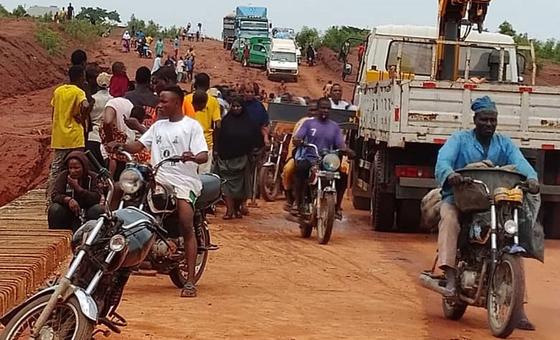
Beginning 29 May, heavy rains in the Local Government Area of Mokwa – known as a trading hub – prompted flash flooding which flattened entire neighbourhoods.

Hundreds were killed, thousands displaced and key roads and bridges were damaged, disrupting movement and economic activity.

Nigeria’s rainy season extends from April-October, making it particularly prone to flooding, which has become more severe in recent years.

Climate change factor

In 2024, a flood in September killed 230 people in Borno state in eastern Nigeria and displaced over 600,000 people. In 2022, severe flooding across the country impacted 34 out of the 36 states, killed hundreds and displaced more than 1.3 million.

A recent report from the UN weather agency (WMO) said the worsening severity is related to climate change and increasing surface and water temperatures, all of which is taking a high toll throughout the African continent.

Agencies on the ground

According to UN Spokesperson Stéphane Dujarric Nigerian authorities are leading recovery efforts and UN agencies and partners are providing supplementary assistance.

The World Health Organization (WHO) is preparing to ship medicine and medical equipment to supplement and support existing primary care systems.

For their part, the International Organization for Migration (IOM) is providing materials for temporary shelter and other non-essential food items.

The UN reproductive health agency (UNFPA) is working to establish temporary clinics and safe spaces for women and girls displaced by the flooding. In these spaces, women can access maternal and reproductive health services, dignity kits and psychosocial assistance. UNFPA is also working to deploy midwives and nurses.

Mohammed M. Malik Fall, resident and humanitarian coordinator in Nigeria, commended Government efforts to respond to the humanitarian situation in Mokwa and said that the UN “stands ready to support the response.”