
UN warns of mounting humanitarian toll as Israel-Iran hostilities continue

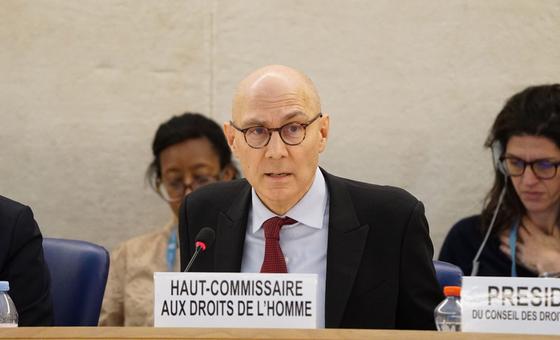
UN High Commissioner for Human Rights Volker Türk on Thursday called for “maximum restraint” and reiterated that both Israel and Iran are bound by international humanitarian law.

“The widescale, continuing attacks by Israel across Iran, and the missile and drone strikes launched in response by Iran, are inflicting severe human rights and humanitarian impacts on civilians, and risk setting the whole region ablaze,” he said in a statement.

The only way out of this spiralling illogic of escalation is maximum restraint, full respect for international law, and return in good faith to the negotiating table,” he stressed.

Appalling collateral damage

The UN rights chief also expressed deep concern over the impact on civilians.

It is appalling to see how civilians are treated as collateral damage in the conduct of hostilities,” he said, adding that threats and inflammatory rhetoric by senior officials on both sides suggest a “worrying intention” to inflict harm on civilians.

The airstrikes, missile and drone attacks – launched by both Israel and Iran since 13 June – have caused heavy damage to civilian infrastructure and claimed hundreds of lives.  

According to Iranian authorities, at least 224 people have been killed, while human rights groups report significantly higher figures. In Israel, officials report 24 deaths and more than 840 injuries so far.

Widespread panic

Warnings from both governments have also prompted widespread panic among civilians.

Israel’s call for civilians to evacuate on Tuesday triggered panic across Tehran, resulting in heavy traffic jams on highways. Movement has reportedly been hampered across the country by fuel shortages, leading to hours-long queues at petrol stations.

Concern for refugees

The Office of the UN High Commissioner for Refugees (UNHCR) expressed grave concern over the deteriorating humanitarian situation, adding that it is monitoring reports that people are on the move within Iran and that some are leaving for neighbouring countries.

UNHCR Spokesperson Babar Baloch cautioned that the situation remained fluid and hard to verify.

Iran has long hosted the largest Afghan refugee population in the world. Now, its own people are experiencing devastation and fear,” Mr. Baloch added.

He also emphasised the principle of non-refoulement, calling on neighbouring countries to grant protection to anyone fleeing violence, and not turn them back.

UNHCR Spokesperson Baloch on the crisis.

Iran hosts an estimated 3.5 million refugees and those in refugee-like situations, including some 750,000 registered Afghans and over 2.6 million undocumented individuals.

Regional worries

There is already regional fallout, with missile launches from Yemen towards Israel and the Occupied Palestinian Territory and heightened tensions reportedly involving armed groups in Iraq, according to OCHA.

This escalation takes place as the region already grapples with mounting humanitarian needs, sharply reduced funding, and constrained operational space for humanitarian action,” the Office said in a flash update issued on Wednesday.

“De-escalation is vital to preventing further suffering of civilians and population displacements,” OCHA underscored.
Source link

Guterres renews call for Israel-Iran ceasefire

I reiterate my call for immediate de-escalation leading to a ceasefire,” Mr. Guterres said in a statement in which he strongly appealled against any further internationalization of the conflict. 

“Any additional military interventions could have enormous consequences, not only for those involved but for the whole region and for international peace and security at large,” he warned.

He condemned “the tragic and unnecessary loss of lives and injuries to civilians and damage to homes and critical civilian infrastructure.” 

Deadly escalation

The crisis erupted on Friday when Israel began targeting nuclear and military sites across Iran, prompting Tehran to launch retaliatory strikes on Israeli cities.

Since then, more than 250 people have been killed across both countries, according to media reports.

The International Atomic Energy Agency (IAEA), which has been monitoring Iran’s nuclear programme for decades, said that it had received information that two centrifuge production facilities were struck on Wednesday.

The TESA Karaj workshop and the Tehran Research Center were previously under its monitoring and verification as part of a 2015 international agreement known as the Joint Comprehensive Plan of Action (JCPOA).

“At the Tehran site, one building was hit where advanced centrifuge rotors were manufactured and tested,” the agency said in a tweet. “At Karaj, two buildings were destroyed where different centrifuge components were manufactured.”

Last week, the IAEA passed a resolution declaring that Iran was not complying  with its non-proliferation obligations.

The text noted Iran’s “many failures” to provide the agency with full and timely cooperation regarding undeclared nuclear material and activities at multiple undeclared locations in the country.

 Diplomacy reigns supreme

As the crisis in the Middle East deepens, the Secretary-General stressed that “diplomacy remains the best and only way to address concerns regarding Iran’s nuclear programme and regional security issues.”

 He underlined that “the UN Charter remains our shared framework to save people from the scourge of war,” urging all Member States to fully comply with the document and international law, including international humanitarian law. 

Israel-Iran crisis: UN chief urges calm after overnight strikes

Any military escalation in the Middle East should be censured, the UN chief said in a short statement issued by his spokesperson’s office.

“He is particularly concerned by Israeli attacks on nuclear installations in Iran while talks between Iran and the United States on the status of Iran’s nuclear programme are underway,” said Farhan Haq, Deputy Spokesperson for the Secretary-General.

In an update on Friday, the head of the UN-backed atomic watchdog announced that the Iranian authorities had confirmed that the Natanz enrichment site had been “impacted” without affecting existing radiation levels.

The Iranian nuclear safety authorities also reported that the Esfahan and Fordow sites had not been impacted.

“This development is deeply concerning,” said Rafael Grossi, head of the International Atomic Energy Agency (IAEA). “I have repeatedly stated that nuclear facilities must never be attacked, regardless of the context or circumstances, as it could harm both people and the environment. Such attacks have serious implications for nuclear safety, security and safeguards, as well as regional and international peace and security.”

According to reports, the Israeli military attacks targeted Iran’s nuclear programme at various sites across the country late Thursday.

Iranian media reported the death of Hossein Salami, chief of the country’s Revolutionary Guards, along with nuclear scientists.

The development comes as the United States was scheduled to begin a fresh round of negotiations with Tehran on Saturday in Oman. Israeli schools closed on Friday in anticipation of a riposte by Iran, with reports that some 100 drones were launched towards Israel in the early hours. 

Source link