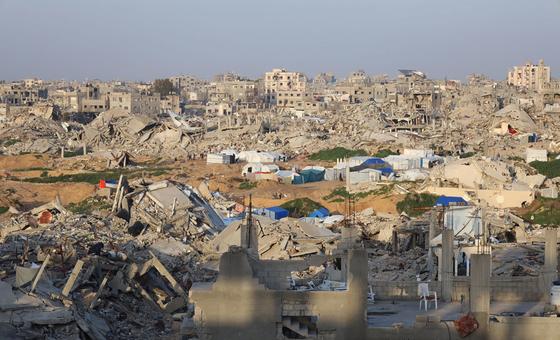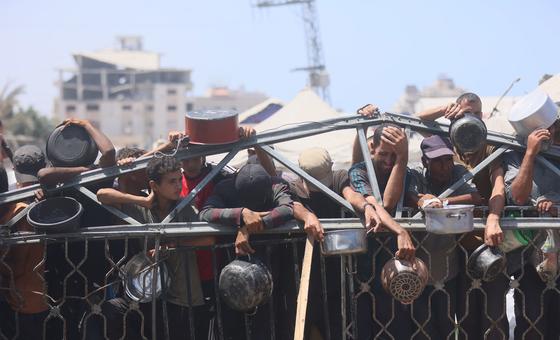
Amid massive destruction of Gaza City, UN chief renews ceasefire call

“It is vital to reach immediately a ceasefire in Gaza,” the Secretary-General told reporters on the sidelines of the Ninth Tokyo International Conference on African Development (TICAD9), “and the unconditional release of all hostages and to avoid the massive death and destruction that a military operation against Gaza City would inevitably cause.

Around one million people still live in the city – Gaza’s largest – in the north of the war-torn enclave. The Israeli army has reportedly described it as a stronghold of Hamas, the terror group whose deadly attacks in Israel and hostage-taking sparked the war on 7 October 2023.

The UN chief also condemned the Israeli Government’s decision to approve a long-shelved settlement expansion project in the occupied West Bank.

The decision by the Israeli authorities to expand illegal settlement construction, which would divide the West Bank, must be reversed. All settlement construction is a violation of international law,” he insisted.

The settlement is believed to have permission for well over 3,000 houses, schools and a clinic, cutting off East Jerusalem from the occupied West Bank, which Israel captured during the 1967 Six-Day war after defeating Egypt, Jordan and Syria.

Urban destruction

Meanwhile in Gaza City, whole urban areas are being “totally destroyed”, the UN understands, with further destruction now underway in the south and southeast, as military manoeuvres continue.

Recent attacks have been particularly devastating in the Az Zaytoun neighbourhood of the city, the UN human rights office (OHCHRreported on Wednesday.

Highlighting more than 50 attacks on residential buildings and entire blocks in Gaza City since 8 August, OHCHR warned that its “systematic destruction” had begun.

Acute malnutrition soaring

Meanwhile, UN aid teams highlighted the catastrophic impact of the accelerating Israeli military operation, with acute malnourishment soaring among children in Gaza City to 28.5 per cent, or more than one in four youngsters.

“Children continue to die from man-made starvation,” UNRWA said in a statement, noting that it has screened more than 95,000 children aged six months to five years for malnutrition across the Gaza Strip since March 2025, after the ceasefire collapsed.

While the ceasefire still held in early March and relief supplies were allowed into Gaza in far greater quantities than today, malnutrition rates were six times lower in Gaza City, at 4.5 per cent, according to the UN agency for Palestinians, UNRWA. 

Across Gaza, acute malnutrition rose to nearly 16 per cent in mid-August, more than three times higher than the 5.2 per cent level recorded by the UN agency in March, it said.

Vital services in danger

Today, services provided by UNRWA in Gaza City are at “severe risk”, the agency warned, pointing to the tens of thousands of people who still live in its shelters and the “many more” who remain in surrounding areas.

There is particular concern for UNRWA’s Gaza Field Office compound – its largest logistics hub in northern Gaza – as the UN agency’s operations in the south have been “crippled” by displacement orders and bombardment.

As an indication of UNRWA’s key role in aid and relief provision across Gaza, it noted that last month alone, it provided more than 100,000 medical consultations and screened 3,500 children for malnutrition in Gaza City.

UNRWA also delivered drinking water to 220,000 people, domestic water to 250,000 and cleared hundreds of tons of waste.

Education and protection specialists from the UN agency reached thousands more in temporary learning spaces or by offering counselling, recreational activities and risk awareness training about the dangers of lethal unexploded weapons.

“While our colleagues, like the rest of the UN, are determined to stay and deliver, all of these services are now at risk as the military operations intensify,” UNRWA said.

Source link

Security Council renews UN’s Haiti mission amid spiralling crises

By adopting resolution 2785, the Council renewed the authorization of the UN Integrated Office in Haiti (BINUH), reaffirming support for a Haitian-led solution to the island nation’s overlapping crises.

The decision comes as armed gangs maintain their grip on most of the capital, Port-au-Prince, with over 1.3 million people displaced and more than 4,000 killed in the first half of 2025 alone, according to UN figures.

Conditions have deteriorated dramatically amid growing food insecurity and the erosion of public institutions. Of particular concern is the safety of women and girls, with a sharp rise in reports of sexual violence since the start of the year – including rape, gang rape, and sexual enslavement.

Time is running out

The Security Council also “expressed its intention to consider, without delay” the recommendations by the Secretary-General on possible future roles for the UN in sustaining security and stability in Haiti.

In February, António Guterres presented the Council with a range of options.

Each new wave of criminal attacks against the communities and institutions of Haiti is a distressing sign that time is running out,” the UN chief said in a letter.

He urged Member States to support the Multinational Security Support (MSS) mission, which the Council authorized in October 2023 to assist Haiti’s national police in tackling gang violence and restoring order. He also emphasized that international efforts to improve security must be matched by national progress toward resolving the political crisis.

Several Council members voiced willingness to engage on the Secretary-General’s proposals. The Chinese representative, for instance, said Beijing was open to working with others to chart a constructive way forward.

“With regard to how to improve the situation in Haiti, including how to respond to the Secretary-General’s recommendations, we are ready to have candid communication with all parties, explore viable solutions and seek the broadest possible consensus,” said Geng Shuang, Deputy Permanent Representative of China to the UN.

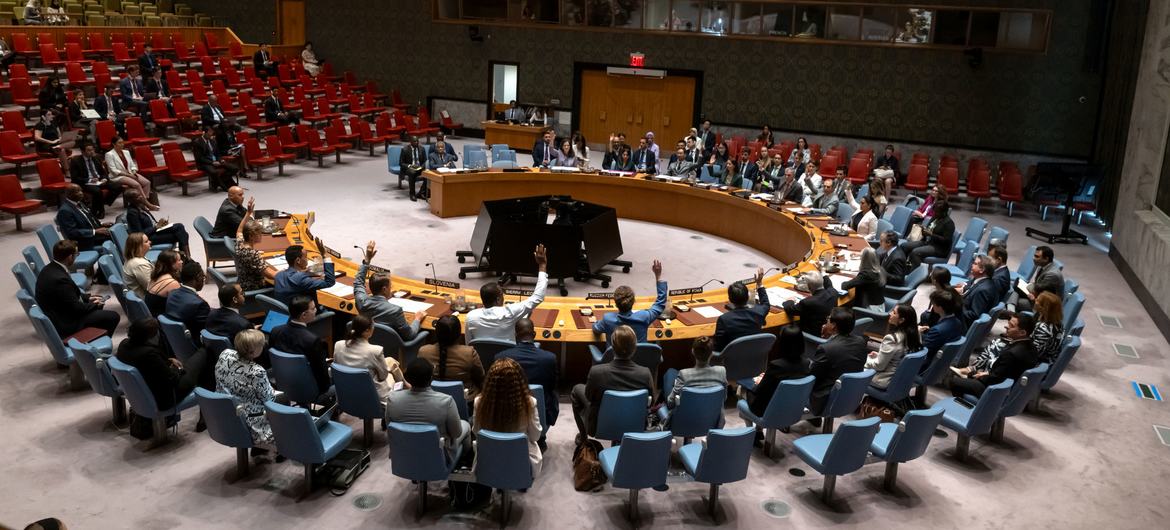
Security Council adopts resolution extending the mandate of the UN Integrated Office in Haiti (BINUH) during the meeting on the question concerning Haiti.

Mission critical

The Council’s action was welcomed by Haiti’s Ambassador, who underscored the political and security stakes ahead of a critical 2026 transition timeline.

This extension should help Haitian authorities undertake a real, genuine political dialogue, to strengthen good governance, bolster security and bring about justice and promote human rights,” said Pierre Ericq Pierre, Permanent Representative to the UN.

He also expressed his Government’s expectation that the UN mission will support implementation of the national roadmap, including constitutional reforms and elections.

Emphasizing national ownership, he added: “BINUH must work as part of a holistic plan to support Haitian authorities in confronting the grave crisis shaking the country to its core.”

The United States, which led negotiations on the resolution alongside Panama, stressed the urgency of political progress and called on international partners to increase support.

“Less than one year remains on the Transitional Presidential Council’s planned roadmap for the restoration of democratic institutions,” said Ambassador Dorothy Shea, acting representative.

Supporting the security of elections and the participation of all sectors of society is key to sustainable political progress in Haiti. Without BINUH, realizing the vision of a stronger, more resilient society would be less likely.

New mission leadership

Council members also welcomed Carlos G. Ruiz Massieu, appointed as the new Special Representative of the Secretary-General and Head of BINUH, succeeding María Isabel Salvador.

Mr. Ruiz Massieu, who currently leads the UN Verification Mission in Colombia, brings decades of diplomatic and political experience, including in peace negotiations and institution-building.

The UN Integrated Office in Haiti (BINUH) – a special political mission – was established in 2019 to advise and support Haitian authorities on political dialogue, justice, human rights and governance.

It succeeded a series of UN peacekeeping and political missions on the island, dating back to 1993, including the large-scale MINUSTAH operation, which wrapped up in 2017 after 13 years.

Source link

Guterres renews call for Israel-Iran ceasefire

I reiterate my call for immediate de-escalation leading to a ceasefire,” Mr. Guterres said in a statement in which he strongly appealled against any further internationalization of the conflict. 

“Any additional military interventions could have enormous consequences, not only for those involved but for the whole region and for international peace and security at large,” he warned.

He condemned “the tragic and unnecessary loss of lives and injuries to civilians and damage to homes and critical civilian infrastructure.” 

Deadly escalation

The crisis erupted on Friday when Israel began targeting nuclear and military sites across Iran, prompting Tehran to launch retaliatory strikes on Israeli cities.

Since then, more than 250 people have been killed across both countries, according to media reports.

The International Atomic Energy Agency (IAEA), which has been monitoring Iran’s nuclear programme for decades, said that it had received information that two centrifuge production facilities were struck on Wednesday.

The TESA Karaj workshop and the Tehran Research Center were previously under its monitoring and verification as part of a 2015 international agreement known as the Joint Comprehensive Plan of Action (JCPOA).

“At the Tehran site, one building was hit where advanced centrifuge rotors were manufactured and tested,” the agency said in a tweet. “At Karaj, two buildings were destroyed where different centrifuge components were manufactured.”

Last week, the IAEA passed a resolution declaring that Iran was not complying  with its non-proliferation obligations.

The text noted Iran’s “many failures” to provide the agency with full and timely cooperation regarding undeclared nuclear material and activities at multiple undeclared locations in the country.

 Diplomacy reigns supreme

As the crisis in the Middle East deepens, the Secretary-General stressed that “diplomacy remains the best and only way to address concerns regarding Iran’s nuclear programme and regional security issues.”

 He underlined that “the UN Charter remains our shared framework to save people from the scourge of war,” urging all Member States to fully comply with the document and international law, including international humanitarian law. 

Gaza: Guterres hails hostage release, renews ceasefire call

Edan Alexander, a 21-year-old American-Israeli national and soldier with the Israel Defense Forces (IDF), had been held by Hamas since the brutal 7 October 2023 attacks on Israel in which roughly 1,200 people were killed and another 250 taken hostage.

He is believed to be the last living American held by militants in Gaza, according to media reports.

Free all remaining hostages

The Secretary-General “is profoundly relieved that Mr. Alexander has been freed and is now returning to his family and loved ones after this harrowing ordeal,” said UN Spokesperson Stéphane Dujarric in a statement.

The UN chief renewed his urgent call for an immediate, permanent ceasefire and the immediate and unconditional release of all remaining hostages, he added, stressing that hostages must be treated humanely and with dignity.

“He calls on all parties to immediately ensure rapid, unhindered, and safe humanitarian relief, including the delivery of critical services, for all civilians in need. Aid is not negotiable,” Mr. Dujarric said.

End the hostilities

The Secretary-General also commended the sustained mediation efforts of Egypt, Qatar, and the United States to bring an end to the fighting.  

He urged “all parties to build on today’s release to reach a comprehensive agreement that will ensure the release of all hostages, an end to the hostilities, the provision of humanitarian aid and the long-overdue alleviation of the human suffering in Gaza,” the statement concluded.

Food security experts warned on Monday that Gaza’s entire population, more than two million people, remains “at critical risk of famine” due to the war and Israel’s blockade on aid entry, effective since 2 March. 

Source link