
Security Council renews UN’s Haiti mission amid spiralling crises

By adopting resolution 2785, the Council renewed the authorization of the UN Integrated Office in Haiti (BINUH), reaffirming support for a Haitian-led solution to the island nation’s overlapping crises.

The decision comes as armed gangs maintain their grip on most of the capital, Port-au-Prince, with over 1.3 million people displaced and more than 4,000 killed in the first half of 2025 alone, according to UN figures.

Conditions have deteriorated dramatically amid growing food insecurity and the erosion of public institutions. Of particular concern is the safety of women and girls, with a sharp rise in reports of sexual violence since the start of the year – including rape, gang rape, and sexual enslavement.

Time is running out

The Security Council also “expressed its intention to consider, without delay” the recommendations by the Secretary-General on possible future roles for the UN in sustaining security and stability in Haiti.

In February, António Guterres presented the Council with a range of options.

Each new wave of criminal attacks against the communities and institutions of Haiti is a distressing sign that time is running out,” the UN chief said in a letter.

He urged Member States to support the Multinational Security Support (MSS) mission, which the Council authorized in October 2023 to assist Haiti’s national police in tackling gang violence and restoring order. He also emphasized that international efforts to improve security must be matched by national progress toward resolving the political crisis.

Several Council members voiced willingness to engage on the Secretary-General’s proposals. The Chinese representative, for instance, said Beijing was open to working with others to chart a constructive way forward.

“With regard to how to improve the situation in Haiti, including how to respond to the Secretary-General’s recommendations, we are ready to have candid communication with all parties, explore viable solutions and seek the broadest possible consensus,” said Geng Shuang, Deputy Permanent Representative of China to the UN.

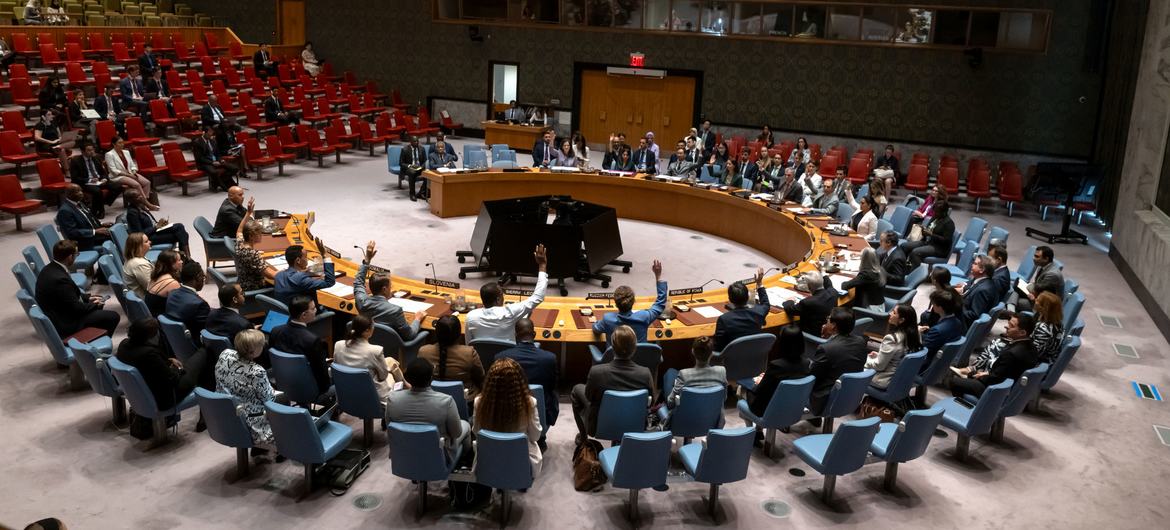
Security Council adopts resolution extending the mandate of the UN Integrated Office in Haiti (BINUH) during the meeting on the question concerning Haiti.

Mission critical

The Council’s action was welcomed by Haiti’s Ambassador, who underscored the political and security stakes ahead of a critical 2026 transition timeline.

This extension should help Haitian authorities undertake a real, genuine political dialogue, to strengthen good governance, bolster security and bring about justice and promote human rights,” said Pierre Ericq Pierre, Permanent Representative to the UN.

He also expressed his Government’s expectation that the UN mission will support implementation of the national roadmap, including constitutional reforms and elections.

Emphasizing national ownership, he added: “BINUH must work as part of a holistic plan to support Haitian authorities in confronting the grave crisis shaking the country to its core.”

The United States, which led negotiations on the resolution alongside Panama, stressed the urgency of political progress and called on international partners to increase support.

“Less than one year remains on the Transitional Presidential Council’s planned roadmap for the restoration of democratic institutions,” said Ambassador Dorothy Shea, acting representative.

Supporting the security of elections and the participation of all sectors of society is key to sustainable political progress in Haiti. Without BINUH, realizing the vision of a stronger, more resilient society would be less likely.

New mission leadership

Council members also welcomed Carlos G. Ruiz Massieu, appointed as the new Special Representative of the Secretary-General and Head of BINUH, succeeding María Isabel Salvador.

Mr. Ruiz Massieu, who currently leads the UN Verification Mission in Colombia, brings decades of diplomatic and political experience, including in peace negotiations and institution-building.

The UN Integrated Office in Haiti (BINUH) – a special political mission – was established in 2019 to advise and support Haitian authorities on political dialogue, justice, human rights and governance.

It succeeded a series of UN peacekeeping and political missions on the island, dating back to 1993, including the large-scale MINUSTAH operation, which wrapped up in 2017 after 13 years.

Source link

‘A fire no one can control’: UN warns of spiralling Iran-Israel war

In an address to the UN Security Council on Friday, Mr. Guterres made an urgent plea for de-escalation, calling the spiralling confrontation a defining moment for the future of global security.

We are not drifting toward crisis – we are racing toward it,” he said.

“This is a moment that could shape the fate of nations…the expansion of this conflict could ignite a fire no one can control,” he warned.

Widespread panic, destruction

The Secretary-General’s remarks came amid a mounting civilian toll in both Israel and Iran, and as several nuclear sites in Iran have come under direct military assault.

Over 100 targets have been struck across Iran, including military and nuclear infrastructure such as the Natanz and Isfahan nuclear facilities and the Khondab heavy water reactor.

Iranian officials report over 224 civilian deaths, with some estimates twice as high. More than 2,500 have been injured reportedly – while major cities like Tehran have seen mass displacements, fuel shortages and widespread panic.

Iran has responded with its own barrage of missile strikes on Israel, hitting cities such as Tel Aviv, Haifa and Beersheba. Critical civilian sites, including the Soroka Medical Center and the Weizmann research institute, have been damaged. Twenty-four Israelis are confirmed dead, with more than 900 injured.

Give peace a chance

Mr. Guterres urged both parties to give diplomacy a chance, reiterating the need for full Iranian cooperation with the UN nuclear energy watchdog, IAEA, and warning that the “only thing predictable about this conflict is its unpredictability.”

He also called for unity within the Security Council and adherence to the UN Charter.

“The Non-Proliferation Treaty is a cornerstone of international security,” he said. “Iran must respect it. But the only way to bridge the trust gap is through diplomacy – not destruction.”

A wide view of the Security Council meeting on the Israel-Iran crisis.

Regional fallout expanding

Rosemary DiCarlo, UN Under-Secretary-General for political affairs, echoed those concerns, providing a grim overview of the violence and rising human toll.

“The vast majority are civilians,” she said, warning of a “humanitarian crisis in real time.”

The regional fallout is expanding, with airspace restrictions now spanning Lebanon to Iraq. Missiles from Yemen’s Houthi forces have targeted Israel and occupied Palestinian territory, while armed groups in Iraq are reportedly mobilizing.

“Any further expansion of the conflict could have enormous consequences for international peace and security,” Ms. DiCarlo cautioned.

She also highlighted global economic implications, noting that trade through the vital Strait of Hormuz has fallen 15 per cent amid rising tensions.

Grave warnings on nuclear safety

The most alarming update, however, came from IAEA Director General Rafael Grossi, who warned the Council that Israeli attacks on Iranian nuclear facilities are degrading critical safety systems and placing millions at potential radiological risk.

At Natanz, the destruction of electricity infrastructure and direct strikes on enrichment halls have led to internal contamination. While no radiological release has been detected outside the facility, Mr. Grossi warned that uranium compounds now pose significant health hazards within.

At Isfahan, multiple buildings – including a uranium conversion plant and a metal processing facility – were hit. At Arak’s Khondab reactor site, damage was sustained, though the facility was not operational.

The greatest risk, however, is the Bushehr Nuclear Power Plant, which remains operational.

A direct strike, Mr. Grossi warned, “could result in a high release of radioactivity to the environment.”

Millions at risk

Even disruption of its external power supply could lead to a core meltdown. In the worst-case scenario, radiation would affect populations hundreds of kilometres away and require mass evacuations.

Mr. Grossi also warned against any attack on the Tehran Nuclear Research Reactor, which could endanger millions in the capital.

Nuclear facilities and material must not be shrouded by the fog of war,” he said. “We must maintain communication, transparency and restraint.

Pledge to stay

Concluding his briefing, Mr. Grossi pledged that the IAEA would continue to monitor and report on nuclear safety conditions in Iran and reiterated his readiness to mediate.

He stressed the agency “can guarantee, through a watertight inspections system,” that nuclear weapons will not be developed in Iran, urging dialogue.

“The alternative is a protracted conflict – and a looming nuclear threat that would erode the global non-proliferation regime.”