
Israeli plan to take complete control of Gaza must stop now, says UN rights chief

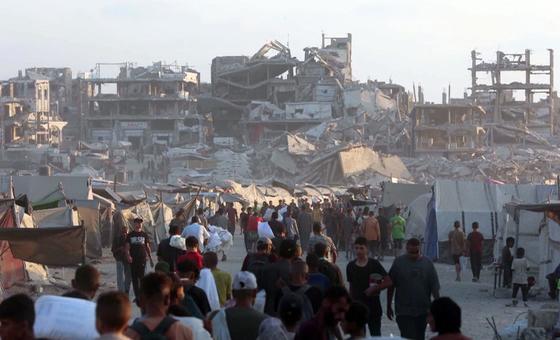
“A complete military takeover of the occupied Gaza Strip must be immediately halted,” insisted Volker Türk, UN High Commissioner for Human Rights, after the Israeli security cabinet approved a plan for a full-scale Israeli military takeover in the battered enclave.

The development runs contrary to international law, Mr. Türk continued, referring to a ruling of the International Court of Justice that Israel must end its occupation and achieve a two-State solution giving Palestinians the right to self-determination.

Any further escalation of the conflict between Hamas and Israel that has devastated Gaza and killed tens of thousands “will result in more massive forced displacement, more killing, more unbearable suffering, senseless destruction and atrocity crimes”, the UN rights chief said.

Aid access call

In a short statement, Mr. Türk insisted that rather than intensifying the conflict, “the Israeli Government should put all its efforts into saving the lives of Gaza’s civilians by allowing the full, unfettered flow of humanitarian aid”.

At the same time, all hostages must be immediately and unconditionally released by Palestinian armed groups, he continued, adding that Palestinians arbitrarily detained by Israel must also also be released.

“The war in Gaza must end now. And Israelis and Palestinians must be allowed to live side by side in peace,” the High Commissioner said.

Little change in dire aid situation 

Since war erupted in Gaza after Hamas-led deadly terror attacks in Israel in October 2023, aid agencies have warned repeatedly that Israeli bombardment, mass evacuation orders and relief restrictions have created a humanitarian catastrophe.

Even UN staff who are still working in the enclave report being unable to find enough to eat, according to the UN agency for Palestinian refugees, UNRWA. Despite Israel’s 27 July announcement of daily military pauses in western Gaza “to improve humanitarian responses”, far too little aid is getting through, humanitarians insist. 

According to the UN human rights office, OHCHR, since 27 May, at least 1,373 Palestinians have been killed while seeking food; 859 in the vicinity of the non-UN aid distribution organization the Gaza Humanitarian Foundation (GHF); another 514 victims died along the routes of food convoys.

Echoing widespread concerns for the people of Gaza, the head of the UN World Health Organization (WHO), warned that other Gazans have only limited access to basic services and food, while malnutrition is widespread and hunger-related deaths are rising.

“In July, nearly 12,000 children under five years were identified as suffering from acute malnutrition, the highest monthly figure ever recorded,” said Tedros Adhanom Ghebreyesus.

In comments to journalists on Thursday, the WHO chief said that so far this year, 99 people have died from malnutrition, including 29 children under five, adding that these reported numbers are likely underestimates. 
Source link

Tobacco control efforts protect three-quarters of the world’s population, WHO report finds

The World Health Organization (WHO) published its 2025 report on the Global Tobacco Epidemic on Monday, focusing on the six policies outlined in the WHO MPOWER tobacco control measures.

Since 2007, 155 countries have implemented at least one of those policy prescriptions which has resulted in over 6.1 billion people – that’s three-quarters of the world’s population – now benefitting: however, major gaps still remain.

Here are the six policy recommendations: 

  • Monitoring tobacco use and prevention policies;
  • Protecting people from tobacco smoke with smoke-free air legislation;
  • Offering help to quit tobacco use;
  • Warning about the dangers of tobacco with pack labels and mass media;
  • Enforcing bans on tobacco advertising, promotion and sponsorship; and
  • Raising taxes on tobacco.

Striking Gains

Some 110 countries now require graphic health warnings on tobacco packaging and WHO’s new report reveals the strategy has delivered striking gains in the fight against consumption.

As one of the key measures under the WHO Framework Convention on Tobacco Control (FCTC), graphic health warnings make the harms of tobacco visibly clear and difficult to ignore.

There has also been a growing trend to regulate the use of e-cigarettes or ENDS – Electronic Nicotine Delivery Systems – with the number of countries regulating or banning ENDS increasing from 122 in 2022, to 133 in 2024.

Major Gaps

Although very effective, 110 countries have failed to launch any anti-tobacco campaigns since 2022, despite the grim statistic that around 1.3 million people continue to die from second-hand smoke every year.

Forty countries still have not adopted a single MPOWER measure and over 30 countries are still allowing cigarette sales without mandatory health warnings. The UN health agency is calling for urgent action in areas where momentum is lagging.

Government must act boldly to close remaining gaps, strengthen enforcement, and invest in the proven tools that save lives,” said Ruediger Krech, WHO’s Director of Health Promotion. 

‘A fire no one can control’: UN warns of spiralling Iran-Israel war

In an address to the UN Security Council on Friday, Mr. Guterres made an urgent plea for de-escalation, calling the spiralling confrontation a defining moment for the future of global security.

We are not drifting toward crisis – we are racing toward it,” he said.

“This is a moment that could shape the fate of nations…the expansion of this conflict could ignite a fire no one can control,” he warned.

Widespread panic, destruction

The Secretary-General’s remarks came amid a mounting civilian toll in both Israel and Iran, and as several nuclear sites in Iran have come under direct military assault.

Over 100 targets have been struck across Iran, including military and nuclear infrastructure such as the Natanz and Isfahan nuclear facilities and the Khondab heavy water reactor.

Iranian officials report over 224 civilian deaths, with some estimates twice as high. More than 2,500 have been injured reportedly – while major cities like Tehran have seen mass displacements, fuel shortages and widespread panic.

Iran has responded with its own barrage of missile strikes on Israel, hitting cities such as Tel Aviv, Haifa and Beersheba. Critical civilian sites, including the Soroka Medical Center and the Weizmann research institute, have been damaged. Twenty-four Israelis are confirmed dead, with more than 900 injured.

Give peace a chance

Mr. Guterres urged both parties to give diplomacy a chance, reiterating the need for full Iranian cooperation with the UN nuclear energy watchdog, IAEA, and warning that the “only thing predictable about this conflict is its unpredictability.”

He also called for unity within the Security Council and adherence to the UN Charter.

“The Non-Proliferation Treaty is a cornerstone of international security,” he said. “Iran must respect it. But the only way to bridge the trust gap is through diplomacy – not destruction.”

A wide view of the Security Council meeting on the Israel-Iran crisis.

Regional fallout expanding

Rosemary DiCarlo, UN Under-Secretary-General for political affairs, echoed those concerns, providing a grim overview of the violence and rising human toll.

“The vast majority are civilians,” she said, warning of a “humanitarian crisis in real time.”

The regional fallout is expanding, with airspace restrictions now spanning Lebanon to Iraq. Missiles from Yemen’s Houthi forces have targeted Israel and occupied Palestinian territory, while armed groups in Iraq are reportedly mobilizing.

“Any further expansion of the conflict could have enormous consequences for international peace and security,” Ms. DiCarlo cautioned.

She also highlighted global economic implications, noting that trade through the vital Strait of Hormuz has fallen 15 per cent amid rising tensions.

Grave warnings on nuclear safety

The most alarming update, however, came from IAEA Director General Rafael Grossi, who warned the Council that Israeli attacks on Iranian nuclear facilities are degrading critical safety systems and placing millions at potential radiological risk.

At Natanz, the destruction of electricity infrastructure and direct strikes on enrichment halls have led to internal contamination. While no radiological release has been detected outside the facility, Mr. Grossi warned that uranium compounds now pose significant health hazards within.

At Isfahan, multiple buildings – including a uranium conversion plant and a metal processing facility – were hit. At Arak’s Khondab reactor site, damage was sustained, though the facility was not operational.

The greatest risk, however, is the Bushehr Nuclear Power Plant, which remains operational.

A direct strike, Mr. Grossi warned, “could result in a high release of radioactivity to the environment.”

Millions at risk

Even disruption of its external power supply could lead to a core meltdown. In the worst-case scenario, radiation would affect populations hundreds of kilometres away and require mass evacuations.

Mr. Grossi also warned against any attack on the Tehran Nuclear Research Reactor, which could endanger millions in the capital.

Nuclear facilities and material must not be shrouded by the fog of war,” he said. “We must maintain communication, transparency and restraint.

Pledge to stay

Concluding his briefing, Mr. Grossi pledged that the IAEA would continue to monitor and report on nuclear safety conditions in Iran and reiterated his readiness to mediate.

He stressed the agency “can guarantee, through a watertight inspections system,” that nuclear weapons will not be developed in Iran, urging dialogue.

“The alternative is a protracted conflict – and a looming nuclear threat that would erode the global non-proliferation regime.”

From border control to belonging: How host communities gain from empowering refugees

In 2024, 122 million people were forcibly displaced — a number expected to rise in the coming years, according to Bob Rae, President of the UN Economic and Social Council (ECOSOC), addressing a meeting on the pressing issue in New York on Thursday.

As population movements become much more complex due to wars disproportionately impacting civilians, climate disasters, hunger and poverty, 70 per cent of refugees live in low to middle-income countries.

Refugee rights

International responses to refugee flows are becoming increasingly politicised, especially as aid is decreasing.

Rather than focusing on addressing the root causes of such crises, the Global North has focused on border management and the control of refugee flows, “often at the expense of the rights of people on the move,” Filippo Grandi, Head of the UN refugee agency (UNHCR) told the ECOSOC gathering.

According to Mr. Grandi, although border management is an important aspect of national government response to the refugee crisis, the emphasis should rather be on making refugees feel more integrated within host communities.

Inclusion of refugees translates to freedom of movement, access to basic services such as healthcare, education, work opportunities, and valid documentation that allows them to work and contribute.

Representatives from Colombia and Mauritania joined a meeting convened by Mr. Rae to talk about better ways to help refugees and the communities that host them, while also finding long-term solutions to the forced displacement crisis.

Both Colombia and Mauritania have welcomed thousands of refugees into their countries, and outlined the positive impact refugees have had on their countries.

Temporary Protection Status in Colombia

In 2021, Colombia adopted a Temporary Protection Status (TPS) programme for Venezuelan refugees.

Today, 2.5 million Venezuelans in Colombia have valid documentation, which provides them access to public services, legal employment, and education.

TPS has not only allowed them to regain dignity and security, but it has also helped Colombia regulate refugee flows.

Human rights at the fore in Mauritania

For over a decade, Mauritania has been hosting large numbers of refugees, most of them from neighbouring Mali.

Committed to upholding the human rights of both refugees and host communities, Mauritania recognises refugees as citizens, providing them with the right to education, healthcare, employment, and legal protection.

Mauritania is working to improve refugee livelihoods while simultaneously enhancing the capacity of host communities by emphasising the role refugees have in local development.

By investing in the resilience of host communities and social cohesion, Mauritania ensures both refugees and host communities live in dignity.

Source link