More than 20 heads of state and government and some 3,000 delegates from international organizations, civil society, youth, academia and the private sector are expected to attend the conference.
UN News is on the ground in Awaza, reporting on the event as it unfolds.
At the flag-raising, Foreign Minister Rashid Meredov formally welcomed participants. “Welcome to Awaza. I wish all participants success in the Conference,” he said.
UN High Representative Rabab Fatima expressed hope that the gathering would help “strengthen and expand partnerships among nations.”
Shared challenges and solutions
The opening ceremony, on Tuesday, will be attended by UN Secretary-General António Guterres, arriving from Almaty, Kazakhstan, where he spoke at the new Centre for Sustainable Development Goals for Central Asia and Afghanistan.

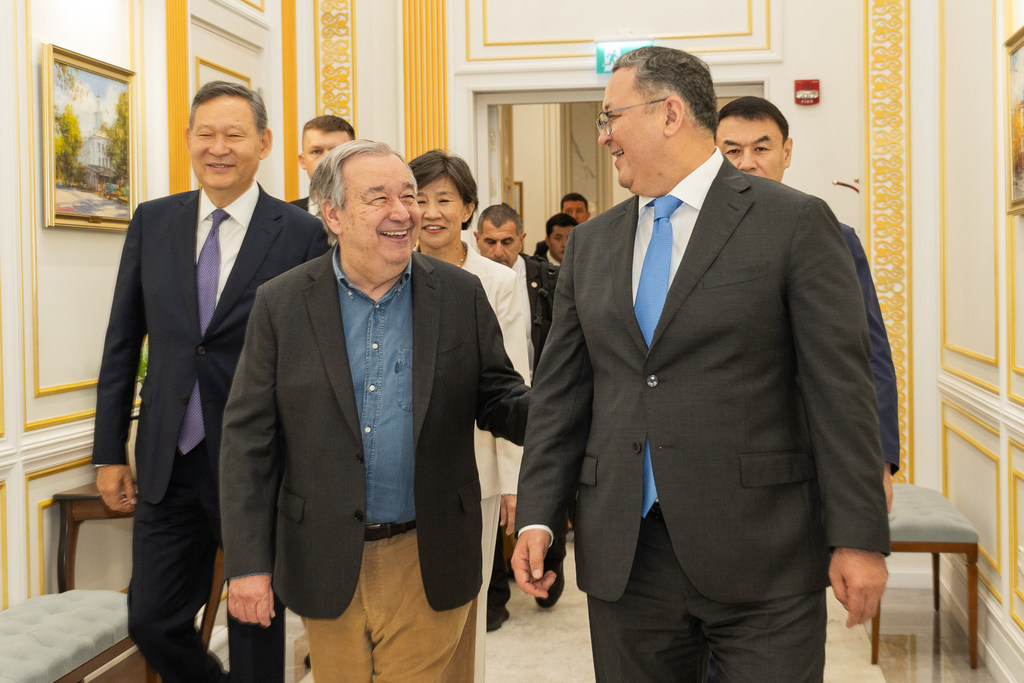
UN Secretary-General António Guterres (centre), alongside Deputy Prime Minister and Minister of Foreign Affairs Murat Nurtleu (left), and Permanent Representative of Kazakhstan to the UN Kairat Umarov (right), arriving in Almaty, Kazakhstan.
“This Centre symbolizes the new era of cooperation in Central Asia – grounded in shared priorities and solutions,” he said.
Warning of “complex and interlinked challenges” including stalled poverty reduction, rising hunger and accelerating climate impacts, he stressed that Central Asia is already experiencing melting glaciers, shrinking water supplies and growing trade barriers.
The Centre, he added, can become “a vital pioneer” for implementing the Programme of Action for Landlocked Developing Countries, turning geographic constraints into opportunities through regional cooperation.
A city transformed
Awaza, a national tourist zone on Turkmenistan’s Caspian coast, has been transformed into a global forum.
Final deliveries of water stations, security scanners, screens and technical equipment continued Sunday at the large sports complex-turned-conference venue. UN technical staff and local teams worked around the clock to set up cameras, plenary halls and logistics for dozens of side events.
“A massive preparatory effort has been carried out jointly with the UN to create the necessary conditions for delegates and all participants,” said Aksoltan Atayeva, Turkmenistan’s Permanent Representative to the UN. “We take our responsibility seriously and are doing everything possible to ensure the best conditions and successful work.”

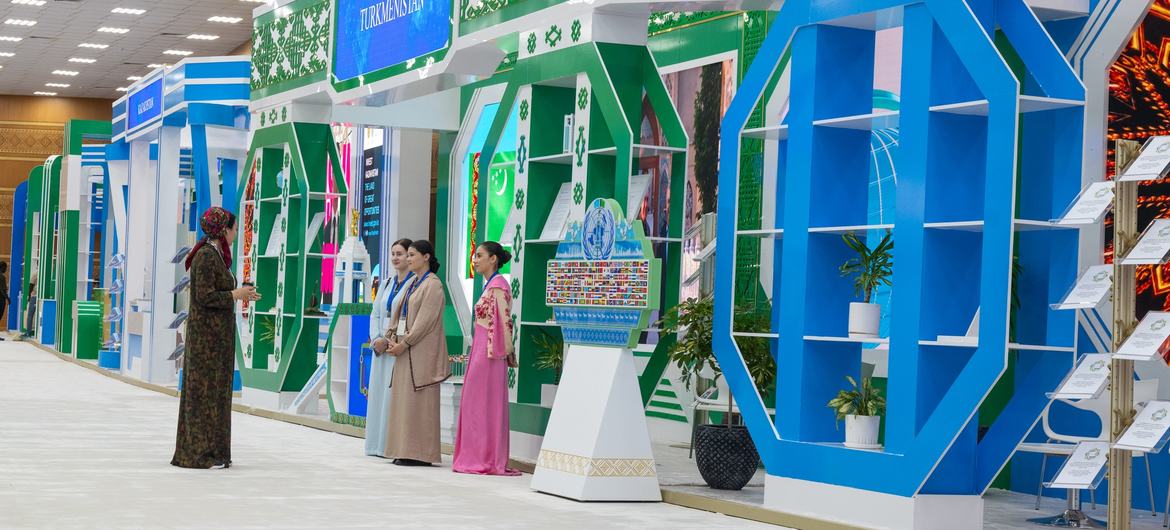
Final preparations being made at the venue of the LLDC3 conference in Awaza, Turkmenistan.
Beyond meetings
In a nearby pavilion, countries prepared exhibitions highlighting progress in transport, energy and communications.
“The Kazakhstan-Turkmenistan-Iran railway and the Turkmenistan-Afghanistan-Pakistan-India gas pipeline are among the key projects,” Annaberdi Kashanov at the Turkmenistan pavilion, told UN News.
There are 32 landlocked developing countries worldwide, home to over 500 million people. Many are also among the world’s least developed countries, facing structural challenges such as high transport costs, limited market access and vulnerability to climate shocks.
Robust infrastructure and improved connectivity remain critical to overcoming these barriers, facilitating trade and integration into global markets.
The LLDC3 conference aims to promote global partnerships to accelerate inclusive and sustainable development.