From shelter to strength: How disaster refuges protect lives in Palau

Palau’s biodiversity is threatened by rising sea levels.

Climate change, a personal issue

For Techitong, these climate related hazards are deeply personal.

“I fear the places I grew up in might be underwater in the next decades,” he said. “I don’t want future generations to only hear stories about what Palau used to be. That’s what drives me.”

Today, he works with the International Organization for Migration (IOM) in Palau alongside the National Emergency Management Office (NEMO), overseeing the strengthening of climate-resilient disaster shelters across the country.

Techitong visits one of the IOM-supported disaster shelters.

Strengthening national resilience

Techitong’s work is part of a broader effort by the United Nations to support Palau’s resilience to the adverse effects of extreme weather events through an integrated, long-term approach.

The UN works alongside the Government of Palau and civil society across four interconnected pillars: People, planet, prosperity, and peace.

Building community resilience to extreme weather events and strengthening disaster risk reduction cuts across all four of these pillars, as resilience is not only environmental, but also social, economic and institutional.

The shelters Techitong oversees put this vision into practice.

Techitong speaks to one of the construction workers building shelters.

The shelters are designed to function as a connected national network of safe spaces accessible to all people during emergencies.

Built to withstand high winds, heavy rainfall and flooding, they will be equipped with typhoon shutters, rainwater catchment systems, solar lighting, generators, and water filtration systems.

Four out of the eight shelters have already been strengthened and handed over to the community in Palau.

“The strengthened shelters consider the needs of persons with disabilities and other vulnerable people, so no one is left behind during emergencies,” said Alex Iyar, a community member involved in the consultations that led to the development of this project.

Beyond infrastructure, the project is strengthening local capacity. Community-based Red Cross Disaster Action Teams are being trained to manage shelters before, during and after emergencies, reinforcing local leadership and ownership.

It gives me hope that my children still be able to enjoy the best parts of Palau that I grew up with.

Addressing displacement risk and protecting social cohesion

Across the Pacific, climate displacement is increasingly common. According to IOM data on global displacement trends, weather-related disasters have triggered hundreds of millions of internal displacements over the past decade.

Disaster events are fundamentally reshaping patterns of mobility worldwide, disproportionately affecting small island States like Palau.

While disaster shelters cannot stop the sea from rising, they can buy time, protect lives and help communities remain rooted for as long as possible.

For Di Maech, a local Palauan conservation worker, this matters deeply. “In Palau, our communities are learning, growing, and finding ways to be resilient in the face of disasters thanks to UN-supported projects.

“It gives me hope that my children still be able to enjoy the best parts of Palau that I grew up with.”

UN Micronesia/Carlota Nunez

Di Maech is a Palauan conservation worker.

Investing in youth leadership

IOM’s Techitong believes the shelters are central to national resilience. “These shelters are not just emergency refuges, they are community hubs that support preparedness, connection and adaptation,” he said.

Techitong still swims in the ocean when he can. The water remains beautiful, powerful and deeply familiar, even as it carries new uncertainty.

“I grew up learning how to move with the waves,” he says. “Now my work is about making sure our communities can do the same. Adapt, protect each other, and keep Palau standing.”

UN Micronesia/Carlota Nunez

Young Palauans play volleyball in Kuabes park, an area that could be underwater in the next 30 years.

World Court says countries are legally obligated to curb emissions, protect climate

The UN’s principal judicial body ruled that States have an obligation to protect the environment from greenhouse gas (GHG) emissions and act with due diligence and cooperation to fulfill this obligation.  

This includes the obligation under the Paris Agreement on climate change to limit global warming to 1.5°C above pre-industrial levels.  

The court further ruled that if States breach these obligations, they incur legal responsibility and may be required to cease the wrongful conduct, offer guarantees of non-repetition and make full reparation depending on the circumstances. 

‘A victory for our planet’

UN Secretary-General António Guterres issued a video message welcoming the historic decision, which came a day after he delivered a special address to Member States on the unstoppable global shift to renewable energy. 

“This is a victory for our planet, for climate justice and for the power of young people to make a difference,” he said.

Reasoning of the Court

The court used Member States’ commitments to both environmental and human rights treaties to justify this decision.  

Firstly, Member States are parties to a variety of environmental treaties, including ozone layer treaties, the Biodiversity Convention, the Kyoto Protocol, the Paris Agreement and many more, which oblige them to protect the environment for people worldwide and in future generations.  

But, also because “a clean, healthy and sustainable environment is a precondition for the enjoyment of many human rights,” since Member States are parties to numerous human rights treaties, including the UN’s Universal Declaration of Human Rights, they are required to guarantee the enjoyment of such rights by addressing climate change.  

Case background

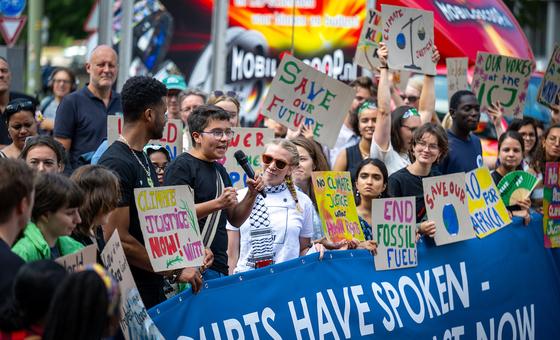
In September 2021, the Pacific Island State of Vanuatu announced that it would seek an advisory opinion from the court on climate change. This initiative was inspired by the youth group Pacific Island Students Fighting Climate Change, which underscored the need to act to address climate change, particularly in small island States.

After the country lobbied other UN Member States to support this initiative in the General Assembly, on 29 March 2023, it adopted a resolution requesting an advisory opinion from the ICJ on two questions: (1) What are the obligations of States under international law to ensure the protection of the environment? and (2) What are the legal consequences for States under these obligations when they cause harm to the environment?

The UN Charter allows the General Assembly or the Security Council to request the ICJ to provide an advisory opinion. Even though advisory opinions are not binding, they carry significant legal and moral authority and help clarify and develop international law by defining States’ legal obligations.

This is the largest case ever seen by the ICJ, evident by the number of written statements (91) and States that participated in oral proceedings (97).

The ‘world court’

The ICJ, informally known as the “world court”, settles legal disputes between UN Member States and gives advisory opinions on legal questions that have been referred to it by UN organs and agencies.

It is one of the six main organs of the UN alongside the General Assembly, the Security Council, the Economic and Social Council (ECOSOC), the Trusteeship Council and the Secretariat and is the only one not based in New York. 

Responsibility to Protect: An unfulfilled promise, a ray of hope

Addressing the General Assembly, António Guterres said that the world is witnessing more armed conflicts than at any time since the end of the Second World War.

Too often, early warnings go unheeded, and alleged evidence of crimes committed by States and non-State actors are met with denial, indifference, or repression,” he told Member States on Wednesday.  

“Responses are often too little, too late, inconsistent, or undermined by double standards. Civilians are paying the highest price.”

The pledge

The Secretary-General’s address marked two decades since the 2005 World Summit, where global leaders made an unprecedented commitment to protect populations from the atrocity crimes of genocide, war crimes, ethnic cleansing, and crimes against humanity.

Known as the Responsibility to Protect, or R2P, the pledge affirmed that sovereignty carries not just rights, but responsibilities – foremost among them, the duty of every State to safeguard its own people.

When national authorities manifestly fail to do so, the international community has a duty to act – collectively, timely and decisively – in accordance with the UN Charter.

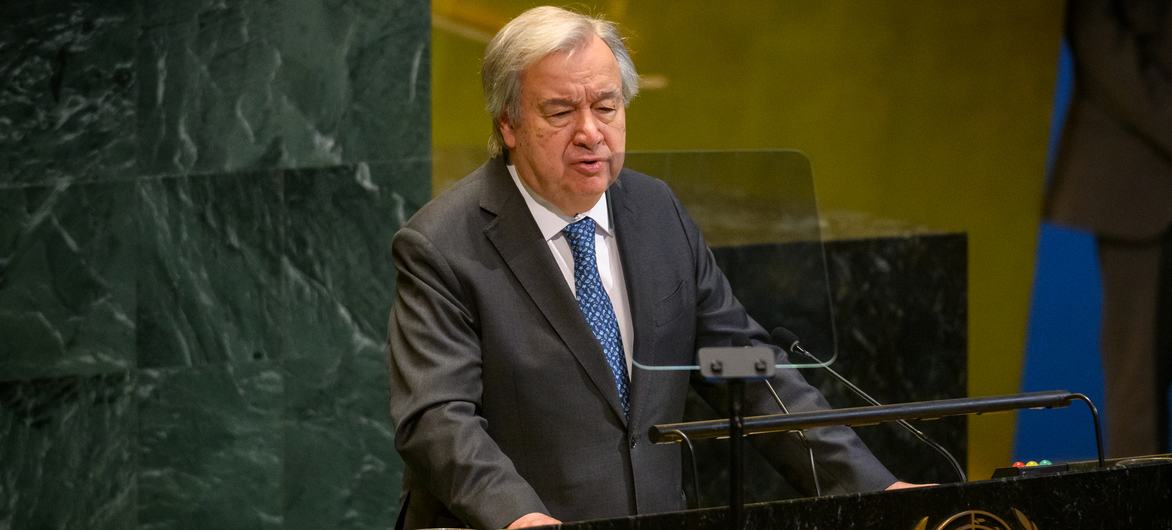
Secretary-General António Guterres addresses the UN General Assembly meeting on the responsibility to protect and the prevention of genocide, war crimes, ethnic cleansing, and crimes against humanity.

An unfulfilled promise

“Two decades on, the Responsibility to Protect remains both an urgent necessity, a moral imperative and an unfulfilled promise,” he said.

He cited worsening identity-based violence, deepening impunity, and the weaponization of new technologies as compounding threats to populations around the world.

“No society is immune from the risk of atrocity crimes,” Mr. Guterres continued.  

A ray of hope

The Secretary-General also presented his latest report on the Responsibility to Protect, reflecting on two decades of progress and persistent challenges. It draws on a global survey showing that the principle still enjoys broad support – not only among Member States, but also among communities affected by violence.

Communities see it [R2P] as a ray of hope,” he said, “but they also call for effective implementation at all levels.

Mr. Guterres emphasised that prevention must begin at home: with inclusive leadership, the protection of human rights and the rule of law. And it must be supported worldwide through multilateral cooperation and principled diplomacy.

No society is immune from the risk of atrocity crimes,” he said.  

“[Prevention] must be supported globally – through multilateral cooperation, principled diplomacy, and early and decisive action to effectively protect populations.”

UN Photo/Paulo Filgueiras

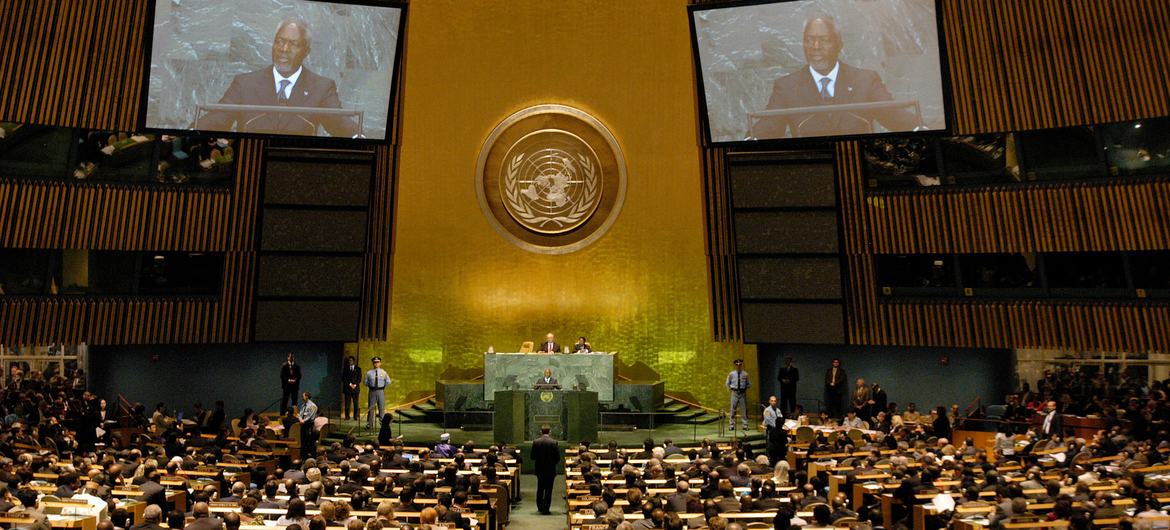
In September 2005, heads of states and governments from around the world gathered at the UN Headquarters for the World Summit.

Flashback: 2005 World Summit and the birth of R2P

The Responsibility to Protect was adopted by consensus at the 2005 World Summit – at the time, the largest-ever gathering of heads of state and government. The Summit also established the Peacebuilding Commission to support post-conflict recovery and the Human Rights Council to uphold human rights.

The R2P principle is built on three pillars: the State’s responsibility to protect its population; the international community’s role in assisting States in this effort; and the duty to take collective action when States manifestly fail to protect their people.

Since its adoption, R2P has helped shape international responses to atrocity crimes, guided UN operations, and informed preventive efforts through national, regional, and multilateral mechanisms.

Keep the promise

Yet the gap between principle and practice remains a central concern – one the Secretary-General is urging the international community to close.

Let us keep the promise,” Mr. Guterres said. “Let us move forward with resolve, unity, and the courage to act.

Source link

Tobacco control efforts protect three-quarters of the world’s population, WHO report finds

The World Health Organization (WHO) published its 2025 report on the Global Tobacco Epidemic on Monday, focusing on the six policies outlined in the WHO MPOWER tobacco control measures.

Since 2007, 155 countries have implemented at least one of those policy prescriptions which has resulted in over 6.1 billion people – that’s three-quarters of the world’s population – now benefitting: however, major gaps still remain.

Here are the six policy recommendations: 

  • Monitoring tobacco use and prevention policies;
  • Protecting people from tobacco smoke with smoke-free air legislation;
  • Offering help to quit tobacco use;
  • Warning about the dangers of tobacco with pack labels and mass media;
  • Enforcing bans on tobacco advertising, promotion and sponsorship; and
  • Raising taxes on tobacco.

Striking Gains

Some 110 countries now require graphic health warnings on tobacco packaging and WHO’s new report reveals the strategy has delivered striking gains in the fight against consumption.

As one of the key measures under the WHO Framework Convention on Tobacco Control (FCTC), graphic health warnings make the harms of tobacco visibly clear and difficult to ignore.

There has also been a growing trend to regulate the use of e-cigarettes or ENDS – Electronic Nicotine Delivery Systems – with the number of countries regulating or banning ENDS increasing from 122 in 2022, to 133 in 2024.

Major Gaps

Although very effective, 110 countries have failed to launch any anti-tobacco campaigns since 2022, despite the grim statistic that around 1.3 million people continue to die from second-hand smoke every year.

Forty countries still have not adopted a single MPOWER measure and over 30 countries are still allowing cigarette sales without mandatory health warnings. The UN health agency is calling for urgent action in areas where momentum is lagging.

Government must act boldly to close remaining gaps, strengthen enforcement, and invest in the proven tools that save lives,” said Ruediger Krech, WHO’s Director of Health Promotion.