Mandela’s legacy ‘is now our responsibility’, Guterres says on International Day

In his remarks, the Secretary-General celebrated the extraordinary life of the South African civil rights icon, affectionately known by his Khosa clan name, Madiba.

“He endured the brutal weight of oppression, and emerged not with a vision of vengeance and division – but of reconciliation, peace and unity,” Mr. Guterres said.

“Today, Madiba’s legacy is now our responsibility. We must carry forward his commitment to peace, justice and human dignity.”

To honour this legacy, the UN chief awarded the annual Nelson Mandela Prize to two individuals who reflect the late leader’s commitment to peace and collective action, and this year’s theme of combating poverty and inequity: Brenda Reynolds of Canada and Kennedy Odede of Kenya. 

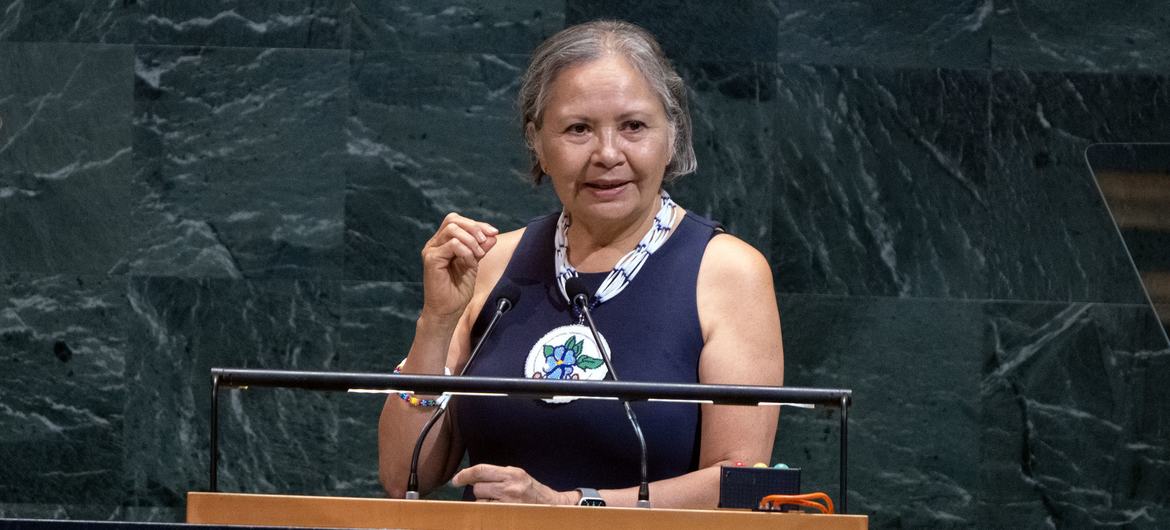
Brenda Reynolds, Nelson Mandela Prize awardee, speaks in the UN General Assembly hall on the observance of the annual Nelson Mandela International Day.

Brenda Reynolds: turning pain into action

Brenda Reynolds is a Saulteaux member from Fishing Lake First Nation in Canada, and as a social worker she has spent decades advancing Indigenous rights, mental health and trauma-informed care.

“There are many parallels to what we had experienced in both our countries, where the governments made impacted policies to change who we are, to face oppression, to face violations of human rights in our countries,” Ms. Reynolds said in her acceptance speech.

In 1988, she supported 17 teenage girls in the first residential school sexual abuse case in Saskatchewan. 

“These charges were the beginning of other disclosures that came from across Canada from survivors speaking about their sexual abuse experiences. Those charges and the disclosures became the largest class action lawsuit to date in Canada,” known as Canada’s Indian Residential Schools Settlement Agreement, she explained.

Afterwards, she became a special adviser to the Truth and Reconciliation Commission and developed the Indian Residential School Resolution Health Support Program – both created by the agreement – helping shape survivor support and trauma responses nationwide.
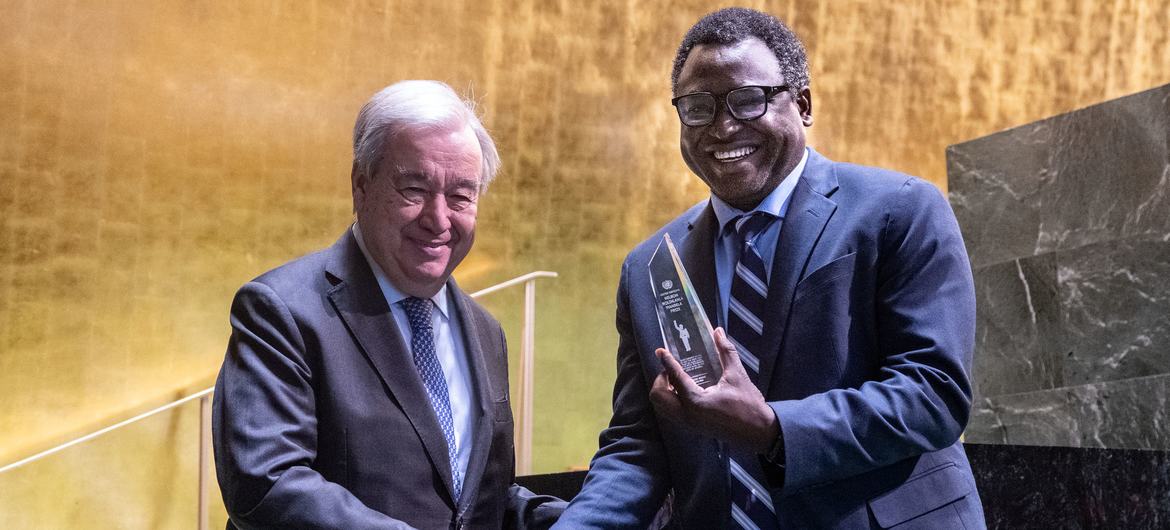
Secretary-General António Guterres (left) with Nelson Mandela Prize awardee Kennedy Odede of Kenya at the informal meeting on the observance of the annual Nelson Mandela International Day.

Kennedy Odede: from slums to CEO

After growing up in Kenya’s Kibera Slum, Kennedy Odede went from living on the street to global recognition when he was named one of TIME magazine’s 2024 100 Most Influential People and became a New York Times bestselling author.

“At ten years old, fleeing domestic violence, I joined the ranks of Nairobi’s street children. One day I stole a mango because I was starving. A mob gathered to beat me dead, until a stranger stepped forward, paid for that mango, and in that single act of grace, showed me that kindness could interrupt cycles of violence,” Mr. Odede recounted in his acceptance speech.

He began his journey as an activist by saving his meagre factory earnings to buy a soccer ball and bring his community together. 

“That ball was not just for play; it was a tool for organising. A centre around which a community could form,” he said. 

This soon grew into Shining Hope for Communities (SHOFCO), the largest grassroots movement in Kenya he now leads as CEO. SHOFCO operates across the country, empowering local groups and delivering vital services to over 4 million people annually.

“Mandela showed all of us at SHOFCO, that leadership is not a privilege reserved for those born to power. It belongs to anyone willing to serve and look within.” 
Source link

Responsibility to Protect: An unfulfilled promise, a ray of hope

Addressing the General Assembly, António Guterres said that the world is witnessing more armed conflicts than at any time since the end of the Second World War.

Too often, early warnings go unheeded, and alleged evidence of crimes committed by States and non-State actors are met with denial, indifference, or repression,” he told Member States on Wednesday.  

“Responses are often too little, too late, inconsistent, or undermined by double standards. Civilians are paying the highest price.”

The pledge

The Secretary-General’s address marked two decades since the 2005 World Summit, where global leaders made an unprecedented commitment to protect populations from the atrocity crimes of genocide, war crimes, ethnic cleansing, and crimes against humanity.

Known as the Responsibility to Protect, or R2P, the pledge affirmed that sovereignty carries not just rights, but responsibilities – foremost among them, the duty of every State to safeguard its own people.

When national authorities manifestly fail to do so, the international community has a duty to act – collectively, timely and decisively – in accordance with the UN Charter.

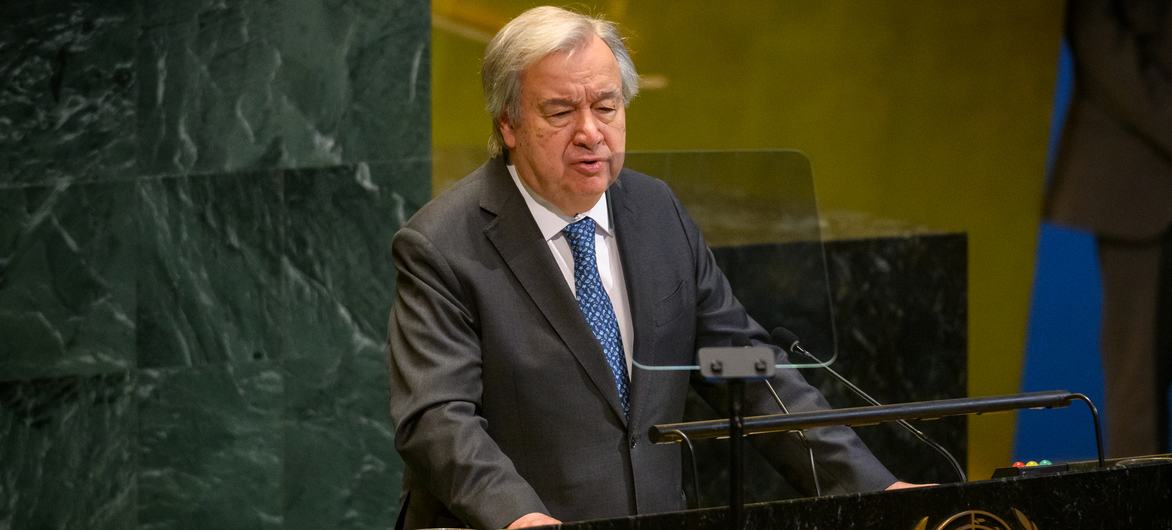
Secretary-General António Guterres addresses the UN General Assembly meeting on the responsibility to protect and the prevention of genocide, war crimes, ethnic cleansing, and crimes against humanity.

An unfulfilled promise

“Two decades on, the Responsibility to Protect remains both an urgent necessity, a moral imperative and an unfulfilled promise,” he said.

He cited worsening identity-based violence, deepening impunity, and the weaponization of new technologies as compounding threats to populations around the world.

“No society is immune from the risk of atrocity crimes,” Mr. Guterres continued.  

A ray of hope

The Secretary-General also presented his latest report on the Responsibility to Protect, reflecting on two decades of progress and persistent challenges. It draws on a global survey showing that the principle still enjoys broad support – not only among Member States, but also among communities affected by violence.

Communities see it [R2P] as a ray of hope,” he said, “but they also call for effective implementation at all levels.

Mr. Guterres emphasised that prevention must begin at home: with inclusive leadership, the protection of human rights and the rule of law. And it must be supported worldwide through multilateral cooperation and principled diplomacy.

No society is immune from the risk of atrocity crimes,” he said.  

“[Prevention] must be supported globally – through multilateral cooperation, principled diplomacy, and early and decisive action to effectively protect populations.”

UN Photo/Paulo Filgueiras

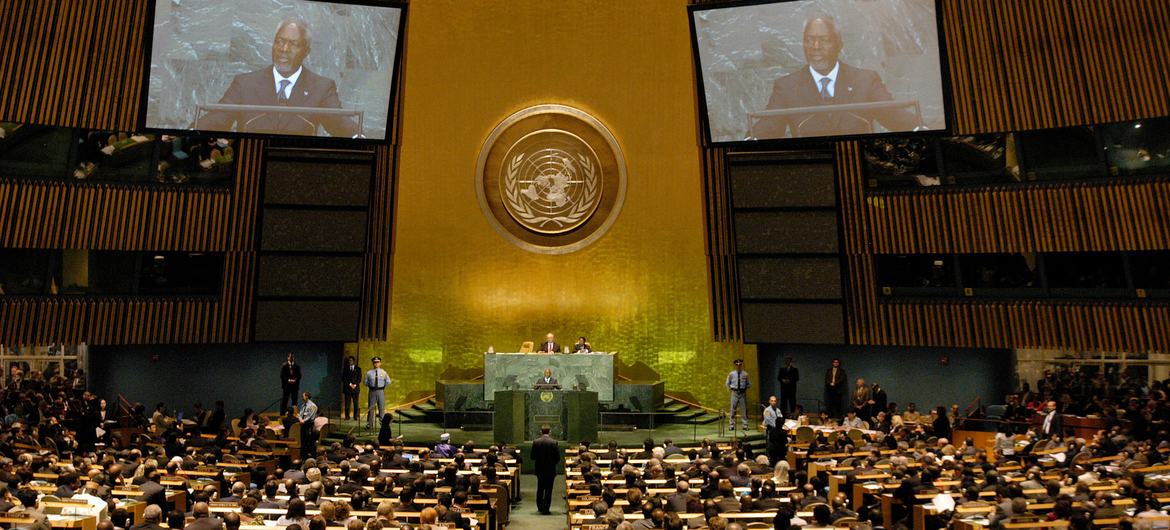
In September 2005, heads of states and governments from around the world gathered at the UN Headquarters for the World Summit.

Flashback: 2005 World Summit and the birth of R2P

The Responsibility to Protect was adopted by consensus at the 2005 World Summit – at the time, the largest-ever gathering of heads of state and government. The Summit also established the Peacebuilding Commission to support post-conflict recovery and the Human Rights Council to uphold human rights.

The R2P principle is built on three pillars: the State’s responsibility to protect its population; the international community’s role in assisting States in this effort; and the duty to take collective action when States manifestly fail to protect their people.

Since its adoption, R2P has helped shape international responses to atrocity crimes, guided UN operations, and informed preventive efforts through national, regional, and multilateral mechanisms.

Keep the promise

Yet the gap between principle and practice remains a central concern – one the Secretary-General is urging the international community to close.

Let us keep the promise,” Mr. Guterres said. “Let us move forward with resolve, unity, and the courage to act.

Source link