Gaza reconstruction talks must not distract from massive needs, say UN aid agencies

Briefing journalists, Juliette Touma, Director of Communications at UNOPS, the United Nations Office for Project Services highlighted that although the 3 October ceasefire agreement had brought some respite to families, “people continue to be killed, day in, day out”.

“It’s absolutely critical to unlock the congestion…at crossing points and to reopen critical lifelines like the Jordan corridor,” said Touma.

She said that Gaza’s highly vulnerable people simply “cannot wait” for a reconstruction plan to take shape – one of the stated aims of the US-led Board of Peace. “They need supplies at the same time, it’s not just the services,” she stressed.

UNRWA commitment

Echoing those concerns, the UN agency for Palestinians, UNRWA, underscored its key and longstanding role in the Occupied Palestinian Territories, including Gaza. This mission was entrusted to UNRWA by UN Member States at the global body’s General Assembly in December 1949.

“We are the largest United Nations agency operating in the Gaza Strip,” said Jonathan Fowler, UNRWA Senior Communications Manager. “We must be able to continue doing our work; that’s crystal clear.”

Board of Peace

While it has yet to be made clear exactly how the UN will support Board of Peace launched by President Trump at Davos on Thursday, last November’s Security Council resolution 2803 that welcomed its creation highlighted the importance of working with “cooperating organizations” including the United Nations.

“We are very strongly committed to do whatever we can to ensure the full implementation of Security Council Resolution 2803,” said Alessandra Vellucci, Director, UN Information Service, Geneva. “There is a role for the UN there about the UN leading on humanitarian aid delivery, which we have been doing for such a long time and we will continue to do the best of our capacities.”

Since Sunday, humanitarian partners providing emergency shelter assistance have reached over 13,000 households in Gaza, distributing hundreds of tents and thousands of tarpaulins, aid coordination office, OCHA, said in its latest update.

Gaza distribution obstacles remain

The UN office noted that “capacity and funding constraints” have limited support to only around 40 per cent of the existing 970 displacement sites across the Strip.

Healthcare needs remain enormous across Gaza, too, where providers such as UNRWA try to help around 15,000 patients a day, despite numerous challenges.

“We had 22 clinics operating across the Gaza Strip before the start of the war, we’re now down to half a dozen,” said Mr. Fowler. “And we have mobile health teams that operate, but in incredibly complicated circumstances.”

A number of UNRWA facilities are located behind the so-called Yellow Line – a series of concrete blocks installed by the Israeli authorities which separates Gazans from the Israel Defense Forces – envisaged in the three-step Gaza peace plan.

“That makes it incredibly difficult to do our work and so many of our locations have been heavily damaged or indeed completely destroyed,” Mr. Fowler continued. “On top of that, we remain banned by the Israeli authorities from bringing in any of our own supplies.”

UNRWA premises ‘stormed’

Turning to the destruction of UNRWA’s headquarters in East Jerusalem on Tuesday, Mr. Fowler described how visiting diplomats had been caught up in the dramatic events when Israeli forces “stormed and demolished” buildings in the compound and fired tear gas. “This is a United Nations compound, so this is an attack on the United Nations,” he told journalists.

Highlighting concerns that the UNRWA-supported Kalandia Training Centre could be shut down “within days”, Mr. Fowler explained that it principally helped lower-income families to earn the skills they needed to earn a living: “If the centre were to be forcibly closed – and we do fear that this could happen within days – there is no educational alternative for these students.”

The UN agency remains deeply worried about developments in the occupied West Bank, one year since the Israeli forces launched operation Iron Wall. “This led to the mass displacement of people from three camps in the north of the West Bank,” Mr. Fletcher explained, in reference to Jenin, Nur Shams and Tulkarem refugee settlements.

“The camps are progressively being demolished by the Israeli military. So therefore, changing the facts on the ground, changing the topography and the demography of these large communities,” Mr. Fowler insisted.

UN provides urgent support after ‘massive’ Russian attack across Ukraine

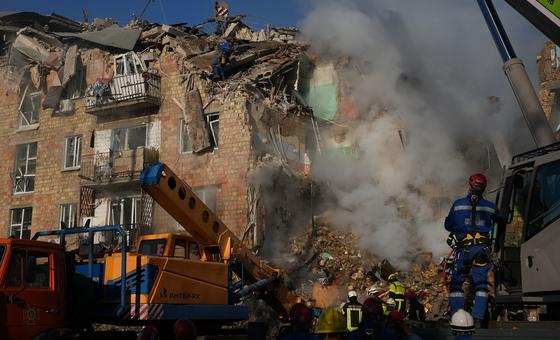
More than 800 drones were launched in waves designed to overwhelm Ukrainian air defences, according to news reports, and a Government building was hit in the capital Kyiv for the first time.

Ukrainian authorities reported that four had been killed, with 44 injured. Air-raid sirens continued for 11 hours straight across the capital and although a majority were shot down more than 50 drones and nine missiles hit their targets.

“Yet again, attacks impacted homes, a government building, a kindergarten and other civilian infrastructure in Kyiv and Chernihiv, Kharkiv, Kremenchuk, Kryvyi Rih, Odesa, Sumy region, Zaporizhzhia – leaving behind loss, destruction and grief,” said UN Humanitarian Coordinator for Ukraine, Matthias Schmale, in a post on social media.

The top aid official said that together with authorities, the UN and humanitarian partners had mobilised to provide urgent support to civilians and civilian areas where damage was sustained.

Civilians should never be a target

“Civilians and civilian infrastructure are protected under international humanitarian law – they are not a target,” he continued.

The UN Children’s Fund, UNICEF, said that the news of a baby being killed along with their young mother in an attack on an apartment building in Kyiv was “devastating”. At least one other child was injured during the attacks on Sumy.

“Ukraine endured another terrifying night of attacks that impacted multiple cities. More young lives brutally cut short,” the agency tweeted.

The attacks came following weeks of high profile diplomacy from Western allies of the Ukrainian Government to broker a lasting peace deal between Kyiv and Moscow.

President Volodymyr Zelenskyy said in a social media post following the attacks that “such killings now, when real diplomacy could have already begun long ago, are a deliberate crime and a prolongation of the war.”

Source link

The descent into ‘a massive famine’ in Gaza has begun, relief agencies warn

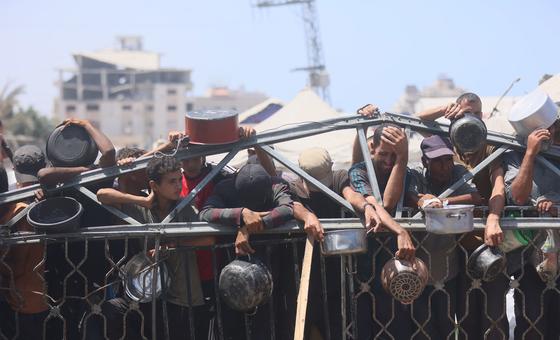
Although the private aid platform run by the US and Israeli-backed Gaza Humanitarian Foundation continues to receive its own supplies, “we are on a descent into a massive famine”, insisted Jens Laerke, spokesperson for the UN aid coordination office, OCHA, on Friday.

Referring to the latest catastrophic assessment of food insecurity in Gaza from the UN-backed IPC group of experts, Mr. Laerke noted that 500,000 people are in the worst possible situation today, with another 160,000 expected to be added to that number in the coming weeks.

Everyone lacks food

“They all need food,” he told journalists in Geneva. The entire Gaza Strip needs food. There would not have been declared famine had there been sufficient amounts of food.”

In a related development, the UN World Health Organization (WHO) highlighted the growing risk of communicable diseases in Gaza, with 94 suspected cases of Guillain-Barré Syndrome now reported.

The disease can cause paralysis and is treatable in hospital with intravenous immunoglobulin or plasma exchange, according to WHO. “But these two [treatments] are at zero stock, as are anti-inflammatories,” said WHO spokesperson Christian Lindmeier, referencing ongoing Israeli aid restrictions impacting humanitarian relief supplies entering Gaza. “These deliveries must be urgently expedited as much as surveillance and testing capabilities.”

Between 20 and 26 August, out of 89 attempts to coordinate relief missions with Israeli authorities across Gaza, 53 were facilitated, 23 were initially approved but then impeded on the ground, seven were denied and six had to be withdrawn by the organizers, OCHA said in an update.

More to come on this developing story…

Source link

Amid massive destruction of Gaza City, UN chief renews ceasefire call

“It is vital to reach immediately a ceasefire in Gaza,” the Secretary-General told reporters on the sidelines of the Ninth Tokyo International Conference on African Development (TICAD9), “and the unconditional release of all hostages and to avoid the massive death and destruction that a military operation against Gaza City would inevitably cause.

Around one million people still live in the city – Gaza’s largest – in the north of the war-torn enclave. The Israeli army has reportedly described it as a stronghold of Hamas, the terror group whose deadly attacks in Israel and hostage-taking sparked the war on 7 October 2023.

The UN chief also condemned the Israeli Government’s decision to approve a long-shelved settlement expansion project in the occupied West Bank.

The decision by the Israeli authorities to expand illegal settlement construction, which would divide the West Bank, must be reversed. All settlement construction is a violation of international law,” he insisted.

The settlement is believed to have permission for well over 3,000 houses, schools and a clinic, cutting off East Jerusalem from the occupied West Bank, which Israel captured during the 1967 Six-Day war after defeating Egypt, Jordan and Syria.

Urban destruction

Meanwhile in Gaza City, whole urban areas are being “totally destroyed”, the UN understands, with further destruction now underway in the south and southeast, as military manoeuvres continue.

Recent attacks have been particularly devastating in the Az Zaytoun neighbourhood of the city, the UN human rights office (OHCHRreported on Wednesday.

Highlighting more than 50 attacks on residential buildings and entire blocks in Gaza City since 8 August, OHCHR warned that its “systematic destruction” had begun.

Acute malnutrition soaring

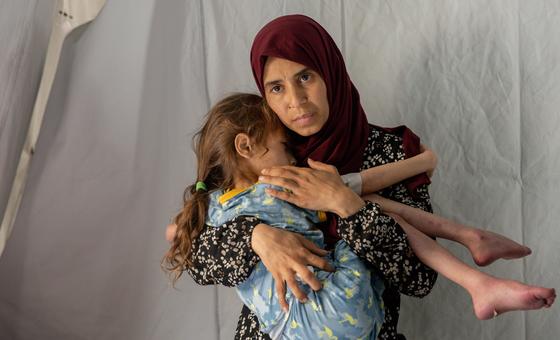
Meanwhile, UN aid teams highlighted the catastrophic impact of the accelerating Israeli military operation, with acute malnourishment soaring among children in Gaza City to 28.5 per cent, or more than one in four youngsters.

“Children continue to die from man-made starvation,” UNRWA said in a statement, noting that it has screened more than 95,000 children aged six months to five years for malnutrition across the Gaza Strip since March 2025, after the ceasefire collapsed.

While the ceasefire still held in early March and relief supplies were allowed into Gaza in far greater quantities than today, malnutrition rates were six times lower in Gaza City, at 4.5 per cent, according to the UN agency for Palestinians, UNRWA. 

Across Gaza, acute malnutrition rose to nearly 16 per cent in mid-August, more than three times higher than the 5.2 per cent level recorded by the UN agency in March, it said.

Vital services in danger

Today, services provided by UNRWA in Gaza City are at “severe risk”, the agency warned, pointing to the tens of thousands of people who still live in its shelters and the “many more” who remain in surrounding areas.

There is particular concern for UNRWA’s Gaza Field Office compound – its largest logistics hub in northern Gaza – as the UN agency’s operations in the south have been “crippled” by displacement orders and bombardment.

As an indication of UNRWA’s key role in aid and relief provision across Gaza, it noted that last month alone, it provided more than 100,000 medical consultations and screened 3,500 children for malnutrition in Gaza City.

UNRWA also delivered drinking water to 220,000 people, domestic water to 250,000 and cleared hundreds of tons of waste.

Education and protection specialists from the UN agency reached thousands more in temporary learning spaces or by offering counselling, recreational activities and risk awareness training about the dangers of lethal unexploded weapons.

“While our colleagues, like the rest of the UN, are determined to stay and deliver, all of these services are now at risk as the military operations intensify,” UNRWA said.


Source link

World News in Brief: ‘Massive’ needs in Sudan, DR Congo aid shortfall, support for Congolese refugees and Angola cholera relief

The UN estimates that in the past few weeks, over 330,000 people have fled into Tawila after the Rapid Support Forces (RSF) launched violent attacks in the Zamzam and Abu Shouk displacement camps and in El Fasher, the regional capital. 

Over 100,000 people also remain trapped in El Fasher. 

‘Massive’ humanitarian needs

Since the beginning of the civil war in Sudan in April 2023, over 18,000 civilians have been killed and over 13 million have been forced from their homes. 

According to UN estimates, over 30.4 million Sudanese are in desperate need of humanitarian aid. 

The World Food Programme (WFP) has provided food assistance to over 300,000 people from the Zamzam displacement camp. Yet, UN Humanitarian Affairs Coordinator Tom Fletcher noted on Thursday that needs remain “massive” in the region. 

“Our humanitarian colleagues also underscore the urgent need for stepped-up, flexible funding to sustain and expand life-saving support for people in need in North Darfur and elsewhere in Sudan,” said UN Deputy Spokesperson Farhan Haq, briefing reporters on Friday. 

However, with ongoing drone strikes in Port Sudan, the main entry point for humanitarian supplies, and increasing violence in North Darfur, providing life-saving assistance has become increasingly difficult. 

“We call once again on all parties to facilitate safe, unhindered and sustained access to the area, via all necessary routes,” Mr. Haq said. 

© UNICEF/Jospin Benekire

A displaced family sit in front of their makeshift shelter in Goma, North Kivu province, DR Congo.

DR Congo: Dire impact of funding cuts amidst cholera outbreak   

Funding shortfalls have forced the humanitarian community to re-prioritise its response plan to alleviate the crisis in the Democratic Republic of the Congo (DRC), the UN aid coordination office OCHA said on Friday. 

Nearly seven million people have already been forcibly displaced by violence since advances by M23 rebels earlier this year.

While the 2025 UN humanitarian plan aims to provide life-saving interventions to 11 million people across the DRC at a cost of $2.5 billion, only $233 million has been received so far. 

Despite escalating needs in the wake of the crisis in the east of the country, “that’s only half the amount we had secured by this time last year,” Farhan Haq told journalists in New York.

Congolese health authorities are facing shortages of medical supplies as the DRC is now facing a cholera outbreak in six provinces.

OCHA is calling for greater protection of civilians in conflict-affected areas, and more support to prevent the collapse of essential services and address the root causes of the crisis.

UN fund allocates over $4 million to support Congolese refugees, Angola cholera outbreak

Two new allocations from the UN Central Emergency Response Fund (CERF) will support Congolese refugees in Uganda and efforts to combat a deadly cholera outbreak in Angola. 

UN Emergency Relief Coordinator Tom Fletcher released the funding on Friday.

More than 60,000 people have fled violence in the Democratic Republic of the Congo (DRC) for neighbouring Uganda since January.

The first allocation, for $2.5 million, will allow the UN and partners to provide life-saving assistance to over 40,000 refugees, including clean drinking water, food, healthcare and nutrition support.

The $1.8 million CERF contribution in Angola will support the urgent response to the country’s worst cholera outbreak in two decades.

Since the beginning of the year, the outbreak has spread to 17 out of 21 provinces, with more than 18,000 cases and 586 deaths reported as of 7 May. 

The funding will go towards scaling up the response and helping to prevent further spread of the disease. 

Source link