UN warns of rising internet shutdowns as digital blackouts spread worldwide

In a statement issued this week, UNESCO said governments are increasingly cutting internet access during protests, elections and times of crisis, despite the central role online connectivity plays in democratic participation and the exercise of basic rights.

The agency noted that 2024 was the worst year on record for internet shutdowns since 2016, citing data from the civil society monitoring group Access Now.

It warned that the trend has continued into 2026, with blanket shutdowns already imposed in several countries facing major demonstrations or electoral processes.

“Access to information is an integral part of the universal right to freedom of expression,” UNESCO said, stressing that internet connectivity is also essential for other rights, including education, freedom of association and assembly, and participation in social, cultural and political life.

It called on governments to adopt policies that facilitate access rather than erect barriers to connectivity.

Internet disruptions also fuel misinformation. When journalists, media outlets and public authorities are cut off from digital channels, verified information becomes harder to access, creating space for rumors and unverified content to spread.

Shutdowns during protests and elections

Recent months have seen a series of high-profile internet shutdowns and digital restrictions imposed amid political unrest.

In January 2026, authorities in Iran imposed a near-total nationwide blackout during renewed protests, sharply curtailing online communications. Connectivity monitors reported traffic falling to minimal levels, disrupting businesses and severely limiting the ability of citizens, journalists and civil society groups to share information.

In Afghanistan, the Taliban ordered a nationwide shutdown in September-October 2025, further constraining humanitarian operations, journalism and access to education, particularly for women and girls.

Elsewhere, governments have increasingly relied on targeted platform bans. In Nepal, authorities suspended access to 26 social media and messaging platforms in September 2025 amid political unrest.

In Sri Lanka, a law adopted in 2024 grants broad powers to restrict online content, raising concerns about shrinking digital civic space.

In Africa, election-related disruptions have remained a recurring feature.

Internet connectivity was significantly disrupted in Cameroon during the October 2025 presidential election, while Tanzania imposed internet restrictions and partial shutdowns around its October 2025 polls, drawing criticism over a wider crackdown on civil freedoms.

Human rights implications

The growing concern echoes warnings from a 2022 report from the UN human rights office (OHCHR), which examined the causes and impacts of internet shutdowns worldwide.

The report detailed how shutdowns can prevent hospitals from contacting doctors in emergencies, deprive voters of information about candidates, cut off small businesses from customers, and leave protesters unable to call for help during violent crackdowns.

It found that internet shutdowns rarely meet international human rights standards, particularly the principles of legality, necessity and proportionality.

Because of their indiscriminate reach, the report said, shutdowns often affect millions beyond the situations they are meant to address, deepening digital divides and undermining social and economic progress.

Source link

‘Bet on youth’ to realise Africa’s digital potential, UN deputy chief says

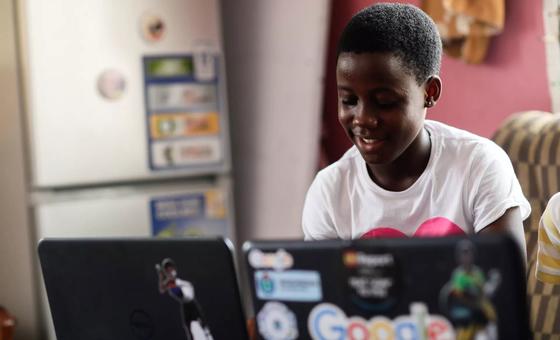
In 2024, only 34 per cent of women and 45 per cent of men on the continent used the internet, compared to global averages of 65 and 70 per cent. Meanwhile, 98 per cent of Africans under the age of 18 do not complete school with even basic STEM (science, technology, engineering and mathematics) skills, reflecting long-term underinvestment in education.  

This slow progress in digital integration and STEM education is impeding Africa’s ability to reach the Sustainable Development Goals (SDGs) by 2030, the report noted. The “digital divide” hits marginalised groups hardest, including women and rural communities.  

“Africa is a vast and populous continent, rich in natural endowments and talents. Yet much of that potential remains underutilised,” said Philémon Yang, the President of the General Assembly in a message to the meeting.  

The potential of youth

Deputy Secretary-General Amina Mohammed, told delegates that Africa must “bet on youth.”

By 2050, there will be over 850 million young people in Africa.   

“This is an incredible opportunity. Realising this potential means investing in STEM education now. It means building digital infrastructure that connects talent to opportunity,” Ms. Mohammed said.

But current systems do not sufficiently support young innovators – three-fourths of young Africans have insecure employment, lacking basic protections.

This lack of social protection is part of a wider labour rights gap, the report noted. In 2023, only 19 per cent of people in Africa had access to at least one form of social protection –such as social security or health insurance – compared to 53 per cent globally.

“Strong social protection is not just about safety nets. It is about creating the stability that allows societies to take risks, innovate and grow,” Ms. Mohammed said. 

People-cantered approaches

The report calls on governments and partners to adopt a people-cantered approach that promotes digital and technological innovation while also decent work, rights and intellectual property.  

“Resilience cannot be achieved without governance that places people at the centre of policy design and implementation,” the report said.

Speakers also stressed that African expertise must guide solutions.

“We reaffirm our collective determination to ensure that Africa’s development is led by its own people, grounded in knowledge, innovation and social justice,” said Ahmadou Lamin Samateh, Minister of Health of the Gambia, speaking for the African Group.

Power of partnerships

In his message, Mr. Yang said no single African country can achieve full digital integration alone; regional cooperation and multilateral support are essential.

“[Digital tools] can offer a way into the future… [but] no country can close these gaps alone…multilateral cooperation with the United Nations at its centre has secured eight decades of unprecedented human progress,” he said.

Ms. Mohammed emphasised the possibilities “when we get this right.”

“The choice is ours — we can continue business-as-usual and watch the 2030 Agenda slip away or we can support systemic transformation.” 

Source link

Human rights must anchor the digital age, says UN’s Türk

Digital technologies have the potential to drive progress and strengthen rights, including connecting people, improving access to health and education, and much more.

But the pace of their evolution also poses serious risks, warned Volker Türk, UN High Commissioner for Human Rights – from restrictions on free expression and privacy violations to discrimination and growing threats to our shared sense of truth and reality.

It is precisely in the face of massive change, that we need more human rights, not less,” he said on Monday, addressing a high-level event on the twentieth anniversary of the World Summit on the Information Society (WSIS) in Geneva.

Prioritising rights

In this time of sweeping change, human rights must be prioritised and used as the blueprint for action.

States’ legal obligations and companies’ duties to respect human rights offer guidance to tackle disinformation and protect our data from illicit use,” Mr. Türk stressed.

Such guidance also helps counter algorithmic bias, digital hate speech, and fosters trust and inclusive digital decision-making.

Role of WSIS

Founded in 2001, the inaugural WSIS was held in two phases in December 2003 (Geneva) and November 2005 (Tunis).

Since then, the forum has brought together diverse stakeholders to collaborate on digital governance and promote a digital landscape that is people-centred, inclusive and development-oriented.

“[The WSIS] helped create a space for States, technology companies, civil society, and others to harness the power of information and communication technologies for development,” said Mr. Türk.

Looking forward

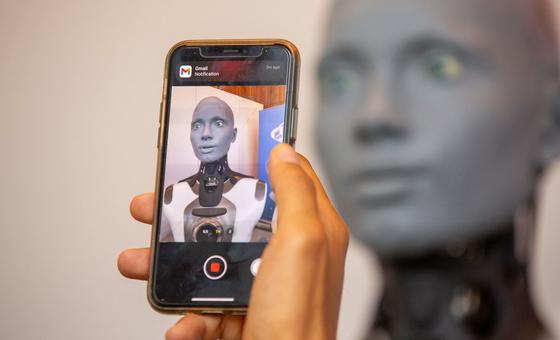
The High Commissioner stressed that the coming months will see critical decisions on regulating the digital sphere, including new UN mechanisms on AI and data governance.

We have a window of opportunity to make a difference,” he concluded.

“We must join forces – States, technology companies, international organizations, civil society, and others – to work towards an inclusive and open digital environment for everyone, everywhere.”

Source link

Health, education, opportunity at stake, amid stubborn digital gender divide

Closing this gap is not optional. There were189 million fewer women than men online in 2024.  

The disparity is about more than access, it reflects deeper systemic barriers, according to ​Doreen Bogdan-Martin who heads the UN telecommunications agency, ITU.

That’s too many missed opportunities to learn, to earn and to shape our shared digital future,” she said in a message for Thursday’s International Girls in ICT Day.

She underscored that connectivity alone is not enough to ensure true digital transformation.

“It must be meaningful – being able to afford digital devices and services, having the skills to use technology and feeling safe in online spaces. Everyone deserves the chance to thrive in an increasingly digital world.”

ITU Secretary-General Doreen Bogdan-Martin’s video message.

2025 Theme

Celebrated annually on the fourth Thursday of April, Girls in ICT Day encourages girls to pursue careers in science, technology, engineering and mathematics (STEM).

Since its launch in 2011, more than 417,000 girls and young women have participated in over 11,500 celebrations across 175 countries.

This year’s theme is Girls in ICT for inclusive digital transformation. The ITU is calling for more investment in girls’ digital education and expansion of access to technology.  

More young women need to become creators – not just consumers in the digital world, the agency argues.

“Whether you are an entrepreneur, launching an AI startup, a teacher incorporating digital skills into your classroom or a policymaker shaping our shared digital future, you can help ensure every woman and girl has the chance to connect, create and lead in digital spaces,” Ms. Bogdan-Martin emphasised.

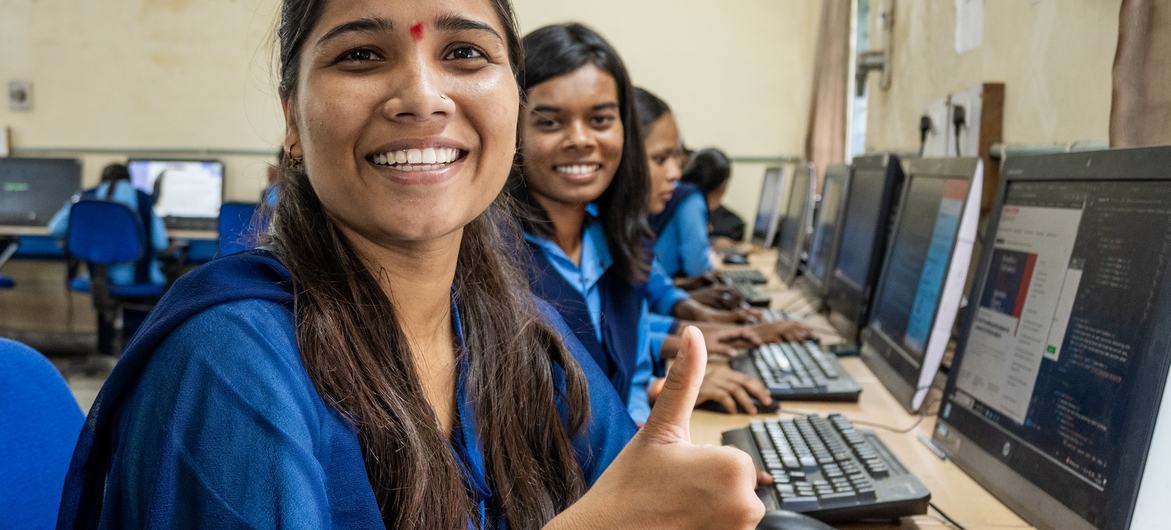
A participant at a UN-supported training on STEM for girls and young women.

Global observance

The 2025 global observance will be co-hosted this year by the Commonwealth of Independent States (CIS) in Eurasia together with States from the Arab region, featuring a live-streamed hybrid event linking Bishkek, Kyrgyzstan and Nouakchott, Mauritania.

The programme includes an intergenerational dialogue bringing together girls, women leaders, and ICT experts to discuss practical strategies for closing the gender gap.

Events are also being organized worldwide, including Girls in ICT in Solomon Islands in the Pacific, the Melon Girls Club in North Macedonia and STEM Supergirls in Croatia.

Source link