Erasure or empowerment? In Africa’s Sahel, women confront a stark choice

Risks to women and girls across this vast region are severe and systemic, as political instability, environmental collapse and a declining international presence take their toll.

From abductions and child marriage to exclusion from schools and public life, their lives and opportunities are being steadily stripped away, Sima Bahous, Executive Director of UN Women, told ambassadors in the Security Council on Thursday.

In the Sahel, where the world’s gravest concerns converge, women and girls bear the brunt,” she said.

She added that crises due to increasing terrorism, poverty, hunger, a crumbling aid system and shrinking civic space are “converging – violently and disproportionately – on their bodies and their futures.

UN Women Executive Director Bahous briefs the Security Council.

Life is being erased

In countries like Burkina Faso, Mali, Niger and Chad, life for women under extremist control “is one of erasure from public space,” Ms. Bahous said.

Their movement, visibility and even clothing are heavily restricted. Schools have been burned or shut down, leaving more than one million girls without access to education.

Abduction is not a by-product of terrorism in the Sahel – it is a tactic,” Ms. Bahous said, noting that in Burkina Faso alone, the number of women and girls abducted has more than doubled over the past 18 months.

In Mali, 90 percent of women are affected by female genital mutilation. Rates of child marriage in parts of the region are among the highest in the world. Maternal mortality – driven by early pregnancy and poverty – is among the world’s worst.

Dwindling resilience and attention

“The distances women and girls travel for water or firewood are growing longer, while their safety is shrinking,” Ms. Bahous said.

Two-thirds of women surveyed report feeling unsafe during these journeys. Climate change only deepens the hardship, with extreme heat and drought increasing both mortality and food insecurity across the region.

Yet despite mounting needs, international support is waning.

Only eight per cent of this year’s humanitarian appeal for the region had been met by May.  

Development assistance has fallen nearly 20 per cent over the past two years. As a result, women’s protection and empowerment programmes have been suspended, while government ministries focused on gender equality are being defunded, merged or closed.

SRSG Simão briefs the Security Council (via video).

Political space closing

At the same time, democratic and civic space is narrowing.

In Niger, only 14 percent of participants in recent institutional reforms were women. In Mali, just two out of 36 members drafting the new national charter were women.

Leonardo Santos Simão, head of the UN Office for West Africa and the Sahel (UNOWAS), also warned that a deteriorating security environment – marked by waves of jihadist attacks and political turbulence – is undermining progress and fuelling displacement.

He added that shrinking space for media, civil society and women’s organizations is threatening hard-won gains and that a broader crisis is undermining governance and peacebuilding efforts.  

“The region’s economy remains highly vulnerable to external shocks. Although macroeconomic indicators show improvement, rising debt levels continue to constrain governments’ capacity to provide essential services,” he said.

Fragile gains

Still, progress is possible – and in some instances, visible.

In Chad, women now hold 34 percent of parliamentary seats. In conflict-prone border zones in Mali and Niger, women’s participation in local peacebuilding rose from five percent to 25 percent, helping resolve over 100 disputes related to scarce natural resources.

Across the region, joint UN programming has increased adolescent girls’ return to school by 23 percent, while doubling women’s participation in local governance across 34 conflict-affected communities. In addition, a UN-World Bank initiative has reached over three million adolescent girls with health care, safe spaces and life-skills training.

Stand with Sahel’s women

Yet, these gains remain fragile.

We cannot abandon the Sahel – whatever the politics, whatever the funding landscapes, whatever the geopolitical headwinds,” Ms. Bahous said in conclusion.

Let us stand with the women of the Sahel – not out of charity, but in recognition of their power to shape a better future.

Source link

‘Peace is a choice’: UN chief urges diplomacy as wars spread from Gaza to Ukraine

This is the only sustainable path to global security, he told ministers at a high-level open debate of the Security Council on Tuesday.

The Secretary-General emphasised that the UN Charter’s tools – negotiation, mediation, conciliation, arbitration and more – remain a lifeline when tensions escalate, grievances fester and states lose trust in each other.

These tools are needed now more than ever, he stressed, as conflicts rage and international law is violated with impunity.

The cost is staggering – measured in human lives, shattered communities and lost futures. We need look no further than the horror show in Gaza – with a level of death and destruction without parallel in recent times.”

The risk of starvation looms and aid operations are being denied the space and safety to function. UN premises, such as the UN Office for Project Services (UNOPS) and the World Health Organization (WHO)’s main warehouse, have been hit despite parties being notified of their locations.

“These premises are inviolable and must be protected under international humanitarian law – without exception,” Mr. Guterres reiterated.

Peace is a choice – make it

From Gaza to Ukraine, from the Sahel to Sudan, Haiti and Myanmar, “conflict is raging, international law is being trampled, and hunger and displacement are at record levels,” he continued, adding that terrorism, violent extremism and transnational crime also remain “persistent scourges” pushing security further out of reach.

Peace is a choice. And the world expects the Security Council to help countries make this choice.

Mr. Guterres pointed to the UN Charter’s bedrock obligation in Article 2.3 that “all Members shall settle their international disputes by peaceful means”, and to Chapter VI, which empowers the Security Council to support “negotiation, enquiry, mediation, conciliation, arbitration, judicial settlement, resort to regional agencies or arrangements, or other peaceful means of their own choice.”

Action 16 of last year’s Pact for the Future urges states to recommit to preventive diplomacy, he said, commending Pakistan – the Council President for July – for tabling a resolution encouraging fuller use of those tools, which was adopted unanimously at the meeting.

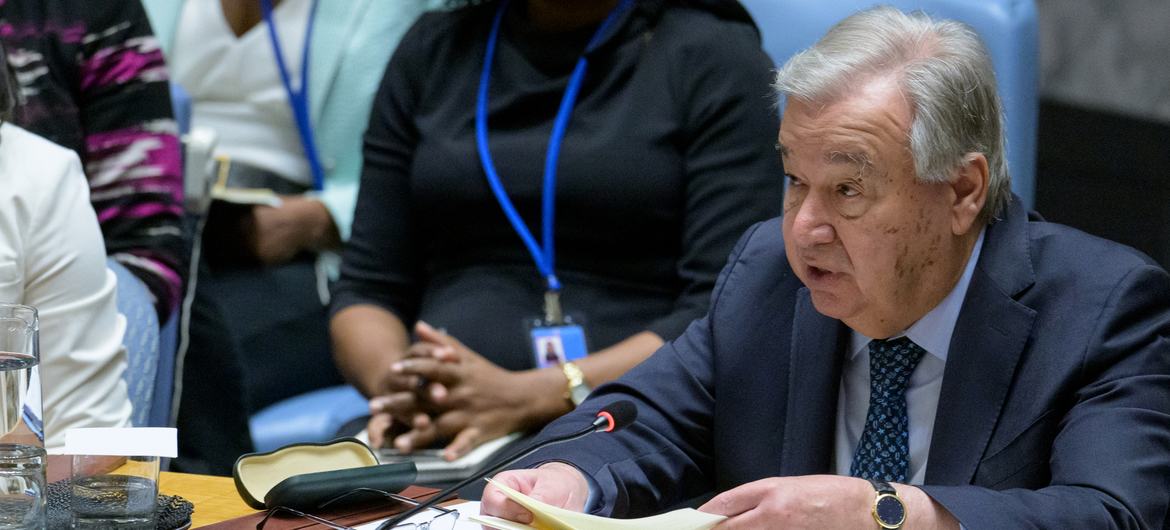
Secretary-General António Guterres addresses the Security Council high-level open debate.

P5 must overcome divisions

Security Council members – “in particular its permanent members” – must overcome divisions, the Secretary-General said, reminding them that even during the Cold War, Council dialogue underpinned peacekeeping missions and humanitarian access, and helped prevent a third world war.

He urged members to keep channels open, build consensus and make the body “more representative” of today’s geopolitical realities with more inclusive, transparent and accountable working methods.

Mr. Guterres also urged deeper cooperation with regional and subregional organizations.

Mediation can work even amid war, he said, noting the third anniversary of the Black Sea Initiative and a related memorandum with Russia that enabled grain movements during the conflict in Ukraine.

Renew commitment to multilateralism

States must honour their obligations under the Charter; international human rights, refugee and humanitarian law, and the principles of sovereignty, territorial integrity and political independence, Mr. Guterres said.

As we mark the 80th anniversary of our Organization and the Charter that gave it life and shape, we need to renew our commitment to the multilateral spirit of peace through diplomacy,” he said.

I look forward to working with you to achieve the international peace and security the people of the world need and deserve.

Security Council open debate

A signature event of the Pakistani presidency, Tuesday’s open debate was chaired by Deputy Prime Minister and Foreign Minister Mohammad Ishaq Dar.

The session aimed to assess the effectiveness of existing mechanisms for pacific dispute settlement, examine best practices and explore new strategies for tackling protracted conflicts.

It also sought to enhance cooperation with regional organizations, boost capacity-building and resource mobilisation, and align future efforts with the conflict-prevention vision outlined in the Pact for the Future.

Source link

Gaza: ‘Unacceptable’ choice between getting shot or getting fed

UN Human Rights Office (OHCHR) spokesperson Ravina Shamdasani told reporters in Geneva on Friday that “we’ve raised concerns about atrocity crimes having been committed and the risk of further atrocity crimes, where people are lining up for essential supplies such as food and medicine and where they are being attacked, where again… they have a choice between being shot or being fed”.

Deadly lottery

This is unacceptable and it’s continuing,” she deplored.

Ms. Shamdasani said that her office is still looking into the incident in which at least 15 Palestinians including women and children were reportedly killed by a strike in front of a clinic in Deir al-Balah run by US-based aid group Project Hope, a partner organization of the UN Children’s Fund (UNICEF).  

In a statement on Thursday UNICEF chief Catherine Russell said that the killing of families trying to access life-saving aid is “unconscionable”.

The Israeli military reportedly said that it was targeting a Hamas member involved in the terror attacks in Israel on 7 October 2023.

Asked about the rationale of putting civilians, including children, in mortal danger when targeting one specific person, Ms. Shamdasani said that over the course of the conflict in Gaza OHCHR has had serious concerns about respect for essential international humanitarian law principles, including that of distinction and proportionality.

“We have seen that of the overall death toll in Gaza; a large proportion are women and children. And again, that raises serious questions about whether these principles are being respected,” she said.

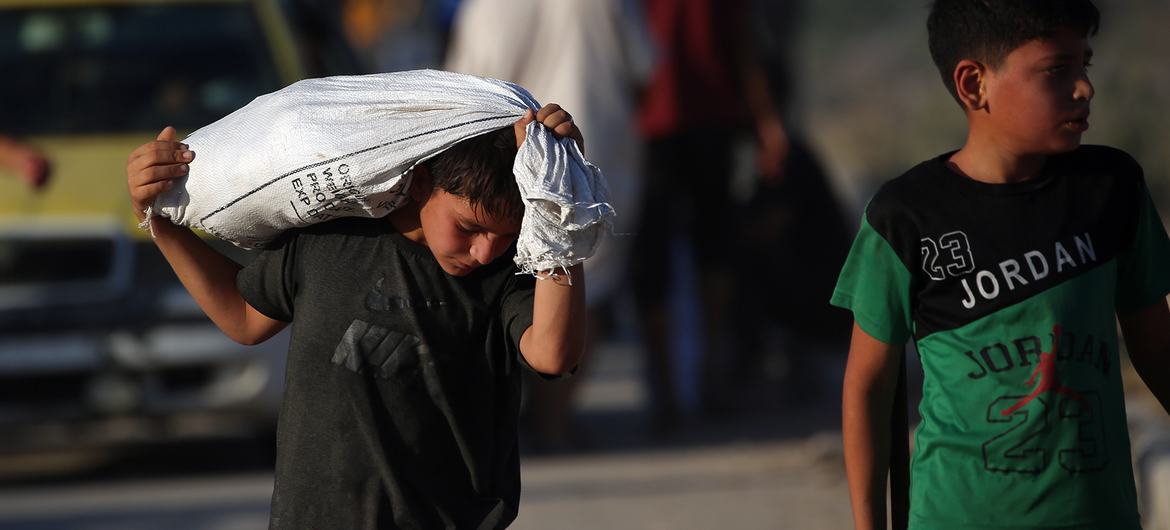
Hungry people in Gaza run the risk being shot when picking up food aid.

Hundreds killed queuing for food

Killings of Gazans at or around aid distribution sites and near humanitarian convoys have become a regular occurrence in a context of restrictions on the entry of food, fuel and relief items into the Strip and particularly since the establishment of food distribution sites bypassing the UN operated by the Gaza Humanitarian Foundation (GHF).

Since late May, this militarised aid distribution model, backed by Israel and the United States, has sought to sideline the UN and its experienced humanitarian partners.  

OHCHR’s Ms. Shamdasani said that from 27 May, when the GHF started operations in Gaza, until 7 July, OHCHR recorded 798 killings “including 615 in the vicinity of the GHF sites and 183 presumably on the routes of aid convoys”.  

Gunshot injuries

The deaths of almost 800 people trying to access aid were “mostly due to… gunshot injuries”, Ms. Shamdasani said.

Joining her in condemning the killings, World Health Organization (WHO) spokesperson Christian Lindmeier said that he is “slowly lacking words to describe the scenario”.

“People being shot at distribution sites… scores of women and children and men and boys and girls being killed while either getting food or in what’s supposedly safe shelters or on the road to health clinics or inside health clinics – this is far beyond unacceptable.”

Fuel crisis

Asked to comment on a 75,000-litre fuel delivery into Gaza on Wednesday, the first such provision in over 130 days, Mr. Lindmeier said that “as good as it is that these this amount of fuel came finally in… we should not be relying on special news of special deliveries,” be it on fuel, food or other relief items.

“There should be a reoccurring delivery into Gaza to keep the lifelines open, to supply the ambulances, the hospitals, the water desalination plants, the bakeries… whatever is necessary to keep a little bit of lifeline open there, to run the incubators,” he said.  

The WHO spokesperson pointed out that 94 per cent of the hospitals in Gaza are now damaged or destroyed, while displacement continues and civilians are being pushed into ever smaller spaces.

Mr. Lindmeier also expressed his hope for a positive outcome of the ongoing ceasefire talks.

“Peace is the best medicine and opening the doors remains the only viable option,” he concluded.

Source link

Social and economic barriers, not choice, driving global fertility crisis: UNFPA

The UN Population Fund (UNFPA) unveiled its flagship State of World Population report on Tuesday, warning that a rising number of people are being denied the freedom to start families due to skyrocketing living costs, persistent gender inequality, and deepening uncertainty about the future.

Titled The real fertility crisis: The pursuit of reproductive agency in a changing world, the report argues that what’s really under threat is people’s ability to choose freely when – and whether – to have children.

The report draws on a recent UNFPA/YouGov survey covering 14 countries that together represent 37 per cent of the global population.

Money worries

Economic barriers were the top factor, with 39 per cent of respondents citing financial limitations as the main reason for having fewer children than they would like.

Fear for the future – from climate change to war – and job insecurity followed, cited by 19 per cent and 21 per cent of respondents, respectively.

Thirteen per cent of women and eight per cent of men pointed to the unequal division of domestic labour as a factor in having fewer children than desired.

The survey also revealed that one in three adults have experienced an unintended pregnancy, one in four felt unable to have a child at their preferred time and one in five reported being pressured to have children they did not want.


Solutions to the fertility crisis

The report warns against simplistic and coercive responses to falling birth rates, such as baby bonuses or fertility targets, which are often ineffective and risk violating human rights.

Instead, UNFPA urges governments to expand choices by removing barriers to parenthood identified by their populations.

Recommended actions include making parenthood more affordable through investments in housing, decent work, paid parental leave and access to comprehensive reproductive health services.

Immigration factor

The agency also encourages governments to view immigration as a key strategy to address labour shortages and maintain economic productivity amid declining fertility.

Regarding gender inequality, the report calls for addressing stigma against involved fathers, workplace norms that push mothers out of the workforce, restrictions on reproductive rights, and widening gender gaps in attitudes among younger generations that are contributing to rising singlehood.