Israeli strike in Doha marks ‘alarming escalation’, warns top UN official, in call to uphold diplomatic norms

Rosemary DiCarlo described Tuesday’s strike in a residential area of the Qatari capital – which targeted Hamas’s political leadership killing several affiliates along with a Qatari security officer – as potentially opening a “new and perilous chapter in this devastating conflict, seriously threatening regional peace and stability.

The attack occurred on 9 September in residential compounds reportedly housing members of the Hamas’ political bureau, including the son of its chief negotiator, Khalil al-Hayya.

While Hamas leaders survived, the organization said, the incident disrupted ongoing negotiations over a US-mediated ceasefire and hostage release agreement to end the war in Gaza.

Respect sovereignty

The sovereignty and territorial integrity of any country, including Qatar – a valued partner in advancing peacemaking and conflict resolution – must be respected,” Ms. DiCarlo told ambassadors.

She urged all parties to exercise restraint and reaffirmed the need to preserve negotiation and mediation channels to prevent further suffering in Gaza and the wider region.

Israel claimed responsibility for the strike, with Prime Minister Benjamin Netanyahu describing it as “a wholly independent operation” following a deadly attack on civilians in Jerusalem on 8 September, which Hamas said it carried out.

Qatar, the Gulf Cooperation Council, the League of Arab States, and the Organization of Islamic Cooperation condemned the action and expressed concern over further escalation.

Confidence undermined

Ms. DiCarlo told ambassadors that Israel’s strike came “at the height of ongoing consultations.”

Any action that undermines the work of mediation and dialogue weakens confidence in the very mechanisms we depend on for conflict resolution,” she said, stressing that durable solutions in the Middle East cannot be achieved through further violence.

She called for renewed commitment to diplomacy, warning that the urgency of a ceasefire and hostage release has never been greater.

I call on all stakeholders to exercise utmost restraint at this sensitive time and recommit to diplomacy. The urgency of a ceasefire and hostage release deal in Gaza has never been greater. Strike a deal. Free the hostages. End the suffering of the people of Gaza.”

Gaza crisis spiralling

Meanwhile, the humanitarian and security situation in Gaza and the occupied West Bank remains critical.

Since the conflict in Gaza erupted in October 2023 – following attacks by Hamas and other Palestinian armed groups on communities in southern Israel, tens of thousands have died – mostly civilians – infrastructure and basic services are largely destroyed, and the enclave lies in ruins while a new offensive to take Gaza City is ongoing.

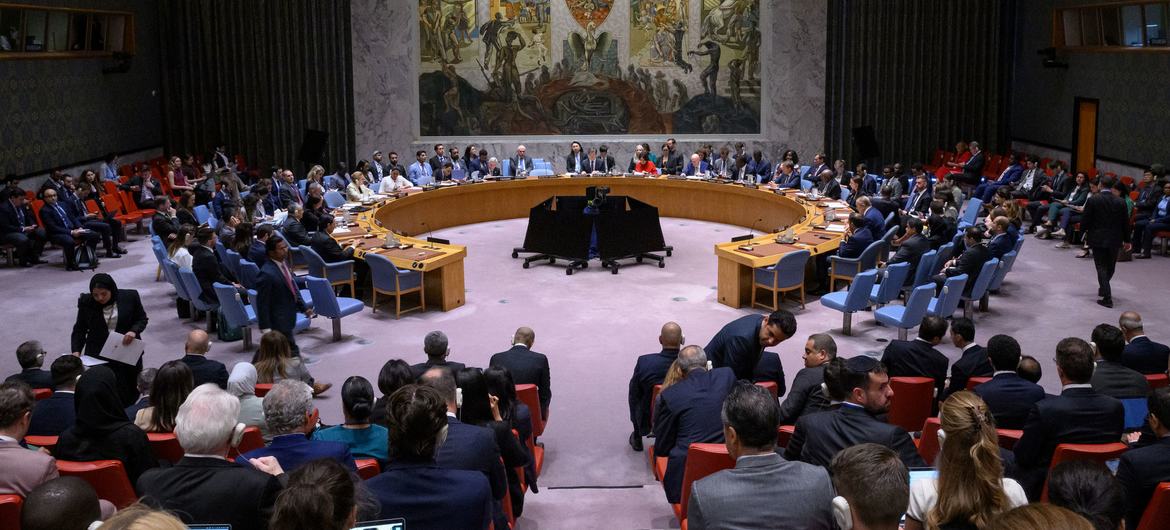
The UN Security Council meets to discuss the situation in the Middle East in the aftermath of an Israeli strike in Doha, the capital of Qatar..

Security Council press statement

Ahead of Thursday’s session, the Security Council issued a press statement expressing condemnation of the strikes in Doha and deep regret over the loss of civilian life.

The statement reaffirmed support for Qatar’s sovereignty and territorial integrity and acknowledges the country’s key role in mediation efforts to end the devastating war, alongside Egypt and the United States.

It emphasised that releasing hostages – including those killed by Hamas – ending hostilities, and ensuring civilian protection in Gaza, remain the Council’s highest priorities.

It also on all parties to seize ongoing diplomatic opportunities for peace.

Source link

‘Season of war,’ as norms of humanitarian law ‘cast aside’ UN refugee chief

Speaking in the UN Security Council, Filippo Grandi said in conflicts across the world in places like Sudan, Ukraine, Myanmar, the Democratic Republic of the Congo and Haiti, “violence has become the currency of our age.”

Forcibly displaced people are among the first victims of war. Worldwide, some 123 million people have had to flee due to conflict.

Since the beginning of the war in Sudan, one-third of Sudan’s population has been displaced by indiscriminate violence, disease, starvation, flooding, droughts and sexual violence, “a situation that frankly defies description,” said Mr. Grandi.

In Ukraine, 10 million people have been displaced by the war, experiencing what he described as “terrible toll.” Seven million of them are now refugees, living outside the country.

“Stagnation has defined the response in Myanmar,” said the UN refugee chief. As a result, Rohingya refugees in Bangladesh have been living in camps entirely dependent on humanitarian aid for the past eight years.

Security and self-reliance

Refugees and displaced people will not return to their communities “unless they are confident that the terms of peace are durable, for them and for their country,” he added.

Promoting security and self-reliance is essential to ending humanitarian crises.

However, a return to peace requires compromise and commitment; peace cannot be made passively, said Mr. Grandi.

Reminding the 15 Members of the Security Council that preventing and stopping wars is their primary responsibility, he noted that it was one that “this body has chronically failed to live up to.”

Seizing opportunities

To achieve durable peace, the UN must be ready both to seize unexpected opportunities, and to take calculated risks, High Commissioner Grandi said adding that “there is now an opportunity to break this dangerous inertia.”

As over one million people have already returned to Syria since December 8, with many more expected to follow, the refugee chief urged the Security Council to ease sanctions to support early recovery efforts and spur investment.

“To minimise the risk that the returning Syrians are taking, I am asking you to take some risks yourselves,” he said.

Retrenchment away from aid

Despite the positive signs coming out of Syria, as well as Burundi and the Central African Republic, Mr. Grandi told the Council that “we see a retrenchment away from aid, away from multilateralism, even away from life-saving assistance,” adding that “we hear of prioritizing national interests, of boosting defense spending — all valid concerns of course, and legitimate state pursuits. But these are not incompatible with aid, quite the contrary.”

One way or another, forced displacement has concerned every member of the Security Council, Mr. Grandi pointed out.

“You have been the refugee. You have welcomed those who sought refuge,” he said reminding its members of their collective responsibility “to end war, to bring peace.”

Source link

Under Currents of RBI Flagging Irregularities in Gold Loans

The Reserve Bank of India (RBI) has recently raised concerns over deficiencies in gold-lending practices, urging gold lenders to review their policies and practices and implement corrective measures within a three-month timeframe. This directive comes in the wake of a review conducted by the RBI, which revealed several irregularities in the gold loan sector.

Gold loans, which are granted against a pledge of gold ornaments and jewellery, have come under the RBI’s scrutiny as they defy the lending norms of other assets and often fail to contribute to overall growth.

The review, as well as the findings of the onsite examination of select supervised entities by the RBI, indicated several irregular practices in this activity. The major deficiencies include shortcomings in the use of third parties for sourcing and appraisal of loans, valuation of gold without the presence of the customer, inadequate due diligence, and lack of end-use monitoring of gold loans.

RBI’s Advisory Too Late?

The RBI has pointed out the lack of transparency during the auction of gold ornaments and jewellery on default by the customer, weaknesses in monitoring of loan-to-value, and incorrect application of risk-factors, among others. These irregularities were observed across various supervised entities, including commercial banks, small finance banks, urban cooperative banks, and non-banking financial companies (NBFCs).

In response to these findings, the RBI has advised lenders to comprehensively review their policies, processes, and practices on gold loans to identify gaps and initiate appropriate remedial measures in a timebound manner. The central bank has also emphasized the need for close monitoring of gold loan portfolios, especially in light of significant growth in the portfolios in certain entities.

The RBI’s directive also highlighted the need for entities to ensure that adequate controls are in place over outsourced activities and third-party service providers. The central bank has warned that non-compliance with regulatory guidelines will be viewed seriously and will attract supervisory action by the RBI.

Impact on the Gold Loan Sector

This warning on gold loan practices follows a similar caution issued by the RBI in August 2024, highlighting issues with home equity or top-up housing loans such as non-adherence to loan-to-value (LTV) ratios and lack of end-use monitoring. The RBI Governor, Shaktikanta Das, had then noted that such loans may lead to funds being deployed in unproductive segments or for speculative purposes.

The RBI’s advisory to gold lenders also highlighted several specific cases of irregularities or deficiencies with respect to gold loans being granted. These included instances where gold loans were given through partnerships with fintechs and business correspondents (BCs), and practices such as valuation of gold being carried out in the absence of the customer, credit appraisal and valuations being done by the BC itself, and gold being stored in the custody of BC.

The review also revealed a lack of a robust system for periodical LTV (loan-to-value) monitoring with instances of breach of regulatory LTV ceilings observed in some entities. In other instances, the application of risk weights was at variance with the prudential regulations. The end use of funds was also usually not verified for non-agriculture loans and there was a lack of proof or proper documentation obtained and retained in respect of agriculture gold loans.

The RBI’s directive has likely led to a negative impact on the share prices of major gold financing companies, as indicated by mentions of stocks slipping for companies like Muthoot Finance and Manappuram Finance. These companies would have to review and potentially tighten their practices, which could involve increased costs and possibly affect their short-term business operations. The directive also suggests increased regulatory scrutiny, which might lead to a more cautious approach by investors in the sector.

Otherwise, the RBI’s directive serves as a wake-up call for gold lenders to tighten their practices, lest the RBI may tighten the rules to  maintain the stability of the financial system. Certainly, the directive is going to impact on gold loans segment of many banks and NBFCs.

Gold as Crisis Saver

Whether Covid-19 or Forex crisis, over the period gold remained the single instrument to save the nations to sustain and India stands to benefit from the gold as a reserve, as the case with many other central banks across the globe. From a low of 7% seen in CY20, the share has improved significantly to 26% at present.

As per World Gold Council report, Central Bank of Turkey was the largest buyer, followed by People’s Bank of China and Reserve Bank of India. This may be on account of attaching greater weight to gold’s value in crisis response, diversification of portfolio and credibility on account of store-of-value. But the value erodes when the asset changes hands from the owners to the lenders. Here, the RBI is quite cautious.